

The Great Visibility Reset: Operationalizing AI Discovery
How Leaders Can Translate AISO Strategy Into Action
-
May 07, 2026
-

Read the first article in this two-part series, The Great Visibility Reset: Winning the AI Discovery Layer.
Introduction
The first article in this two-part series mapped key structural shifts from traditional search-based to AI-driven discovery, introducing sector archetypes that define how companies compete for search visibility today.1 Yet despite growing awareness of this shift, most organizations lack clear visibility into their performance in AI driven search environments, and leaders lack clarity on how to define, measure and improve on it. So, how can organizations operationalize AI discovery strategies aligned to their business models and sector objectives?
This article details a practical approach to implementing AI search optimization (“AISO”) — also commonly called “generative engine optimization” — with a framework for execution across three control layers: discovery, authority and conversion. This piece also asks what companies can do to remain competitive as AI-mediated discovery evolves.
From SEO to AISO: A Shift From Ranking to Influence
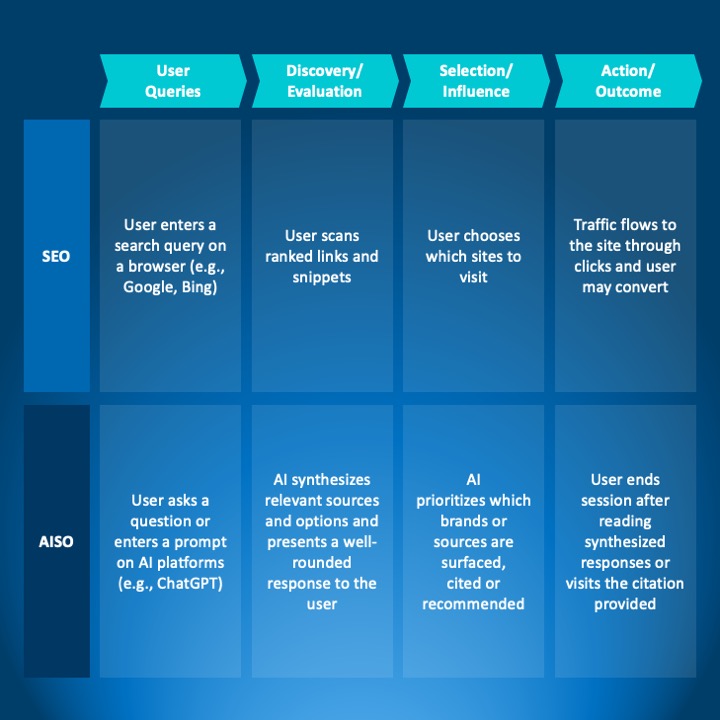
Traditional search engine optimization (“SEO”) and AISO share a common end objective: ensuring that the right audience finds a company at the right moment about the right topic. Yet whereas SEO optimizes for search position across a results page, AISO optimizes for inclusion, citation and recommendation within AI-generated responses.
As discovery shifts from navigating results pages to interacting with synthesized answers, understanding how SEO and AISO differ in practice provides important context for how to optimize in an AI-mediated environment. The graphic below compares key differences between traditional SEO and AISO execution.
Figure 1 - User Journey Differences Between SEO and AISO
Operationalizing the Three Control Layers
To execute effectively in AI-mediated environments, organizations must operationalize three control layers: discovery, authority and conversion. Each layer maps to how AI engines retrieve, evaluate and synthesize content, as well as where companies have the most leverage to influence surfaced content. Together, the three layers form the foundation of a scalable AISO strategy and directly map to the business objectives outlined in part one of this series.
Figure 2 - Core AISO Execution Layers and Key Capabilities
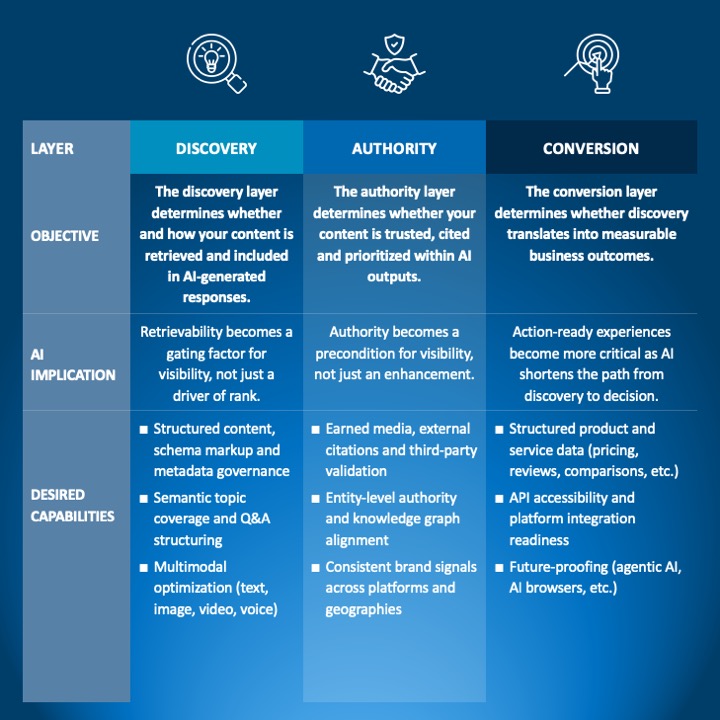
The three control layers apply universally; but where a company directs effort first depends on its sector archetype (see part one). A transactional commerce company, for instance, prioritizes discovery and conversation, in which AI-driven product recommendation directly influences purchase decisions. A trust-based advisory firm, on the other hand, weights authority above all else since credibility and citation are the conversion event.
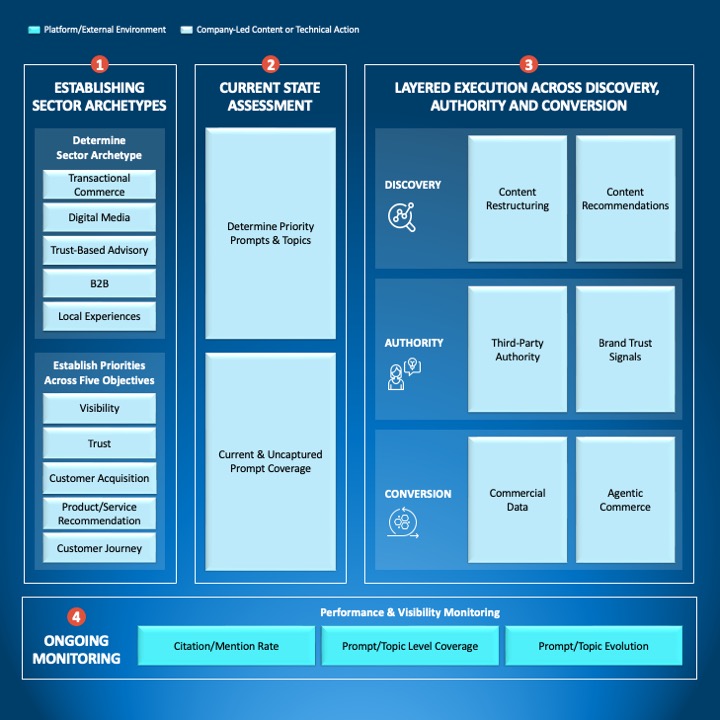
Because AI discovery environments evolve continuously, AISO should not be treated as a one time optimization. Rather, companies should conduct rapid test-and-learn cycles to quickly understand their positioning, and facilitate ongoing monitoring processes to track shifts in visibility, citation and conversion as platforms evolve over time (see graphic below).
Figure 3 - Example AISO Execution Approach
Case Study: Applying AISO in a Digital Commerce Context
To illustrate how this approach can work in practice, consider a hypothetical digital commerce company seeking to strengthen how its products and brand surface across AI-mediated discovery environments.
Phase 1: Establishing Sector Archetypes
The first step for the company is to determine based on its sector archetype which strategic priorities best reflect its business model, and to then align against the five AISO objectives accordingly (see part one for more information on sector archetype definitions and prioritization across the five AISO objectives):
- Sector Archetype - Transactional Commerce
- Transactional Commerce AISO Objectives - Highest across Customer Acquisition, Product/Service Recommendation and Customer Journey objectives
This priority profile then serves as the basis for determining where effort and investment should be concentrated across AISO layers.
Phase 2: Current State Assessment
The next step is to assess the company’s current AI discoverability posture across major AI platforms. The objective is to establish a clear baseline for current performance and identify where the company is gaining or losing influence across stages of the AI discovery journey. Some of the key priority metrics for this archetype may look like:
- Brand mentions across priority prompts
- Product mentions across comparison and recommendation prompts
- Citation frequency and share of voice
Phase 3: Layered Execution Across Discovery, Authority and Conversion
With that baseline in place, the company could prioritize execution across the three AISO layers targeting the interventions most likely to improve its highest-priority objectives. This may include improving product and category pages for answer readiness, strengthening third-party validation and citation signals, and enhancing structured product data to support conversion.
For instance, if this hypothetical digital commerce company found that a category like travel luggage was not surfacing consistently in AI-generated recommendation prompts, the company could then focus first on strengthening comparison content, product attributes, review visibility and pricing signals in that category before scaling similar interventions more broadly.
Phase 4: Ongoing Monitoring
Because AI-mediated discovery is evolving quickly, the company would need to manage AISO as an ongoing capability rather than a one-time optimization effort. By monitoring prompt-level visibility, citation trends, competitor presence and emerging shifts in demand, it could continuously refine where it invests, identify new coverage gaps and adapt execution as the landscape evolves.
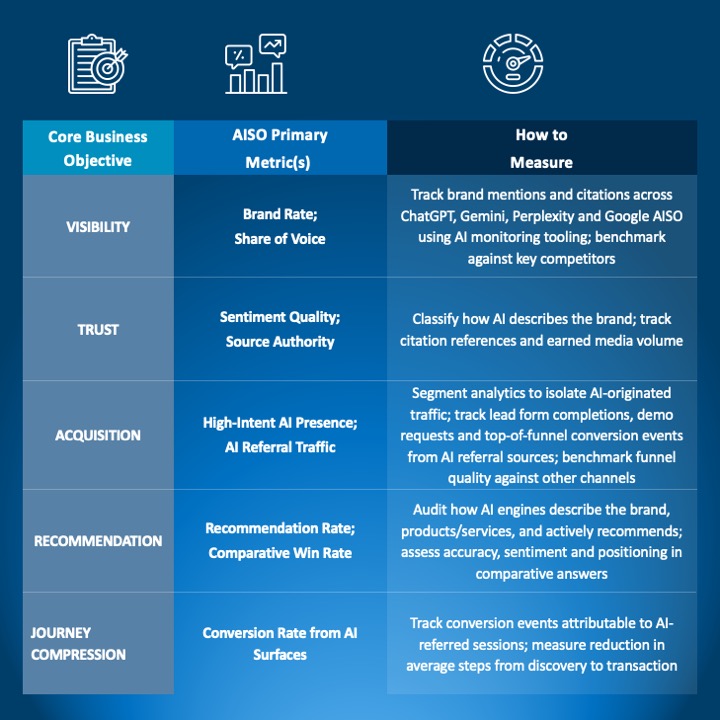
In this case, execution would need to be paired with a clear measurement framework. The KPIs below show how the company could track progress across the five AISO objectives and use those signals to guide ongoing optimization.
Figure 4 - Illustrative KPI Framework Across AISO Objectives
Future-Proofing: The Next Wave of AI-Mediated Discovery
As with earlier transitions from brick-and-mortar stores to e-commerce, or from print media to internet browsers, the AISO landscape is rapidly evolving. Organizations that adopt offensive AISO strategies early on will be better positioned to capitalize on this shift as AI capabilities continue to advance and new discovery behaviors emerge.
The next phase of AI-mediated discovery is already emerging with agentic browsers and agent-to-agent workflows. Agentic browsers can research, compare and take actions on behalf of users rather than just surfacing information,2 while agent-to-agent workflows allow AI systems to coordinate directly across services to complete tasks on a user’s behalf.3 As this shift continues, brand performance may depend less on being cited and more on becoming the option that AI systems recommend or select.
Footnotes:
1: Gupta, Sumeet, Carl Jones, Madhur Mahajan, Emily Yeung and Alex Patilsen, “The Great Visibility Reset: Winning the AI Discovery Layer,” FTI Consulting (Apr. 7, 2026).
2: Gupta, Sumeet and Akshat Trivedi, “The Rise of AI Commerce and the Decline of Traditional Purchase Funnels,” FTI Consulting (Mar. 19, 2026).
3: Gupta, Sumeet and Akshat Trivedi, “Shopping in the Age of AI: Eight Strategies for Retailers to Win,” FTI Consulting (Mar. 26, 2026).
Related Insights
Published
May 07, 2026
 Key Contacts
Managing Director
Senior Director
Senior Consultant
Consultant