

Rebuilding Investor Confidence After Shock Events
Why Middle East Governments Must Protect Existing Capital Before Seeking New Investments.
-
August 26, 2026
Downloads Download Article
-

Most governments respond to investment shocks by going out to look for new investors, but this is the wrong instinct. The markets that emerge from shocks in better shape are often the ones that focus first on the investors already in the room.
The Middle East is navigating several pressures simultaneously. Regional conflict has disrupted trade routes, airport operations and capital markets at the same time. Oil price volatility is compressing government revenues, and a difficult global trading environment has fractured further, making the investment decision for multinational capital more complex than at any point in the past decade.1 For governments in the middle of long-run economic diversification programmes, this is a genuinely testing moment.
When shocks happen, they generate investor uncertainty. The longer a shock is left unmanaged, the more it compounds. United Nations Conference on Trade and Development (“UNCTAD”) data shows global foreign direct investment (“FDI”) fell to under $1 trillion in 2020,2 as the pandemic made operating conditions and the path to recovery unusually difficult to assess.3 As that uncertainty lifted, FDI sharply recovered to approximately $1.6 trillion in 2021. The Russia-Ukraine war then introduced a new and sustained layer of geopolitical uncertainty, worsened by interest rate volatility and supply chain fragmentation, with FDI falling to $1.3 trillion in 2023.4 Overall, there was a 6% rebound in global FDI to $1.6 trillion in 2025, but the escalating conflict in the Middle East is a significant risk to the global investment outlook.5
These major shocks and recoveries ultimately reveal a pattern that FDI runs parallel to the duration of the uncertainty that surrounds an event. A few visible exits early in that uncertainty period signal to the broader market that something is wrong, and that signal is very difficult to walk back.
The challenge for governments is less about changing strategy to find new investors and more about preserving the confidence of your current investors. Investors want to see evidence that today’s problems are being managed, that the underlying system remains reliable and that the market’s longer-term trajectory is intact. This involves first solving practical investor concerns, then reinforcing institutional certainty and finally communicating the story to the market.
What a Shock Does to Investors
The practical effect of a shock is that investors stop asking, “Will this generate good returns?” and start asking, “Is this a safe place for my capital?” Until the second question is answered, the first becomes almost irrelevant. Capital does not leave markets because investors have lost confidence in the longer-term goals, it leaves because investors cannot model the near-term practicalities, including what policy will look like, whether agreements will hold and whether capital can move freely.
Timing matters more than most governments recognise. Investor decisions can begin to crystallise soon after a major disruption, particularly when uncertainty remains unmanaged and investors receive little clarity about what comes next. The emotional dimension of that decision carries significant weight. Whether an investor felt valued, visible and supported during the period of uncertainty shapes their commitment in ways that financial modelling alone does not capture.
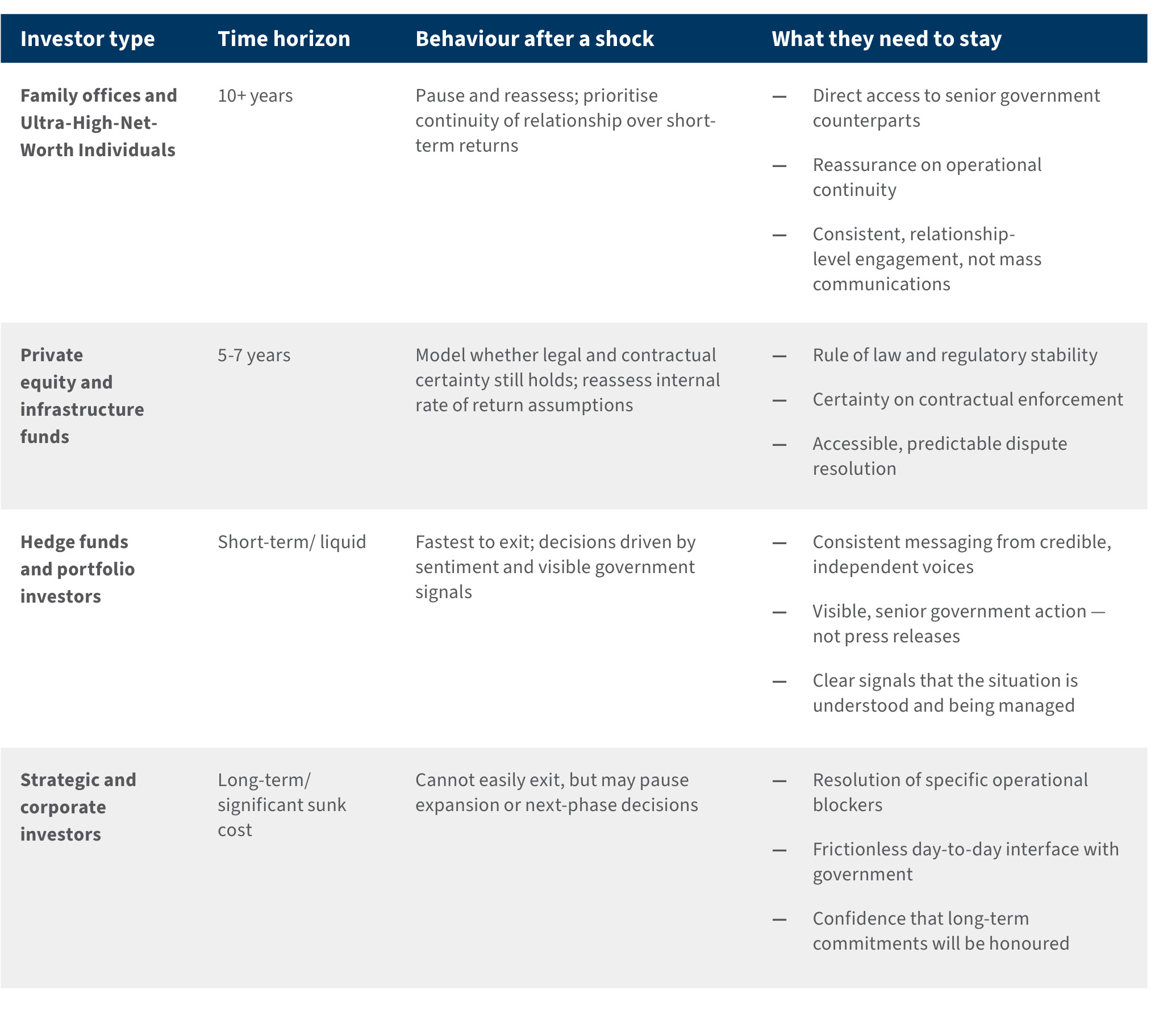
Not All Investors React the Same Way
Understanding which type of investor is in the room and what each one actually needs in order to stay in the room is the starting point for any credible retention strategy.
Why Retention Comes First
The default response after a shock — to run roadshows, release incentive packages and give the “open for business” message — is not wrong in principle, but it is wrong in timing. Existing investors are less costly to retain than new ones are to attract. Moreso, they signal more credibly to the broader market than any promotional campaign.
Take Ireland’s experience between 2008 and 2012 operating under an EU/European Central Bank/ International Monetary Fund (“IMF”) bailout programme. Ireland implemented sharp fiscal adjustments while simultaneously holding its foreign investment base. FDI inflows held up through the programme years and recovered strongly after Ireland exited in December 2013, ahead of schedule.6
The reason for Ireland’s success is three-fold. First, the government gave absolute certainty on the 12.5% corporate tax rate at the outset of the crisis and never wavered.7 IDA Ireland continued to prioritise its existing investor base throughout the adjustment period, treating them as partners rather than observers.8 Lastly, the government engaged with the IMF transparently to build the institutional credibility that underpinned continued investor commitment. Its investment base emerged stronger.9
The act layer focuses on solving the specific problems that specific investors are experiencing today. This could be where a payment is delayed, an approval has stalled or a licence that has stopped moving. In normal conditions these are routine frustrations, but against a backdrop of uncertainty, they become leading indicators of institutional capability and investors read them as such. The investor that cannot move a payment during a stress period carries that experience forward, shaping subsequent decisions.
The focus here was clearly a deliberate programme of retention, directed at the right investor types and beginning before investors have already made their decision.
The Trust Stack: Act, Anchor, Articulate
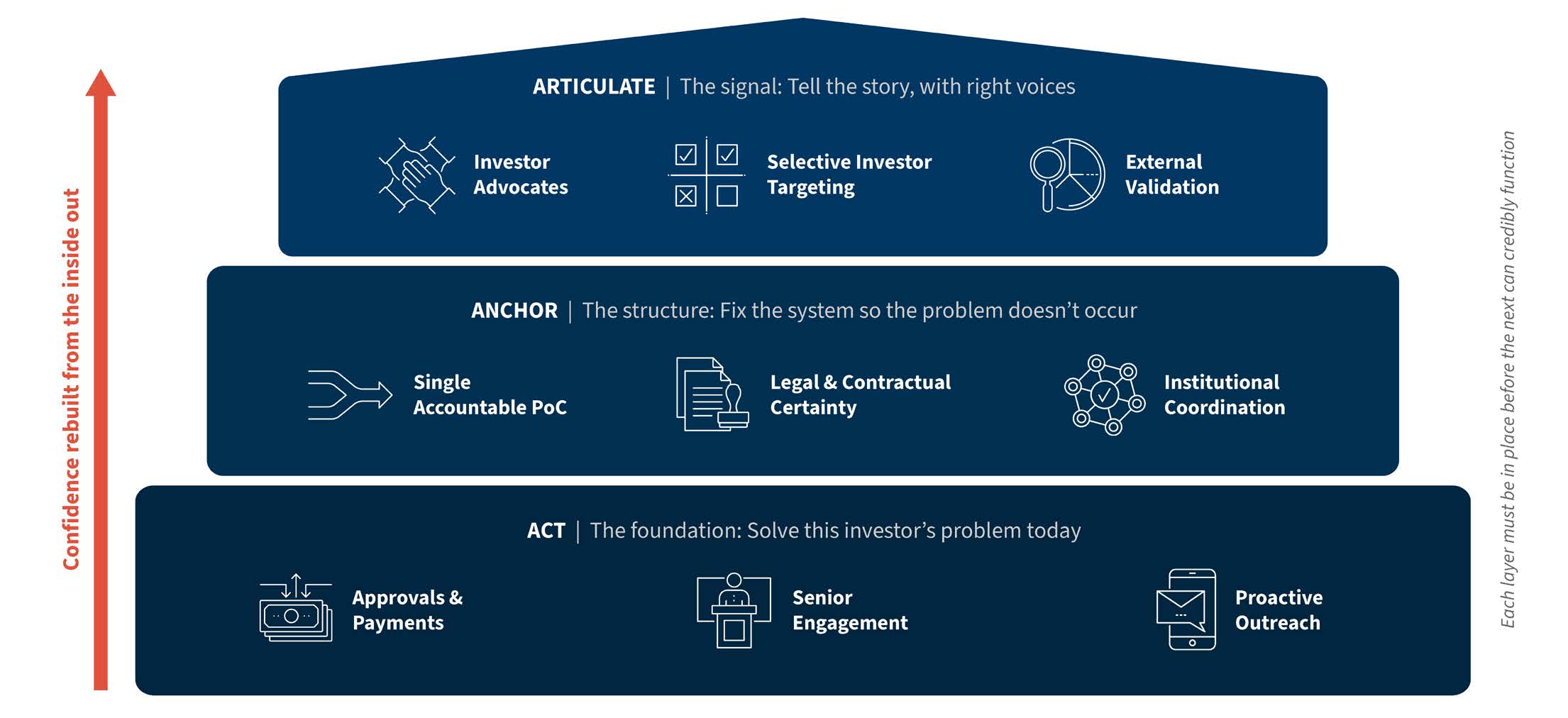
Governments often focus on what they say after a shock. Investors pay closer attention to what governments do. The Trust Stack sets out the sequence for rebuilding confidence, each layer is only as credible as the one beneath it.
Figure 1 – The Trust Stack. Rebuilding Investor Confidence from the Inside Out.
Act: The Foundation
The act layer focuses on solving the specific problems that specific investors are experiencing today. This could be where a payment is delayed, an approval has stalled or a licence that has stopped moving. In normal conditions these are routine frustrations, but against a backdrop of uncertainty, they become leading indicators of institutional capability and investors read them as such. The investor that cannot move a payment during a stress period carries that experience forward, shaping subsequent decisions.
When it comes to key sectors, these signals matter disproportionately. In construction and real estate, a government’s response to contractor payment delays during a period of stress tells investors whether financial commitments survive pressure. In financial services, clarity on capital movement and operational protocols in volatile conditions tells banks and asset managers whether their positions are protected.
When conflict broke out in Ukraine in February 2022, Poland faced an immediate investor reassessment. As a neighbouring country with close economic ties to the region, it was among the first markets where investors began reviewing their exposure. Poland attracted record FDI inflows that year, as a result of leadership’s swift action. The Polish government and its investment promotion agency maintained high-level engagement with major international investors, addressing concerns about operational continuity and the stability of Poland’s investment environment.10 Throughout 2022, the Polish Investment and Trade Agency proactively organised foreign investment missions, seminars and webinars,11 while FDI inflows reached a record level.12 The lesson: Timing of senior engagement is not a communications preference. It is a strategic decision with measurable consequences.
Speed, seniority and proactivity are what make the Act work, and waiting for investors to raise concerns is too slow. South Korea’s response to the 1997 Asian financial crisis serves as a reference point, where President Kim Dae-jung’s engagement with the investor community and introduction of reforms helped South Korea rebuild investor confidence and attract FDI averaging $9.2 billion annually in the decade that followed, against $1.4 billion before the crisis.13 While the shocks were different, the lesson is the same.
Anchor: The Structure
Where Act addresses individual concerns, Anchor addresses systemic ones. The investor question shifts from “Can you resolve my problem today?” to “Can I trust that the rules of the game will hold?” And specifically, whether the institutions around them are coherent enough to be relied on when conditions are difficult.
Fragmented institutions are a structural liability that becomes acute under pressure. In markets where financial firms must navigate multiple regulatory authorities simultaneously, inconsistent messaging or conflicting requirements can bring capital allocation decisions to a halt. In real estate and infrastructure, jurisdictional ambiguity between legal frameworks creates precisely the kind of uncertainty that sophisticated investors with choices will not tolerate. The damage accumulates in the portfolio decisions of investors who are reassessing quietly.
Singapore built a system in which agencies do not contradict each other, significant investors have a single accountable point of contact and the legal and contractual environment is trusted to hold regardless of external conditions. The World Bank’s Worldwide Governance Indicators place Singapore in the 98-99th percentile globally on Rule of Law,14 consistently one of the highest scores in Asia and among the top performers globally. The correlation between that score and Singapore’s FDI resilience across multiple economic cycles is not coincidental. Investors choose it because of what those constraints guarantee.
Legal and contractual certainty functions as the structural floor beneath investment confidence and require institutional coherence that is genuine and demonstrable.
Articulate: The signal
The third layer only functions if the first two are genuinely in place. Communication that runs ahead of the operational and structural reality widens the confidence gap, making it legible to every sophisticated investor who tests the claim against their own experience. When Articulate is working properly, the most powerful voices are from the investors who stayed, who were supported when it mattered and who are willing to say so credibly.
Targeting also shifts post-shock, as the investors most worth reaching are those who value predictability, institutional depth and long-run stability.
Portugal’s exit from its EU/IMF bailout programme in May 2014 illustrates the Articulate layer at its most deliberate. The Portuguese government did not simply exit the programme and announce it.15 In the months leading up to Portugal’s exit, it ran a structured series of investor briefings, maintained transparent communications with creditors and market participants throughout the adjustment period and made the decision to exit without a precautionary credit line, presenting a signal of confidence considerably stronger than a managed withdrawal would have sent.16 The investors and analysts who validated Portugal’s recovery did so because the operational and structural story was credible when they tested it. World Bank FDI data for Portugal shows FDI recovering in the years following programme exit.17
The Regional Imperative
The Trust Stack can be used wherever investor confidence needs to be built or rebuilt, but the Gulf Cooperation Council (“GCC”) presents some of the most significant opportunities to deploy it. West Asia FDI inflows rose nearly 20% to almost $111 billion in 2025, driven largely by strong performance across Gulf economies.18 With regional geopolitical pressures introducing new uncertainty, the case for structured, deliberate investor retention has rarely been more urgent.
Saudi Arabia grew FDI inflows by 57% to $33 billion in 2025, driven by energy, infrastructure and diversification.19 The priority now is ensuring operational delivery, which means resolving any approval bottlenecks, making payment timelines reliable and ensuring coordination across government agencies is seamless, so that investors who have committed to a first project see enough evidence to commit to the next phase.
Qatar saw FDI inflows rise sixfold to $3 billion in 2025 and has a proven institutional framework, tested through three and a half years of sustained regional disruption between 2017 and 2021 that retained investor relationships and maintained investment-grade credit ratings throughout. The opportunity now is to deploy those learnings as a forward-looking competitive signal, briefing investors directly on what Qatar’s institutional response looked like from the inside, commissioning their independent account of it and making that investor testimony the centrepiece of every new market conversation.20
The UAE, alongside Singapore and Hong Kong, accounts for more than a third of all developing-economy FDI inflows globally, reflecting sustained institutional credibility.21 Converting that into durability means identifying investors who are quietly recalibrating their exposure, initiating substantive bilateral engagement before their decision crystallises and mobilising the broader investor base through structured forums and coordinated rating agency briefings to make the case for UAE stability in their own words.
The Long Game
Investors have long memories of which markets showed up for them during difficult periods and which did not, with those memories shaping capital allocation decisions for years. For governments working through these shocks, the sequence itself becomes the strategy. Resolve the immediate operational concerns of investors today, fix the structural issues that allow confidence to hold at the system level then tell the story through the investors who stayed and were supported.
In a region where volatility is structural, being demonstrably and consistently investable is genuinely rare — and that scarcity is an asset. Global FDI swings sharply when uncertainty rises, recovers when it clears and then faces the next shock — this pattern is consistent and instructive. The window between a recovery and the next disruption is the most valuable moment to act, because it is when institutional credibility is built rather than tested. The markets that capture redirected capital when uncertainty rises are the ones that used the intervening period to deepen their record of reliability.
For GCC governments, this challenge is particularly important. The region has built significant investor momentum over the past decade, attracting capital through ambitious diversification programmes, major infrastructure investment and institutional reform. The priority now is protecting that momentum, given that during periods of heightened uncertainty, confidence can be eroded through delayed decisions, deferred expansion plans and growing investor caution.
Footnotes:
1: “How the War on Iran Is Reshaping Transportation & Logistics,” FTI Consulting (March 19, 2026)
2: “Global Foreign Direct Investment Fell by 42% in 2020, Outlook Remains Weak,” UNCTAD (24 January 2021)
3: “World Investment Report 2026: International Investment in a Turbulent Era,” UNCTAD (7 July 2026)
4: World Investment Report 2024, UNCTAD (2024)
5: “World Investment Report 2026: International Investment in a Turbulent Era,” United Nations Conference on Trade and Development (UNCTAD) (7 July 2026)
6: “Foreign direct investment, net inflows – Ireland,” World Bank Open Data
7: “Financial Statement – Budget 2009,” Department of Finance, Government of Ireland (14 October 2008)
8: “IDA Ireland End of Year Statement 2011," Department of Enterprise, Trade and Employment, Government of Ireland (5 January 2012)
9: “Ireland's Economy Back from the Brink, but Continued Progress Needed,” International Monetary Fund (19 December 2013)
10: “Prime Minister Mateusz Morawiecki took part in a video conference with Ron O'Hanley, President of State Street Corporation,” Chancellery of the Prime Minister Republic of Poland (13 September 2022)
11: “Another Record-Breaking Year for PAIH,” Polish Investment and Trade Agency (17 January 2023)
12: “Foreign Direct Investment in Poland and Polish Direct Investment Abroad in 2024,” Narodowy Bank Polski (2025)
13: “The Korean Financial Crisis of 1997: Onset, turnaround and, Thereafter,” The World Bank (2006)
14: “Worldwide Governance Indicators,” World Bank (2025),
15: “Portugal Successfully Exits EFSF Programme,” European Stability Mechanism (18 May 2014),
16: Sovereign Investor Relations, IMF Working Paper WP/20/204, International Monetary Fund (September 2020)
17: “Foreign Direct Investment, Net Inflows (BoP, Current US$) – Portugal,” World Bank Open Data (accessed July 16, 2026)
18: Supra 4.
19: Ibid.
20: “Qatar Outlook Revised To Stable on Macroeconomic Resilience; AA-/A-1+ Ratings Affirmed", S&P Global Ratings (7 December 2018)
21: “World Investment Report 2026: International Investment in a Turbulent Era,” UNCTAD (7 July 2026)
The views expressed herein are those of the author(s) and not necessarily the views of FTI Consulting, Inc., its management, its subsidiaries, its affiliates, or its other professionals.
Related Insights
Published
August 26, 2026
 Key Contacts
Senior Managing Director, Head of FTI Consulting Middle East
Senior Managing Director