European Transportation & Logistics Outlook: Q2 2026
Flexibility Over Optimisation: Navigating Disruption and Regulatory Pressure
-
12 août 2026
-

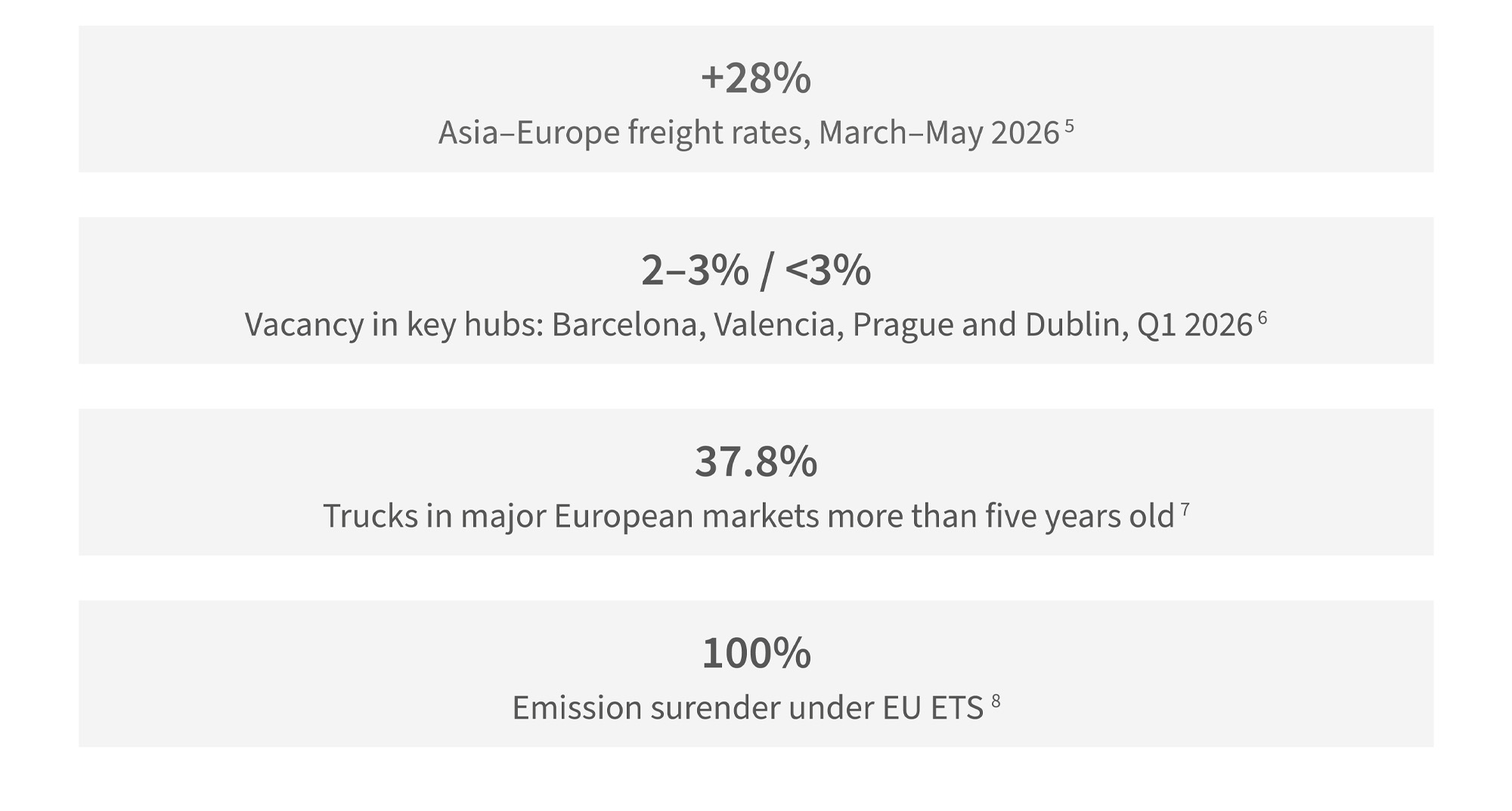
Unsurprisingly, rising fuel prices are a key topic in the European Logistics and Transport sector. Companies appear to have anticipated further future price increases, with ocean freight costs climbing much faster than fuel prices. We have seen Asia–Europe freight rates jump by 28%, almost double the 10.5-13% increase in fuel prices over the same period.1
This could lead to three potential scenarios in H2 2026, each affecting a different part of the logistics cost base: ocean freight commitments, warehouse and transport capacity, and cost/regulatory pass-through.
Scenario 1: Geopolitical disruption normalises. If disruption eases, the risk shifts from securing capacity to avoiding over-commitment. Companies that pulled purchases forward may delay new inbound orders, leaving freight capacity or warehouse space that no longer matches near-term demand. The key exposure is ocean freight rates, where carrier mix, booking windows and contract structure become more important if rates begin to normalise after a period of volatility.
Scenario 2: Consumer demand weakens while cost pressure remains high. If demand softens, the risk shifts to inventory absorption. Pulled-forward stock may need to be held in networks where the right warehouse capacity is not always available in the right location. Although EMEA has a weighted vacancy of 7.0% in Q1 2026 this masks much tighter conditions in key hubs, with Barcelona, Valencia and Prague at approximately 2–3% vacancy and Dublin below 3%.2,3
Scenario 3: Disruption re-emerges or persists. If disruption returns or continues, the risk shifts to service continuity and margin protection. Freight rates, surcharges and lead times may remain volatile even if demand is weak, while Europe-specific regulation adds a separate cost and compliance layer for companies operating in Europe.4
Companies should respond in three ways:
- Protect transport flexibility: Review freight commitments, booking windows and carrier mix, and test whether fleet capacity is sufficient if volumes recover, particularly in markets where fleet renewal has lagged. Specifically, European Road haulage is constrained in some markets, requiring early engagement with providers to ensure capacity commitments and prices. Extension clauses should be considered, and where volumes allow, extended. Enforcing volume commitments, where possible, is a key strategy to avoid costly spot market risks.
- Secure the right warehouse capacity: Assess whether pulled-forward inventory can be absorbed in the specific locations needed, and identify nearby hubs where availability is less constrained. Early and scenario-based options should be reviewed within the existing warehouse footprint, and where constraints have been identified, longer lead times should be taken into account.
Review key cost drivers: Identify where logistics costs can be optimised and assess which Europe-specific regulatory costs can be passed through, absorbed or offset through operating improvements. This should include a review of packaging and recycling opportunities across the product flow and, ideally, involves joint approaches with suppliers and customers. Often an added benefit is further integration across the supply chain.
Key Figures
In H2 2026, the competitive advantage may not come from optimising for a single market outcome, but from retaining the flexibility to respond as disruption, demand and regulation evolve.
Ocean Freight Volatility and H2 2026 Purchasing Scenario
Geopolitical disruption has pushed up fuel prices and freight-rate volatility. Brent crude moved from around US$85 / barrel to a peak of US$115 / barrel in Q2 2026, following the Strait of Hormuz disruption.9 At the same time, container freight rates have risen faster than the fuel-cost impact alone would suggest. With a 62% rise in fuel prices since March 26 translated into 10.5–13.0% total-cost inflation, while freight rates from Asia to Europe have increased 28% over the same period.10
This suggests the rate move is not only a bunker-cost pass-through, it also reflects tighter effective capacity, early restocking and peak-season demand. In May 2026, ocean freight rates moved well ahead of normal seasonality, with Shanghai Containerized Freight Index (“SCFI”) up 35% and the World Container Index (“WCI”) up 26% over the month.11 Companies may therefore be moving goods earlier than planned, securing capacity before further disruption or pulling purchases inbound while rates are still available. This is happening despite weak European consumer demand, as consumer confidence fell to -21 points in April 26.12
Freight Rates Outpaced Fuel-Driven Cost Impact (March to May 26)13

For goods already pulled forward, the key question is whether inventory can be absorbed in the right locations, especially where warehouse vacancy is already tight. If rates do not normalise, companies may need to preserve flexibility on booking windows, carrier mix and capacity commitments to protect critical lanes without over-committing.
Companies that locked in capacity early may have protected service levels, but they now face a greater risk of carrying commitments that made sense during disruption but may not make sense if demand softens or rates normalise.
Capacity Constraints in Key Logistics Locations
Lower vacancy in key logistics locations is making site selection harder. Munich vacancy was approximately 1.1% in H1 2025 and Germany remained relatively tight at 3.6% vacancy in Q1 2026.14,15 Other core European hubs also show limited available space, with Barcelona, Valencia and Prague at approximately 2–3% vacancy and Dublin below 3%. This means headline European weighted vacancy of 7% in Q1 2026 does not fully reflect the reality of hubs in above constrained locations.16
Incoming supply also looks more constrained. Savills’ Development Pipeline Index was 140.3 in Q1 2026, down from its Q3 2022 peak of 184.8.17 In Germany, planning and land constraints are flagged as risks that could limit new supply.18 This matters for companies considering Munich, Rhine-Main/Frankfurt, Rhine-Ruhr, Berlin or other core hubs, because suitable space may take longer to find and may not be available in the right specification or timing.
Fleet capacity adds a second constraint. European HD truck registrations were 298,000 on a rolling four-quarter basis in Q4 2025, down 6% YoY, with Germany and France 12% and 9% below their 10-year averages. 37.8% of trucks in major EU markets were more than five years old as of 2024, versus a 34.9% average since 2004, indicating slower fleet renewal in key markets.19
Vacancy Rates in Europe (non-exhaustive) 20
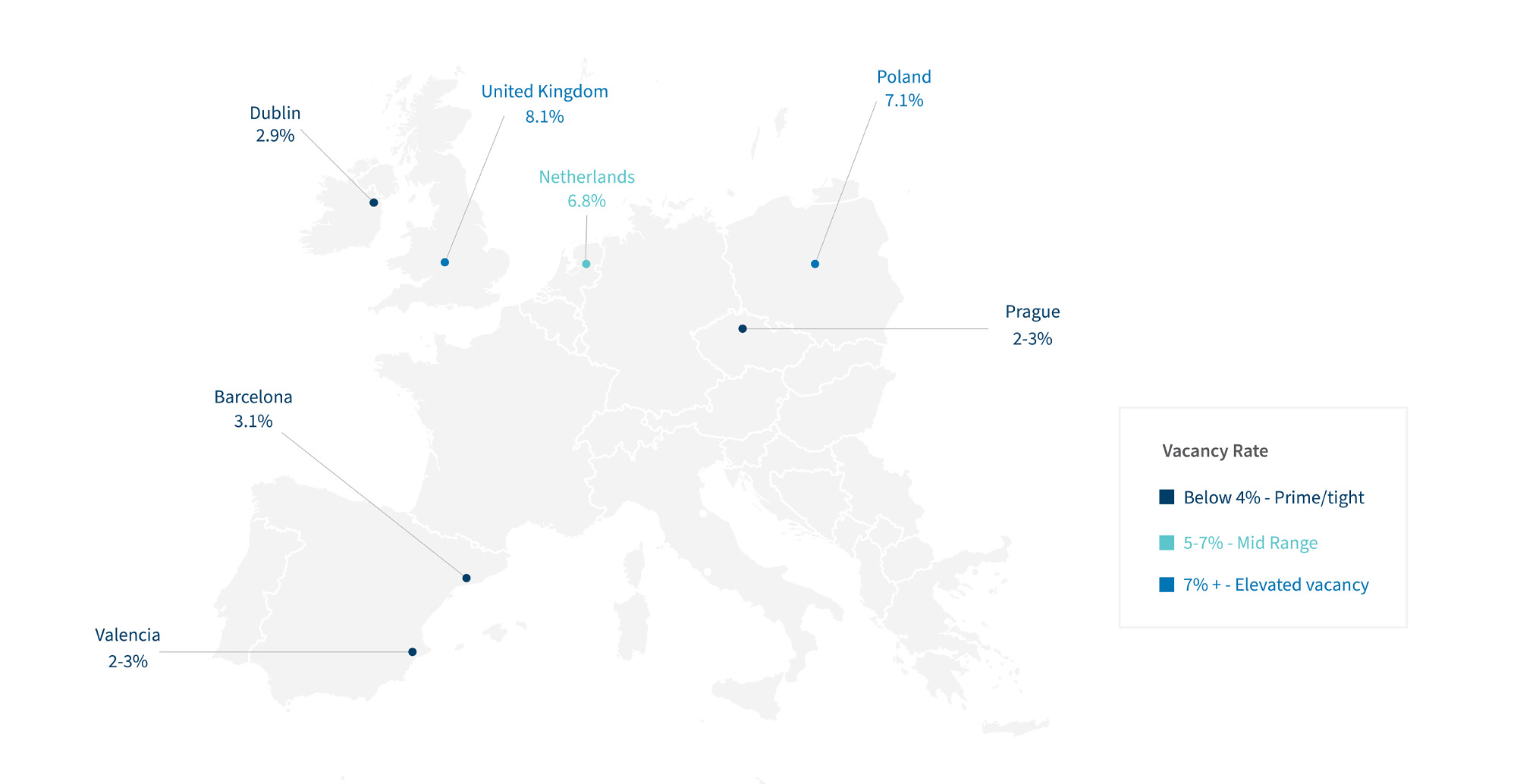
Source: Source: Savills, European Logistics Spotlight, Q1 2026, p.2
Companies considering constrained logistics markets should test both real-estate availability and transport capacity before committing to a location. They should also assess whether carrier fleets have sufficient renewal and replacement capacity to absorb current volumes and any future demand recovery, and whether efforts to secure capacity today could constrain their ability to reposition inventory and volumes if demand patterns change.
General Market and Regulatory Pressures
General market and regulatory pressures have made the logistics cost challenge harder. AI disruption fears have already hit listed logistics and transport names. U.S. and European trucking and 3PL stocks declined by as much as 20%, with an average decline of 11%, versus -1.6% for the S&P 500.21 General market pressures have been compounded by AI-related concerns in freight brokerage, with investors reacting to the risk that AI tools could reduce broker involvement, lower labour needs and pressure margins. In light of this reaction by investors and following increasing pressure to respond to AI-related disruption, it’s critical that companies demonstrate that they can protect revenue and improve margins. Ensuring proactive engagement with the market is critical, as any sign of unexpected revenue will likely be attributed to price and service competition from non-traditional providers. In a volatile market, the say-do-ration is even more critical.
Regulatory pressure adds a separate cost and compliance layer for companies operating into Europe. From 2026, 100% of maritime emissions must be surrendered under the EU Emissions Trading System, and the Greenhouse gas (“GHG”) scope widens to include methane and nitrous oxide in addition to CO₂. FuelEU Maritime is also now in force across European waters, adding another compliance requirement for operators calling at EU ports.22 Competitors without comparable European exposure may not face the same EU-specific compliance obligations, potentially resulting in lower compliance costs and administrative burdens. This can create a relative competitive advantage in markets where regulatory exposure differs, even though the regulations themselves play an important role in advancing environmental and decarbonisation goals.
Why 2026 Matters (illustrative example)

Source: Wisdom Marine Lines IR Presentation, June 2026, p 25 | EUA spot USD 80, VLFO USD 850/ tonne (may 2026)
Companies need to manage logistics costs without eroding revenue or margins, as AI-related pricing pressure and Europe-specific regulation are both adding pressure to the same cost base. AI disruption concerns are already tightening market expectations for freight brokerage and transport margins, while EU ETS, FuelEU Maritime and other European compliance requirements add cost and administrative complexity for operators in the region. Companies therefore need to identify which costs can be passed through, which need to be absorbed and where operating efficiencies can offset the pressure to provide the greatest flexibility if regulatory costs continue to increase.
Footnotes:
1: Lai, Tommy, “Container Shipping Sector,” KGI Securities (May 21, 2026)
2: “European Logistics Spotlight: History Doesn't Repeat, It Rhymes,” Savills Research (Q1 2026)
3: “European Logistics Spotlight: History Doesn't Repeat, It Rhymes,” Savills Research (Q1 2026)
4: Tyndall, Michael, et al., “Future Transport: Ignore Consumer Preference at Your Peril,” HSBC Global Investment Research (April 9, 2026)
5: Lai, Tommy, “Container Shipping Sector,” KGI Securities (May 21, 2026)
6: “European Logistics Spotlight: History Doesn't Repeat, It Rhymes,” Savills Research (Q1 2026)
7: Housden, Nick, et al., “RBC Truck Tracker,” RBC Capital Markets (February 13, 2026)
8: Tyndall, Michael, et al., “Future Transport: Ignore Consumer Preference at Your Peril,” HSBC Global Investment Research (April 9, 2026)
9: “European Logistics Spotlight: History Doesn't Repeat, It Rhymes,” Savills Research (Q1 2026)
10: Lai, Tommy, “Container Shipping Sector,” KGI Securities (May 21, 2026)
11: Limite, Marco, et al., “Container Shipping Spot Rates – Upwards June Seasonality,” Barclays (June 4, 2026), Report found on Alpha Sense
12: “European Logistics Spotlight: History Doesn't Repeat, It Rhymes,” Savills Research (Q1 2026)
13: Lai, Tommy, “Container Shipping Sector,” KGI Securities (May 21, 2026)
14: “Independent Market Report,” Stoneweg European Stapled Trust (SERT) Annual Report 2025 (March 2026)
15: Clouard, Pierre-Emmanuel, et al., “Thinking Outside the (Big) Box #7,” Jefferies (May 6, 2026)
16: “European Logistics Spotlight: History Doesn't Repeat, It Rhymes,” Savills Research (Q1 2026)
17: “European Logistics Spotlight: History Doesn't Repeat, It Rhymes,” Savills Research (Q1 2026)
18: “Independent Market Report,” Stoneweg European Stapled Trust (SERT) Annual Report 2025 (March 2026)
19: Housden, Nick, et al., “RBC Truck Tracker,” RBC Capital Markets (February 13, 2026)
20: “European Logistics Spotlight: History Doesn't Repeat, It Rhymes,” Savills Research (Q1 2026)
21: Jain, Parash, et al., “Global Logistics: AI Disruption – Risks vs Resilience,” HSBC Global Investment Research (February 13, 2026)
22: Tyndall, Michael, et al., “Future Transport: Ignore Consumer Preference at Your Peril,” HSBC Global Investment Research (April 9, 2026)
A lire aussi
Date
12 août 2026
 Contacts
Managing Director
Managing Director
Managing Director