

IPO & SPAC Market Update: Q2 2026
A Mega IPO Defines a Quarter of Broader Market Recovery
-
2026年8月04日
-

Executive Summary
The second quarter of 2026 marked a defining period for global initial public offering (“IPO”) markets, driven by one of the largest public offerings in history. The SpaceX IPO transformed headline market statistics, pushing U.S. and global deal values to multiyear highs and demonstrating that capital markets remain receptive to high-quality, large-scale issuers. While this landmark transaction heavily influenced aggregate results, underlying IPO activity also continued to improve, with both the United States and Europe recording higher deal volumes than a year ago.
Outside of the megadeal, the quarter reflected a market that continues to normalize. Investors remained selective, favoring companies with differentiated growth stories, strong fundamentals and exposure to long-term structural themes such as artificial intelligence, digital infrastructure and industrial modernization. At the same time, special purpose acquisition company (“SPAC”) formation remained active, and traditional IPO issuance gained momentum as issuer confidence continued to strengthen.
U.S. Market Overview
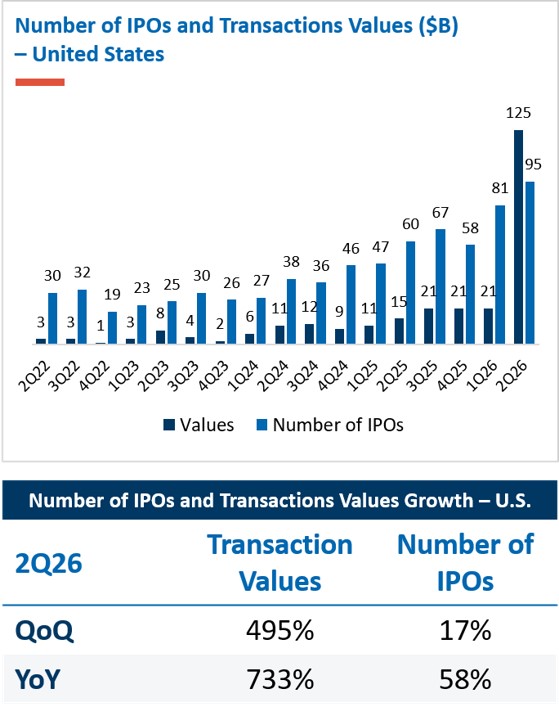
The U.S. IPO market delivered its strongest quarter in several years, with 95 IPOs completed and approximately $125 billion raised. IPO volume increased 17% quarter-over-quarter and 58% year-over-year, while transaction value surged 495% sequentially and more than sevenfold compared with the second quarter of 2025. These headline figures were overwhelmingly driven by the approximately $86 billion SpaceX offering, which accounted for the majority of capital raised during the quarter.
Even excluding SpaceX, market fundamentals continued to improve. Larger issuers increasingly demonstrated confidence in public markets, supported by healthy investor demand for companies operating in sectors benefiting from long-term secular growth. Several billion-dollar offerings across technology, industrials, energy and digital infrastructure illustrate that the IPO window continues to broaden beyond a small number of issuers.
Figure 1: Number of IPOs and Transaction Values ($B) — United States
Source: FTI Consulting analysis of publicly available and licensed subscription data (2026)
Global Market Overview
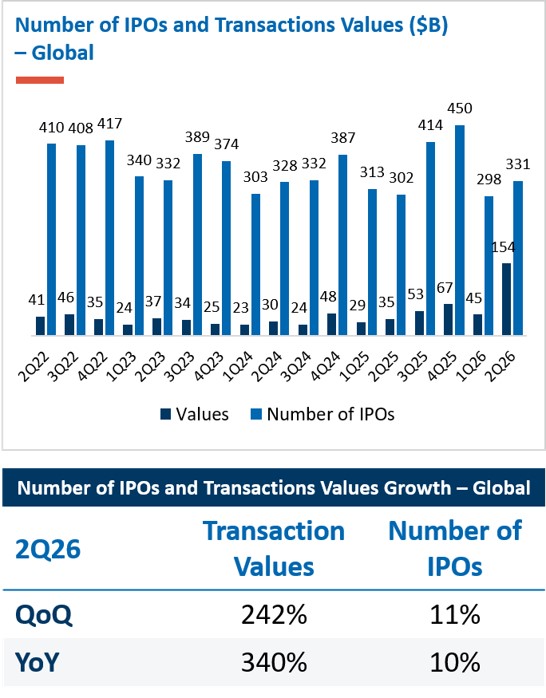
Global IPO markets also posted strong headline growth during the second quarter, with 331 IPOs raising approximately $154 billion. Deal values increased 242% quarter-over-quarter and 340% year-over-year, while global IPO volume rose 11% sequentially and 10% compared with the prior year. Much like the United States, these results were significantly influenced by the outsized impact of the SpaceX transaction.
Europe continued its gradual recovery, recording 37 IPOs during the quarter, representing a 28% increase from the previous quarter and a 61% increase year-over-year. Total proceeds reached approximately $8 billion, up 14% sequentially and 300% compared with the prior year. Industrial companies accounted for much of the region’s largest offerings, reflecting continued investor appetite for businesses supporting infrastructure investment, manufacturing and energy transition initiatives.
While global issuance remains below historical peak levels, improving transaction volumes across multiple regions suggest capital markets continue to reopen for well-positioned issuers despite an environment of ongoing macroeconomic and geopolitical uncertainty.
Figure 2: Number of IPOs and Transactions Values ($B) — Global
Source: FTI Consulting analysis of publicly available and licensed subscription data (2026)
U.S. SPAC vs. Traditional IPO Activity
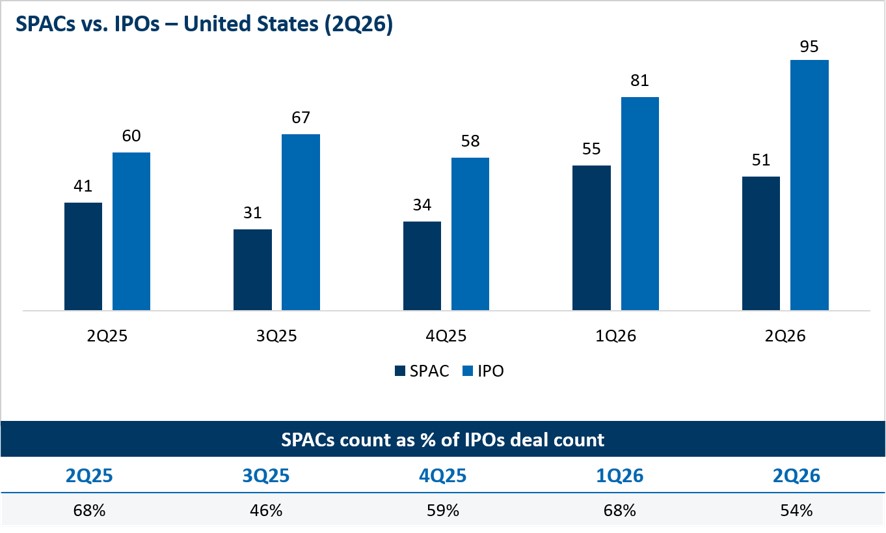
SPAC issuance remained an important component of the U.S. new issue market, although traditional IPOs continued to regain market share. SPAC formations represented 54% of all U.S. IPOs during the second quarter, down from 68% in the first quarter of 2026. This moderation reflects renewed confidence among private companies pursuing traditional IPOs as market conditions stabilize.
The decline in SPAC share should not be interpreted as weakening sponsor interest. Rather, it demonstrates that both pathways to the public markets remain active, providing companies with greater flexibility when evaluating capital-raising alternatives. As the traditional IPO market continues to strengthen, issuers are increasingly selecting the route that best aligns with their strategic objectives, timing and investor base.
Figure 3: SPACs vs. IPOs — United States (2Q26)
Source: FTI Consulting analysis of publicly available and licensed subscription data (2026)
Sector and Regional Highlights
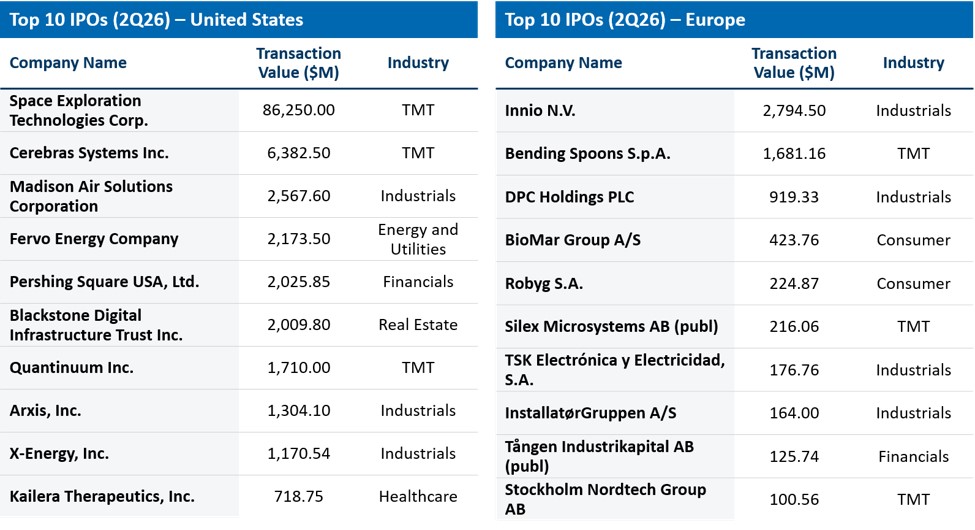
Technology remained the dominant force in U.S. IPO activity, led by the landmark SpaceX transaction and several additional billion-dollar offerings, including Cerebras Systems and Quantinuum. Industrials also emerged as a leading sector, reflecting continued investment in advanced manufacturing, infrastructure and engineering businesses. Energy, healthcare, financial services and digital infrastructure rounded out a diverse group of large transactions, highlighting broad investor interest across sectors with durable long-term growth characteristics.
European activity was similarly concentrated in industrial businesses, with four of the region’s 10 largest IPOs coming from the sector. Technology also remained an important contributor through software and semiconductor-related issuers. Excluding the SpaceX transaction, the largest U.S. IPOs collectively raised nearly three times as much capital as Europe’s top transactions, underscoring the continued depth and scale of U.S. capital markets.
Figure 4: Top 10 IPOs (2Q26) — United States & Europe
Source: FTI Consulting analysis of publicly available and licensed subscription data (2026)
Looking Ahead
While the second quarter will largely be remembered for one historic IPO, the broader market trends are equally noteworthy. Rising IPO volumes across major regions, continued participation from both traditional IPOs and SPACs and increasing representation across sectors suggest the recovery in new issue activity continues to gain traction.
In the coming quarter, market participants will focus on whether additional large-scale issuers choose to access the public markets and whether improving investor confidence expands opportunities for mid-market companies. Although macroeconomic conditions, interest rates and geopolitical developments remain important considerations, companies with compelling growth stories, strong governance and thorough IPO readiness are likely to remain well-positioned to capitalize on improving market conditions.
関連するインサイト
Related Information
出版
2026年8月04日
 主な連絡先
主な連絡先
Senior Managing Director, Global Head of M&A
Senior Managing Director, Co-Leader of SEC Accounting & Advisory
Senior Managing Director, Co-Leader of SEC Accounting & Advisory
シニア・マネージング・ディレクター