

How Value Propositions Help B2B Companies Accelerate Growth
-
October 23, 2026
-

In B2B markets, winning a deal rarely comes down to product features alone. More often, it depends on whether a company can clearly and consistently articulate why a customer should choose its offering over others.
Yet despite their strategic importance, many value propositions are inconsistently defined and applied. They may be reduced to a tagline, buried in a pitch deck or left to individual sellers to interpret, resulting in fragmented messaging, misaligned teams and customer conversations that default to price.
Clear and consistently communicated value propositions strengthen commercial alignment, improve customer conversations and help organizations compete on differentiated value. For CROs, CMOs and sales enablement leaders, they are a critical lever for driving growth.
Redefining the Value Proposition
A value proposition is a strategic statement that answers three interconnected questions with precision:
- Who is the offering designed for? Define the priority customers, segments, design targets and buying committee stakeholders that matter most. This requires an explicit choice about where the organization will focus.
- Why would those customers choose you over the alternatives? Articulate the differentiated reasons to believe, including functional benefits, emotional drivers, switching advantages, competitive differentiation and supporting proof points. The competitive set should include both direct alternatives and the decision to maintain the status quo.
- What do you deliver? Define the full offer across products, services, customer experience, delivery model, route to market, brand and price. These elements represent the tangible expression of the value proposition.
Ownership and governance should sit with senior commercial leadership, typically the CMO, CRO or product marketing leader, with alignment from the CEO and broader executive team. This ensures that the value proposition reflects business strategy, competitive positioning and financial priorities.
Development will often be led by product marketing, drawing on input from sales, product, customer success and market research.
Activation, however, requires shared accountability across the go-to-market organization. Marketing translates the value proposition into messaging and campaigns, sales brings it into customer conversations and customer success reinforces it by connecting the original promise to realized outcomes. This cross-functional model is critical because a value proposition only creates commercial impact when it is understood and applied consistently across the customer journey.
Why Value Proposition Clarity Is a Growth Imperative
As B2B buying grows more complex, companies that cannot articulate value consistently are more likely to default to generic claims, fragmented execution and price-based competition. Inconsistent value messaging increases reliance on discounting and makes it harder to monetize differentiated service, expertise, quality or delivery. With buyers spending only 17% of their purchasing journey interacting with vendors, differentiation must be clear throughout the entire buying journey, not only during sales conversations.1
At the same time, B2B customers increasingly expect suppliers to understand their industry, priorities and desired business outcomes, rather than simply communicate product capabilities. With 77% of B2B buyers describing purchases as very complex or difficult, leading organizations must maintain a consistent strategic promise while tailoring messaging to different stakeholder needs.2 This heightens the need to move beyond firmographics toward behavioral, needs-based and economic segmentation.
Strong value propositions are grounded in a clear understanding of which customers to serve and what drives their needs, buying criteria, willingness to pay and profitability. A clear value proposition:
- Aligns strategy, messaging, sales, pricing and customer experience around a shared definition of value. This helps organizations prioritize the most attractive opportunities and reduce unnecessary customization or over-service.
- Helps sellers qualify opportunities, tailor conversations and connect capabilities to measurable customer outcomes. This addresses a meaningful gap: 86% of buyers are more likely to purchase when a company understands their goals, while 59% say most sales representatives fail to do so.3
- Enables marketing to build differentiated campaigns, content and positioning around customer outcomes. This is increasingly important as 73% of decision-makers view high-quality thought leadership as more trustworthy than traditional marketing materials when evaluating capabilities.4
- Clarifies why an offering merits premium pricing by connecting differentiated capabilities to measurable business outcomes and reinforcing its value relative to competing alternatives.
- Gives strategy, product, marketing, sales, customer success, pricing and leadership a common basis for prioritization and decision-making. In turn, coordinated execution yields a tangible commercial impact.
With the alignment that a quality value proposition brings, a B2B company can significantly grow its profitability. Companies with strong customer-facing alignment can achieve 2.4x higher revenue growth and 2x profitability growth versus less-aligned peers, while strong sales and marketing alignment can increase marketing-generated revenue by more than 200%.5,6
Activating Your Value Proposition with Commercial Teams
The most effective value propositions can be organized around four questions that reflect the customer decision journey: Why Change? Why Now? Why Us? and Why Expand? In this context, Why Expand? focuses on deepening an existing customer relationship by extending the value proposition to additional products, services, use cases or areas of the business. The framework below outlines how each question serves a distinct objective across the customer journey and helps commercial teams tailor their messaging to the customer’s needs and priorities.
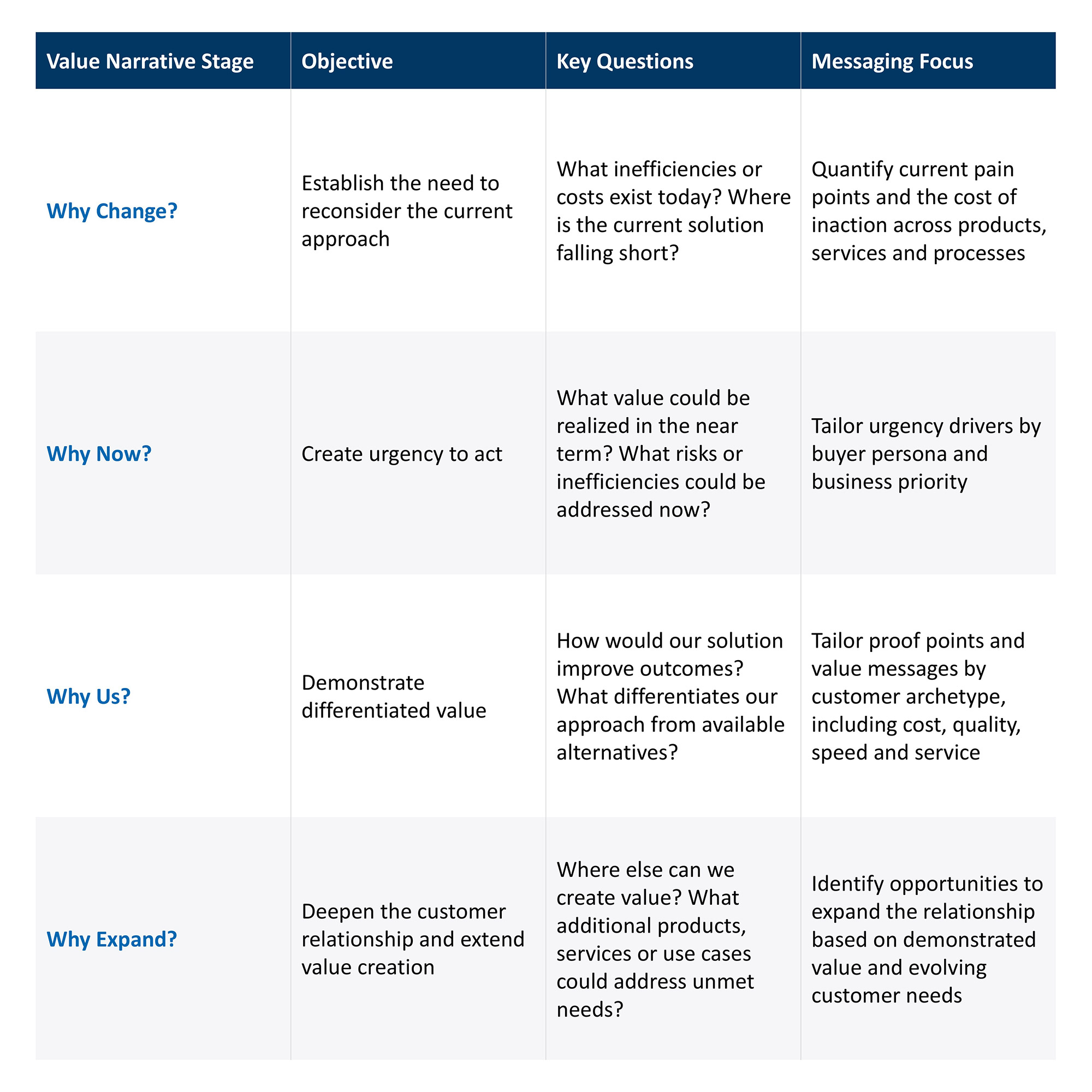
When a company is answering the above questions and activating its value proposition with commercial teams, it needs to ensure that its approach is:
- Customer-Specific: Start with a clear design target by identifying the priority segments, industries, use cases and stakeholders where the company has the strongest right to win. This sharpens Why Change? messaging by grounding the proposition in specific customer challenges, unmet needs and the cost of inaction.
- Tailored to Buyer Personas: Adapt the proposition to the distinct priorities and decision criteria across the buying committee, which typically includes 6-10 decision-makers.7 Persona-level tailoring strengthens Why Now? messaging by linking urgency and value to what matters most to each stakeholder.
- Differentiated: Clearly articulate why the company is better positioned than competitors, substitutes or the status quo by focusing on defensible capabilities, experience, delivery models and outcomes. Strong Why Us? messaging gives buyers a credible reason to choose the company rather than relying on generic category claims.
- Outcome-Oriented: Connect capabilities to measurable business outcomes such as revenue growth, cost reduction, productivity, speed, risk reduction or customer experience. Quantifying value strengthens Why Change?, Why Now? and Why Us? messaging by demonstrating both the cost of inaction and the impact of acting.
- Commercially Actionable: Translate the value proposition into practical tools, including talk tracks, discovery questions, proof points, competitive guidance and value quantification, that marketing, sales and customer success can consistently activate. This creates a common commercial narrative and makes Why Expand? a natural extension of demonstrated customer value.
Conclusion
A strong value proposition becomes most powerful when it moves beyond messaging and shapes how a company goes to market. It gives commercial teams a common language for articulating value, helps buyers understand why an offering matters and creates a stronger foundation for differentiation beyond price. The opportunity for B2B leaders is to embed that value proposition across the commercial organization and buyer journey, turning a clear articulation of value into a repeatable driver of growth, margin, win rates and customer loyalty.
Footnotes:
1: Stuart Brameld, “B2B Buyer Journey: Gartner’s 6-Stage Framework Explained,” Growth Method (updated June 22, 2026).
2: Ibid.
3: Salesforce Staff, “50 Sales Statistics That Reveal How Great Teams Sell,” Salesforce (July 25, 2024).
4: Joe Kingsbury, David Bersoff, Annie Dunleavy, Scott Hills, Robyn Armes, Tusar Barik, Jann Schwarz, “2024 B2B Thought Leadership Impact Report. Reaching Beyond the Ready: Thought Leadership’s Impact on Engaging Out-of-Market B2B Buyers,” Edelman (2024).
5: “Forrester: Aligning Around The Customer Will Turbocharge Companies’ Growth Engines,” Forrester (February 21, 2023).
6: Sanam Dhanoa, “The Art of Sales and Marketing Collaboration and Making ABM Work,” LinkedIn (February 7, 2024).
7: Brameld, supra note 1.
The views expressed herein are those of the author(s) and not necessarily the views of FTI Consulting, Inc., its management, its subsidiaries, its affiliates, or its other professionals.
Related Insights
Published
October 23, 2026
 Key Contacts
Senior Managing Director
Managing Director
Senior Director
Director
Consultant