

How Geopolitics and Domestic Politics Have Rewired Brazil’s Business Risk
-
August 17, 2026
Downloads Download Article
-

Brazil’s approaching electoral cycle crystallizes a broader reality: companies can no longer treat geopolitical and political risk as background noise, but as a core strategic variable in how they invest, operate and communicate. In a system where domestic politics, foreign policy and public security narratives are now fused, corporate strategies that ignore this new risk environment are structurally exposed.
The Risk Environment
Brazil heads toward general elections in October 2026 in a context where geopolitical and domestic political risks are jointly reshaping the business environment. On the one hand, the country faces deep polarization, institutional strain and an increasingly fragmented party system. On the other, it is being targeted by U.S. measures – from proposed 25% tariffs under Section 301 to the terrorist designation of major criminal organizations1 – that embed Brazil’s internal dynamics in broader, global strategic disputes over trade, security and the digital economy.
A Workers’ Party–led government under Lula confronts an opposition aligned with former President Jair Bolsonaro that remains organizationally active and closely linked to international far‑right networks (e.g. Conservative Political Action Conference (“CPAC”) and Foro de Madrid), which use narratives around crime, sovereignty and globalism to mobilize voters. The result is an electoral cycle in which disputes over institutions, security and foreign policy are not episodic events, but continuous sources of volatility with direct implications for business risk and medium‑ to long‑term planning, and particularly for multinationals and foreign investors that must now factor decisions taken in Washington, Brussels and Beijing into their Brazil strategies as much as developments in Brasília.
Based on this scenario, FTI Consulting Brazil has identified 5 main risks2 impacting the current Brazilian business environment. In wide-ranging interviews with Brazilian academics, conducted over March and April, we corroborated each of the variables underpinning the risk analysis that follows. The risks are shown on the heatmap below:
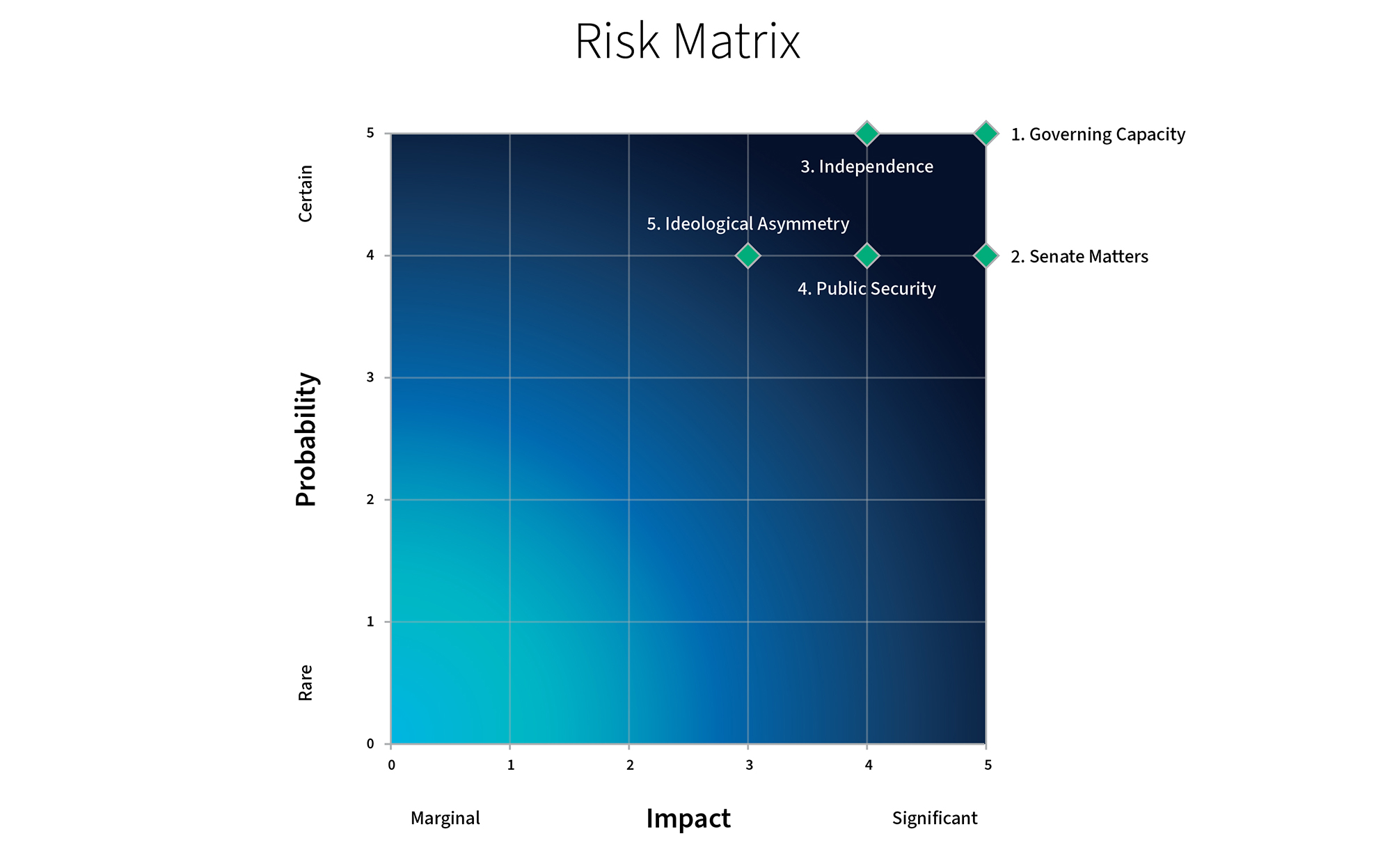
Source: FTI Consulting, 2026
Risk 1. Governing Capacity and Structural Friction
High‑impact structural and background risk. Regardless of who wins, chronic coalition‑building and institutional friction shape the speed, coherence and predictability of reforms, fiscal policy and regulation, and thus Brazil’s long‑term risk premium.
Brazil’s governability constraints are structural, not contingent on electoral outcomes. Even a strong congressional majority does not ensure policy delivery in a fragmented, transaction-driven system that requires continuous coalition management and allocation of political capital. This reading is reinforced by Guilherme Casarões,3 who argues that even a legislative majority aligned with the President would not guarantee governability, underscoring the persistent gap between electoral victory and governing capacity.
For businesses and investors – particularly those assessing Brazil from their headquarters abroad – the implication is clear: the post-election environment is unlikely to produce linear or predictable policy trajectories. Institutional friction and legislative volatility should be treated as baseline conditions in medium-term planning, shaping discount rates, strategic positioning and board-level risk assessments, regardless of the incoming administration’s market orientation.
Risk 2. Why the Senate Race Matters
High probability, moderate to high impact: Senate composition influences judicial appointments, agency oversight and the durability of business relevant reforms over a four-to-eight-year horizon.
Senatorial contests – often overshadowed by presidential campaigns – are critical for assessing institutional and regulatory risk. The issue may be read as limited to a potential shift toward Bolsonaro-aligned candidates – which is not the case – but needs to be read through how any reconfiguration of the Senate may alter legislative coordination, oversight dynamics and the interaction with the judiciary. Different political compositions can influence the trajectory of judicial proceedings, the pace and content of the legislative agenda and the degree of institutional friction in a system already under strain since 2022.
Casarões4 stresses that the Senate elections should be watched closely, as an increase in Bolsonaro-aligned senators could lead to the impeachment of Supreme Federal Court (“STF”) justices and an attempt to overturn the court’s rulings related to the January 8 attacks. This is harmful to democratic institutions because it erodes the system of checks and balances and it creates a precedent for impeachment based on political/ideological preference. And it is negative for the business environment as it increases legal and regulatory uncertainty and diminishes judicial independence, leading to a perceived erosion of the rule of law.
For companies, this is not simply a question of “who wins,” but how the balance of power in the upper chamber shapes regulatory stability, agency oversight, key appointments and the durability of reforms over a four- to eight-year horizon. The underlying risk is a more fragmented or assertive Senate that increases policy volatility, even in the absence of a clear ideological shift. This matters concretely across sectors. In energy and mining, Senate dynamics affect licensing timelines, environmental oversight and the implementation of sectoral reforms; in telecommunications and digital markets, they influence spectrum policy, data regulation and the governance of agencies such as ANATEL; in financial services, Senate composition can shape the regulatory treatment of payment systems, fintech oversight and the legislative response to emerging market structures. In each case, a more politicized or disjointed Senate raises the probability of regulatory delays, inconsistent enforcement and abrupt course corrections that must be priced into investment decisions.
Risk 3. The Weaponization of Interdependence
Certain probability and high impact that creates cross sector risk. Tariffs, Pix and broader digital/trade measures directly affect costs, margins, market access and infrastructure that companies depend on.
The current global economic and geopolitical environment reflects a structural shift rather than a cyclical fluctuation. Carlos Poggio,5 emphasizes the erosion of liberal economic assumptions and the consolidation of a more politicized international economic order. Brazil’s recent experience illustrates this dynamic: protectionism and security considerations are increasingly displacing market efficiency as the primary drivers of policy, particularly in sectors deemed strategic. This interpretation is reinforced by Feliciano Guimarães,6 who highlights the growing state scrutiny over economically relevant companies that operate in strategic sectors in shaping political and economic outcomes.
This trend is evident in the U.S. Section 301 decision against Brazil, underscoring how strategic sectors are becoming focal points of state intervention – an outcome consistent with Guimarães’s7 argument that firms in these sectors are increasingly exposed to state action. The imposition of an additional 25% tariff on a broad range of Brazilian exports is framed as a response to an “unreasonable” digital trade and payments framework. Notably, Pix is singled out as a “national champion,” with the USTR arguing that the Central Bank’s dual role as regulator and operator, combined with mandates and fee caps, disadvantages U.S. card networks. In line with Poggio’s8 analysis, this reflects how domestic regulatory models are now being contested through geopolitical and trade instruments.
For companies, the implication is clear: in an environment where interdependence is systematically exploited for geopolitical leverage, decisions on pricing, infrastructure and data are no longer purely commercial. Firms operating in or relying on public digital rails such as Pix should assume that trade, regulatory and security instruments may be deployed against them as part of broader strategic disputes. This exposure affects not only Brazilian firms but also multinationals whose local operations depend on payment, cloud, data, or logistics infrastructure, potentially drawing them into conflicts beyond their immediate control.
Risk 4. Public Security Narratives As Electoral Instruments
Possible probability and sectoral moderate to high impact creates an elevated compliance and reputational exposure. PCC/CV Foreign Terrorist Organizations designations by the U.S. and law and order narratives are powerful tools for reshaping compliance expectations, banking and payments scrutiny, and reputational risk, especially for finance, logistics and consumer facing multinationals.
The U.S. designation of PCC and CV as terrorist organizations exemplifies how security policy is being instrumentalized as an electoral wedge rather than treated as a technocratic response to organized crime. The U.S. decision to classify both groups as Foreign Terrorist Organizations and subject them to sanctions regimes adds an external layer to this dynamic, amplifying its domestic political reverberations in the midst of Brazil’s October race. David Magalhães9 argues that pursuing this designation via domestic policy instruments rather than international mechanisms is a deliberate choice designed for electoral impact, while Bruno Langeani10 frames it as a form of external interference that does little to address structural security challenges. Casarões11 warns that the narrative architecture created by this designation implicitly associates the Workers’ Party and the Brazilian left with organizations now labeled as terrorist – a perception that is difficult to rebut and can weigh on the Lula administration’s electoral standing.
For companies, especially foreign investors and multinationals, the implication is that law-and-order narratives and terrorism labels are not neutral; they are high-leverage tools for redefining “order” and “disorder” in the political arena. The designation materially raises compliance costs by intensifying due diligence requirements, expanding banking and payments scrutiny, and increasing exposure to sanctions risk for any indirect links to PCC- or CV-affiliated actors. Reputational risk can shift rapidly as security discourse is mobilized as a tool of coercion and blame, with spillovers into how investors, partners and regulators perceive exposure to Brazil-related crime and security issues. In practice, firms must now budget for higher legal and compliance overhead, more conservative transaction screening and potential de-risking by international financial institutions – costs that will vary by sector but are likely to be pervasive across logistics, agribusiness, mining, financial services and cash-intensive consumer businesses.
Risk 5. Ideological Asymmetry and Volatility
Likely probability and moderate impact create regulatory and policy unpredictability. Asymmetric strengths of Bolsonarismo12 vs. the Workers’ Party drive narrative swings, coalition shifts and episodic market turbulence, complicating planning and communications even when macro anchors hold.
Our assessment is that the contest between Brazil’s two dominant political forces – Bolsonarismo and the Workers’ Party – are characterized by ideological asymmetry, reinforcing volatility over programmatic clarity. Bolsonarismo combines strong mobilization capacity with uneven policy articulation and priorities, while the Workers’ Party retains deeper institutional grounding but faces political fatigue and reduced ability to expand beyond its core base. This interpretation is supported by David Magalhães,13 who situates Bolsonarismo within a transnational ecosystem of radical right movements driven by anti-globalist narratives, and by Guilherme Casarões,14 who questions the movement’s ideological depth and its capacity to sustain a consistent governing project.
In practice, this asymmetry suggests that electoral dynamics will be shaped less by competing policy agendas and more by mobilization, narrative competition and the exploitation of opposing vulnerabilities. For companies, the implication is a higher likelihood of abrupt shifts in tone, coalition structures and policy signaling, raising operational and compliance costs even where macroeconomic anchors remain broadly stable.
What Companies Need To Know When Operating in Brazil
In this environment – defined by systematical exploitation of interdependence for political leverage, politicized foreign policy, security narratives as electoral instruments and structurally constrained governability – companies cannot afford a passive stance toward geopolitical and political risk. A “understand, prepare and engage” approach is not a nice to have; it is an operational imperative for both Brazilian corporates and multinationals headquartered outside of Brazil allocating capital to the country:
- Understand: Integrate political science, security analysis and foreign policy expertise – including from academia and specialized advisory teams – into corporate risk mapping, rather than relying solely on traditional market intelligence or macroeconomic forecasts. This is particularly important for foreign based boards seeking to interpret Brazil’s complex signals from afar.
- Prepare: Build scenario planning that explicitly incorporates electoral dynamics, institutional stress points and geopolitical shifts into investment, supply chain and communications decisions. For multinationals, this includes assessing exposure to instruments like tariffs, sanctions and regulatory changes tied to digital infrastructure, payments and critical sectors.
- Engage: Develop structured, transparent dialogue with public authorities at federal and state levels, as well as with civil society and opinion shapers, recognizing that corporate positioning on international and security issues will increasingly be read through a political lens. For foreign investors, anchoring Brazil strategies in credible local partnerships and stakeholder engagement can help mitigate misperceptions and reduce the risk of being inadvertently pulled into domestic political disputes.
Companies – domestic and international – that build these capabilities now will be better placed not only to protect value, but to shape the emerging debate on how Brazil can remain an attractive, stable hub in a world where geopolitics is no longer a distant concern, but a daily operational reality.
Note: Fifteen (15) main experts in foreign policy, trade, Brazil-U.S. relations, public security, party politics were invited to participate in the interview rounds and five (5) interviews were conducted in person and virtually with the participants’ informed consent for 2026.Participants authorized the use of their contributions for research and publication purposes in this report, including attribution by name where appropriate, except where anonymity or the application of the Chatham House Rule was specifically requested.
Footnotes:
1: U.S. Mission Brazil, Fact Sheet: President Trump Directs USTR Section 301 Action in Response to Brazil’s Unreasonable Acts, Policies, and Practices, July 16th 2026. ; U.S. Department of State, Terrorist Designation of Comando Vermelho and Primeiro Comando da Capital. May 28th 2026.
2: The qualitative ratings used in this analysis are based on two dimensions: (i) probability of occurrence – the likelihood that a given dynamic will materialize or intensify over the next 12–24 months; and (ii) impact on the business environment – the breadth, depth and persistence of effects on regulation, compliance, investment and operations. Probability is classified as rare (<10%, requires multiple unlikely contingencies), improbable (10–30%, low probability but plausible under specific conditions), possible (30–50%, credible outcome but uncertain), likely (50–70%, more probable than not, with visible momentum) or certain (>70%, trend clearly underway and likely to persist). Impact is classified as marginal (very localized, affecting specific transactions or actors), low (limited sectoral effects, manageable with minor adjustments), moderate (affecting multiple sectors, requiring adaptation), high (cross-sector implications with strategic relevance), or significant (economy-wide or systemic, with structural implications for corporate strategy).
3: Guilherme Casarões, FTI Consulting Interview, March 27, 2026, São Paulo, Brazil. Brazilian Studies scholar is an Associate Professor at the Department of Politics & International Relations – Florida International University.
4: Guilherme Casarões, FTI Consulting Interview, March 27, 2026, São Paulo, Brazil.
5: Carlos Gustavo Poggio, FTI Consulting Interview, March 19, 2026, São Paulo, Brazil. US and Latin America Foreign Policy scholar is Associate Professor at the Political Science Department – Berea University.
6: Feliciano Guimarães, FTI Consulting Interview, April 15, 2026, São Paulo, Brazil. Brazilian Foreign Policy scholar is an Associate Professor at Institute of International Relations – University of São Paulo (“USP”).
7: Feliciano Guimarães, FTI Consulting Interview, April 15, 2026, São Paulo, Brazil.
8: Carlos Gustavo Poggio, FTI Consulting Interview, March 19, 2026, São Paulo, Brazil.
9: David Magalhães, FTI Consulting Interview, March 17, 2026, São Paulo, Brazil.
10: Bruno Langeani, FTI Consulting Interview, March 19, 2026, São Paulo, Brazil. Public Security scholar is a Senior Advisor at Instituto Sou da Paz (Brazilian civil society organization that works with public policies focused on public security, arms control and violence prevention).
11: Guilherme Casarões, FTI Consulting Interview, March 27, 2026, São Paulo, Brazil.
12: Political movement associated with former Brazilian president Jair Bolsonaro, characterized by ultraconservatism, nationalism, anti-communism and militarist rhetoric; also denotes its supporters.
13: David Magalhães, FTI Consulting Interview, March 17, 2026, São Paulo, Brazil. Neoconservatism expert, is an Associate Professor at the Economy and International Relations Institute– Federal de Uberlândia University (“UFU”).
14: Guilherme Casarões, FTI Consulting Interview, March 27, 2026, São Paulo, Brazil.
The views expressed herein are those of the author(s) and not necessarily the views of FTI Consulting, Inc., its management, its subsidiaries, its affiliates, or its other professionals.
Related Insights
Related Information
Published
August 17, 2026
 Key Contacts