

Key Trends and Implications in Healthcare AI Adoption
-
August 12, 2026
-

Amid mounting financial and operational pressures, including workforce shortages, rising costs of care and evolving market dynamics, artificial intelligence (“AI”) is emerging as a potential lever to drive efficiency, sustainability and improved outcomes. This places healthcare systems at a critical crossroads for AI adoption. However, the path to value is not one-size-fits-all. Health systems vary widely in size, geography, service offerings and strategic priorities, requiring tailored approaches to AI adoption.
In partnership with Healthcare Information and Management Systems Society (“HIMSS”), FTI Consulting conducted a detailed assessment of health system perspectives1 and AI utilization to better understand how organizations are navigating this rapidly evolving landscape and where meaningful value is actually being realized.2
Below are three key trends observed in the assessment and associated implications for healthcare providers. In light of the findings, this article also shares key takeaways for healthcare organizations and their leaders looking to succeed in the current AI landscape.
Figure 1: Three-Quarters of Healthcare Leaders Believe AI Will Fundamentally Change Care Delivery in the Next Few Years; Many Also Believe AI Has the Potential To Materially Reduce the Costs of Delivering Healthcare.

Question: Please indicate the extent to which you agree or disagree with each of the following:
Trend #1: AI Adoption Varies Significantly Across Healthcare Systems
The variation in AI adoption across healthcare systems reveals an emerging divide. Larger, multi-facility health systems are actively scaling AI across multiple use cases and building the organizational capabilities needed to sustain that growth.
Across many of the most commonly reported AI use cases, organizations with annual revenues exceeding $1 billion are more likely to be in the scaling phase than their smaller counterparts. Revenue cycle management (“RCM”), the second most frequently cited use case, provides one example of this trend: 54% of organizations with annual revenues greater than $1 billion report actively scaling AI-enabled RCM solutions, compared with just 15% of organizations with less than $1 billion in annual net revenue.3
Kaiser Permanente exemplifies this trend through its early deployment of ambient documentation tools, exploration of AI-driven risk identification and population health applications, as well as investments in initiatives that support AI research and innovation across the healthcare ecosystem.4 In contrast, smaller, single-facility organizations often struggle with implementation costs, limited resources and a lack of clear adoption pathways. Small, rural hospitals are a clear example of this pattern, with research showing that infrastructure gaps, data limitations and implementation challenges limit deployment and contribute to a growing urban–rural divide in technology-enabled care.5
This divergence suggests that consolidation pressures may intensify over time, as organizations unable to capture AI-driven efficiencies risk falling behind in cost structure, workforce retention and clinical performance. The result may be a widening gap between AI-enabled health systems and those without the scale or infrastructure to participate effectively.
Implication: Healthcare leaders should adopt a deliberate, organization-specific AI strategy that accounts for system scale and readiness. Prioritize high-impact use cases that align with your unique operational and financial pressures while evaluating whether the infrastructure exists to support sustainable deployment and scale.
Trend #2: Organizations Struggle To Define and Quantify Return on Investment for AI
Organizations that establish clear return on investment (“ROI”) measurement frameworks, including tying ROI to operations and shared services, will be better positioned to secure funding, expand successful pilots and demonstrate value to stakeholders. Others risk remaining stuck in “pilot purgatory.”
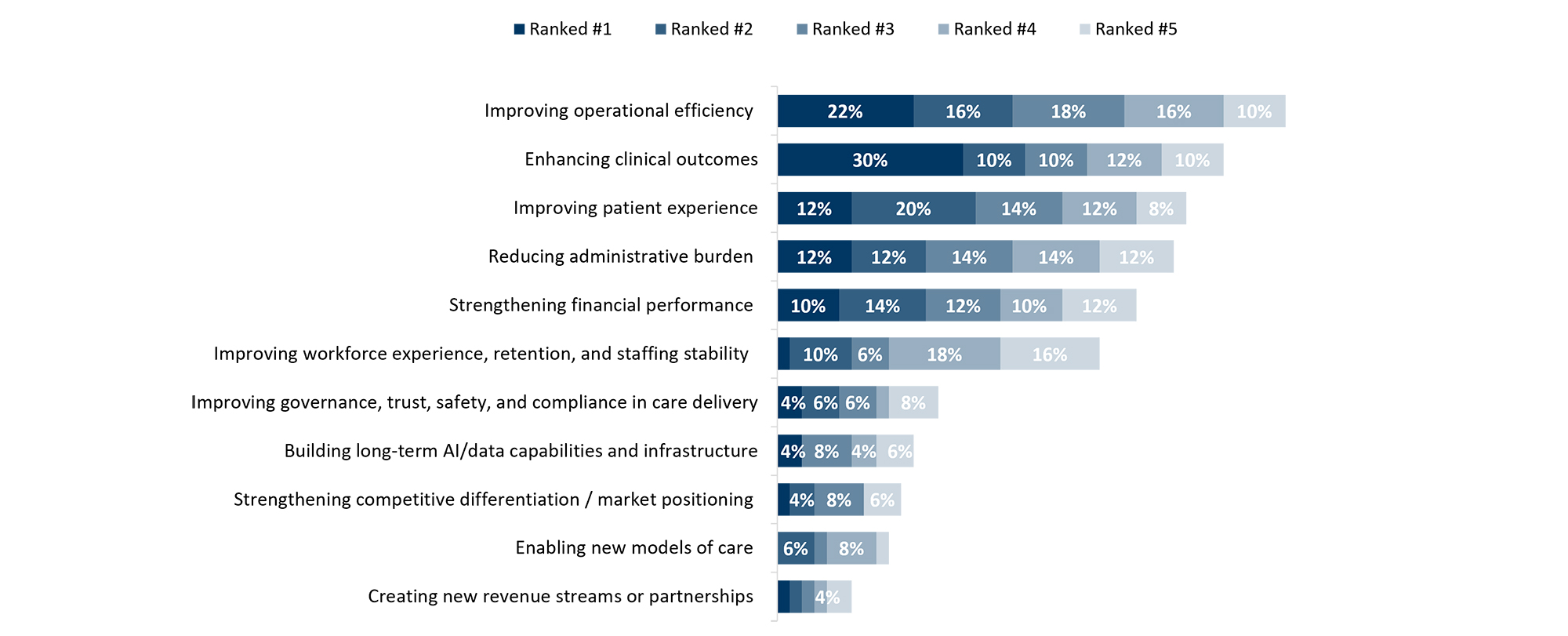
At the same time, improving operational efficiency, enhancing clinical outcomes, improving patient experience and reducing administrative burden remain the primary objectives driving AI investment. Operational efficiency emerged as the leading priority, with 82% of respondents ranking it among their top five objectives for AI. This was followed by improving clinical outcomes (72%), enhancing the patient experience (66%) and reducing administrative burden (64%) (see Figure 2). Strong ROI frameworks allow organizations to translate these objectives into measurable outcomes and prioritize initiatives that deliver tangible value.
Figure 2: What Are the Most Important Objectives Driving Your Organization’s Investments in Artificial Intelligence Technologies?
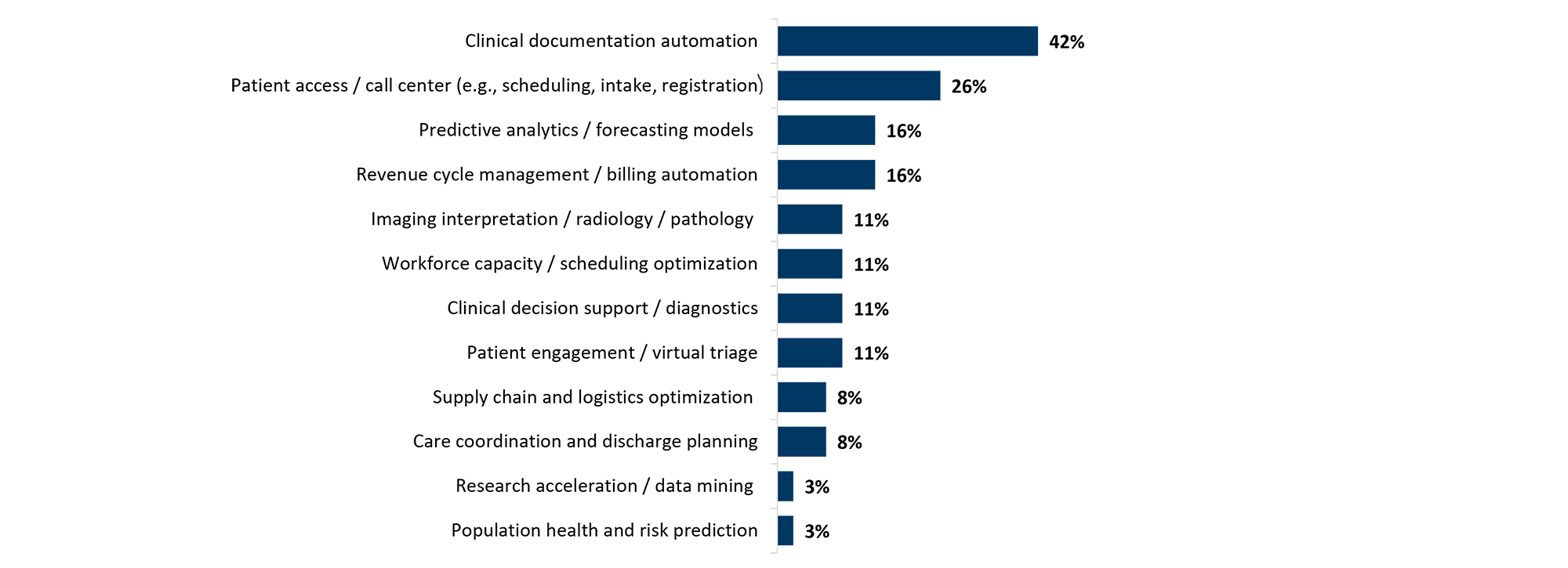
Clinical documentation automation has emerged as both the most widely adopted and highest-impact use case.6 Its success is helping organizations build foundational technical infrastructure, governance structures and stakeholder trust needed to expand into more advanced applications such as predictive analytics, personalized medicine and clinical decision support.
Figure 3: Thinking About the Areas in Which Your Organization Has Implemented AI, Which Have Delivered the Strongest Results in Helping You Achieve Each of the Following Objectives?
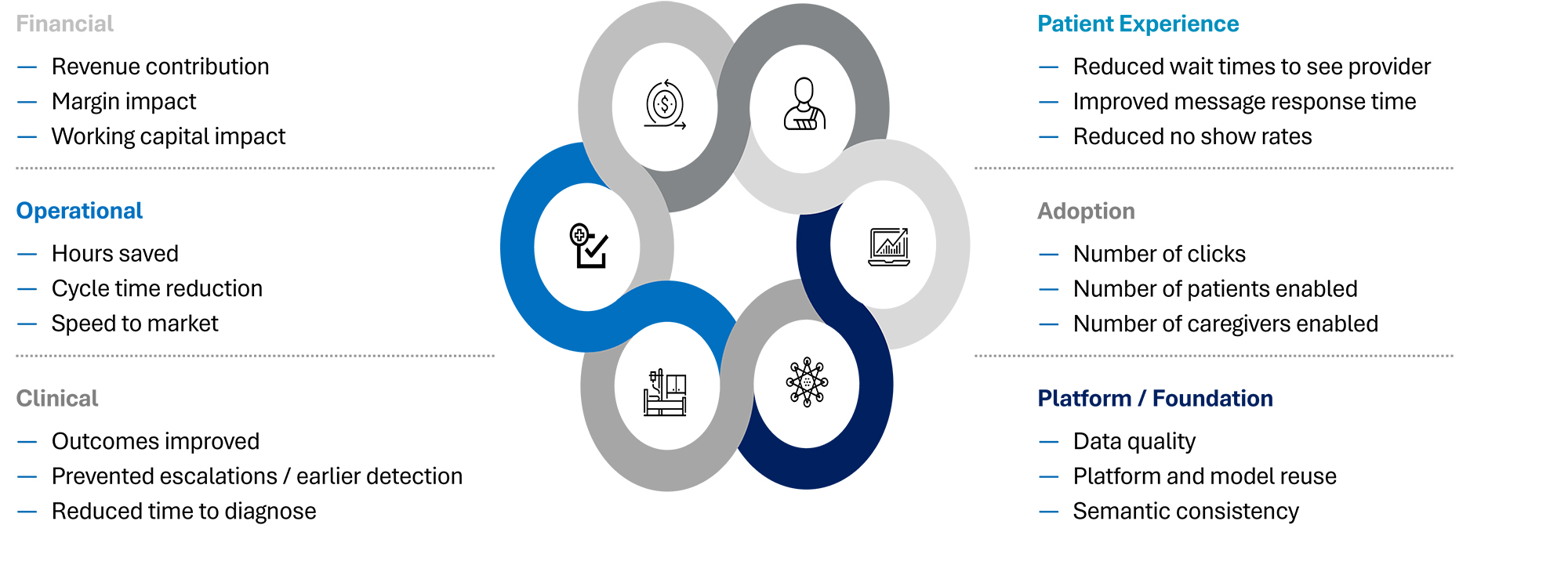
Implication: Regardless of AI maturity, identifying use cases with measurable and defensible impact is critical to securing resources and building stakeholder alignment across the organization. Establishing a value prioritization framework will support the identification and measurement of impact.
Figure 4: Example Value Prioritization Framework for AI Implementation in Healthcare Source: FTI Consulting
Trend #3: Healthcare Organizations Face Increasing Workforce Shortages and Employee Burnout
With 66% of leaders viewing AI as essential for addressing workforce shortages and burnout, labor market pressures may ultimately outweigh concerns around cost and implementation complexity.7 As staffing challenges intensify, AI adoption is increasingly shifting from a strategic option to an operational necessity, particularly for organizations struggling to recruit and retain clinical talent in competitive markets.
With the average cost of replacing one physician amounting to 2-3 times their annual salary, investments in AI solutions that reduce burnout and improve retention offer not only workforce stability but also substantial cost savings for healthcare organizations.8 As a result, solutions that directly support clinical workflows and reduce administrative burden are gaining traction as high-value applications.
Implication: AI should be treated as a workforce strategy, not just a technology investment. Prioritize use cases that reduce administrative burden and burnout and engage clinical leaders in selection to ensure solutions fit frontline workflows, improve experience and support retention.
From Investment to Implementation
While interest in AI continues to grow, the prominence of cybersecurity concerns, particularly among C-suite leaders, and integration challenges signal that execution, not capability alone, will determine success.9 Organizations with strong information technology (“IT”) infrastructure, robust security postures and interoperable systems will be best positioned to scale AI effectively. Conversely, those with legacy systems and fragmented data environments may struggle to realize AI’s benefits, widening the performance gap with more technologically mature competitors.
In addition, effective change management remains a critical determinant of success. Clear governance structures, stakeholder alignment, workforce training and sustained communication are essential to driving adoption and ensuring AI initiatives deliver measurable value.
As your healthcare organization evaluates how best to leverage AI, a few areas consistently shape whether these efforts deliver lasting value. These are the points where outside perspective and support can be most useful:
- Opportunity Identification and Strategic Alignment: Conducting rapid assessments to identify high-impact use cases and ensure AI investments align with organizational priorities.
- Readiness and Roadmap Development: Performing readiness assessments to identify capability gaps and develop scalable, actionable implementation roadmaps.
- Solution Evaluation and ROI Analysis: Helping organizations navigate the complex AI landscape by assessing potential ROI and identifying the most appropriate solutions for their needs. This includes establishing appropriate governance and value measurement criteria to sustain long-term results.
- AI Technology Selection and Implementation: Determining the appropriate technology to support identified AI use cases, whether through existing IT optimization, custom development or off-the-shelf capabilities.
- Clinical Integration and Change Management: Partnering with stakeholders to align AI initiatives with clinical needs and support adoption through effective change management.
Takeaways
AI represents a powerful opportunity for health systems, but realizing its value requires a focused and disciplined approach. Key considerations include:
- Prioritizing solutions aligned to your organization’s unique needs and strategy; one well-implemented use case delivers more value than multiple misaligned initiatives
- Engaging stakeholders across clinical, operational and financial domains to ensure alignment and adoption
- Establishing clear ROI frameworks to support decision-making, sustain investment and realize value
- Building the foundational infrastructure required to enable and scale AI effectively
AI in healthcare is moving from experimentation to operational reality, but adoption will be uneven and consequential. Organizations that move decisively by building measurement frameworks, investing despite uncertainty and solving integration challenges will likely capture sustainable advantages in cost, quality and workforce stability. Those that wait for perfect clarity may find themselves permanently behind in an increasingly AI-enabled healthcare landscape.
About the Assessment
The assessment was conducted between December 2025 and January 2026 and included responses from 50 U.S.-based healthcare leaders, including executives, information technology leaders, health information management and clinical informatics professionals, and clinical leaders at the vice president level and above. Participants included individuals working for multi-hospital systems, stand-alone and specialty hospitals, academic medical centers, and integrated delivery networks within urban, suburban and rural settings. They completed a blinded online survey, and FTI Consulting was not disclosed as the sponsor of the research.
Footnotes:
1: Nicole Ramage, “AI in Healthcare,” Healthcare Information Management Systems Society (Jan. 2026).
2: Ibid.
3: Ibid.
4: Kaiser Permanente, Press Release, “Kaiser Permanente improves member experience with AI-enabled clinical technology,” (Aug. 14, 2024); and Kaiser Permanente, Press Release, “Kaiser Permanente sponsors real-world demonstrations of AI, machine learning in health care,” (Dec. 18, 2023).
5: Katherine E. Brown, PhD and Sharon E. Davis, PhD, “Gaps in artificial intelligence research for rural health in the United States: a scoping review,” Journal of the American Medical Informatics Association (Nov. 24, 2025).
6: Ibid.
7: Ibid.
8: Tod Stillson, M.D., “The Significant Cost of Physician Turnover and How It Puts You in Control,” SimpliMd (May 30, 2025).
9: Ibid.
The views expressed herein are those of the author(s) and not necessarily the views of FTI Consulting, Inc., its management, its subsidiaries, its affiliates, or its other professionals.
Related Insights
Related Information
Published
August 12, 2026
 Key Contacts
Senior Managing Director
Senior Managing Director
Consultant