

Private Equity’s Exit Backlog: Widely Acknowledged but Little Changed
-
August 12, 2026
Downloads Download Article
-

My FTI Consulting colleagues who attended the annual SuperReturn conference recently in Berlin heard some surprisingly honest talk from some featured speakers and guests. Notably, Scott Kleinman, co-president of Apollo Asset Management, commented to Bloomberg News that private equity had “lost its way a bit” during the low-to-near zero interest rate environment from 2018 through early 2022, adding that the inventory of PE-owned companies was “really high” and that “folks have to start capitulating for sure on valuations.”1 Referring to valuation price gaps between potential buyers and sellers, Victor Khosla, founder of Strategic Value Partners, added his own dose of honesty when he noted, “There are entire sectors like private equity, like real estate, that are constipated. They can’t sell.”2 The content of these comments wasn’t necessarily revealing to SuperReturn attendees or others entrenched in the private investment industry — the exit backlog is hardly a secret — but the candor of the discussion was unusual for an industry known to project its dealmaking acumen, market strength and deal optimism in most any business environment or situation.
And to be clear, this bloated exit backlog is not an indictment of the PE industry generally or its business prospects, which remain favorable judging from fundraising totals and dry powder for larger sponsors, and receptive market conditions for well-structured buyout deals. Rather, the backlog reflects a thorny challenge for a specific cohort of deals done near or at a market top that no longer comports with current deal market conditions, with Kleinman keenly commenting, “This is not about the ability to exit. There is capital available for exits, it’s just that you may not like the valuation that is being offered.”3
An apt analogy to the PE exit backlog would be the “stuck in the mud” residential housing market. Home buyers in 2020-2022 paid top dollar for their houses due to COVID-19 and the wide availability of ultra-low mortgage rates, while millions more refinanced their existing mortgages. Many of those homeowners who may now be ready to move but cannot get the asking price they are mentally anchored to are instead choosing to delist their homes after a couple of months rather than accept a meaningful price cut in a housing market where mortgage rates have doubled since 2021. Consequently, available home supply has dwindled, potential buyers balk at sky-high asking prices, and existing home transaction activity is stuck near a century low volume of four million units for the fourth consecutive year despite the huge number of Americans who want to transact but won’t meet somewhere in the middle.
However, unlike homeowners, PE sponsors do not have the luxury of holding out indefinitely for their asking price on mature investments, as capital must be returned to limited partners who have expectations of realizing returns on these older deals.
Quantifying the Exit Backlog
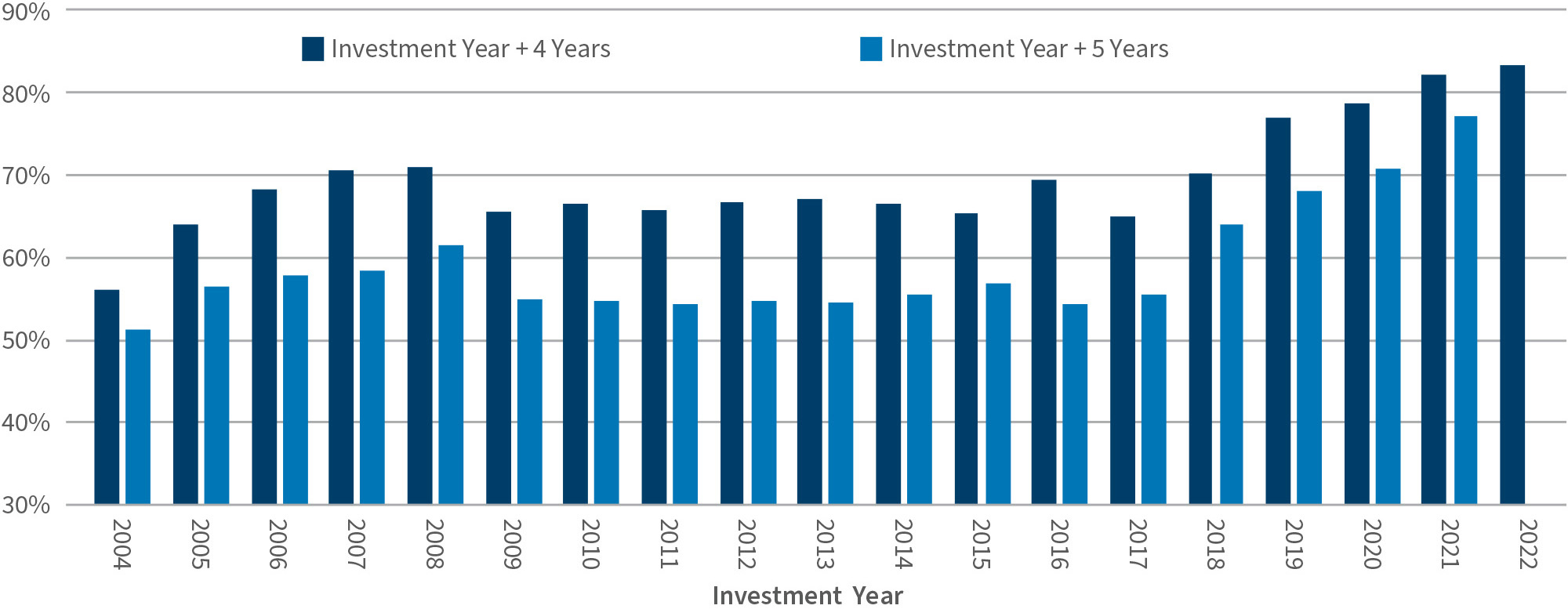
U.S. buyout deal data from PitchBook for sponsor-owned U.S. based companies demonstrates the exit backlog buildup in stark visual terms. For each deal investment year since 2004, we computed the percentage of deals still held by those sponsors four and five years hence (Figure 1). Those percentages were remarkably steady for deals done from 2009 through 2017. However, the percentage of deals still held by sponsors four and five years after investment (T+4 and T+5) began climbing steadily in 2018, with the cohort of buyout deals done in 2021-2022 showing the highest T+4 and T+5 investment retention rates this century,4 even higher than the 2007-2008 cohort of deals done right before the global financial crisis hit. Not surprisingly, large U.S. buyout deals completed in 2019-2022 were done at record-high purchase price multiples of nearly 13X EBITDA, according to LSEG LPC, compared to a range of 9x-11x EBITDA for large buyout deals done from 2007-2018.5
Overall, the average T+4 and T+5 investment retention rates for deals done in 2018-2022 are running approximately 1300-1500 bps above their comparable averages for the period from 2009-2017. This translates into approximately 1,400 investments from that period still held by sponsors above and beyond what would have been held had average pre-2018 retention rates (T+4 and T+5) prevailed for those deal totals, or nearly 11% of the total inventory of 13,500 U.S. based sponsor-owned companies tallied by PitchBook. This estimate of the excess exit backlog is not alarmingly large but certainly is attention-getting and will continue to be a prominent conversation topic in private equity circles until it is whittled down.
Figure 1 - Pct. of Buyouts Held by Sponsors: 4-Years and 5-Years After Investment Year
Novel developments in the PE industry in recent years reflect efforts by sponsors to return capital to investors without having to exit mature investments made at peak market values. These include a growing secondary market for purchasing limited partner units at a discount, stepped up dividend distributions to investors via new borrowings, continuation vehicles from sponsors and more bolt-on acquisitions to platform deals in order to squeeze out additional efficiencies that can create value.
These efforts can provide liquidity to anxious investors in a circuitous way, but this invites the obvious question: Why don’t sponsors just sell these mature investments to provide a return of capital? The answer is a bit oblique. While it is likely that very few of these ripe deals are “losers” in the literal sense of the word, they also might not be the winners they were expected to be from an IRR perspective. Monetizing such deals via a sale transaction at current market multiples would reveal these shortfalls and foreclose any chance of capturing more value should market conditions later become more favorable. In these instances, sponsors might be postponing investment sales that would dent a fund’s projected or expected IRR in hopes that market conditions will improve. Arguably, this is a risky strategy for older deals done at high valuations. Holding out for more value eventually, either through improved operating performance or better deal market metrics, might produce a better cash-on-cash return but still not improve IRR, which is time dependent. It is a calculated gamble. Sponsors surely know how this works, and some are choosing to roll the dice.
Moreover, the realization of less than expected IRRs upon a deal sale could alienate investors and damage a sponsor’s new fund-raising efforts, which are critical to its perpetuity. This harsh reality factors into sponsors’ decision-making as well. Mr. Kleinman alluded to a possible shakeout in private equity among smaller sponsors once the exit backlog is worked down sufficiently and IRR reality sets in from the 2019-2022 deals.
Lastly, market conditions for deal exits likely won’t improve near-term, as leverage loan spreads already are near record lows, base interest rates are unlikely to move lower given heightened inflation concerns and impending mega-sized IPOs for AI-related companies might suck up too much investment capital from the IPO market for middle market companies hoping for a public market exit.
Sometimes, Timing Is Everything
Much has been written in academic circles about M&A transactions often failing to achieve projected synergies and meeting EBITDA targets anticipated at deal closing, thereby falling short on value creation expectations,6 but there is less research on the impact of badly timed transactions on investment returns. There is an old investing maxim that it is difficult to generate a high IRR on a badly timed purchase. Stated in more pedestrian terms—sometimes, timing is everything, though not quite. Deals made at the top of an investment cycle when money is cheap, business forecasts are rosy and purchase price multiples are high, more often fail to live up to those lofty expectations. From an IRR perspective, it is difficult for an investment return to overcome the impediment of bad timing when making a deal. In these instances, optimistic operating projections may not materialize as modeled, leverage and purchase price market multiples may contract compared to deal closing, or worse, both can happen.
Some PE sponsors are confronting difficult choices with respect to monetizing older deals, especially the 2020-2022 cohort. Forgive the terribly mixed metaphors, but often these choices boil down to biting the bullet or kicking the can down the road. Simply put, it is likely one or the other for this particular deal cohort. For those sponsored companies in the latter category, it is imperative to evaluate legitimate opportunities objectively to implement changes that can create genuine value without diminishing the long-term health of the enterprise, that is, to avoid the temptation to cut too deeply, throttle capital investment or overburden workers and systems for the sake of boosting near-term results, and to be realistic about efficiency or growth opportunities for an investment that has been long held and assumedly has had ample time to make such changes.
Footnotes:
1: Private Equity Urged to “Capitulate” to Clear Buyout Backlog, Dani Burger, Jan-Henrik Forster and Leonard Kehnscherper, Bloomberg, June 10, 2026.
2: Ibid.
3: Apollo’s Kleinman Says Private Equity Lost Its Way on Deals, Neil Callanan and Dani Burger, Bloomberg TV, June 10, 2026.
4: Note that there is only a T+4 measure for the 2022 investment cohort, with 2026 exit activity estimated from annualized exits to date in 1H26. Similarly, the T+5 measure for the 2021 cohort is also estimated from annualized exits to date in 1H26.
5: LSEG LPC’s Leveraged Loan Monthly, December 2025, LSEG Data & Analytics, January 15, 2026.
6: EBITDA Addback Study Shows Increased Debt Projection and Leverage Misses, S&P Global Ratings, February 25, 2026.
The views expressed herein are those of the author(s) and not necessarily the views of FTI Consulting, Inc., its management, its subsidiaries, its affiliates, or its other professionals.
Related Insights
Related Information
Published
August 12, 2026
 Key Contacts
Global Chairman of Corporate Finance