AI Implementation Across Search Has Entered the Mainstream and Is Redefining Information Discovery
Insights From FTI Consulting’s 2025 Consumer Insights Survey
-
23. Feb 2026
Herunterladen Download Report
-

For most of recent history, digital search has followed a similar pattern: users entered keywords, reviewed links and pieced together information on their own.
Recently, that behavior has been undergoing a tectonic shift. Once dominated by large, keyword-based search engines, the discovery landscape has been transformed by social media platforms and AI-driven systems that change how consumers interact with online information.
Even before AI-native search emerged, traditional search engines faced mounting pressure from social and video sharing platforms which offered faster, community-driven answers in easily consumable and multimodal formats (most notably video). These platforms changed how users search for and engage with information, reshaping the digital discovery lifecycle and paving the way for further evolution.
The introduction of large language models (“LLMs”) and other AI forms such as text to speech and image/video generation, marked a second and more significant inflection point in the brief history of digital search journey. In the early 2020s, AI-driven systems began enabling a new search pattern, one that synthesizes, contextualizes and delivers tailored and conversational-style information from across the web.
On one hand, it gave rise to AI-native search platforms which place LLMs at the core of the discovery experience, offering users a direct and conversational interface. On the other hand, LLM capabilities are being rapidly incorporated into the broader search ecosystem. Existing platforms have begun embedding AI directly into existing workflows, from AI overviews showing in search engine results to social platforms experimenting with AI-assisted discovery and publishers integrating LLMs into internal website search and content navigation.
These shifts across the search landscape are replacing the legacy “DIY” information-discovery model where users navigate fragmented sources and synthesize information themselves. The rise of AI capabilities reshapes the search and discovery process by:
- Combining info from multiple inputs, reducing the need to click through to sources.
- Adding conversational capabilities that allow for nuanced and customized answers.
- Enabling enhanced multimodal user inputs and platform outputs across audio, image and video, shifting search from simple text-based responses to easily consumable formats.1 For example, recently released image generators can include real-time information from the web, including weather reports, changing how sources are included and referenced within responses.2
- Providing agentic capabilities that support users in taking action on their searches, such as enabling direct add-to-cart, purchasing, dinner reservations and calendar scheduling.
The advancement of these capabilities fundamentally changes how information flows throughout the internet and in effect how businesses are referenced and discovered.
As AI reshapes the discovery landscape, companies must rethink their online positioning and how they are represented within AI-mediated experiences. To do so, it is important to analyze how AI is actually being used and thought about by consumers to understand how the landscape will evolve. FTI Consulting’s 2025 Consumer Insights survey provides key insights into usage dynamics and sentiment towards AI-enabled search, which can guide companies on key factors that will shape the future of search.
How Consumers Use AI Search
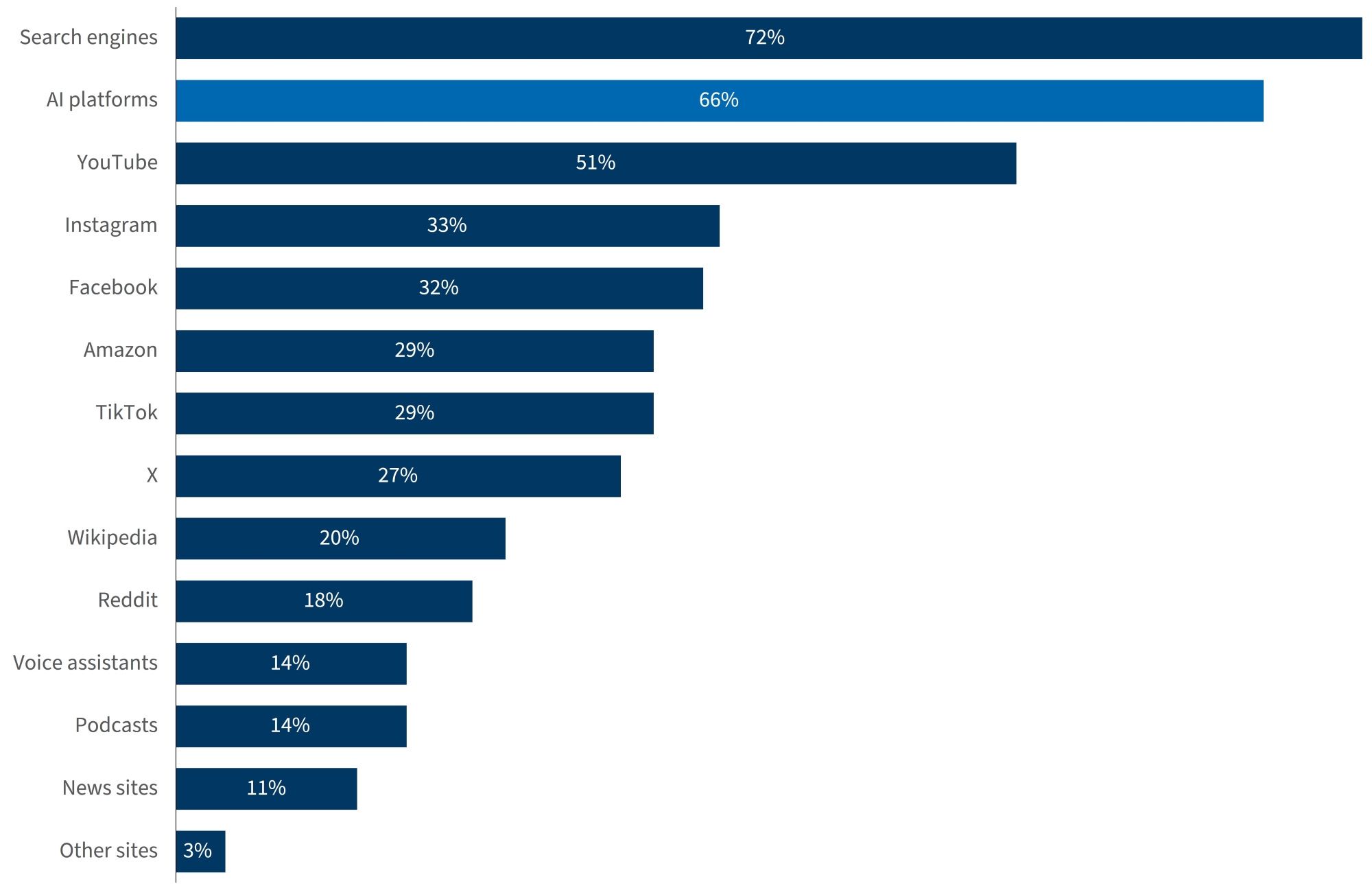
Consumer data confirms that AI search has rapidly evolved from an emerging behavior into a mainstream discovery pathway. Our Consumer Insights survey indicates that AI platforms are now used by a substantial share of consumers to find information, trailing traditional search engines only slightly. AI-driven discovery also extends beyond these AI platforms and is embedded across nearly all other platforms including Google, YouTube and Instagram. Notably, YouTube is the third most used platform for finding information, which shows the appetite for video based, multimodal search responses — an important trend to note as AI video search capabilities develop.
Platforms Used for Finding Information1
Gen AI users who find established new partnerships important. N=465
Source: FTI Consulting’s 2025 Consumer Insights Survey
Survey question: Which of the following platforms do you use when searching for information on specific topics (e.g., when you want to learn or seek knowledge about something new)?
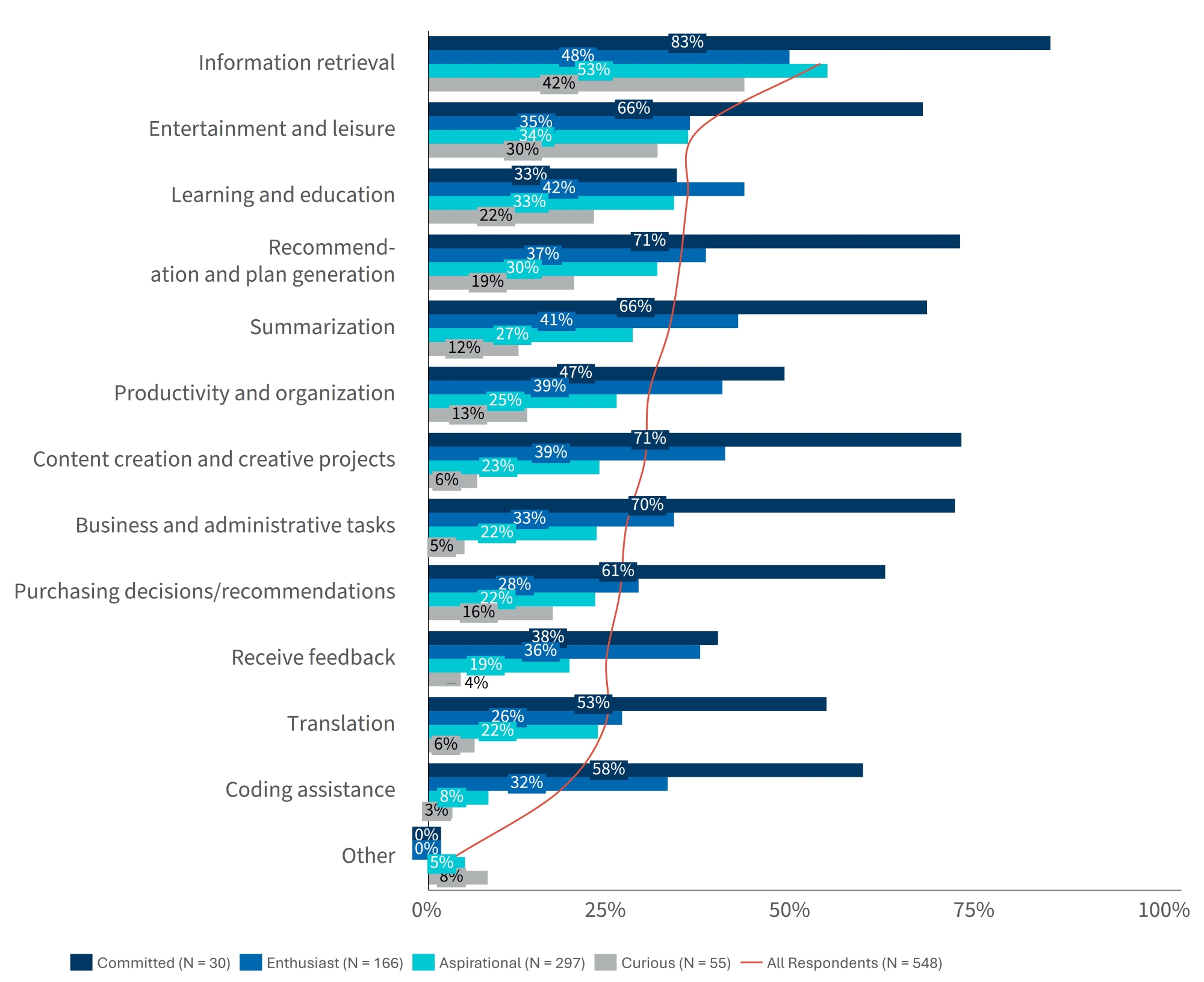
Consumers use AI search across the full spectrum of discovery — ranging from information retrieval and learning to entertainment and leisure, planning, summarization, productivity support and purchasing decisions.
Main Purposes for Using Generative AI Search Tools1
Respondents made use of an AI search tool in the last 12 months. N=548
Source: FTI Consulting’s 2025 Consumer Insights Survey
Survey question: Which of the following purposes do you currently use generative AI search tools for?
Unlike platform-specific alternatives, AI search works horizontally across the search and discovery journey, collapsing specialized features into centralized conversational interfaces that can handle many search types.
Taken together, these patterns indicate that discovery is increasingly shaped by relevance and search intent rather than channel dominance. AI search approaches parity with traditional search by synthesizing and contextualizing information across multiple use cases. As a result, visibility is increasingly based on how effectively information can be interpreted and surfaced within unimodal and multi-modal AI-mediated environments.
Consumer Sentiment – Desire for Reliability
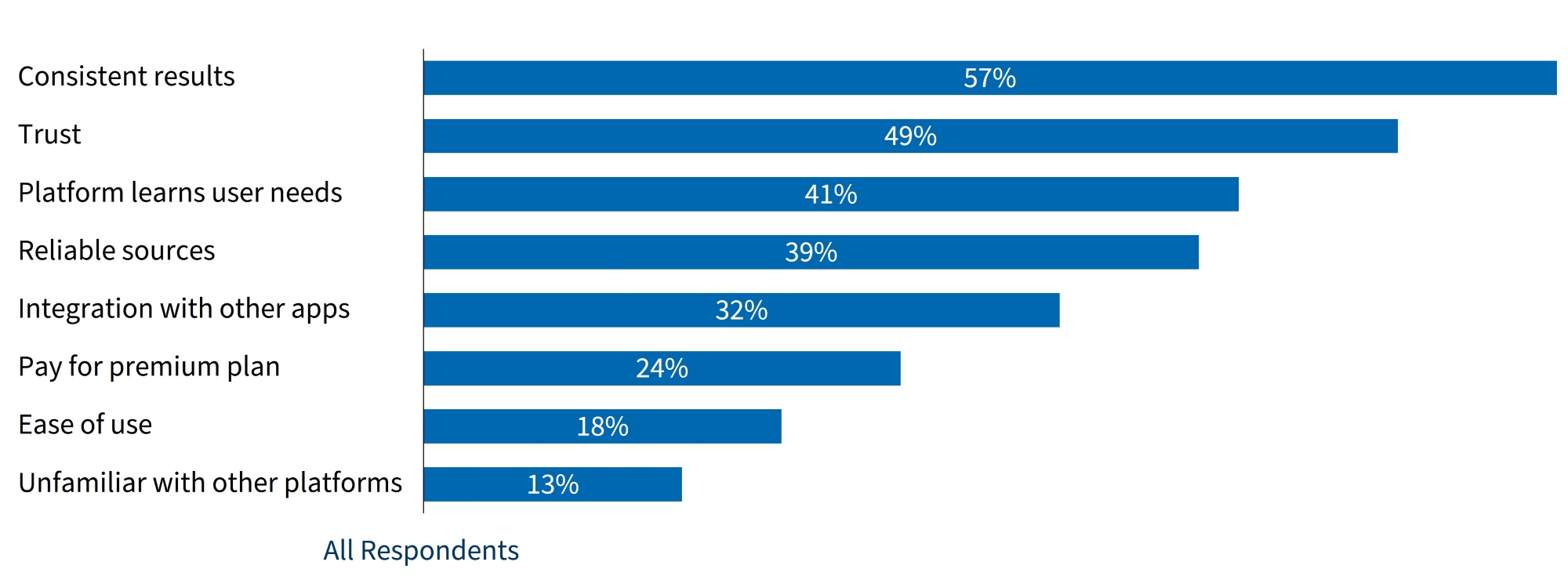
While AI search is now widely used, consumers exhibit varied behaviors in how they interpret, trust and act on responses. Given that AI search results abstract the source from the output, users must decide whether to trust responses without visibility into all the source material. This aggregation of information introduces a new dynamic wherein some users may never visit the source, leaving the synthesized search response to become their ‘source of truth,’ which requires strong trust. As a result of this abstraction of information, sources have a lack of control over how the synthesized answers are aggregated. They may be unintentionally worded in a way that may be misleading or even experience “hallucinations” wherein the information provided is incorrect. Our Consumer Insights survey data confirms that AI search users highly value consistent results, trust and source authority in AI-mediated discovery when choosing their preferred platform.
Reasons for Using Primary Platform1
Gen AI users with a primary platform. N=3072
Source: FTI Consulting’s 2025 Consumer Insights Survey
Survey questions: 1) What are the main reasons you primarily use a single AI search platform instead of switching between multiple? 2) Excludes 2 respondents who indicated their primary AI search platform as “Other”
Our Consumer Insights survey reveals that 90% of users place importance on partnerships with legitimate sources. As such, search platforms are incentivized to work with sources to ensure the most accurate and up to date information. This user preference reinforces the importance of recognizable and trustworthy brands, institutional authority and reputable partnerships within AI search models. For IP owners, this dynamic reinforces the value of trusted primary content. As AI platforms continue to become discovery gateways, authoritative sources retain leverage as the point of verification, context and depth. This creates an opportunity to monetize credibility and highlights the value of partnering with platforms to ensure key company or brand information is properly referenced in search.
Consumer Sentiment – Click Through Is Present but Not Ubiquitous
By decoupling answers from sources, AI search changes user interaction so that clicks occur through the AI output rather than directly on the source.
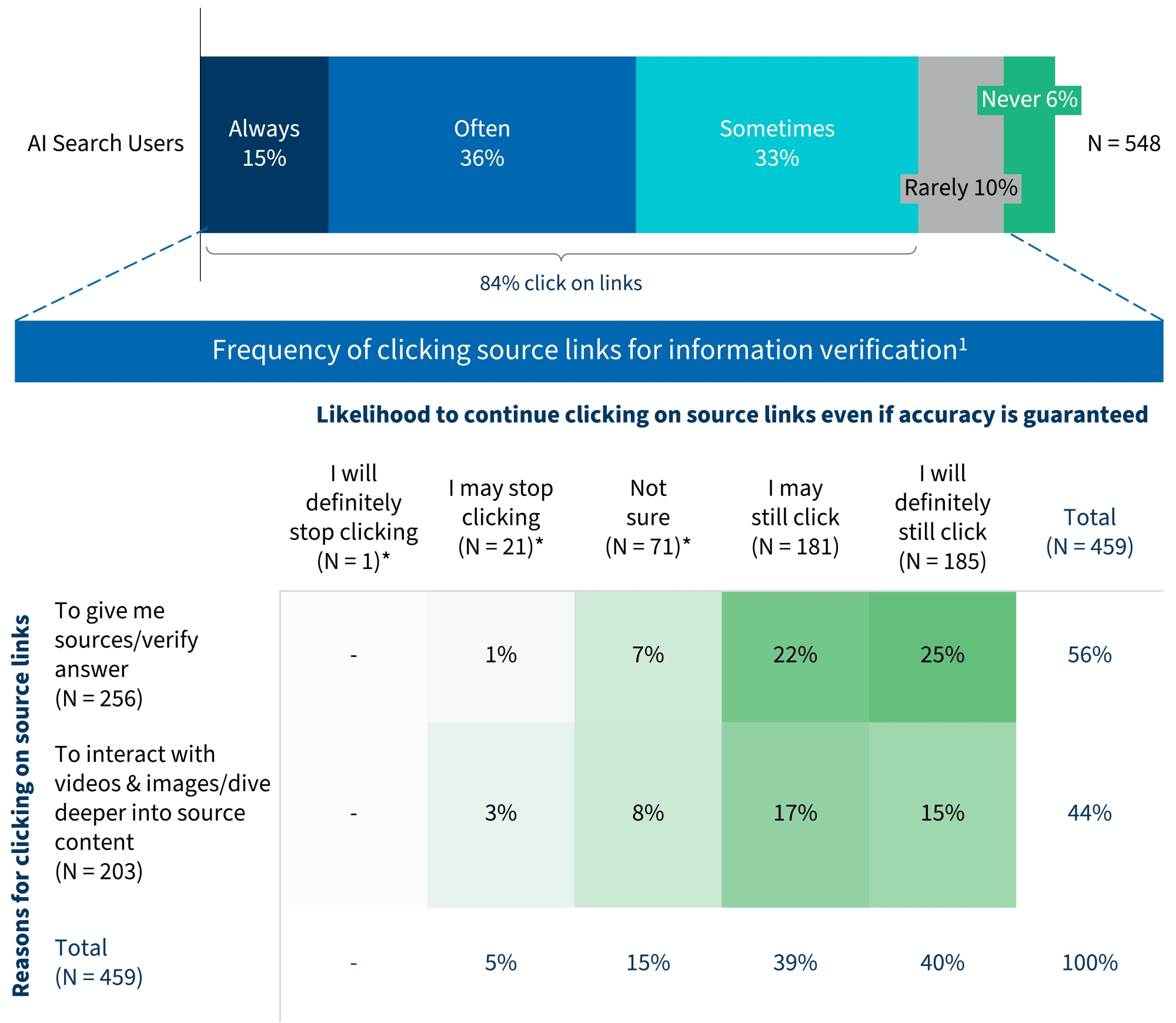
Despite the reduced need to visit sources, due to the early stage of AI development and the remaining lack of trust in responses, a material share of users still click through to source links to validate information, particularly for complex or high-stakes topics. Our Consumer Insights survey reveals that 50% of all generative AI search users still frequently click source links to verify answers and engage more deeply with content. Even in scenarios where the AI response is guaranteed to be correct, 57% of those users report they would “definitely” still click links to validate the information and examine original sources.
Frequency of Clicking Source Links for Information Verification1
Source: FTI Consulting’s 2025 Consumer Insights Survey
Survey questions: 1) When AI search platforms provide links to the sources of their answers, how often do you click on the links to verify the information? 2) Q: How likely are you to continue clicking on the source links on AI platforms if the AI platforms can guarantee you that the answer is correct and contains no errors? 3) What is the primary reason for clicking on the source link(s) provided by the AI search platforms
However, this verification behavior occurs at a much lower rate than in traditional search, where accessing answers typically requires clicking through. Given this dynamic, companies must acknowledge that consumers increasingly receive relevant key info from aggregated answers as opposed to visiting their primary sources.
Even more, over time clickthrough is likely to decrease even further because of two primary factors:
- AI search will inevitably improve in terms of accuracy and reliability as models improve and more trusted partnerships are made. Also, claims by major AI companies about artificial intelligence that will equal or exceed human cognition (artificial general intelligence (“AGI”)), although still speculative, have the potential to completely redefine the capabilities and quality of AI responses.
- On top of this, multimodal capabilities are being developed that lay the groundwork for a future of search where responses can instead be delivered in audio, image and most notably video form. AI models such as Google’s image generator ‘Nano Banana’ can include real-time information from the web into generated images, acting as a unique search methodology.3 Image based responses will entirely shift how sources are cited. In the future, these capabilities will likely be integrated into AI video models, wherein videos that can be distributed around the internet will be based on web content.
As these developments occur, the need and ability for external verification is expected to decline. Richer outputs, including audio and visual explanations as well as generated summaries, reduce both the necessity and the natural opportunities for users to navigate away from AI interfaces.
Without guaranteed click-through to owned sites, companies must take steps to ensure AI responses reflect their brand accurately, convey positive sentiment and provide correct and up-to-date information.
Business Implications – Capturing Value in a Zero-Click Search Environment
To capture value in an AI-mediated search ecosystem, businesses and intellectual property owners must shift from passive content distribution to active participation in AI discovery frameworks. Participation opportunities extend beyond traditional traffic capture to include direct content licensing agreements with AI platforms, preferred-source partnerships and premium data or content integrations designed to support AI training and inference workflows. These mechanisms allow trusted content providers to move upstream in the value chain, positioning their content as a foundational input rather than a downstream traffic beneficiary.
Competitive differentiation will hinge on executional discipline: ensuring content is technically optimized, consistently attributed, aligned with how AI systems evaluate credibility and partnered with leading AI platforms to avoid content disruption, allowing brands to retain influence both in zero-click environments and at moments when users choose to engage more deeply.
Organizations that act now to strengthen digital credibility and align content visibility strategies with AI discovery mechanics will be best positioned to capture value as the next wave of information discovery unfolds.
What’s Next
As AI systems increasingly mediate discovery, companies must adapt from optimizing for clicks to optimizing for representation, trust and action within AI-driven journeys. Three priorities define an effective response:
Rearchitect digital presence for AI-mediated discovery
Websites are becoming the primary inputs for AI systems. Companies should ensure their digital presence is structured so AI platforms and their crawlers can accurately interpret, synthesize and reference their information, with the key objective for businesses being maintaining visibility and accuracy in zero- and low-click discovery environments.
Key Actions:
- Structure content for machine readability, leveraging AI search optimization (“AISO”)
- Ensure consistency across pages to avoid conflicting signals
- Separate foundational “answerable” content from high-value experiences
- Design content to perform both with and without a click, maintaining brand presence in AI-generated summaries
Deploy AI agents to support discovery, decision and action
As AI increasingly mediates how users search and make decisions, companies must meet users where decisions increasingly happen, which is inside AI-assisted workflows. As AI agents that can act on requests (e.g., purchase items or book flights) become even more capable, coupled with the use of conversational AI interfaces, agent-to-agent discovery wherein AI assistants retrieve information directly from and interact with brand systems will become even more prominent.
Key Actions:
- Develop AI agents that can answer brand- and product-specific questions accurately
- Enable agents to guide users from inquiry to actions such as booking, purchasing and onboarding
- Integrate agents across owned channels
- Use agents to maintain consistency for messaging, pricing and policy explanations
Establish strategic partnerships with AI platforms
In an AI-driven discovery ecosystem, companies need to ensure response presence, and some companies with trusted data and authoritative content can monetize their assets. Companies should proactively define how their information is accessed and represented. Inaction in this area may result in disruption of discoverability and a potential loss of revenue.
Key actions:
- Identify and quantify the value of proprietary data and content
- Define partnership structures that balance reach with control, such as licensing and preferred-source agreements
- Establish controls over brand representation and attribution
- Implement governance to ensure information remains accurate, current and compliant as models update
AI search is no longer a future consideration. It is reshaping digital discovery more with every query. Companies positioned to capture this structural tailwind will treat their websites as machine-readable knowledge bases, deploy AI agents to guide user actions, and establish partnerships that protect and monetize their most trusted information. Those that do not do so risk losing relevance as visibility and influence shift elsewhere.
Except as specifically noted above, the information set forth in these materials was derived from a series of interviews with industry experts conducted between January 8 and January 9, 2025 and from FTI analysis. The information above is provided for discussion purposes only and should not be relied upon by any person for any purpose without independent verification. We expressly disclaim responsibility for any such reliance. Nothing contained herein should be construed as financial or investment advice of any kind.
Footnotes:
1: “Introducing next-generation audio models in the AP,” OpenAI (March 20, 2025).
2: Naina Raisinghani, “Introducing Nano Banana Pro,” Google (November 20, 2025).
3: Ibid.
Related Information
Datum
23. Feb 2026
 Ansprechpartner
Managing Director