

Recalibrating Sustainability
How Food and Agriculture Companies Are Adjusting Environmental Goals
-
03. Dez 2025
-

Over the past decade, the dialogue surrounding food and agribusiness has evolved considerably, especially in the realm of sustainability. While it has been generally accepted that a sustainable approach is critical for securing the future of the food and agribusiness value chain, the sector now grapples with ambiguous definitions of the term ‘sustainability,’ which has led to often unclear and sometimes unrealistic expectations.
Exploring the Evolving Role of Sustainability Amid the Competing Tensions Shaping Food and Agribusiness1
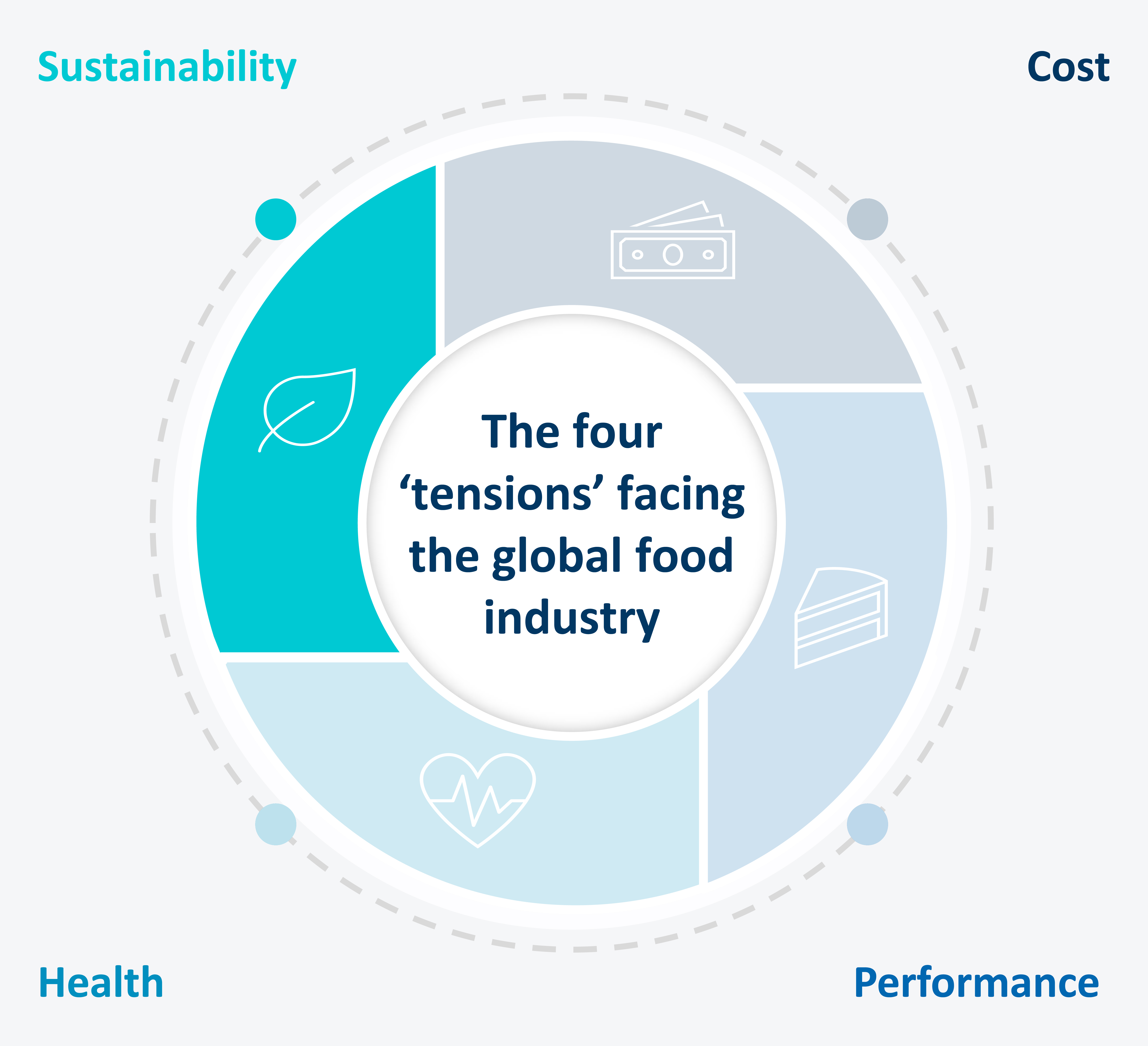
The term ‘sustainability’ was initially defined by the United Nations Brundtland Commission as “meet[ing] the needs of the present without compromising the ability of future generations to meet their own needs.”2 This was refined into the “Triple Bottom Line” of Environmental, Social and Economic sustainability.3
Recent years have shifted focus away from the Triple Bottom Line in favor of a focus on Environmental, Social and Governance (“ESG”). This has led to an implicit de-prioritization of the last ‘E’ of sustainability – Economic. The Triple Bottom Line framework made clear that for any lasting impact to be achieved across environmental or social dimensions, there had to be an economic/business case for each change. Otherwise, true achievement of those aspirations is not attainable in the long term.
Over the past decade, many food and agriculture companies made bold environmental pledges — net-zero by mid-century, regenerative agriculture, plastic reduction — to meet rising expectations. But the tide is turning. Companies are now revising timelines, softening targets or rebranding commitments as aspirational.4
Broader Trends in Climate Reporting Across Sectors
The shift in food and agriculture reflects broader ESG recalibration across sectors.5 Many companies have revised, delayed or softened their targets — sometimes without achieving them — prompting criticism of “green rinsing.” In some cases, targets have been made less specific or dropped altogether. Some argue that making targets more realistic, aligned with science and business reality, improves credibility — while others say the constant “resetting” erodes trust and accountability.6
Disclosure patterns echo this trend. While most industries have held steady, new climate reporting has declined in Food, Beverage & Agriculture and Fossil Fuels — two of the sectors most exposed to climate scrutiny.7 This trend is not unexpected: both are structurally hard to decarbonize, making accurate Scope 3 data collection and mitigation road‑mapping especially complex.8
Number of Climate Related Disclosures (2023 – 2024)
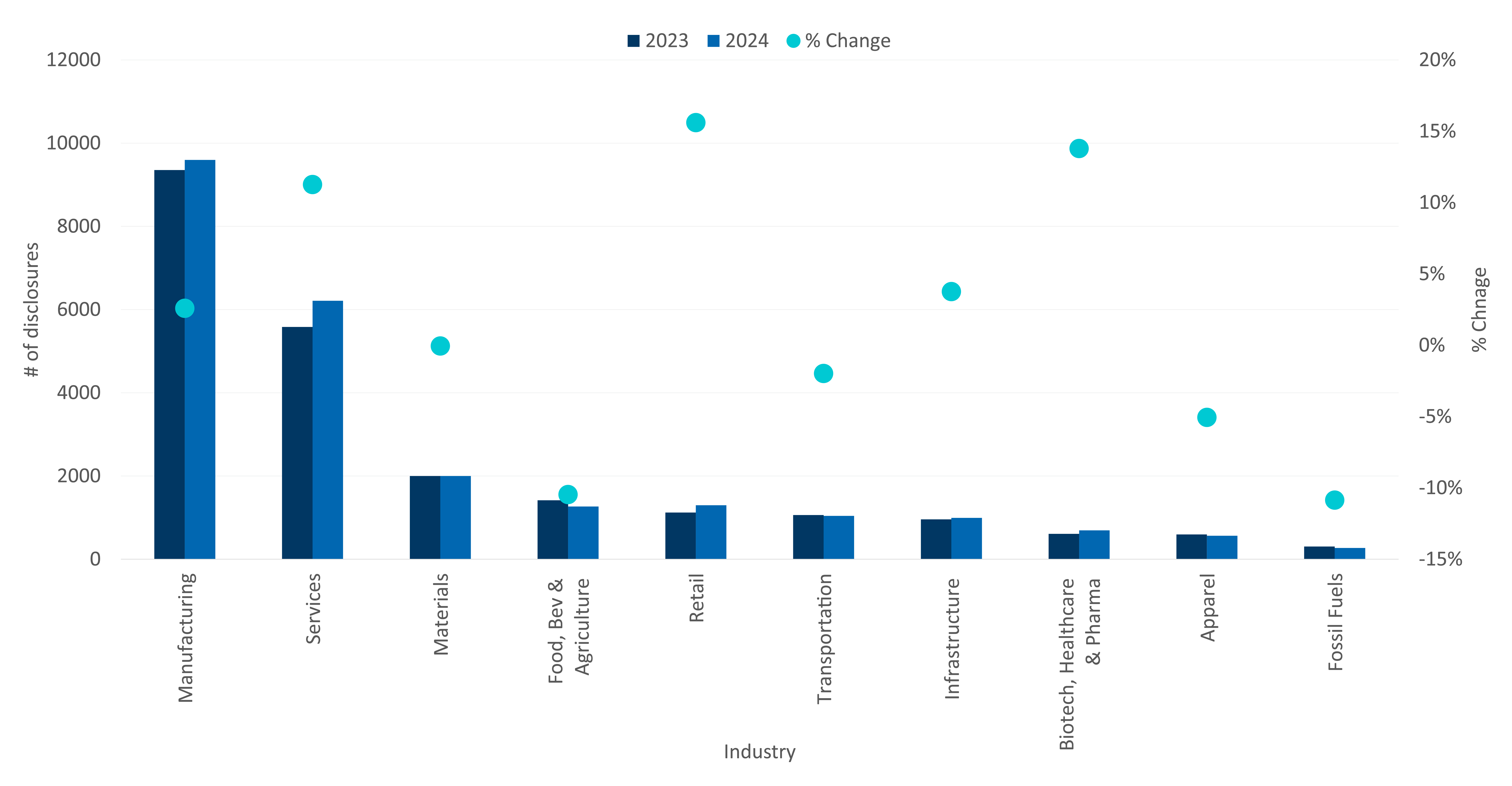
Source: CDP: Charting the Change: Disclosure Data Dashboard9
Still, disclosure requirements themselves are not receding. Global frameworks such as those issued by the Task Force on Climate-Related Financial Disclosures (“TCFD”) and the International Sustainability Standards Board (“ISSB”), as well as the European Union’s Corporate Sustainability Reporting Directive (“CSRD”) are raising the bar for transparency and comparability.10,11 While federal ESG regulations in the United States are unlikely in the near term, state-level requirements continue to expand around climate-related disclosures and Extended Producer Responsibility requirements. California’s climate disclosure laws will soon mandate detailed emissions and climate risk reporting for thousands of companies, regardless of where they are headquartered, and New York’s pension fund investment requirements and various state-level environmental regulations create compliance obligations that affect companies nationwide.12,13
The result is a global shift: even as voluntary reporting in difficult sectors tapers, regulatory-driven disclosure is accelerating — cementing a transition from storytelling to verifiable, finance-linked performance.
Why This Matters:
Inaction is no longer an option. Executives must prepare for rising regulatory scrutiny and stakeholder expectations. Staying ahead means building systems that enable transparent, verifiable ESG performance — especially for resource-intensive industries like food and agriculture.
What’s Driving the Retreat from Sustainability Goals
The retreat from sustainability goals stems from the realization that environmental goals must be financially viable. Many companies overcommitted during a period of low capital costs and ESG enthusiasm. Now, with rising inflation, higher input costs and unstable supply chains, sustainable solutions often carry a steep price tag.
Compounding this challenge, a recent Oxford study published in Science found that of more than 1,500 global climate policies, only 63 demonstrated a measurable impact on mitigating climate change. This underscores not only the notable economic costs of pursuing ambitious sustainability programs but also the uncertainty of realizing clear benefits.14
As a result, many companies are being forced to prioritize near-term financial performance over long-term sustainability commitments. At the same time, there is a growing risk that costly regulatory requirements — particularly in Europe — could face future erosion if compliance costs continue to outpace demonstrable benefits. In fact, some of these requirements are increasingly being characterized as non-tariff trade barriers, raising the possibility that they may come under pressure in dynamic U.S. trade negotiations.15
Adding to the complexity are structural challenges like:
- Decarbonizing and enhancing water stewardship in food and agriculture presents unique challenges given the sector’s reliance on resource-intensive practices, complex global supply chains and significant water needs, often in regions where availability is limited
- The cost and difficulty of tracking Scope 3 emissions, which rely on data from thousands of independent growers and suppliers
- Political and legal risks, especially in the U.S., where ESG strategies are increasingly scrutinized and challenged by lawmakers
- Consumer resistance to paying a premium for sustainable products, which limits companies’ ability to pass through higher costs
In this environment, the trade-offs between sustainability and profitability are more visible and more consequential than ever.
Why This Matters:
Food and agriculture companies must right-size their ESG ambitions — not to do less, but to ensure long-term impact. Reframing sustainability goals around what’s operationally feasible and financially supportable is essential to avoid backlash and policy uncertainty.
ESG Must Be Grounded in Economic Reality
What’s becoming clear is that ESG efforts must be rooted in business fundamentals. Companies that promised sweeping transformation without a clear financial or operational path are now under pressure to refocus.
Common strategic responses include:
- Extending timelines or reframing targets as “aspirational”
- Narrowing the focus from global supply chains to internal operations where they have direct control
- Reducing the prominence of ESG communications that are not directly tied to core business outcomes
These are not necessarily signs of failure, but rather evidence of ESG maturity — shifting from high-level aspiration to pragmatic integration with operational planning.
Why This Matters:
ESG goals disconnected from economic realities are unsustainable. Investors, boards and customers now expect ESG to deliver tangible value — whether through cost reduction, resilience or risk management. For food and agriculture leaders, success lies in embedding sustainability where it can be measured, managed and monetized.
The Future: Pragmatic and Profitable Sustainability
There are reputational and operational risks in walking back environmental goals. However, this moment is also revealing that: companies that have integrated ESG with business strategy are moving forward; others are exposed as overpromised.
Looking ahead, the focus must shift to:
- Transparent, achievable goal-setting
- Linking sustainability efforts to business performance
- Grounding roadmaps in science, execution capability and financial logic
This is a return to the original Triple Bottom Line — environmental and social progress underpinned by economic viability. The path forward lies in re-introducing the “lost E” into the ESG equation: explicitly incorporating economic realities and trade-offs as the foundation for durable sustainability.
Why This Matters:
The next phase of sustainability isn’t about who sets the boldest goals, but who delivers measurable results while still generating profit. For food and agriculture firms — where climate exposure, resource volatility and consumer trust are existential — building ESG into long-term value creation is the path to resilience and relevance.
Footnotes:
1: “Navigating the Four Tensions Shaping the Food and Agribusiness Value Chain,” FTI Consulting, Inc. (August 18, 2025).
2: United Nations, World Commission on Environment and Development, “Report of the World Commission on Environment and Development: Our Common Future,” (1987).
3: Miller, Kelsey, “The Triple Bottom Line: What It Is & Why It’s Important,” Harvard Business School Online (December 8, 2020).
4: Burrows, David, “Tussling over targets: corporates’ ESG changes spark debate,” Just Food (January 28, 2025).
5: “Survey: 80% of Corporations Are Reworking ESG Strategies Amid Policy Shifts,” Conference Board (May 29, 2025).
6: Ibid.
7: “Charting the Change: Disclosure Data Dashboard,” CDP (2024).
8: “Scope 3 Decarbonisation: Practitioner Challenges,” VCMI (April 2025).
9: Supra Note 7.
10: “FSB reports on progress towards globally consistent and comparable climate-related disclosures,” Financial Stability Board (November 11, 2024).
11: “Progress on Corporate Climate-related Disclosures — 2024 Report,” IFRS Foundation (November 2024).
12: “California’s ESG Disclosure Rules: What You Need to Know,” EHS (April 15, 2024).
13: Wrobel, Miriam et al., “ESG Mid-Year Update: Who Still Cares, and Why You Should,” Harvard Law School Forum on Corporate Governance (July 29, 2025).
14: “Effectiveness of 1,500 global climate policies ranked for first time,” University of Oxford (August 23, 2024).
15: “Joint Statement on a United States-European Union framework on an agreement on reciprocal, fair and balanced trade,” European Commission (August 21, 2025).
Related Insights
Related Information
Datum
03. Dez 2025
 Ansprechpartner
Senior Managing Director, Global Leader of Environmental, Social and Governance (ESG) and Sustainability
Managing Director
Senior Director