Can AI Shopping Agents Reinvigorate E-Commerce Sales?
-
octubre 27, 2026
Downloads Download Report
-

Where Online Retail Growth Goes Next
U.S. e-commerce retail sales growth slowed again in 2025 to its lowest rate since the aftermath of the 2008 Global Financial Crisis, and the lowest annual growth rate this century in a non-recession/non-crisis year, with nominal online sales growth of just 5.5% last year vs. 7.6% and 8.8% in 2024 and 2023, respectively, narrowly outpacing solid store-based sales growth of 3.8% in 2025. While e-commerce sales growth rebounded in 1H26 from its 2025 lows, this is largely tied to higher fuel prices since February, which has encouraged more online shopping but won’t likely persist at its 1H26 pace when energy prices moderate.1
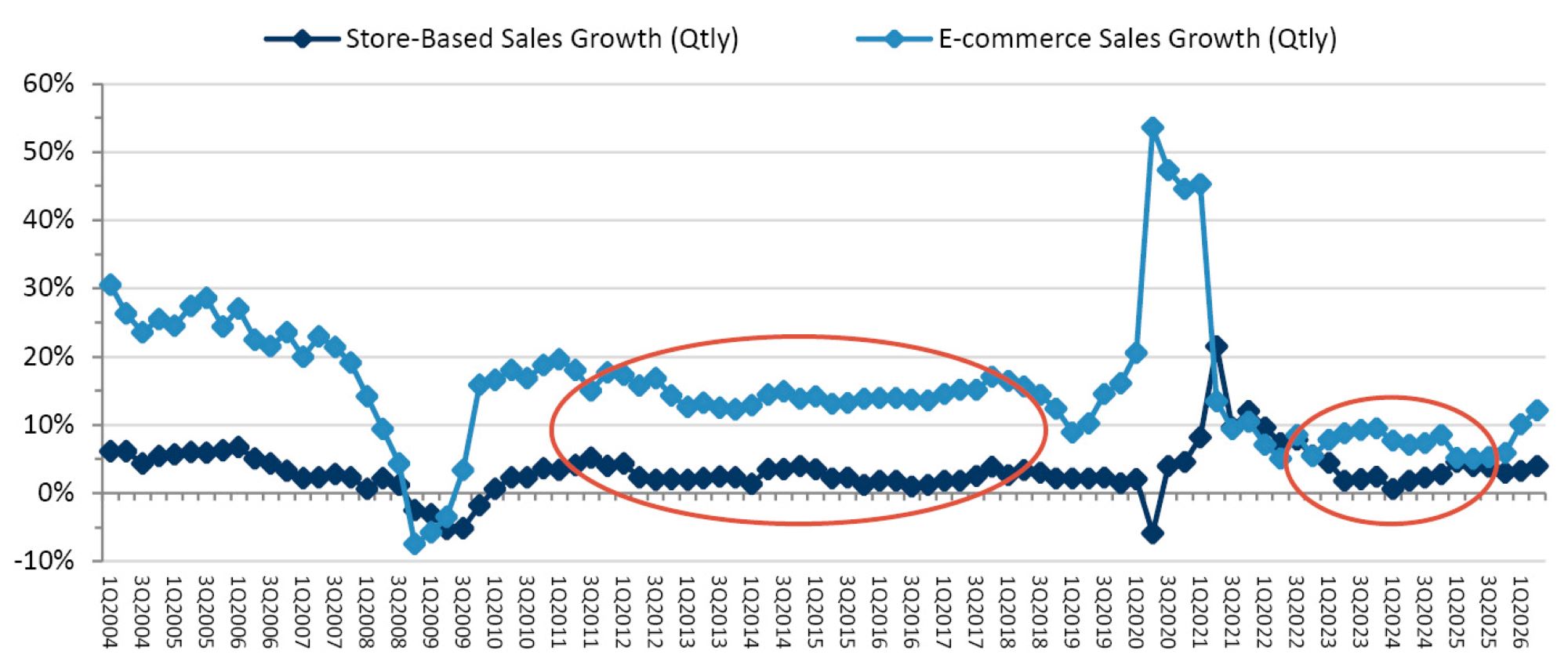
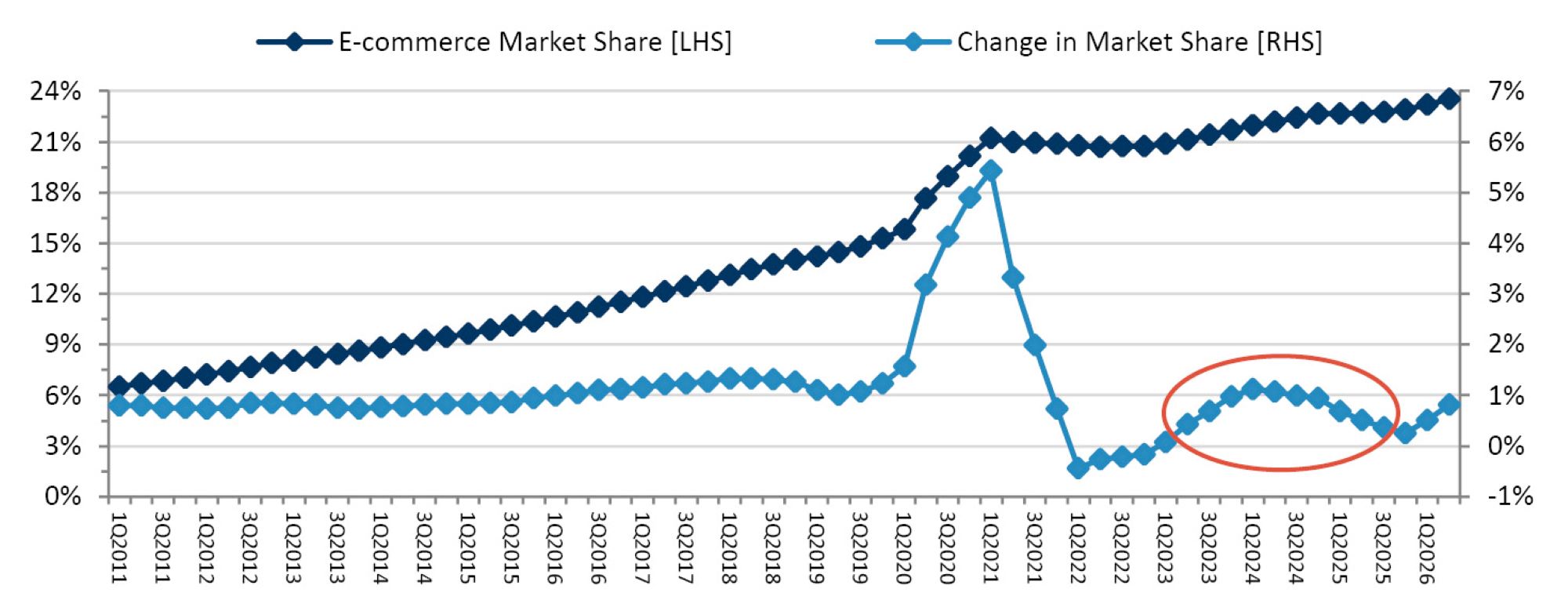
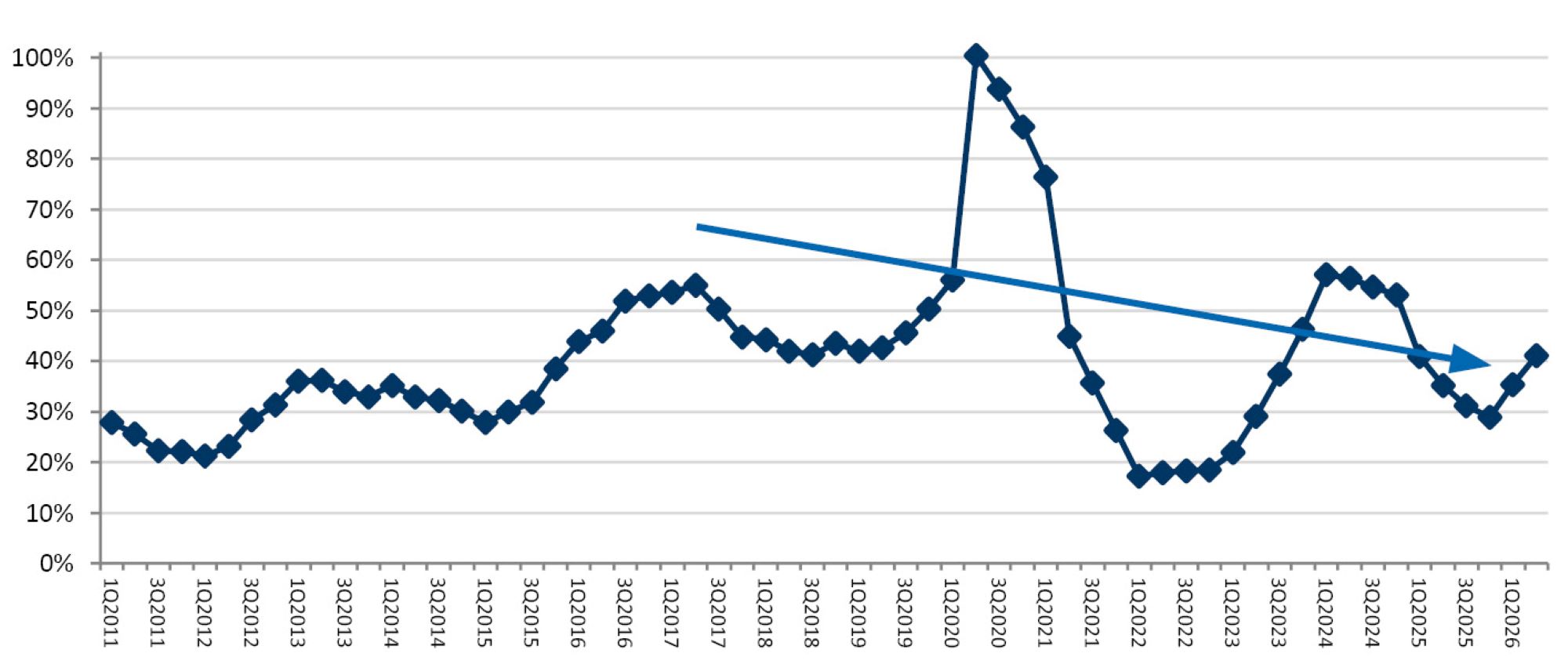
As we have written previously, slowing e-commerce sales growth is a function of the channel’s maturity and is to be expected as online market shares in several high penetration product categories approach natural ceilings. Slowing online sales growth (YoY) has been evident in the post-COVID period compared to years of consistent mid-teen rates of growth prior to the pandemic (Figure 1). Moreover, market share gains for the U.S. e-commerce channel have slowed to less than 100 bps annually and will continue to decelerate on its current trajectory. E-commerce sales accounted for a 23% share of total U.S. retail sales (excluding auto and gasoline) in 2025 (Figure 2) while annual sales growth for the online channel accounted for 30% of total retail sales growth last year, meaning that e-commerce is still punching above its weight class but not nearly as much as it used to (Figure 3). Should these extant trends continue, the online channel should reach our model forecast ceiling of a 30% market share of U.S. retail sales within a decade. Regardless of its precise growth trajectory over the next few years, the U.S. e-commerce channel appears to be approaching its early plateau stage after more than two decades of consistently stellar growth that has forever reshaped the retail landscape.
Figure 1 – Retail Sales Growth (YoY): Store-based vs. E-commerce
Source: FTI Consulting analysis using U.S. Census Bureau, Quarterly E-Commerce Report
For most of the last decade, online sales grew four times faster than store sales, at a steady low-to-mid-teens rate. Since the pandemic that growth has slowed, although 2026 shows signs of a rebound.
53% — Peak online growth, second quarter of 2020
12% vs 4% — Online vs store growth, first quarter of 2026
Figure 2 – E-Commerce Market Share of U.S. Retail Sales (LTM Basis)
Source: FTI Consulting analysis using U.S. Census Bureau, Quarterly E-Commerce Report
Market share gain improved in 1H26 but will remain below 100 bps per annum.
+0.8 pts — Yearly share gain in 2026, back on the rise
+0.8 bps — 1H26 market share gain rebounded vs. notable slowdown in 2025
Figure 3 – E-Commerce Sales Growth as a % of Total U.S. Retail Sales Growth
Source: FTI Consulting analysis using U.S. Census Bureau, Quarterly E-Commerce Report
Online makes up just under a quarter of U.S. retail sales but drove about 30% of total retail sales growth by the end of 2025. E-commerce still punches above its weight, but by much less than it used to, even with a pickup to around 40% this year.
57% — Online share of U.S. retail sales growth at its 2024 peak
30% — Online share of U.S. retail sales growth at the end of 2025
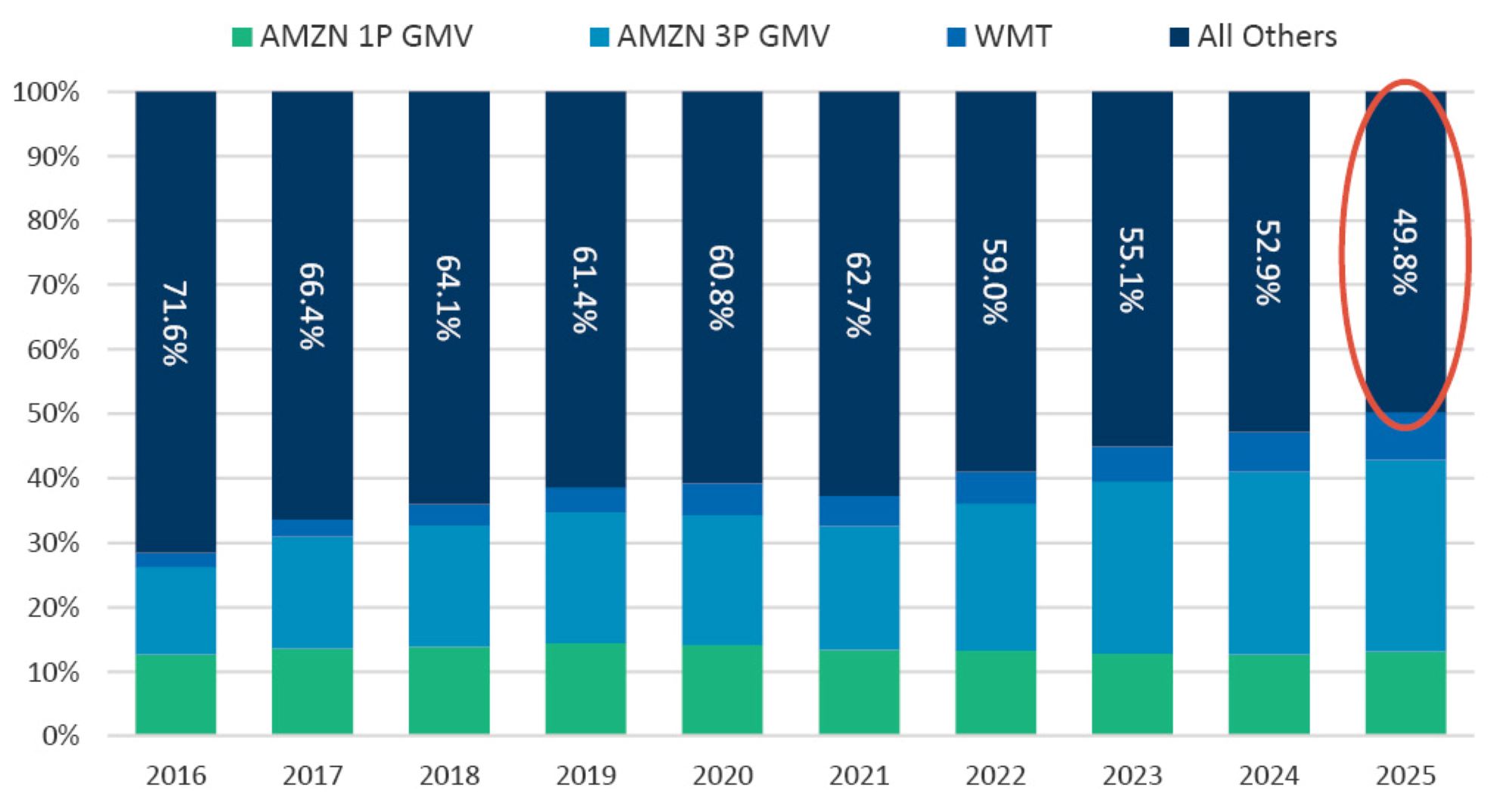
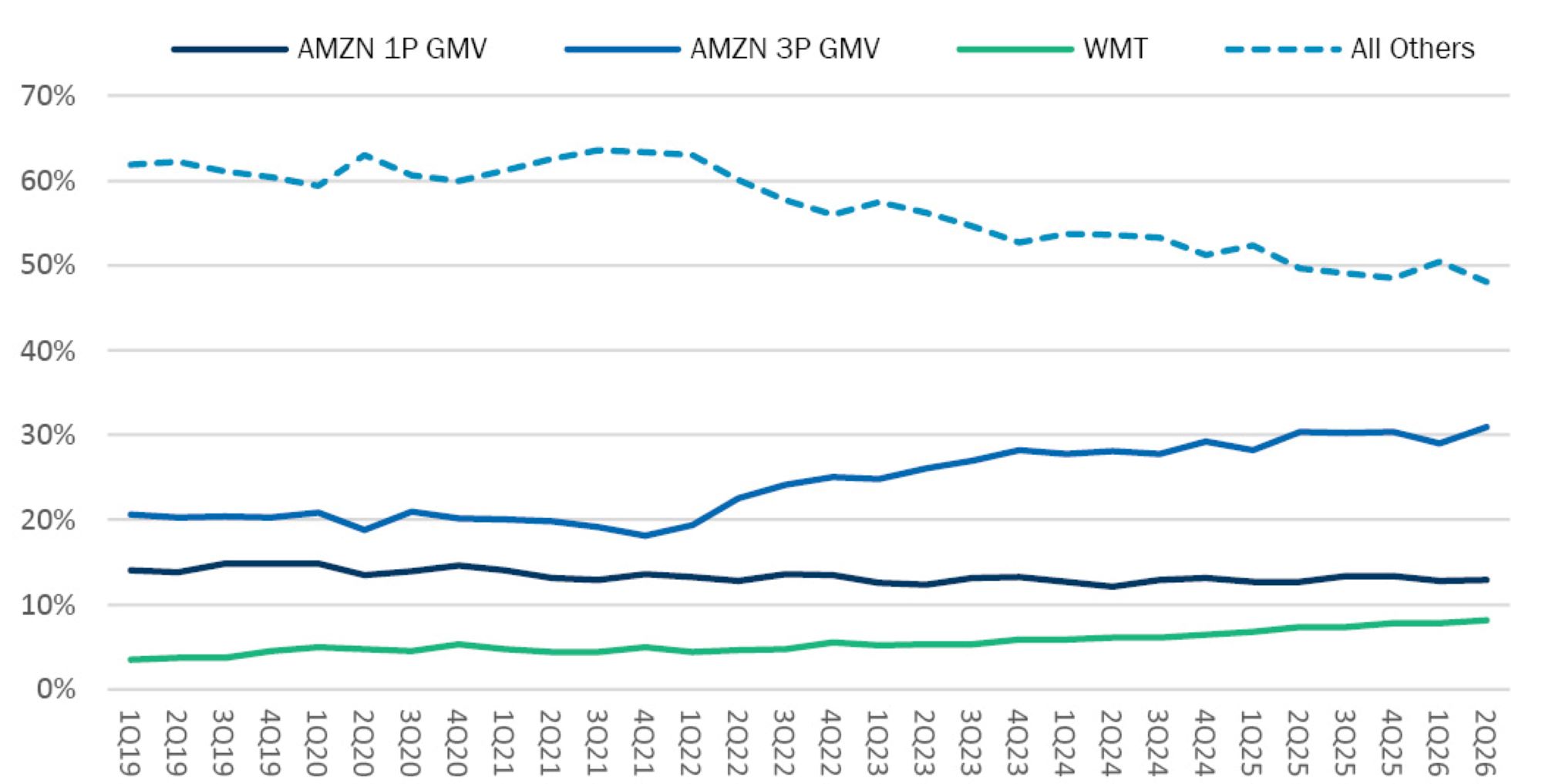
Moreover, Amazon and Walmart continue to grow their U.S. online sales at a faster rate than the overall channel, meaning that these two leaders continue to pick up market share from other e-commerce retailers and platforms. We estimate that the portion of U.S. online sales accruing to omnichannel and online-only sellers other than Amazon (1P+3P GMV) and Walmart fell below 50% in 2025 compared to 61% in 2019 (Figures 4a and 4b). This should be concerning to other e-commerce retailers who are losing online market share to the Big Two even as the overall channel still enjoys fairly healthy growth. While Amazon remains the industry’s undisputed leader, we estimate that Walmart has doubled its market share of U.S. online sales since 2019, which now tops 8.0%.
Hence, there is a three-pronged challenge for most U.S. online retailers: Total retail sales growth, though respectably positive on a nominal basis, is meager after adjusting for inflation, that is, real sales growth (YoY) is closer to nil-to-1.0%. Furthermore, overall e-commerce sales growth is in deceleration mode while Amazon and Walmart continue to take market share within the online channel. Lastly, the impending arrival of true agentic shopping capabilities (not mere shopping bot assistants) is the latest disruptor that retailers will have to navigate.
Of these challenges, the first two pressures are largely incremental and ones that retailers have navigated before; a maturing channel growing more slowly and a competitive landscape consolidating around two dominant players. Agentic shopping, that is the ability of consumers to utilize AI shopping agents to research, discover, compare and/or transact entirely within a chat function and outside of browser-based searching, however, is a different challenge as it changes not only how fast retailers grow, but also who does the shopping in the first place.
Figure 4a – Annual Estimated Share of U.S. E-commerce Sales
Source: FTI Consulting analysis using U.S. Census Bureau, Quarterly E-Commerce Report and SEC filings
For the first time, Amazon and Walmart together account for more than half of US online sales, up from under 30% in 2016. Most
of that growth has come from third-party sellers on Amazon’s marketplace.
50.2% — Amazon and Walmart’s combined share of US online sales in 2025
~30% — Share of US online sales made by third-party sellers on Amazon in 2025, up from ~13% in 2016
Figure 4b – Quarterly Estimated Share of U.S. E-commerce Sales
Source: FTI Consulting analysis using U.S. Census Bureau, Quarterly E-Commerce Report and SEC filings
Since 2022, third-party sellers on Amazon have driven most of the shift in US online sales, while Walmart has more than doubled its share. Everyone else now holds less than half the market.
31% — Share of US online sales made by third-party sellers on Amazon in 2026, up from 18% at the end of 2021
48% — Share of US online sales held by all other retailers in 2026, down from 61% in 2019
Ready or Not, the Age of Agentic Shopping Is Fast Approaching
Agentic shopping is the new frontier of e-commerce in its very early stages of rollout by some large retailers and early adoption by shoppers. It will likely take a couple of years to perfect the technology, establish working alliances between retailers and foundational large language models (LLMs), evangelize its use case and gain wider acceptance among shoppers. Many online shoppers have been using shopping assistants for a few years, mostly for product searches and discovery, but true end-to-end agentic shopping that can autonomously handle the entirety of a shopping experience, including checkout and transaction processing, and which requires minimal shopper engagement or oversight, is not here on a meaningful scale — but it’s coming soon. Though AI agents overwhelmingly are used for product research, these AI-based searches increasingly are driving a growing share of referral web traffic for large retailer with traffic from generative AI platforms to merchant sites surging 4,700% year-over-year, per FTI Consulting’s own survey research (The New Shelf Space, July 2026).2 Though beneficial, this does not represent the ultimate goal of agentic shopping, which is transaction completion.
Agentic shopping represents a potential boost to e-commerce sales, as many online shoppers increasingly will delegate more shopping tasks to AI-driven bots once sufficient trust is established, especially for routine and repeated purchases of lower cost products. As easy as it is to purchase coffee or detergent every two weeks on a retailer’s website, the ability to have such purchases made autonomously by an AI shopping agent using prompting parameters specified by the shopper (e.g., buy a 24 ounce bag of Starbucks French Roast coffee only if it is under $20) is appealing and convenient.
However, the prospect of AI agents searching and transacting for increasingly disengaged consumers could ratchet up concerns that shoppers will become detached from the shopping experience for most routine purchases, which reduces the likelihood of new product discovery and impulse buying. Furthermore, agentic shopping will not be a pie grower; it is a means by which retail sales will move further from stores to the online channel, and from web browsers to AI shopping bots. It is conceivable that agentic shopping could even slow retail sales growth to the extent that consumers entrust more of their product searches and purchasing to AI agents and browse websites less frequently.
It is not entirely clear at this point how agentic commerce will work and which models will prevail or fail. Shopping agents from the foundational LLM companies can search across the entire retail landscape to find and recommend a product but wouldn’t likely have real-time access to retailers’ prices and product availability unless such arrangements are in place with retailers. Inaccessible real-time data would impair a shopping agent’s ability to procure a product and consummate a transaction without the user’s active engagement and/or a handoff to a retailer’s website. Consequently, it is widely believed that many large retailers will partner up with foundational LLMs to facilitate agentic shopping’s full potential.
Conversely, large retailer-specific shopping agents certainly will have access to real-time product prices and availability and can more easily complete a purchase transaction autonomously, but most likely will conduct product searches only within their own retail ecosystems, which presents a drawback for shoppers looking for the best deal out there. Consumers will soon be learning how to navigate this terrain and establish their preferences.
There are other considerations as well, and retail analysts debate the extent to which agentic commerce will happen and the timing of this transition, as well as the potential for agentic shopping to disproportionately reward the large incumbents who have the infrastructure, in-house tech capabilities and budgets to support these AI-based buildouts, while harming smaller retailers who may be left further behind. Agentic commerce has the potential to further tilt the playing field in favor of the largest retailers. However, most analysts’ estimates of incremental product revenue accruing to the largest retailers from agentic shopping remain relatively modest through 2030 given the infancy of the technology and expected slow adoption of end-to-end agentic shopping initially by most consumers.
As with previous innovations in digital retail shopping, such as mobile shopping, wider adoption of agentic shopping will take time to build trust with consumers, especially around the areas of data security and autonomous purchasing by AI agents. Most shoppers will need convincing that their payment information and other sensitive personal data do not reside with or within the foundational LLMs that undergird shopping agents. We know from experience that consumers will adopt agentic shopping in different ways, and that such adoption will
“The implication from agentic shopping is not just a consumer behavior question, it is an operating model question. Replenishment, for example, will impact supply chain, margin structure and promotional calendar as machines evolve to complete the journey in real time.”
Tim Schleeter, Senior Managing Director
largely depend on the age demographic of users and the types of product purchases being considered. Younger age cohorts are more likely to early adopt agentic shopping in its full spectrum capabilities, including autonomous purchasing, while older shoppers will be hesitant to allow AI agents to consummate transactions.
We have seen versions of this movie play out repeatedly over the last two decades. There are always large contingents of slow adopters and holdouts, but eventually nearly everyone gets aboard. However, the age of agentic shopping has only just begun, and it will likely take considerable time.
Over the past year, the conversation around agentic commerce has focused on discovery. How will consumers find products through AI? How will brands appear? How do retailers optimize their brands and products to increase visibility and consideration within AI-generated recommendations? Those questions are the subject of a recent FTI Consulting research article on brand visibility in AI-mediated discovery (The New Shelf Space, July 2026)3 that dives into the further implications of brands rewriting marketing for machine readers rather than human ones. The more consequential question for retailers may be which parts of the shopping journey consumers choose to hand over once they do adopt it.
Those are important questions, but they are only the beginning. As AI evolves from recommending products to helping consumers compare, build baskets and complete purchases, the defining question for retailers shifts from visibility to delegation. Which shopping decisions and parts of the shopping journey will consumers continue to own and which will they happily outsource to AI? That answer will determine where retailers compete, where they invest, and how they organize for the future.
A New Framework for Thinking About Agentic Commerce
While today’s shopping journey is largely human-led, tomorrow’s may look very different. Today, a human shopper discovers, compares, selects, purchases and replenishes. Tomorrow, an agentic shopper may research, recommend, build a basket, purchase, replenish and manage inventory: a far more comprehensive set of steps that shifts the burden away from manual searching and toward AI handling the mechanics on the consumer’s behalf.
The important point is not that AI replaces every step but that consumers may choose different levels of delegation depending on the purchase, the category and the shopping mission.
We believe consumers won’t adopt AI shopping uniformly. Instead, categories are likely to fall into distinct behavioral families based on how much decision-making consumers are willing to delegate.
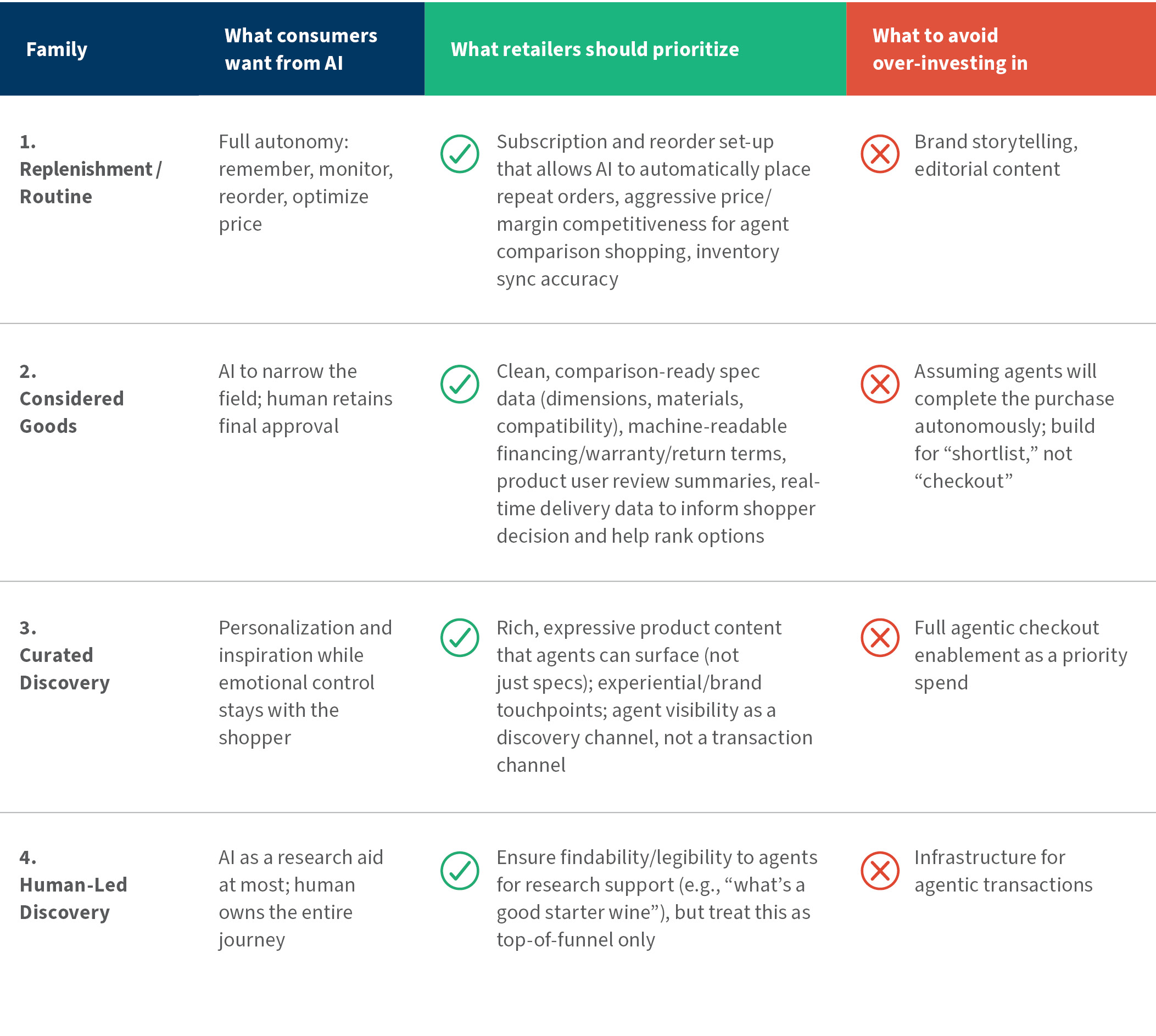
Family 1: Replenishment/Routine (Autonomous Replenishment)
The autonomous replenishment family is where consumers are most willing to hand off decisions: it’s where consumers want AI to remember, monitor, reorder and optimize — categories where they are “tired” of shopping. Characteristics of these categories include repeat purchases, low emotion, strong basket economics, high substitution tolerance and price sensitivity. Examples are household consumables (paper goods, cleaning supplies), personal care basics (deodorant, basic skincare, vitamins, baby essentials), grocery pantry staples (condiments, milk, eggs, paper towels) and pet food and staples.
Family 2: Considered Goods (Guided Decisions)
Guided decisions cover high-stakes purchases where consumers still want to control the final call, even as they lean on AI to do the heavy lifting of narrowing the field. Here, AI curates options against a set of criteria, essentially replacing the search, not the purchase, so consumers keep their approval rights without navigating through specification complexity or comparison fatigue. These are categories with a heavy research burden, technical considerations, budget sensitivity and lower brand loyalty; think home furniture and décor, major electronics and appliances, and home improvement or DIY projects like building a new living room under a set budget.
Family 3: Curated Discovery
Curated discovery is where brand and discovery still matter most: consumers shop these categories to express their identity, find inspiration and signal status. AI can curate, personalize and inspire, but the emotional decision has to stay with the consumer. Apparel, covering fast fashion, premium-contemporary and luxury, along with prestige beauty and footwear, both athletic and fashion, all fall into this family.
Family 4: Human-Led Discovery
Human-led discovery is reserved for categories where consumers actively want to indulge and discover on their own, where choosing is part of the value. AI can support the process, but it can’t replace the human. These purchases are often occasion-driven, sensory, highly personal or enthusiast-led, such as selecting a thoughtful gift, discovering a special bottle of wine or spirits, exploring specialty food, choosing a fragrance or beauty product or pursuing a hobby or collectable.
From Products to Missions
Perhaps the biggest shift isn’t individual products at all, but the basket. Retailers have traditionally optimized around SKUs, categories and promotions, but what if AI optimizes around missions instead? What if, rather than asking AI to recommend a single product, consumers are increasingly asking it to solve a problem — the weekly groceries, back-to-school, home renovations, vacation packing or seasonal wardrobe refreshes? The competitive advantage may shift from recommending a product to orchestrating an entire shopper mission.
Implications by Category
So how does this framework become useful? Agent-readiness investment should be targeted, not uniform. Returns vary significantly across the four categories, and retailers need to know which ones justify the spend.
The table below translates our four-family framework into concrete priorities for retailers and highlights where agent-readiness investment offers a potentially lower return.
As AI-driven shopping and purchasing evolve, we see these findings as an opening move, one that gives brands a foundation to start refining their AI commerce strategies today. The next phase of our research will test our hypothesis that the future of commerce won’t be determined solely by whether consumers use AI, but where they choose to give it control.
The brands that wait for an answer will be reacting to a market others have already shaped. This is where AI commerce strategy starts.
Footnotes:
1: FTI Consulting analysis using U.S. Census Bureau, Quarterly E-Commerce Report
2: Trivedi A., The New Shelf Space, FTI Consulting, July 22, 2026
3: Supra n 2
Artículos relacionados
Publicado
octubre 27, 2026
 Contactos clave
Senior Managing Director, Co-Leader of U.S. Business Transformation
Senior Managing Director
Managing Director
Managing Director
Managing Director