

The Changing Anatomy of a Blockbuster: What It Means for Pharma
The Race to Capture Blockbuster Value Is Becoming a Race for Rights and Readiness
-
octobre 02, 2026
-

The Blockbuster Peak Is Ahead
The blockbuster era is far from over. FTI Consulting’s analysis of 304 blockbuster drug-company pairs in the U.S. market suggests that much of the blockbuster cohort — and their associated commercial value — has yet to reach its peak.
To understand how the blockbuster landscape is evolving, we reviewed a cohort of products from 2015 to 2025 that already have or are expected to reach greater than $1 billion in peak-year sales. Our analysis identified that the peak for roughly two-thirds of these products is expected between 2025 and 2030, highlighting that a substantial cohort of blockbusters are still growing in their commercial contribution. The data also highlights several structural shifts around the composition of blockbuster assets overall. Our broader analysis demonstrates growing representation of biologics and other advanced therapeutic modalities, alongside continued concentration in oncology.
This matters at a time when many large pharmaceutical companies face significant revenue pressure from patent expiries across today’s leading products. Replacing that revenue will depend partly on what the next generation of blockbuster drugs looks like, and how companies choose to construct portfolios around future opportunities.
Our analysis reviews two related questions: What role does scientific novelty play in determining the scale of blockbuster success? And how are leading companies that commercialize these assets sourcing innovation and constructing their portfolios?
Novelty Is Valuable but No Longer Decisive
First-in-class scientific innovation has historically featured prominently among the most successful blockbuster products. Across the 2015 to 2025 cohort, “first-in-class” products account for much of the population, particularly among the mega-blockbuster (“MBB”) population that we define as generating more than $5 billion in peak-year sales.
The projected 2026 to 2030 cohort shows a different pattern, with non-first-in-class products reaching substantial blockbuster sales levels — comparable with many earlier first-in-class products. The upper end of the blockbuster range also shifts between the two cohorts. Sales levels that represented exceptional outcomes in the earlier period sit below several of the largest products projected to peak between 2026 and 2030. First-in-class drugs are still expected to demonstrate larger projected commercial potential in the out years.
Compared with the current cohort, the projected 2026 to 2030 cohort includes a greater number of blockbuster products. Many are expected to span more than one indication, although products spanning more than five indications remain the exception. The data also supports the trend toward more personalized medicines, with fewer indications per blockbuster highlighting the move toward smaller population size per asset, with potentially higher price points.
Figure 1: First-in-class drugs increasingly feature among the largest projected blockbusters.
First-in-class assets and the rising MBB threshold.*
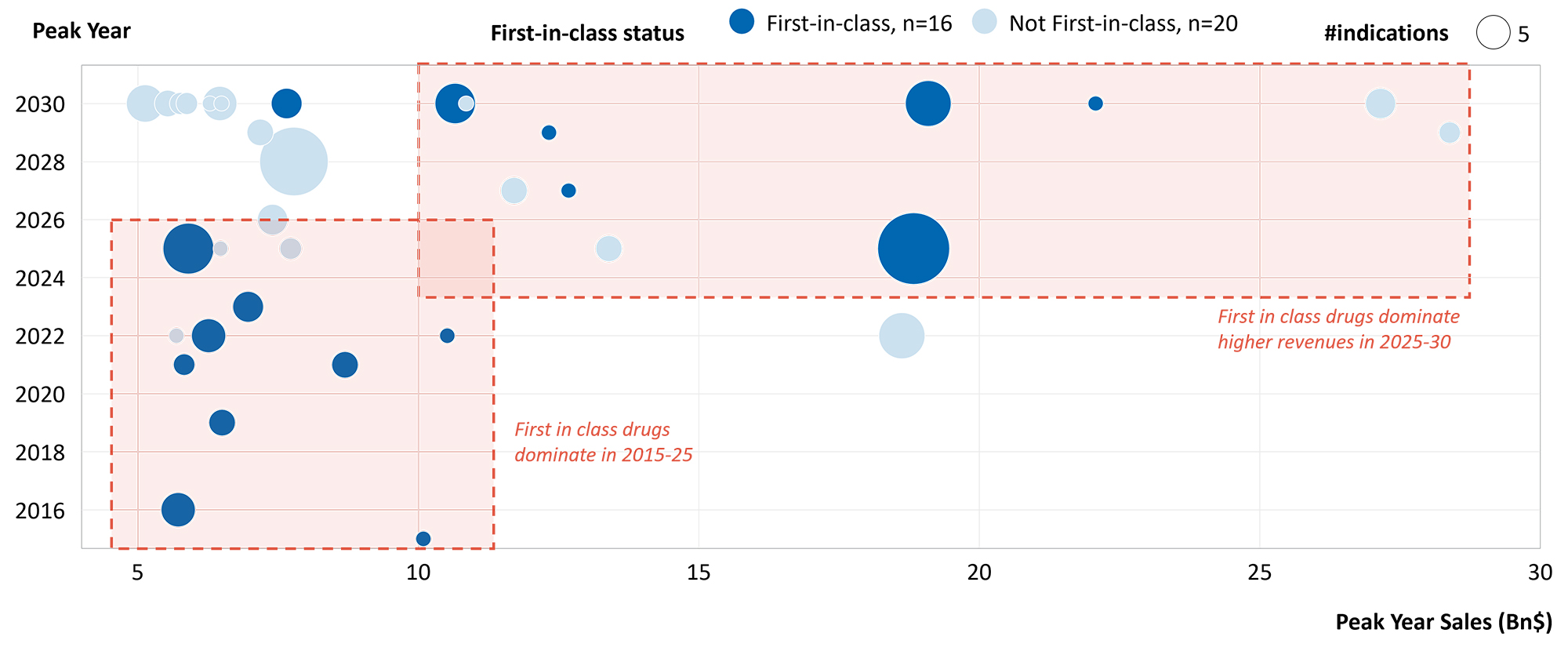
*MBB drugs are defined as drugs with >$5 billion in U.S. sales in at least one year from 2015–2030, excluding vaccines. Drugs are shown by peak-year sales, peak year, number of indications and first-in-class status.
Source: FTI Consulting analysis; Evaluate Pharma.
The data points to a more nuanced role for scientific novelty and challenges the assumption that novelty alone is a reliable predictor of commercial success. First-in-class molecules are projected to generate some of the largest commercial outcomes, while differentiated non-first-in-class products continue to offer significant potential.
For research and development (R&D) leaders and for investors, the implication is that scientific novelty is only one consideration for portfolio construction and resource allocation and that non-first-in-class programs are also capable of generating substantial value. First-in-class should be considered alongside a broader assessment of clinical differentiation, potential indication breadth and commercial potential.
External Innovation Is a Core Component of Blockbuster Portfolios
At the company level, the question becomes about portfolio composition. Emerging biotech companies often originate or advance the science from early hypotheses to clinical candidates. Larger pharmaceutical organizations provide the regulatory infrastructure, medical affairs depth, payer access, launch experience and balance-sheet strength required to finalize development and commercialize at scale.
Our analysis shows that companies with multiple blockbuster products rarely rely on a single source or type of innovation. Most companies source more than half of their blockbuster molecules inorganically, while their portfolios generally contain a mix of first-in-class and non-first-in-class products.
Figure 2: Blockbuster (“BB”) portfolios combine different types and sources of innovation.
Pharmaceutical companies’ number of blockbuster products vs. share of first-in-class products in their blockbuster portfolios vs. peak-year revenue.*
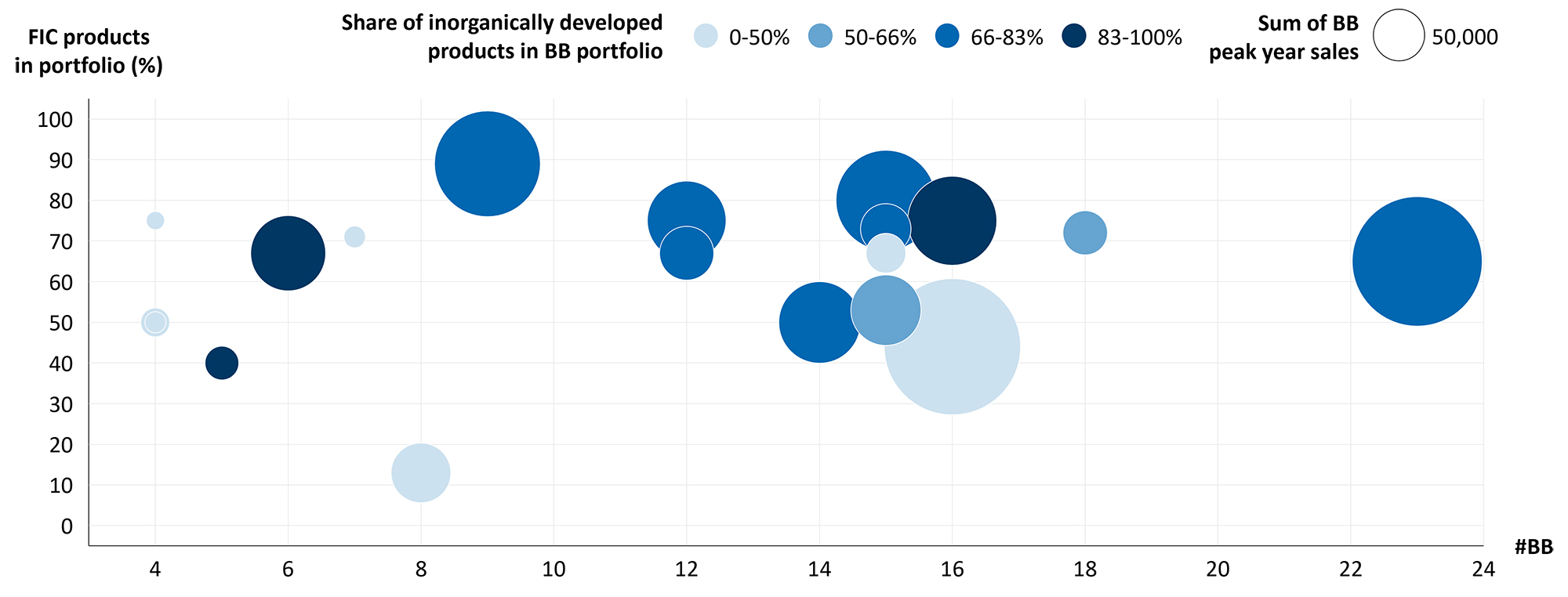
*BB drugs are defined as drugs with >$1 billion in U.S. sales in at least one year from 2015–2030, excluding vaccines. Analysis excludes pharmaceutical companies with only one BB drug.
Source: FTI Consulting analysis; Evaluate Pharma.
Figure 2 shows considerable variation in the size and composition of blockbuster portfolios across leading pharmaceutical companies.
- Innovation level: Most portfolios contain a mix of first-in-class and non-first-in-class products, with a slight skew toward first-in-class-led portfolios.
- Source of innovation: Companies in this cohort are building broad, externally sourced blockbuster product portfolios (50%–83% of inorganic sourcing).
Portfolio Planning Balances Internal and External Innovation
When considering future portfolio mix and construction, R&D leaders need to balance the potential higher revenues that first-in-class programs can provide with the meaningful commercial potential available from differentiated non-first-in-class products. The more pressing challenge for large biopharmaceutical companies (“biopharma”) is how governance and resource allocation should be managed across internal and external opportunities.
Healthcare Quarter in Review Read Now
Few large biopharma companies look to fill every identified pipeline gap through internal R&D. Thus, deciding which assets to partner, license or acquire externally is a key activity. The data suggests that, on its own, scientific novelty is no longer the primary indicator of potential blockbuster value. Differentiated follow-on assets are still projected to generate blockbuster returns and therefore can justify investment if the clinical profile, addressable patient population and expected commercial return can support it. Companies require strong portfolio governance that can compare these internal and external assets against the same strategic need and investment criteria.
Accessing the right asset is only the first part of the challenge for larger biopharma companies, as the value of external innovation depends partly on whether the organization can develop and launch what it brings in. These large commercialization companies still need the capabilities to align late-stage development, alliance management and commercial capabilities to turn that asset into a successful product.
Biotech Leaders Should Preserve Multiple Routes to Value
Biotech’s priority is continuing to progress assets through development while preserving options for how the asset ultimately reaches the market. The right path to commercialization for any one product depends on internal capabilities and the capital required to advance the asset, balanced with the potential of that asset.
Companies that “go it alone” can generate the greatest long-term value for certain products. But, for others, a partner can accelerate development and derisk commercial launch. Assessing whether a biotech company has the organizational expertise and capital to support this pathway, or whether a partnership could contribute capabilities, scale or reach, is a decision that leaders should revisit pre-clinical and continue asking throughout development.
Better Forecasting Supports Better Portfolio Decisions
Forecasting commercial potential is inherently uncertain, as it is based on projecting a view of future realities related to dynamic comparator and competitive landscapes, market and payer access challenges and physician behavior years before an asset is approved and enters the market. Leadership teams use these outputs to allocate R&D resources and make investments, value licensing opportunities, negotiate transactions and choose commercialization pathways.
Traditional forecasting approaches often rely on analog products, market-share assumptions or patient-based uptake models. While these inputs are still important, they can become less reliable when a market is still taking shape, there are limited comparators or market leaders are approaching loss of exclusivity. In these conditions, there may be no clear analog to anchor on, and attributing peak sales to specific product characteristics relies solely on judgment and assumption.
Stronger forecasting tests those assumptions and makes them visible. FTI Consulting’s ValueNav framework combines competitive intelligence, cutting-edge predictive algorithms and more than 15 years of real-world competitive dynamics data to inform strategic launch decisions and test the range of outcomes possible for a given asset. Learning from historical launches, the framework identifies combinations of product and market characteristics that may drive uptake. It helps leadership teams understand the unique commercial potential of a product and, for biopharma companies or investors, compares that opportunity against competing resource allocation needs and supports informed partnering and licensing decisions with imperfect information.
What This Means for Pharma and Biotech
These findings reinforce the need for a clear R&D portfolio strategy that balances first-in-class programs with differentiated non-first-in-class products, supported by an integrated assessment of both scientific and future commercial potential. While first-in-class programs can support the largest commercial outcomes, focusing only on these products risks overlooking substantial value elsewhere in the portfolio. For biotech leaders, the same concept applies to commercialization strategy: the business must revisit the viability of progressing lead programs independently as new data becomes available.
The same asset can create value in different ways. A biotech company can capture significant value by advancing innovative science and partnering or transacting at the right point. A larger pharmaceutical company can create further value by combining that asset with the developmental, regulatory and commercial capabilities required to scale it. Better portfolio planning, forecasting and valuation help both sides understand the trade-offs, allocate capital with greater discipline and choose the path that offers the strongest potential return.
Related Insights
Date
octobre 02, 2026
 Contacts
Managing Director
Managing Director
Senior Director
Director
Senior Consultant