

Climate Change & Adaptation 2026
Rethinking Climate Risk Integration Across Business, Finance and Policy
-
March 31, 2026
Downloads Download Report
-

Financial institutions, corporate executives and investors are operating with climate risk models that systematically underestimate exposure by a factor of two to four times. This isn’t a compliance issue, instead it represents one of the most significant mispricing phenomena in modern capital markets, materializing today across credit spreads, equity valuations and capital allocation decisions.
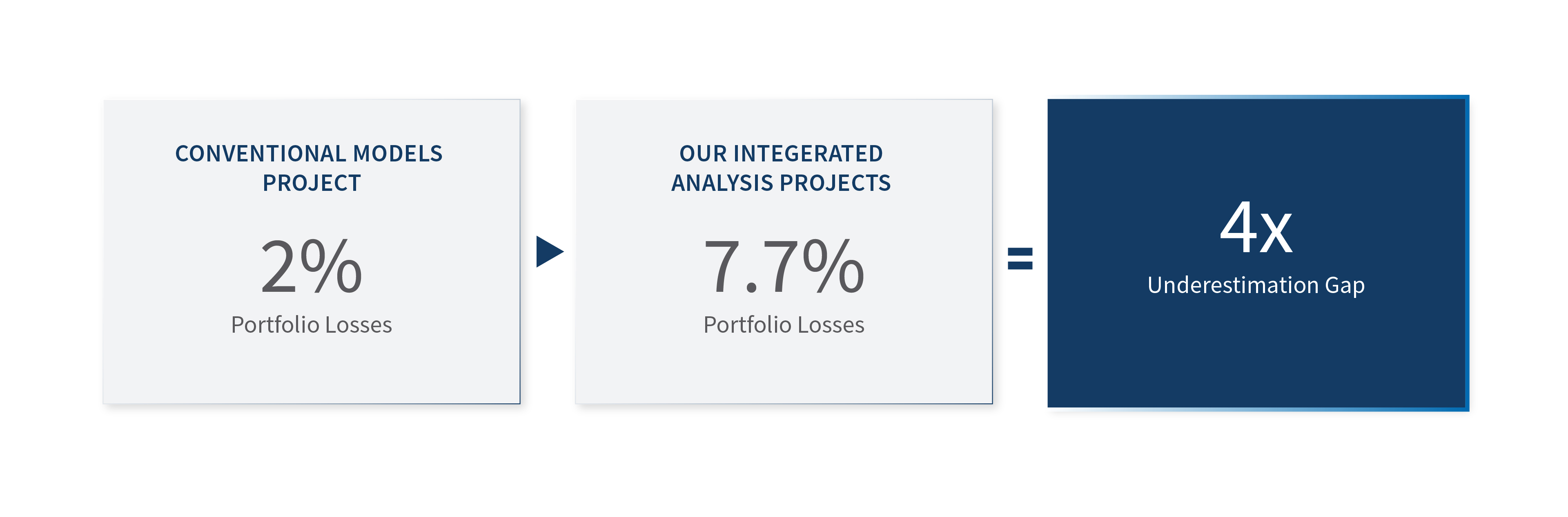
We analyzed 148 global companies representing $31.4 trillion in market capitalization to test whether current climate risk models provide decision-useful intelligence. The findings are stark: conventional platforms project approximately 2.0% portfolio losses, while our integrated analysis reveals 7.7% average exposure – a four-fold gap that stems from systematically underweighting transition risks relative to physical climate impacts.
Three insights define the challenge. First, transition risks – carbon pricing, technology disruption, stranded assets – exceed physical risks in magnitude and urgency, yet receive minimal analytical attention. Second, material exposure manifests within 10–15-year horizons relevant to actual business decisions, not distant 2050 targets. Third, climate exposure varies by 3x to 4.5x within single sectors, rendering sector-level analysis ineffective.
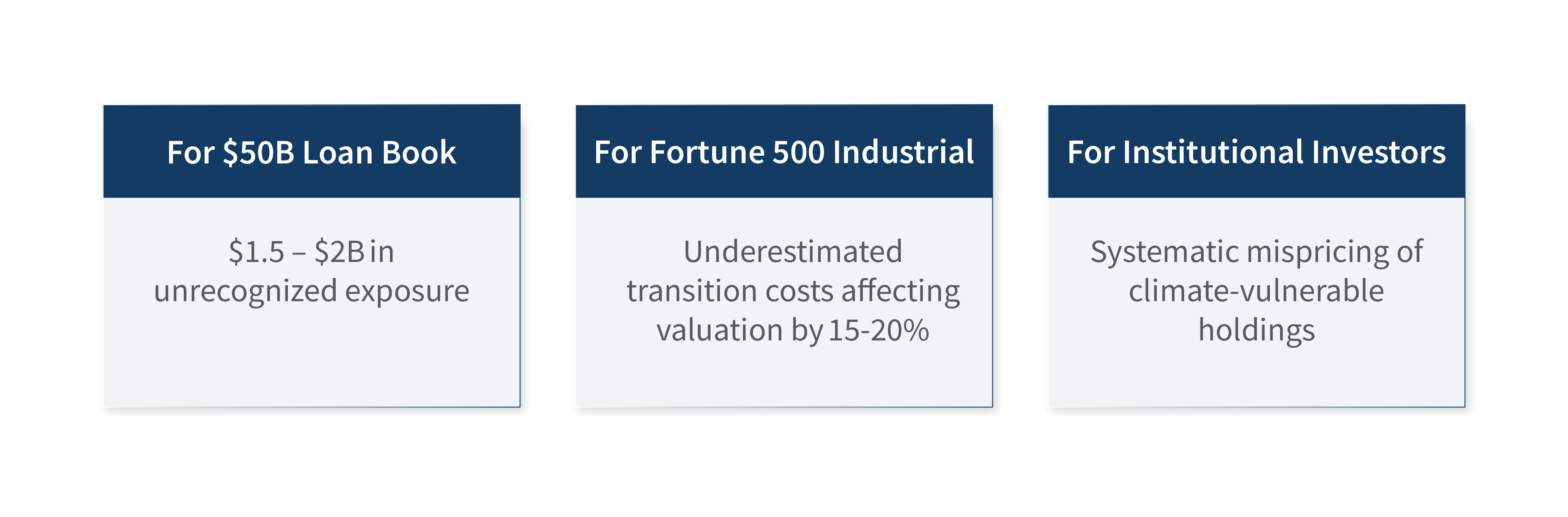
For a $50 billion corporate loan book, this represents $1.5 to $2 billion in unrecognized exposure. For investors, it means systematically mispriced portfolios with hidden concentrations. For corporates, it affects cost of capital by 25-40 basis points and competitive positioning. Recent UK regulatory action demonstrates supervisors are now comparing institutional approaches – those with systematic underestimation face heightened capital requirements.
This report quantifies the gap, identifies why current models fail, demonstrates the extreme heterogeneity that sector averages obscure and establishes the analytical architecture required to move from blind spots to informed advantage. The institutions that master company-specific climate risk quantification will capture competitive advantages through superior risk-adjusted returns, effective transition finance allocation and enhanced stakeholder credibility.
Download the report
About the Authors:
William Holloway – William is a Senior Managing Director at FTI Consulting in the Construction, Projects & Assets Practice, where he leads the firm’s global Strategic Advisory and Management Consulting offering. With more than 18 years of experience, he advises companies on asset management, operational efficiency, and decarbonization strategies, and serves as an expert witness in international arbitrations and litigation related to energy and infrastructure projects.
Saad Moazam – Saad is a Director at FTI Consulting in the Construction, Projects & Assets Practice, where he advises corporates and financial institutions on investor-grade climate transition strategies and sustainable value creation. With a background in engineering and finance and experience across EMEA and the United States, he specializes in bridging technical complexity with commercial decision-making for clients in capital and energy-intensive sectors. Saad is an author of key reference frameworks for energy sector transition planning and works closely with climate-tech startups to deliver AI-enabled solutions across the asset and investment lifecycle.
Sunil Rana – Sunil is the Founder and CEO of Vyzrd, based in Sydney, Australia. He has nearly 25 years of experience spanning corporate strategy, sustainability, economic development, public policy design, private equity, value creation and venture capital.
Kevin Bourne – Kevin is the Head of Markets at Vyzrd, based in London, UK. He brings more than 30 years of experience, having held senior leadership and executive committee roles at major global institutions including the FTSE/LSEG, HSBC and S&P Global Sustainable1. Kevin has been instrumental in developing industry-leading models in the ESG space and works closely with industry bodies and forums, advising on sustainability and climate change agendas.
The views expressed herein are those of the author(s) and not necessarily the views of FTI Consulting, Inc., its management, its subsidiaries, its affiliates, or its other professionals.
Related Insights
Related Information
Published
March 31, 2026
 Key Contacts