Brazil at the Ballot Box: What’s at Stake for Business in 2026
Brazil Will Elect Almost the Entirety of Its Legislative in 2026, Causing Impact for Businesses
-
March 10, 2026
Downloads Download Report
-

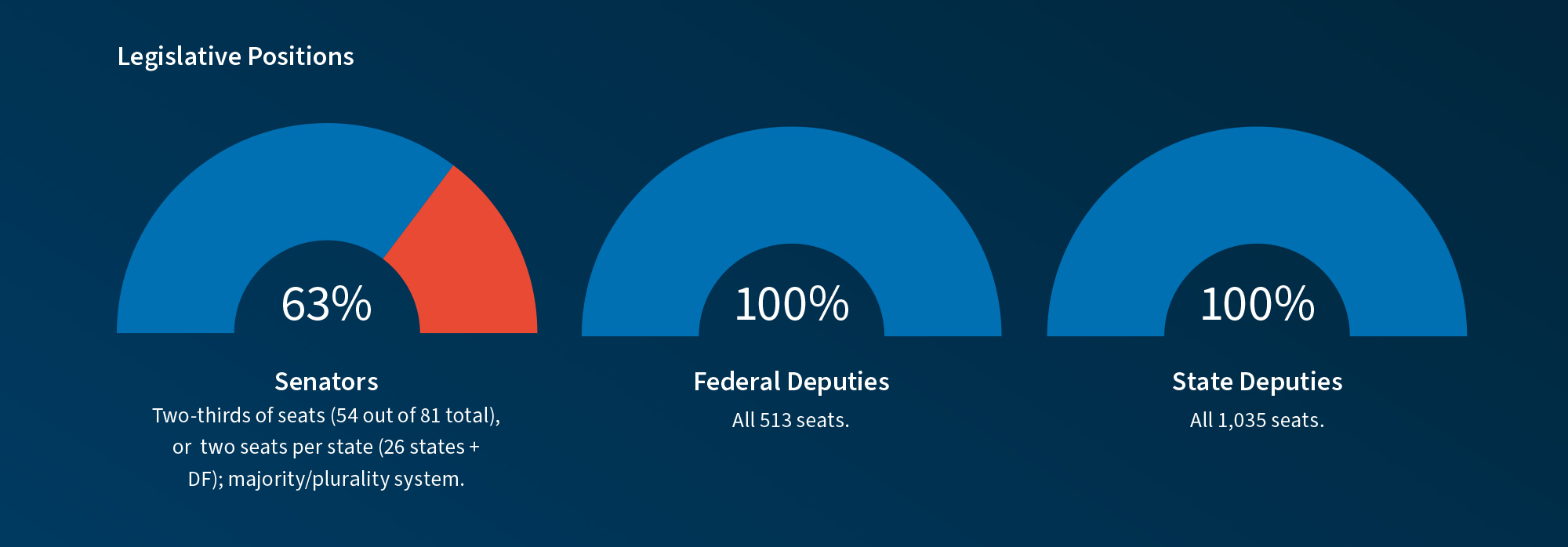
Brazil goes to the ballot box to elect not only one national presidential ticket, 27 state-level governors, but also approximately two-thirds1 of the seats in the senate, and the entirety of the lower house and state legislative assemblies. Roughly 97–98%2 of the offices up for grabs in 2026 are legislative positions, with only a small fraction corresponding to executive posts at the federal and state levels.
In this context, the year will be marked by higher regulatory uncertainty and macroeconomic volatility for businesses, as the electoral cycle comes at a crucial year of intense political polarization, institutional instability between its powers, and fiscal deficits. The structural reforms underway will likely suffer delays and generate fiscal instability at the national level.
This piece sets the scene for a series of analyses from FTI Consulting’s team in Brazil looking at the electoral cycle and its implications for the domestic business environment.
What Will Be Decided
Brazil’s 2026 general elections will decide the presidency and key legislative and state executive positions nationwide.
Executive Positions
- President and Vice President: One national ticket elected by majority vote; runoff if no 50%+1 in first round.
- Governors and Vice Governors: 27 positions (26 states + Federal District - DF), also by majority, with potential runoff.
Legislative Positions
Main Dates of Interest
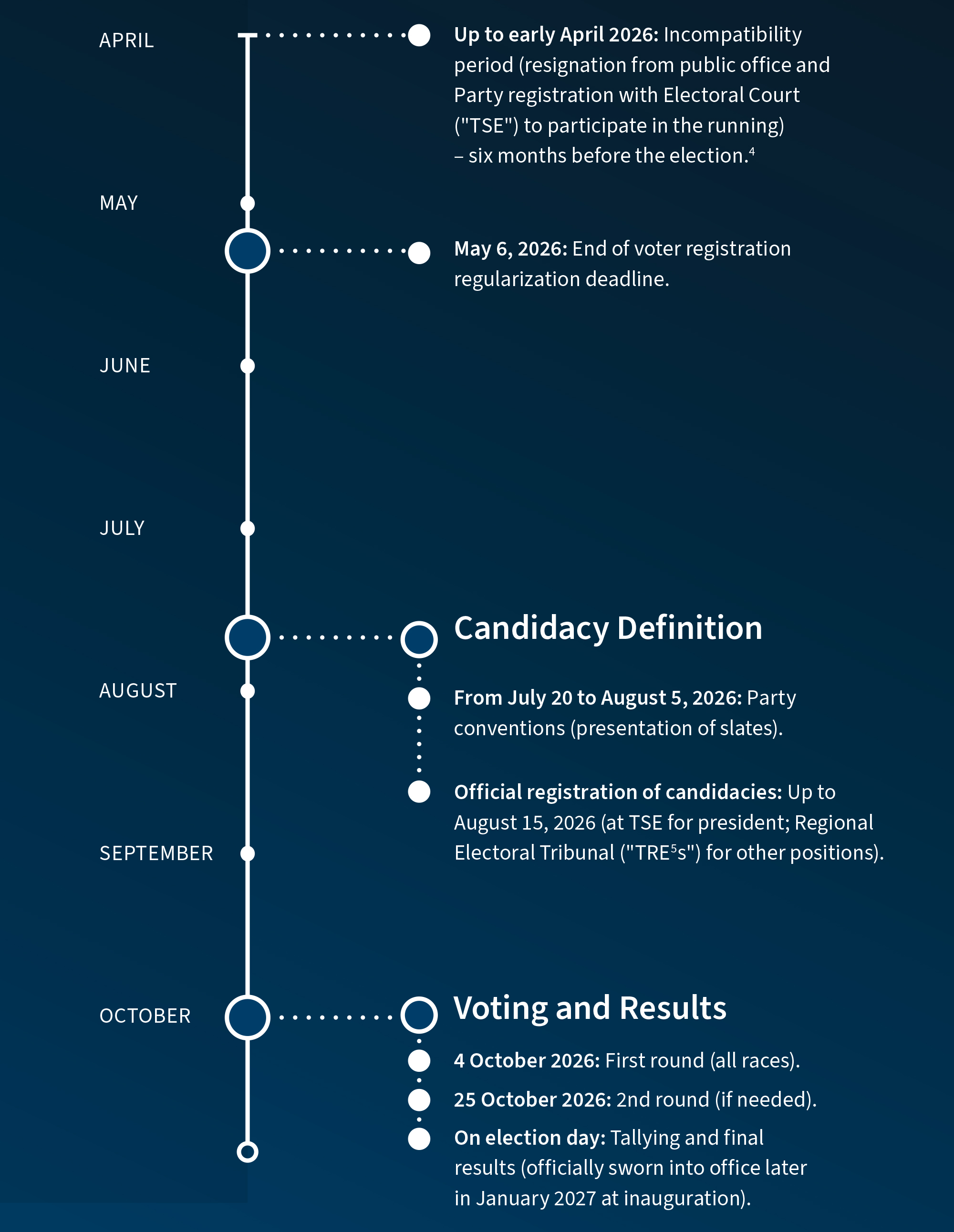
The main dates of the electoral calendar for Brazil’s 2026 general elections, as defined by the Superior Electoral Tribunal (“TSE”)3 and electoral legislation, include deadlines for incompatibility (resignation from public office), voter registration regularization, party conventions, candidacy registrations, election and final results.
Why it Matters for Companies
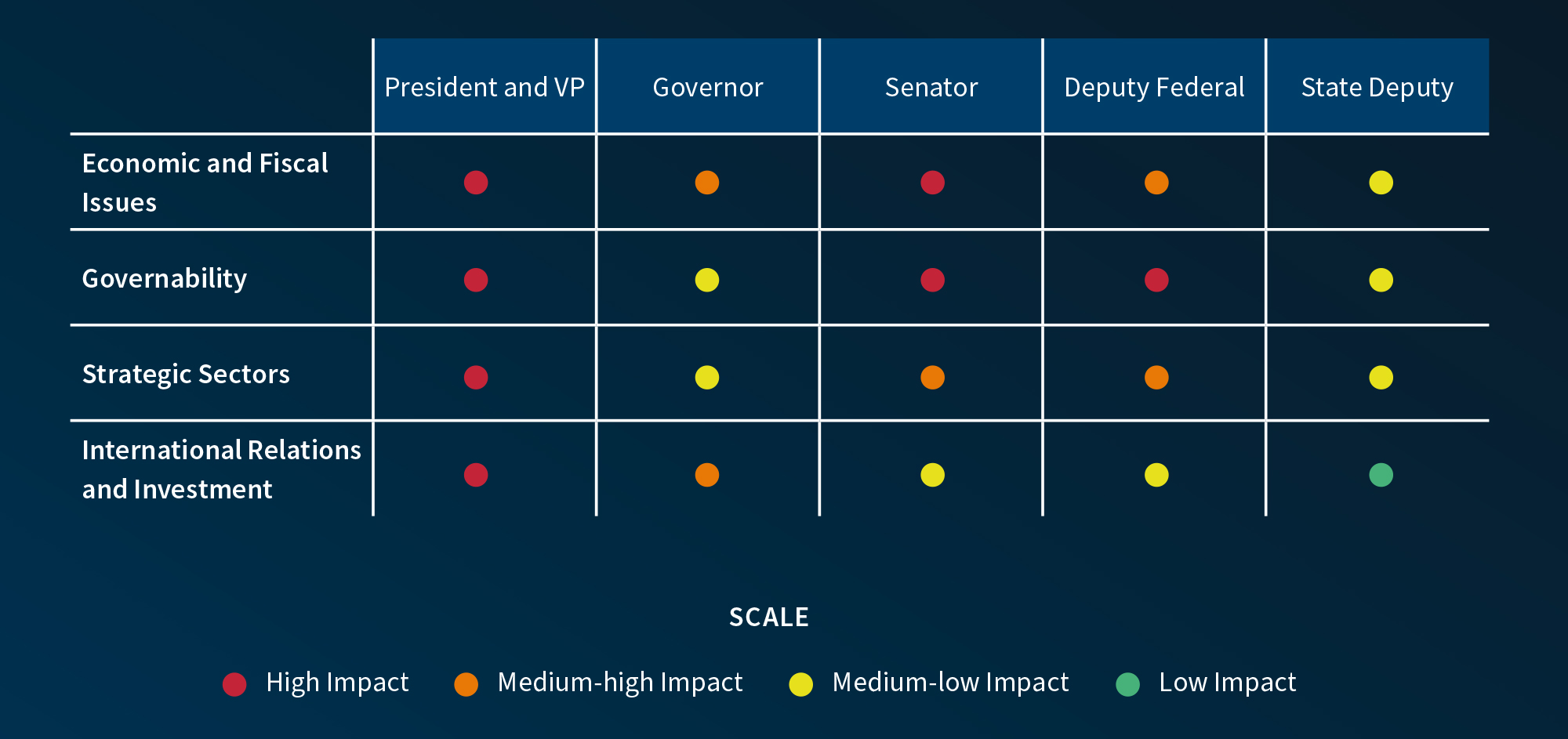
Brazilian political actors at federal and state-levels profoundly shape the local business environment through legislation, regulation, incentives, and policy execution, often determining operational costs, investment attractiveness, and sectoral competitiveness. The heat chart below, developed by our local FTI Consulting experts,6 outlines level of impact that each position has on the domestic business environment7 across four analytical dimensions: (i) economic and fiscal issues; (ii) governability; (iii) strategic sectors; and (iv) international relations and investment.
Economy and Fiscal Issues
- Budgets, Reforms and taxes: The president drives federal budgets, tax reforms, and spending via provisional measures and vetoes. Can advance deregulation (e.g., Economic Freedom Law from 20198 and initiatives like the Ministry of Entrepreneurship for SME) or raise taxes/revenue collection (e.g., fiscal framework pushing consumption tax simplification), impacting competitiveness, credit access, trade responses to tariffs, and ESG policies impacting energy and mining approvals and corporate margins.
- Inflation and interest rates: Administrative interventions in central banks or state-owned enterprises generate exchange rate volatility and high interest rates, raising operational costs and deterring Foreign Direct Investment (“FDI”).
Governability
- Congress: Presidential coalitions with congressional leaders following elections – often mediated through budget amendments – are central to governability. Congress ultimately approves or blocks reforms, shaping timelines and outcomes for M&A, credit, and innovation.
- Vice President: The VP may act as a political interlocutor with Congress, a crisis coordinator, and an institutional stabilizer, especially in heterogeneous tickets or moments of low presidential approval.
Strategic Sectors
- Broad strategy: Defines national strategies for energy, oil and gas, mining, and infrastructure via sectoral plans and agency mandates, steering state-owned banks and firms toward or away from specific value chains. Also, balances development and environmental agendas (e.g., licensing rules, ecological incentives) that can accelerate or delay large projects.
- Private sector articulation: The President and VP are relevant interlocutors with the private sector, fostering dialogue to align economic policies, mitigate sectoral risks, and attract investments, with the president setting the strategic agenda and the vice president executing operational missions. The president convenes high-level meetings and defines responses to crises (e.g., creating a committee on tariff hikes and seeking credit approval, government procurement, and job protection as well as requests to preserve foreign investments and the bioeconomy). Articulation boosts governance but relies on transparency to avoid perceptions of favoritism.
- Energy and infrastructure: Appoints CEOs for state-owned enterprises and banks setting prices, dividends, and licenses; statist leanings increase regulatory risks in oil/gas/mining.
- Environment and ESG: Ecological policies or deregulation affect approvals in renewable energy and mining, with ripple effects on global supply chains.
International Relations and Investments
- Foreign policy: How the president is perceived while conducting foreign policy and trade negotiations internationally (e.g., tariff responses, trade agreements, critical minerals diplomacy) directly impacts the country’s ability to forge positive trade agreements. It also shapes export market access and foreign investor perception, influencing willingness to do business in Brazil.
- Trade: Responses to tariffs or trade deals influence exports, with retaliation risks affecting the trade balance (e.g., agribusiness/minerals).
- FDI: Signals openness or state-capitalist tilt to markets, affecting risk premium, and appetite for FDI and portfolio flows.
Economy and fiscal issues
- Tax policy: Control state tax policy instruments – especially ICMS (state-level VAT), using exemptions, presumed credits, and tax incentives to attract or retain companies, thereby altering local cost structures. Governors in central states like Goiás (35% ICMS incentives/revenue)9 and Mato Grosso (31%)10 lead in aggressive packages for agribusiness/mining, outpacing others in “tax wars”. Governors in southeast states adjust rates collectively to offset losses (e.g., São Paulo: proposal to hike - 18%→19.5% - post-tax reform), affecting the cost of doing business in Brazil (known as “Brazil Cost”). These moves will persist until 2032 VAT transition, as determined in the 2025 Tax Reform.11
- Debt: Negotiate debt and fiscal adjustments with the Union, which constrains space for new incentives and infrastructure spending that underpin local competitiveness.
Governability
- Coalitions: Governors lead state-level coalitions with assemblies, trading budget items, appointments, and local works to secure support for development agendas and regulatory packages. They also act as power brokers in national politics through governors’ consortia, influencing federal reforms that cascade down to firms operating in their states. Some governors may be more effective than others due to their personal abilities as well as their state economic power.
Strategic sectors
- Implementation and adaptation of federal regulation: Governors regulate local operations through incentives (e.g., Amazon incentives balancing ESG with output),12 and by setting timelines and conditions for the implementation of federal regulation governing energy, sanitation, logistics, environmental licensing and greenfield projects. This multilevel governance can create bottlenecks or accelerators for renewables, lithium, and agribusiness exports.
- Investment promotion: Use state development agencies and investment promotion offices to target business clusters (e.g., agribusiness processing, industrial districts, tech hubs) for benchmarking and investment attraction, shaping regional value chains.
International Relations and Investment
- Subnational diplomacy/Paradiplomacy: Roadshows, attendance in global forums such as the World Economic Forum or NY Climate Week and Memoranda of Understanding with foreign investors are ways to promote states as investment platforms aligned with federal trade policy. Governors also promote state-level Foreign Direct Investment (“FDI”) via incentives, where they compete in “location attractiveness” using incentives and infrastructure to capture FDI diverted by global supply-chain reconfiguration. Some governors may leverage better than others due to their personal abilities as well as their state economic attractiveness.
Economic and Fiscal issues
- Tax and Fiscal agenda: Senators can approve or amend federal tax and fiscal rules, including debt ceilings and revenue measures, and can dilute or harden presidential proposals that impact business taxation (e.g., cut in fiscal incentives’ rates, affecting presumed profit and interest rates, raising capital costs for Small and Medium-sized Enterprises (“SMEs”); increased bureaucracy for fiscal incentives and taxes’ rates on certain sectors), influencing competitiveness and investments.
- Reforms: The senate is key in approving regulation. Measures aimed at simplifying the tax regime, and expanding industrial incentives, are critical to economic activity, ensuring the competitiveness of Brazilian goods and innovation. Brazil is known for the high “Brazilian cost” and any possibility of cuts and simplification could have significant positive impact on it.
Governability
- Regulation: The senate acts as a revising chamber and veto player, able to slow, reshape, or block executive priorities, affecting reform sequencing and policy stability. Alliances with the congress facilitate or stall reforms, impacting M&A, credit, and innovation.
- Appointments: Approves key appointments to the Central Bank, regulatory agencies and ambassadors, affecting institutional credibility and the implementation quality of business-related policies. It is relevant to note that although many technical positions are filled through competitive examinations, leadership positions tend to be chosen based on political considerations, directly linked to the political agenda of the elected government.
Strategic Sectors
- Regulation: Votes on sectoral laws and amends regulatory frameworks (g., environmental licensing, carbon market), impacting sectors with more/less bureaucracy. Also, influences oversight hearings and commissions that pressure agencies and state-owned companies in sensitive sectors through pricing policy, concession models and local-content rules. This defines regulatory risk and long-term rules for capital-intensive industries.
- Credit and innovation: Approve financing and debates on digital platforms, affecting M&A and tech.
- Private sector: Leaders in parliamentary fronts – always in coordination with the lower house – that seeks to reduce bureaucracy, ensure legal certainty, and boost free enterprise.
- Innovation: Strengthen frameworks for regulatory agencies (e.g., digital antitrust Bill from 2025),13 impacting innovation, M&A, and competition.
International Relations and Investment
- Foreign policy: Ratifies international treaties and agreements, including trade and investment frameworks that shape market access and investor protection. Motions against tariffs protect commodity exports, stabilizing the trade balance for businesses. Also, holds hearings on foreign policy and international disputes, signaling congressional support or pushback that investors weigh when assessing political risk.
- Foreign financing: Authorizes foreign loans by the union and subnational entities, influencing available financing for infrastructure and sectoral projects.
- Parliamentary diplomacy: Uses missions and resolutions to support (e.g., benchmarking public policy and regulatory framework in other countries) or criticize foreign partners, which can affect bilateral climates in sensitive deals.
Economic and Fiscal issues
- Regulation: Initiate and amend ordinary and complementary laws on taxation, labor, business entities, and regulation, directly affecting costs, compliance, and market structure. Shape the budget through amendments and sectoral earmarks, influencing which regions and sectors receive infrastructure, credit, or subsidies.
Governability
- Coalitions: Form the core of governing coalitions; their party blocs and caucuses (e.g., agribusiness, services, union, evangelical, etc.) determine the viability of pro-market or redistributive agendas. They also exercise oversight through inquiries and audits, constraining executive discretion and affecting predictability of policy enforcement.
- Reforms: Coordinate with the executive for reforms, influencing credit – specially from state-owned developing banks and legal certainty via oversight of public spending.
Strategic Sectors
- Regulation: Lead sectoral bills (e.g., tax incentives or regulatory sandboxes), shaping innovation and competition. Also approve specific regulation with operational impact such as the circular economy bill from 202214 and debates on “Brazil Cost” that may generate positive or negative impact on manufacturing, infrastructure, and exports.
- Private sector: Interact with business associations and unions directly or through parliamentary fronts, exclusive to the chamber or shared with the senate, embedding sector-specific advantages or burdens into law (e.g., special regimes for export manufacturing or services).
International Relations and Investment
- Trade and investment: Approve enabling legislation for trade agreements and investment rules, influencing how international commitments translate into domestic opportunities or constraints.
- Parliamentary diplomacy: Use missions and resolutions to support (e.g., benchmarking public policy and regulatory framework in other countries) or criticize foreign partners, which can affect bilateral climates in sensitive deals.
Economic and Fiscal issues
- ICMS and tax wars: Approve state tax laws and incentive programs (ICMS, sector-specific benefits) deferrals, and National Council on Tax Policy (“CONFAZ”)15 agreements, influencing logistics, trade, and manufacturing. This impacts “Brazil Cost” and the relative attractiveness of municipalities and regions directly.
- Budget and auditing: Approve state budgets, monitor governor spending and loans, enabling or blocking infrastructure and credit investments in state-owned banks.
- Approve state tax laws and incentive programs (ICMS, sector-specific fiscal incentives), determining local “Brazil Cost” and the relative attractiveness of municipalities and regions.
- Decide on state budgets and borrowing authorizations, influencing the scale and quality of state infrastructure and services that firms rely on.
Governability
- Local fronts: Form alliances against tax wars and for entrepreneurship, attracting FDI and jobs to specific areas (e.g., inland Amazonian regions).
- Executive: Provide or deny legislative support to governors, affecting the stability of state-level reforms and the continuity of business-friendly policies. Use investigative committees and oversight tools to scrutinize concessions, Public Private Partnerships, and procurement, affecting perceived integrity and risk for local investors.
Strategic Sectors
- Licensing and policies: Regulate and fine-tune state implementation of federal frameworks in sanitation, environment, land use, and innovation, impacting licensing speed and legal uncertainty for projects. Tackle state-level “Brazil Cost” and circular economy, aiding manufacturing and exports via streamlined environmental licenses and innovation. Approves policies such as São Paulo’s State Policy for Impact Businesses,16 promoting social/environmental startups with dedicated committees and investment frameworks.
- Incentives: Create state policies for clusters (e.g., industrial districts, technology parks, impact-business laws), influencing where startups and SMEs choose to operate. Enact tools like the Entrepreneur Defense Code, streamlining business openings, licenses, and curbing inter-municipal tax wars.
International Relations and Investment
- Parliamentary diplomacy: Use missions and resolutions to support (e.g., benchmarking public policy and regulatory framework in other countries) or criticize foreign partners, which can affect bilateral climates in sensitive deals.
- Foreign investment: Approve legal frameworks for PPP concessions, and state agencies that interface with foreign investors, affecting bankability and risk allocation for projects. Shape local ESG and ecological fiscal-transfer rules, which can either attract climate-aligned capital or deter it if standards and enforcement are weak.
Footnotes:
1: Superior Electoral Tribunal (“TSE”), “Confira quais cargos estarão em disputa nas Eleições 2026.” (07 January 2026).
2: Superior Electoral Tribunal (“TSE”), “Confira quais cargos estarão em disputa nas Eleições 2026.” (07 January 2026).
3: Superior Electoral Tribunal (“TSE”) – has its competencies outlined in the 1988 Federal Constitution, the 1965 Electoral Code, the Elections Law, and the Ineligibility Law. In its role, it is responsible for processing and judging the registration and cancellation of political parties, their national directories, and candidates for President and Vice-President of the Republic; ruling on special appeals and ordinary appeals against decisions from regional electoral courts; approving the division of states into electoral zones or the creation of new zones; and requesting the necessary federal forces to enforce the law, its own decisions, or those of regional courts that request it, to ensure voting and vote counting. It is also tasked with responding to queries on electoral matters, as well as reviewing electoral and party financial statements. For more details: https://www.tse.jus.br/comunicacao/noticias/2024/Dezembro/voce-sabe-o-que-e-e-o-que-faz-o-tse
4: In accordance to Complementary Law 64/1990.
5: Each state has its own Regional Electoral Tribunal (“TRE”).
6: The analysis was conducted based on the formal institutional responsibilities associated with each office, as well as the historical behavior of elected officials in these roles; actual outcomes from 2027 onward will depend on the individuals who take each position.
7: We understand domestic business environment as an overview of how business encompasses all external forces and conditions that affect an organization’s activities and outcomes. It is dynamic, constantly evolving and has particularities at state and city level.
8: BRAZILIAN PRESIDENCY, Law 13874/2019 (2025).
9: SECRETARIA DE ESTADO DE ECONOMIA, Boletim Anual da Receita Estadual (2024).
10: COMSEFAZ, Boletim Fiscal dos Estados Brasileiros (2024).
11: For further details: link.
12: UNDP, How Brazilian forest states are leading the global fight against climate change (2024).
13: CHAMBER OF DEPUTIES, Bill 4746/2025 (2025).
14: CHAMBER OF DEPUTIES, Bill 1847/2022 (2025).
15: CONFAZ, National Council on Tax Policy (2025).
16: ALESP, Bill 656/2024 (2025).
Source: https://www.al.sp.gov.br/alesp/banco-imagens/detalhe/?id=47963
Source: https://live.staticflickr.com/65535/51357929418_17c3aac084_b.jpg
The views expressed herein are those of the author(s) and not necessarily the views of FTI Consulting, Inc., its management, its subsidiaries, its affiliates, or its other professionals.
Related Insights
Related Information
Published
March 10, 2026
 Key Contacts