

AI’s Impact on Business Transformation: Five Priorities for Firms
-
March 06, 2026
-

Read the first article in this two-part series, “AI’s Impact on Business Transformation: Seven Structural Shifts.”
Introduction
As noted in the first1 article of this two-part series, AI has moved from a breakthrough technology cycle to an economic force driving seven critical shifts poised to reshape the structure of businesses and their underlying economics. They include:
- Acceleration in decoupling of revenue from labor
- Evolving cost structures
- Continued disruption of customer journeys
- Changing pricing strategies
- Transformation of revenue generation models
- Tightening of workforce and operating models
- Formation of new competitive moats
So what lies behind these shifts? And what can companies do to prepare?
Key Drivers for These Shifts
Significant changes took place last year that will drive the above seven long-term shifts in 2026 and beyond. While GenAI is commonly associated with LLMs, several types of AI have advanced in ways that enable high-value use cases across many industries and business functions.
Beyond LLMs, a growing number of function- and sector-specific small language models are delivering high accuracy in specific tasks for a fraction of the computational power and cost. A growing number of AI models generate media, interpret images, facilitate robotics and enable scientific breakthroughs.
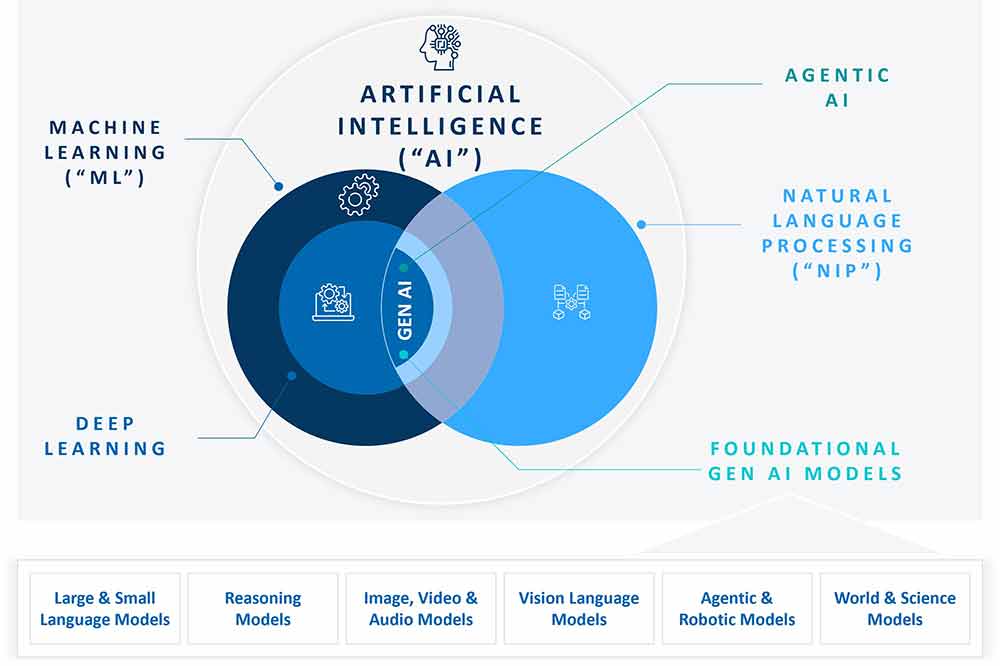
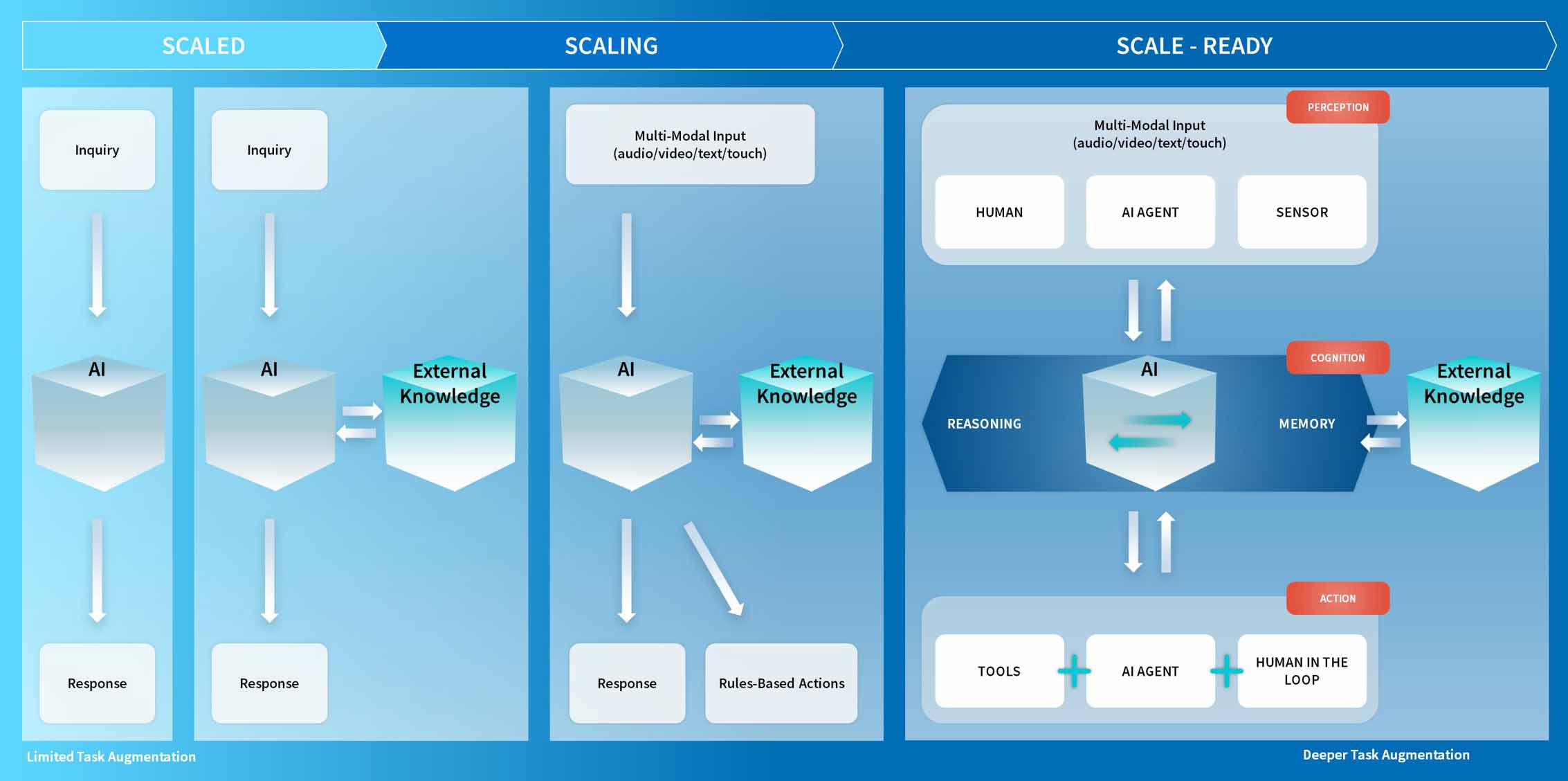
New model architectural improvements (e.g., mixture-of-experts, inference-time reasoning, memory optimization, context extensions and real-time skill loading) are dramatically improving performance capabilities while reducing inference cost. Most importantly, these evolutions — along with protocol standardization such as the model context protocol (“MCP”), which lets AI systems discover and use external tools — have led to maturing agentic AI that allows models to execute complex workflows with varying degrees of autonomy.
Agentic interactions have rapidly scaled into a production-ready technology. Agent frameworks from leading Big Tech and open-source providers including Google, Microsoft, LangChain, Nvidia, OpenAI and others achieved general availability in 2025, thereby reducing barriers for enterprise, and have even found their way into consumer use through emerging viral applications such as OpenClaw and agentic browsers like OpenAI Atlas and Perplexity Comet.
Evolution of Agentic Architecture
AI-optimized hardware from a variety of firms including Amazon and Google are powering these advancing models, in turn challenging Nvidia’s position and contributing to a widespread, historic global investment in data center buildout. The trillions being spent on AI represents the biggest investment of its kind in recent history, rivaled only by capital expenditures on the internet, highways, railroads and electrification.
As a result, there has been an astonishing diffusion and adoption of AI across global populations and industries. In the consumer AI market, for instance, ChatGPT and Gemini logged 810 million and 750 million monthly active users, respectively, by the end of 20252 — up from practically zero just three years ago. In enterprise, AI spend in 2026 is expected to exceed $2.5 trillion by some estimates,3 with close to half of that expected to go towards non-infrastructure spending including services, software and platforms.
Five Priorities for Companies in 2026
Despite record spending on AI in the hope that it drives value creation, companies continue to struggle in capturing financial gains. This is common, however, for rapidly evolving technology cycles. Case work with dozens of firms across sectors — varying in size and complexity — have revealed common reasons for this gap between potential and realization.
This year, we expect enterprise AI adoption to deepen, driven by improved AI performance, economics and operating model strategies. Companies that pause investment in AI risk falling behind, thereby accumulating intuition debt and credibility gaps that may prove difficult to close.
With such a narrow window for disciplined investment, leading organizations will need to achieve the following consistently to maximize their chances of success:
- Concentrate capital and leadership attention on a limited set of use cases, with clear EBITDA or growth impact while developing a strategic plan for scaling after early flywheel successes.
- Redesign operating models and decision rights alongside technology deployment, to improve productivity and enterprise clock speed.
- Use AI to drive business model innovation for revenue growth and differentiation, not just efficiency and productivity gains.
- Build flexible, scalable architectures and platform capabilities that allow rapid adoption as AI technologies continue to evolve and mature.
- Drive workforce AI enablement and upskilling to ensure that employees remain well equipped to leverage new technologies and realize productivity gains.
How To Move Forward
By taking the above five steps, firms will enhance their prospects in a competitive and rapidly changing landscape. As the pace of advances and adoption accelerates in 2026, performance gaps are expected to widen between AI leaders and laggards, and execution capabilities around AI deployment will increasingly become a competitive differentiator. Fortunately, firms that become more AI-native in their approach are more likely to see tangible financial success, competitive advantages and clear executions that command premium valuations.
1. Sumeet Gupta and Carl Jones, “AI’s Impact on Business Transformation: Seven Structural Shifts,” FTI Consulting.
2. Lauren Forristal, TechCrunch, “Google’s Gemini app has surpassed 750M monthly active users,” TechCrunch (February 4, 2026).
3. “Gartner Says Worldwide AI Spending Will Total $2.5 Trillion in 2026”, Gartner (January 15, 2026).
The views expressed herein are those of the author(s) and not necessarily the views of FTI Consulting, Inc., its management, its subsidiaries, its affiliates, or its other professionals.
Related Insights
Related Information
Published
March 06, 2026
 Key Contacts
Managing Director