

AI’s Impact on Business Transformation: Seven Structural Shifts
AI Has Fast Evolved Into an Economic Force Reshaping How Value Is Created, Captured and Sustained
-
March 02, 2026
-

Read the second article in this two-part series, “AI’s Impact on Business Transformation: Five Priorities for Firms.”
Introduction
Since 2023, when our team first started publishing analyses1 on AI development, there has been an unprecedented acceleration in technology and a dramatic inflation in expectations that has led to the biggest hype and potential for value creation since the dot-com era. Now, a broader trajectory has become apparent — including several long-term structural shifts in how AI is transforming businesses.
Over the past two years, we observed the market’s approach to AI. Some companies were carried away by hype and made undisciplined investments. Others, who chose to stay on the sidelines, accumulated AI intuition debt: a compounding lack of understanding of AI in the workforce at all levels that prevented them not only from using AI for everyday efficiency, but also inhibited new ideas for future value creation. The lack of ROI on the former approach was tangible, but the consequence of the latter — while not immediately measurable — is also likely to negatively impact firms, as periods of disruptive change throughout history suggest.2
Artificial Intelligence Expectations vs Value Creation Potential
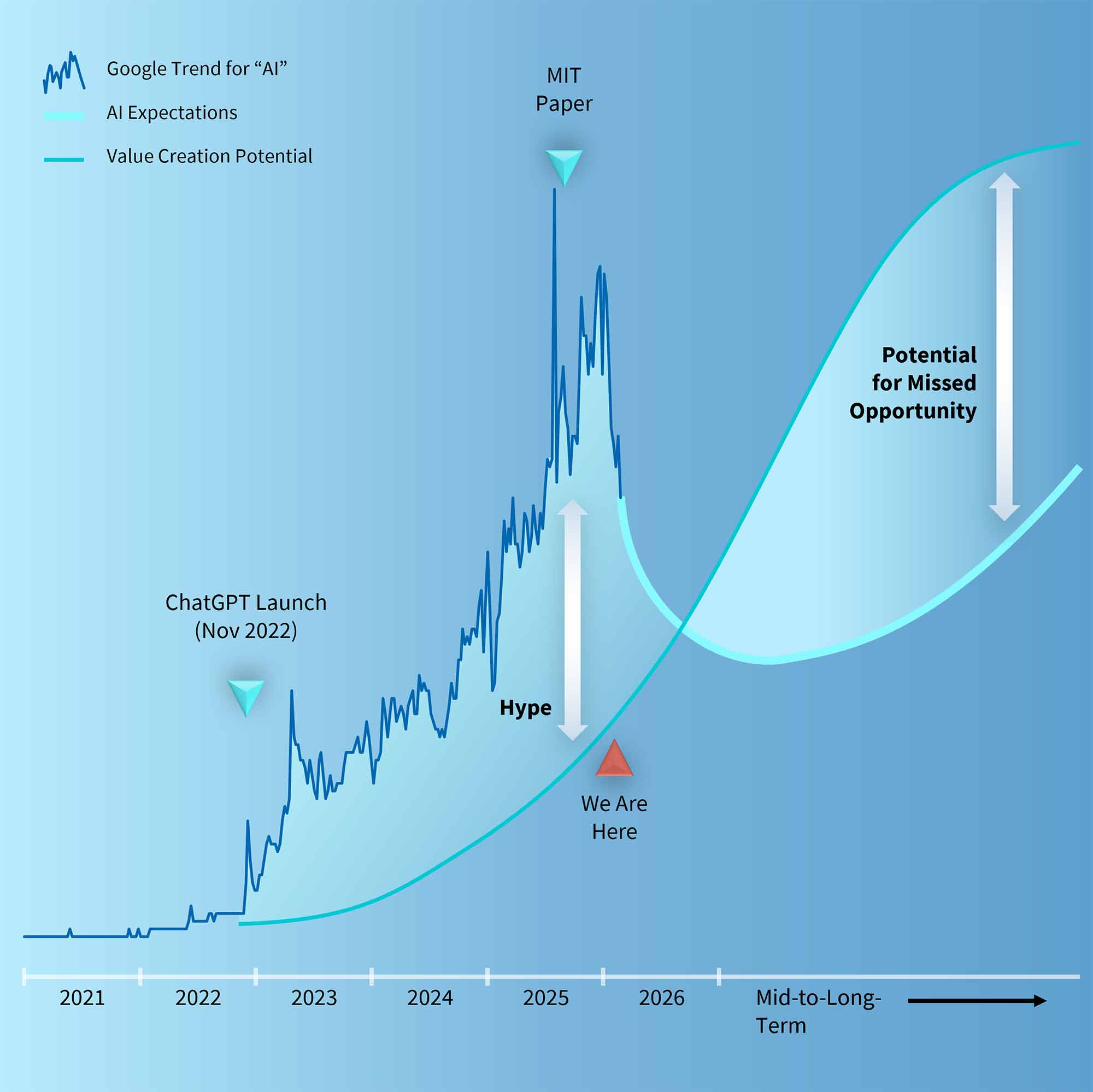
The past year has seen clarity emerge in two key areas, which we expect to impact firms’ approaches to AI development and implementation in the coming year:
- Long-term structural shifts in how business is conducted are becoming more apparent. Companies are increasingly aware of the first-principles thinking required to successfully address the AI transformation, as the technology continues to change how business takes place.
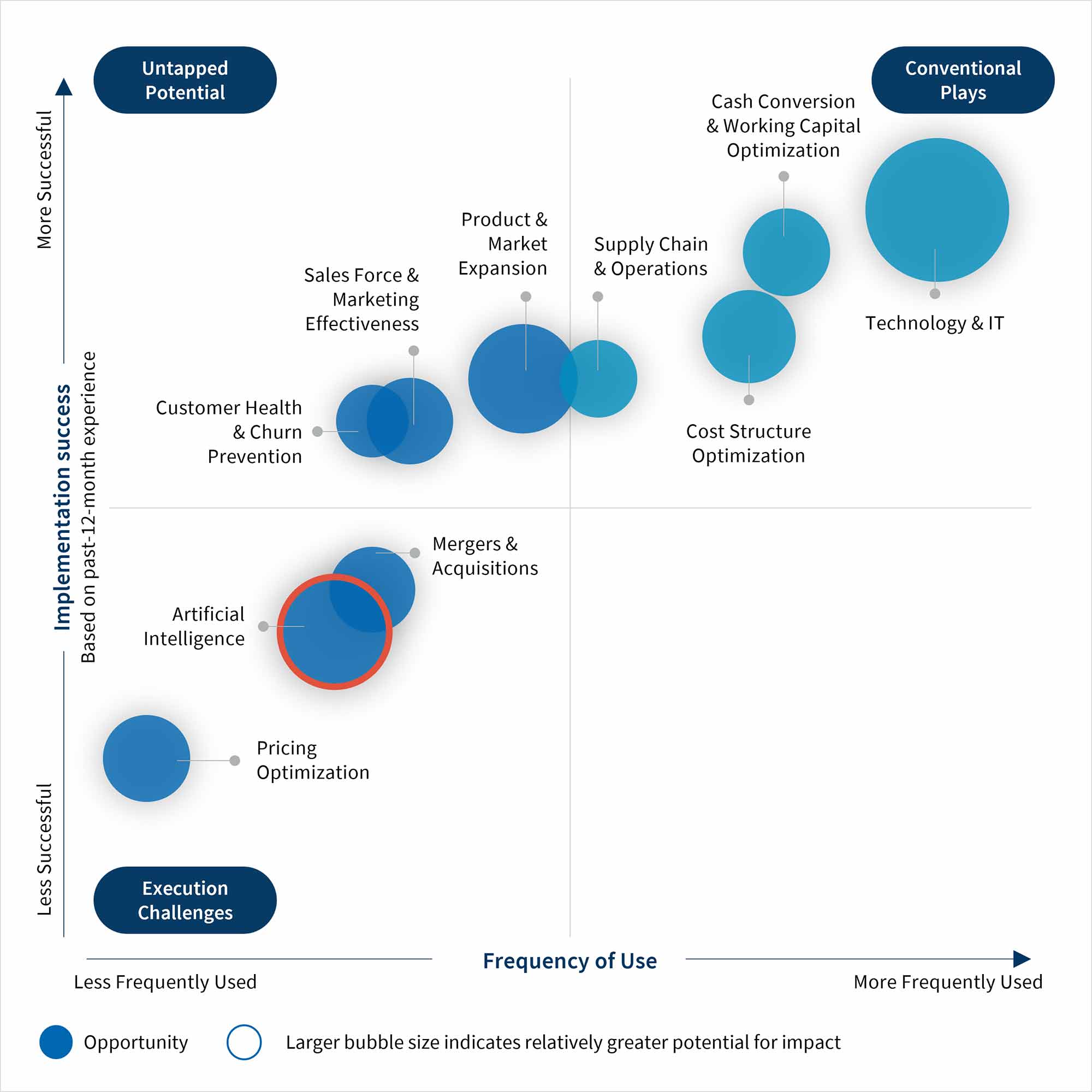
- Hype and expectation curves are approaching equilibrium. The frothiness of the hype peak is dissipating, while the maturity of AI value creation has progressed to a point where broad systematic value creation is visible despite the likelihood of continued local volatility and plenty of surprises. Indeed, a majority of the companies from our 2025 survey cited AI as both their largest value creation lever and their greatest execution challenge.3
Seven Long-Term Shifts
We expect AI to drive seven structural long-term shifts in the economics of how business is conducted. Sectors may experience the following shifts differently, at varying speeds and time scales, due to underlying industry economics and market mechanics. They include:
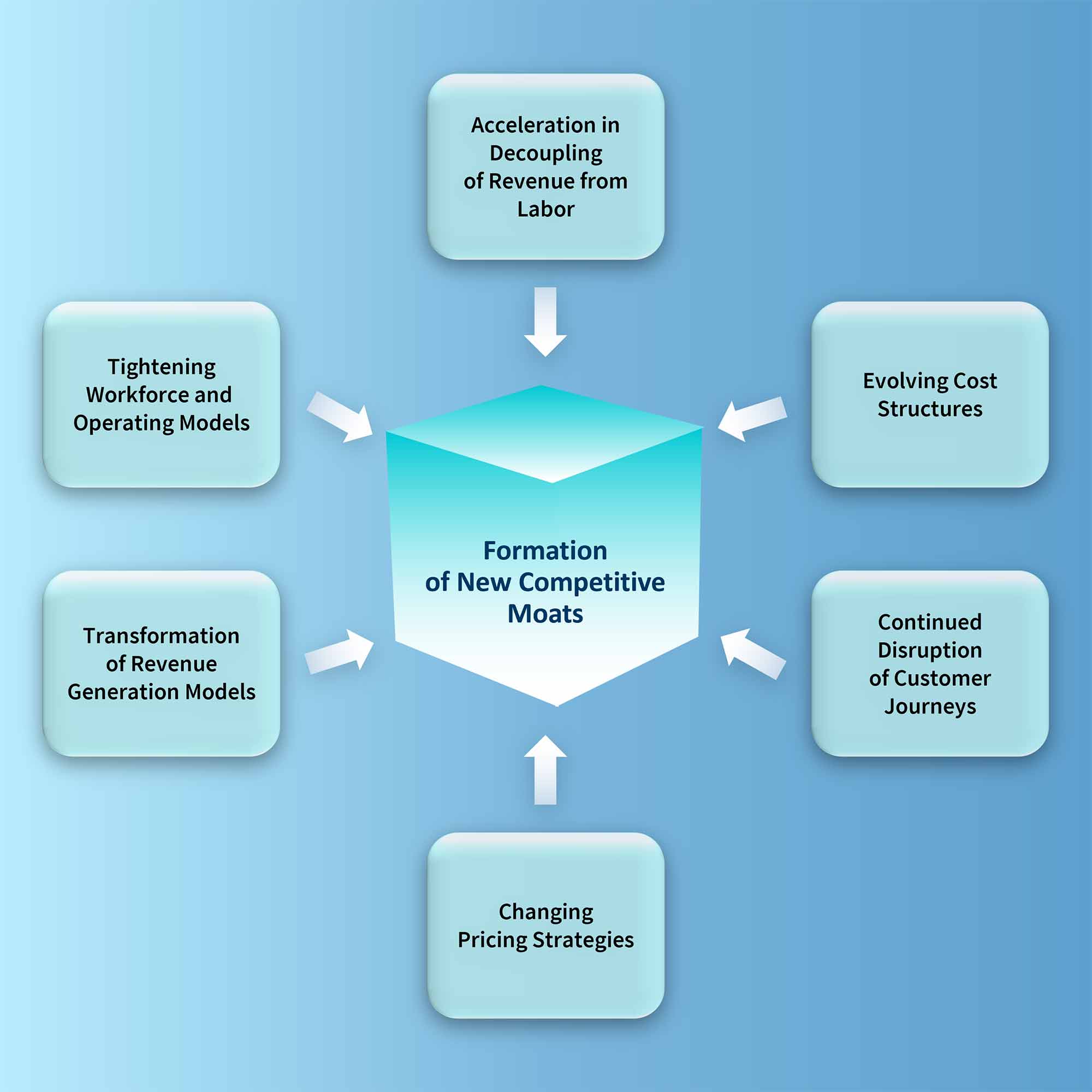
- Acceleration in Decoupling of Revenue from Labor: Digitization of business in the past two decades has increasingly decoupled value generation from human labor. As AI automates cognitive work, an AI-powered workforce is likely to drive revenue growth, accelerating this decoupling for various functions and sectors. This could drive a secular rise in revenue-per-employee as a competitive metric, with early evidence visible from emerging AI-native companies.
- Evolving Cost Structures: The marginal cost of many services (e.g., support, content, analysis, design) will trend toward zero over time, driving EBITDA expansion. Many fixed-cost items will move from labor to compute and data as they become automated, and firms will face greater upfront fixed costs for supporting transformation mandates. In the long term, however, variable costs will come down per unit of revenue expansion.
- Continued Disruption of Customer Journeys: Increasing digitization, social and mobile technologies have disrupted customer journeys over the past decade. Agentic AI now dramatically reduces information arbitrage and causes the conversion funnel of product and service discovery to become high velocity, automated, nonlinear and triggered from a diverse assortment of emerging AI surfaces. As information is commoditized, a premium will need to be placed on differentiation through better experiences, more personalization and overall quality of service to drive customer engagement, conversion, willingness to pay and loyalty.
- Changing Pricing Strategies: As efficiency becomes table stakes in AI, exposed sectors and functions will see pricing compression and EBIT pressure. This will lead to strategies for pricing and margin expansion driven by differentiation, such as proprietary assets, data, brand, domain knowledge and patents. New pricing models, like those based on outcomes, successes and quality metrics, will continue to be tested with greater frequency and maturity.
- Transformation of Revenue Generation Models: As AI transforms the nature of products, services, sales/fulfilment channels, customer segments and perceived value, it will have far-reaching impacts on additive and net-new revenue expansion opportunities. Companies with unique content, data or domain knowledge IP will find new ways to monetize it with AI. AI engagement surfaces (like chatbots) are already experimenting with new ad models through their interfaces, serving as new channel mediators that companies can monetize for better product and service discovery. A leading media company, for instance, was able to apply AI to their existing content products to develop product categories for new markets and customer segments in just a matter of weeks.
- Tightening Workforce and Operating Models: As human and AI labor intermingle, enterprise execution and decisioning clock speed will become faster, driving greater output and outcome-based expectations from the workforce. Current job definitions will blur and merge as AI occupies interstitial workspaces and takes over tasks (e.g., field and service ops teams may converge, or roles between product and R&D teams may blur). We expect this shift to cause most companies to consider flatter organizations, fewer management layers and more decentralization with federated governance.
- Formation of New Competitive Moats: Traditional moat generation based on process, information arbitrage, capital and labor access becomes a weaker proposition as AI changes the economics for each of these categories and allows competitors to move more easily into adjacent businesses. Software-like scalability effects will increasingly impact non-digital industries as AI natives take functional expertise, turn it into digital infrastructure and scale digital platforms that are based on first principles without legacy operational baggage. Building a competitive moat will increasingly hinge on proprietary data, unique domain knowledge and inherent brand equity, as well as an organization’s ability to drive feedback iterations with high velocity and to establish a level of AI integration that drives operating model changes.
How To Move Forward
AI has quickly evolved from a revolutionary technology cycle to a structural economic force reshaping how value is created, captured and sustained. Yet, while sector-specific differences exist, a broad-based competitive divide is steadily beginning to form between firms. This will continue to manifest in the speed and seriousness with which they recognize structural shifts across their business and apply first principles thinking to operating and business model transformations.
Companies that treat AI as a marginal efficiency tool risk incremental gains in a period of exponential change. On the other hand, firms that redesign cost structures, revenue models, talent strategies and competitive moats will define the next generation of market leaders. In the second part of this series, we examine key drivers of the above structural shifts and five priorities for executives in 2026.4
Footnotes:
1: Sumeet Gupta, Claudio Calvino and Madhur Mahajan, “The Fourth AI Inflection,” FTI Consulting (June 12, 2023).
2: Sumeet Gupta, “The Shape of the Fourth AI Inflection in 2025,” FTI Consulting (January 27, 2025).
3: 2025 Private Equity Value Creation Index, FTI Consulting (2025).
4: Sumeet Gupta and Carl Jones, “AI’s Impact on Business Transformation: Five Priorities for Firms”, FTI Consulting (March 6, 2026).
The views expressed herein are those of the author(s) and not necessarily the views of FTI Consulting, Inc., its management, its subsidiaries, its affiliates, or its other professionals.
Related Insights
Related Information
Published
March 02, 2026
 Key Contacts
Managing Director