


Many Global Consumers Are Avoiding the U.S.
Impacted Businesses Unlikely To See Much Relief in 2026
-
March 13, 2026
Downloads Download Article
-

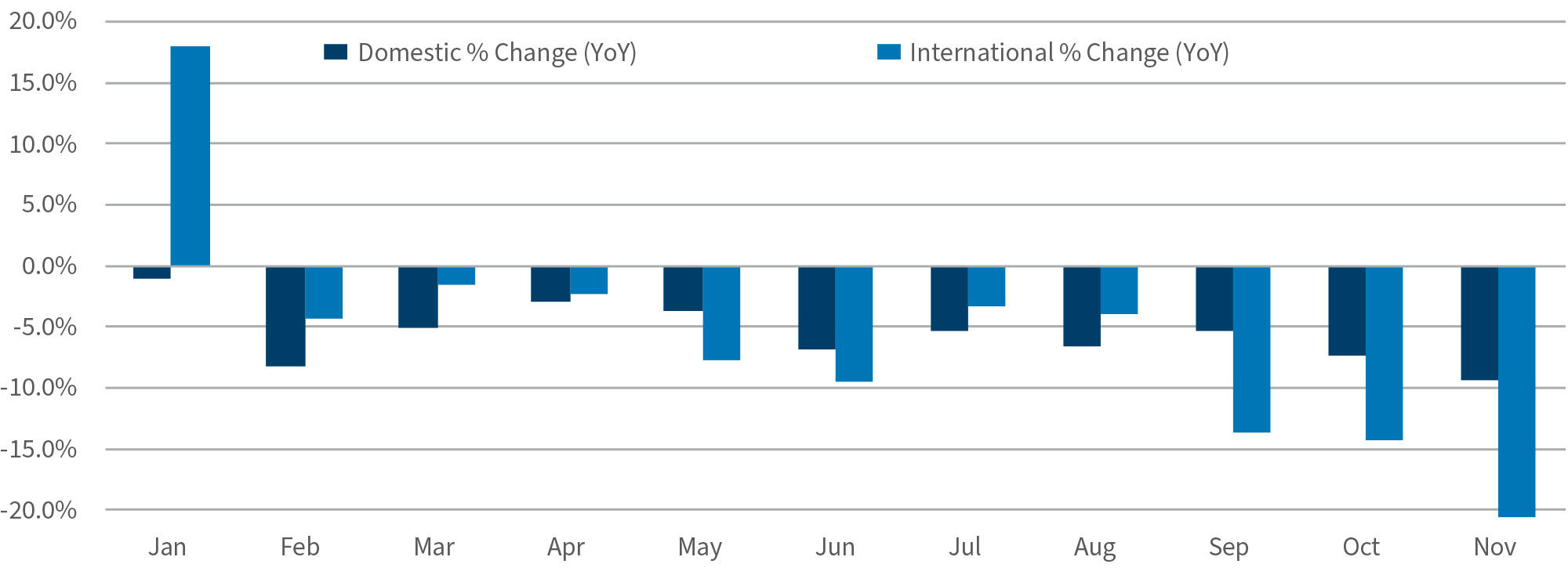
Las Vegas just finished a dismal year for tourism in 2025, with the number of visitors to the city declining by 7.5% YoY. It is hard to fully convey what a large annual drop that is for Vegas, which usually experiences modest annual changes in tourist visitation. The 38.5 million visitors to Las Vegas last year made the lowest annual total since 2010, excluding the COVID-impacted years of 2020-2021, and set back the steady recovery in tourism since the pandemic ended. Hotel occupancy rates fell by more than 300 bps in 2025, to 80.3%, with the sharpest declines coming in the second half of the year.1 There are, of course, several reasons why Las Vegas struggled to attract tourists last year, including the financial struggles of casual gamblers and off-putting price hikes for a variety of ancillary services, such as entertainment, dining, parking and resort fees. But the decline in international tourism to Las Vegas, particularly as trade frictions increased, materially contributed to the steep fall-off in tourist visits. International flight arrivals to Las Vegas fell 6.0% overall last year, with monthly declines accelerating after March and reaching double-digits in the fourth quarter, considerably steeper than the decline in domestic flight arrivals (Figure 1). Tourists arriving via international flights account for nearly 7.0% of total flight arrivals into Las Vegas but those visitors tend to stay longer and spend more than domestic tourists.
Certainly, an avoidance of the U.S. as a vacation destination by foreign travelers has factored into the Vegas tourism decline. Preliminary data shows Las Vegas visits by Canadians declined by approximately 20% in 2025 from 1.4 million visitors in 2024, while airline capacity between Las Vegas and Canada is down by approximately 35%, to its lowest level since 2006.2 The falloff in Las Vegas tourism is an open secret in the city, and it has the attention of many local officials who acknowledge that the decline in international visitation, particularly from Canada, is a significant contributing factor and are devising plans to win them back.
More recently, some travel officials fear that Europeans may also choose to alter their travel plans to America in 2026 as well. While the travel and leisure sector is counting on a bounce-back year for international tourism to the U.S. following a decline in 2025, travel intentions for the busy summer season remain uncertain, except perhaps for World Cup travelers.
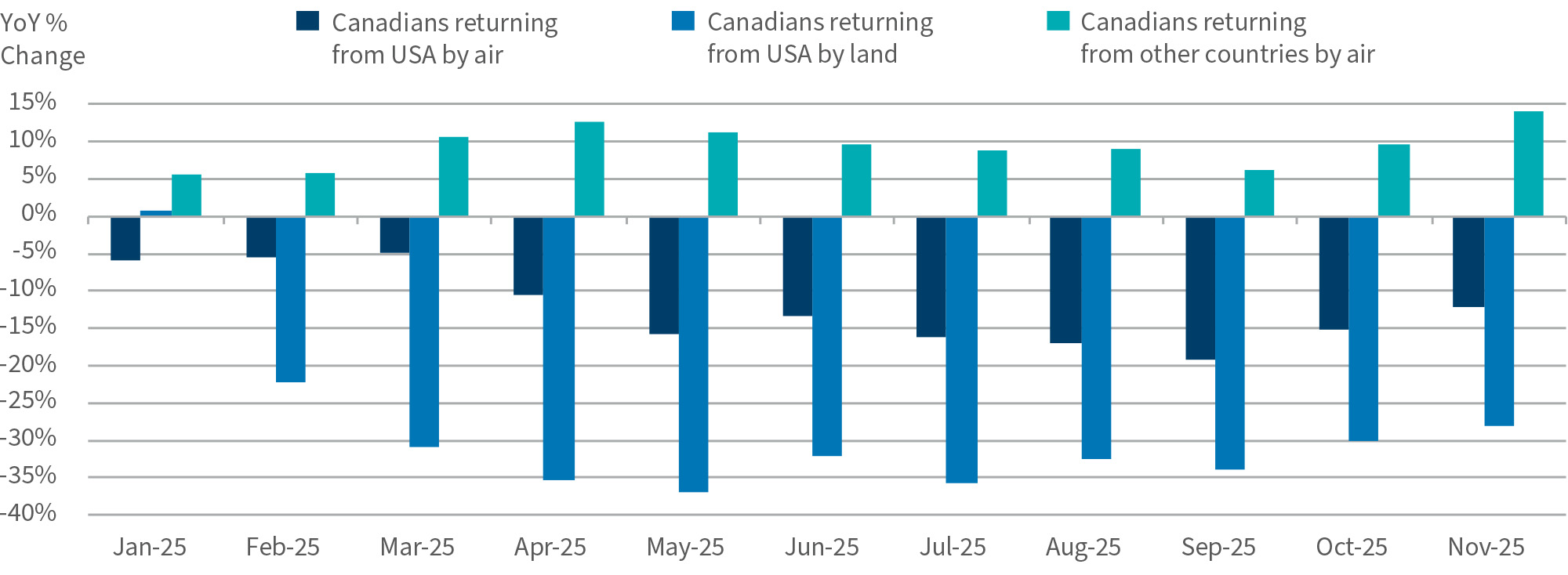
But Las Vegas isn’t the only U.S. destination that Canadians are avoiding; travel here by our northern neighbors is down sharply everywhere, with land travel especially hard hit. Statistics Canada reported that Canadians returning from U.S. visits by air and land fell 15% and 33%, respectively, since April 2025 (Figure 2). Land travel accounts for just over two-thirds of all trips to the U.S. by Canadians. Local news stories from our northern states that share a border with Canada now regularly feature articles highlighting the negative impact of falling Canadian tourism on small businesses and local economies.3 A recent report issued by the Joint Economic Committee (Minority) of the U.S. Congress indicated that the number of passenger vehicle crossings from Canada to our border states was down nearly 20% (YoY) from January through October, with steeper declines registered during the all-important summer travel season.4 Overall, this avoidance is causing considerable economic pain in those locales, which doesn’t necessarily make its way into national media news coverage.
And Canadians are doing more than avoiding travel to America; many are boycotting our exports as well, with the most notable example being American wines and spirits. Canada represents the second largest export market for American-made distilled spirits, and that market has nearly collapsed since April. The export value of American spirits to Canada fell by 85% in 2Q25 and by 73% from March through October compared to prior year periods, according to the Distilled Spirits Council of the United States, as Canadians increasingly switched to domestic brands.5
But it is not just Canada cutting back on consumption of U.S. spirits; export sales to the UK, Japan and the EU each were down by double-digits in 2Q25, including a 12% YoY decline in the EU, by far the largest export market for American spirits, accounting for nearly 50% of a $2.5 billion market for U.S. exports in 2024.6 Lastly, U.S. wine exports to Canada—by far the largest export market for U.S. wines—fell by 91% YoY from March through August, according to the Wine Institute. There’s little reason to believe this dynamic will improve much in 2026.
Coupled with a gradual but steady decline in hard alcohol consumption by Americans, the sudden and severe decline in spirits exports has wreaked havoc on our domestic industry, resulting in a badly oversupplied whiskey and bourbon market, rising inventory levels and falling values of aging barrels and bankruptcy filings by seven major distilleries in 2025. Most recently, Jim Beam announced it was indefinitely suspending production at its largest bourbon distillery, perhaps for the entirety of 2026. Again, these tend to be small middle market businesses that don’t grab national headlines, but if you live in Kentucky or Tennessee or Napa Valley, you are keenly aware of the turmoil that has beset the wine and spirits business and the role that our tariffs have played in alienating previously loyal global customers.
Figure 1 - Deplanements at Harry Reid Airport Las Vegas: 2025 vs. 2024
Source: Las Vegas Convention and Visitors Authority
Figure 2 - International Travel by Canadians: 2025 vs. 2024
Source: Statistics Canada
Economic Backlash Is Poised To Continue in 2026 and Impacted Business Casualties Will Mount
None of these developments on their own are large enough to undermine overall U.S. economic growth, but they are causing considerable economic stress and anxiety in various parts of the country. Worse yet, impacted businesses have few good options within their control to counter this aversion to American goods and services and win back customers unless these actions are collective and organized within these afflicted industries. Even then, it is hard to know if global consumers can be wooed back with just a bargain.
Global consumers are increasingly voting with their feet – and closing their wallets – to U.S. goods and services. More importantly, distress currently seen in the tourism and wine and spirits industries as a consequence of negative sentiment from their customers may be a foreshadowing of things to come. Whether your business is selling vacation packages, hospitality services or domestically made food & beverage products to a global consumer audience, it could be a challenging year if these peeved patrons are a material portion of your customer base.
Footnotes:
1: “Tourism Analytics: Las Vegas 2025,” Las Vegas Convention and Visitors Authority.
2: “Canadian tourism in Las Vegas on downward trend, meets 2006 levels,” Fox5 Staff, Fox5vegas.com, January 14, 2026.
3: “Canadian visitors staying away from Vermont amid political tensions,” Calvin Cutler, WCAX.com, December 26, 2025.
4: “Amid Trump’s Tariffs, Declining Canadian Tourism Is Harming Businesses in Every State Along U.S.-Canada Border,” The Joint Economic Committee-Minority, December 10, 2025.
5: “Trade War Fallout: The Collapse of U.S. Spirit Exports to Canada in 2025,” Southern Ag Today, December 18, 2025.
6: “American Distilled Spirits Exports 2025 Mid-Year Report,” Distilled Spirits Council of the United States, distilledspirits.org, October 2025.
The views expressed herein are those of the author(s) and not necessarily the views of FTI Consulting, Inc., its management, its subsidiaries, its affiliates, or its other professionals.
Related Insights
Related Information
Published
March 13, 2026
 Key Contacts
Global Chairman of Corporate Finance