

The Great Visibility Reset: Winning the AI Discovery Layer
Key Considerations for Leaders Navigating AI Search
-
April 07, 2026
-

Two decades ago, the rise of the internet and web-based search, led by Google, fundamentally reshaped how businesses were discovered. Companies were forced to adopt new digital strategies for their brands, products, services and content to be found, engaged with and purchased. Those who adapted quickly captured outsized reach, demand generation and market share. Countless traditional businesses that failed to adapt saw their market positions erode as consumer demand shifted online.
Today, we are once again at a major turning point. The shift in discovery from web-based search to AI-driven discovery may be less immediately visible than the transition from print to the internet. But it’s changing the mechanics of how products and services are discovered, going beyond simple optimization for the latest search algorithm or AI platform — and requires a more sophisticated business strategy supported by a series of coordinated, multi-pronged tactics to win.
To compete in AI-driven discovery, companies must rapidly establish a baseline visibility strategy, prioritize high-impact AI search optimization (“AISO”) opportunities and adopt a continuous test-and-learn approach that keeps pace with evolving platforms and user behaviors.
Key Shifts Observed Across the AI Search Landscape
Early signals already point to structural shifts influencing how discovery works. ChatGPT now processes more than 2.5 billion prompts daily across 900 million weekly active users and 50 million paying subscribers, making it one of the most widely used information interfaces globally.1 At the same time, Google traffic to publishers has declined 33% globally and 38% in the United States year-over-year, while organic click-through rates have fallen 61% on queries where AI overviews appear.2,3
The discovery shift is confirmed by FTI Consulting’s 2025 Consumer Insights Survey, which found that 66% of consumers already use AI platforms to find information, approaching the 72% who still default to traditional search engines.4 Consumers are increasingly using AI across the full discovery spectrum, from information retrieval (83%) to entertainment (66%) and education (33%), signaling that AI is becoming a horizontal discovery layer across multiple consumer intents and journeys.
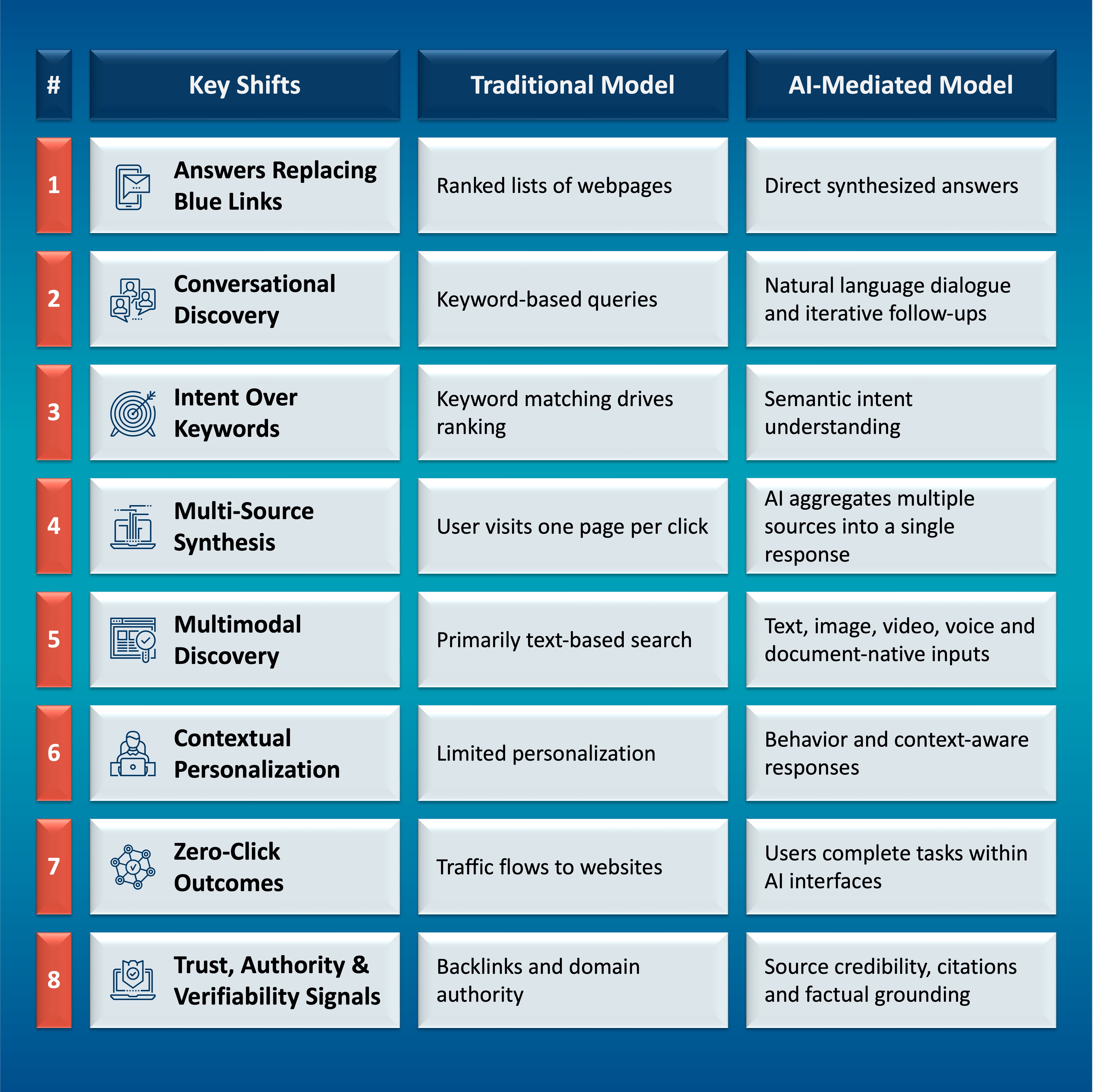
Below are eight key shifts that define the new information landscape, as discovery shifts from traditional search to AI search:
Figure 1: Key Shifts Exhibited from Traditional Search to AI Search
How Businesses Can Capitalize on These Shifts
Developing an effective strategy requires evaluating two key questions, based on sector dynamics and business goals:
- Sector Context: What is the nature of discovery and its implications by sector?
- Business Objective: What is a company trying to achieve through discovery optimization?
In our casework with leading companies across sectors, five core business objectives consistently appear:
- Visibility: Driving reach, share of voice and brand prominence
- Trust: Establishing credibility, domain authority and reputation in the category
- Customer Acquisition: Generating qualified leads and driving users into the conversion funnel
- Product/Service Recommendation: Ensuring inclusion in AI-generated recommendations, comparisons and decision criteria
- Customer Journey Compression: Simplifying complex research, comparison and decision journeys to accelerate conversion
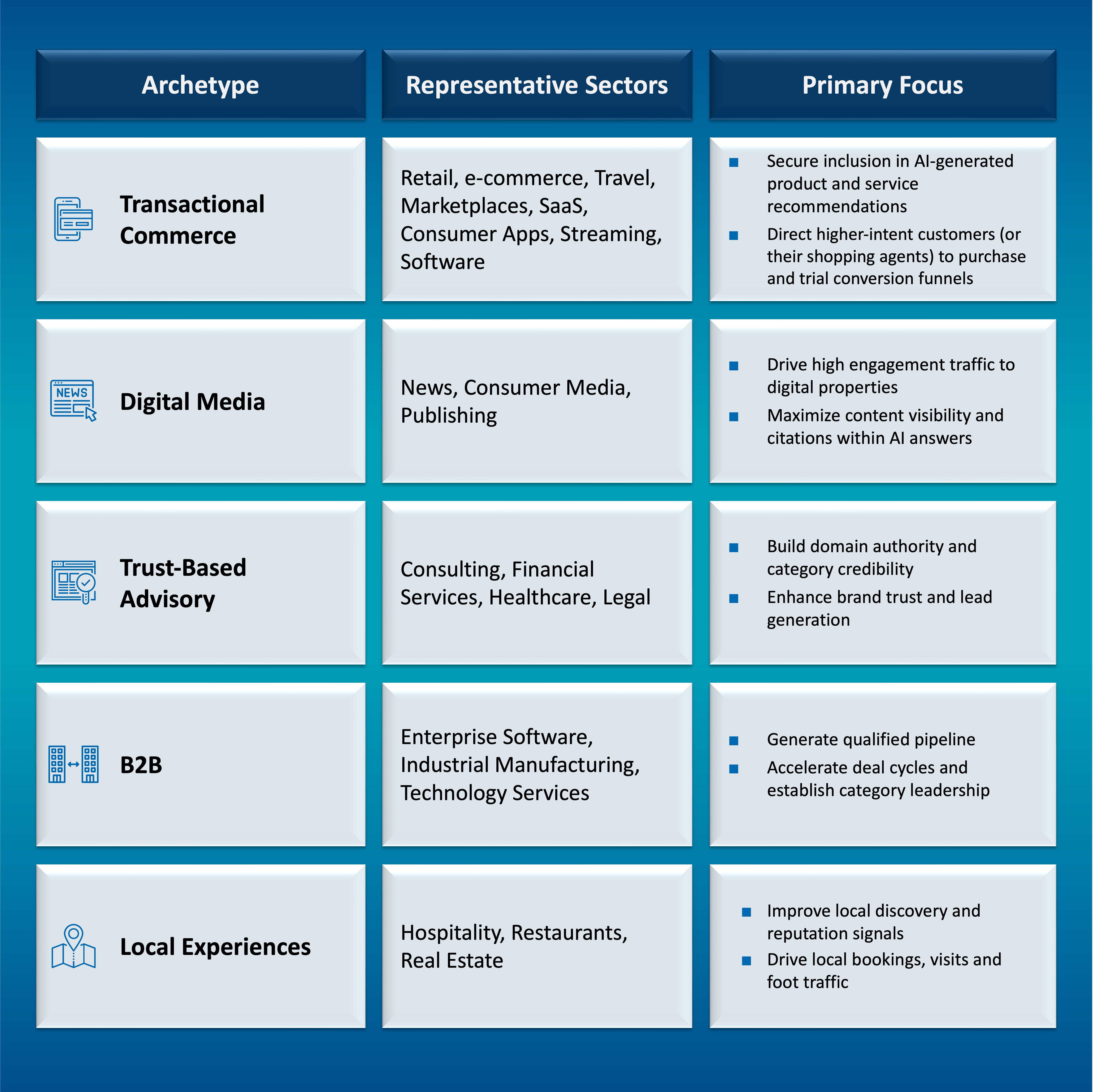
Additionally, five key business sector archetypes emerge (below), laying the groundwork for AI search optimization strategy:
Figure 2: Sector Archetype Matrix — Primary AISO Focus by Industry
Sharp declines in traditional search traffic, if addressed strategically, represent a critical opportunity to strengthen a brand’s presence across emerging AI discovery surfaces. For instance, a digital media company can offset lost traffic share by increasing visibility through AI citations on high-performing content, while systematically optimizing broader page cohorts to improve machine readability and citation likelihood. In parallel, improving on-site engagement quality can drive higher-intent AI referrals and incremental monetization through better ad performance, suggesting that in some cases these efforts may partially fund themselves over time.
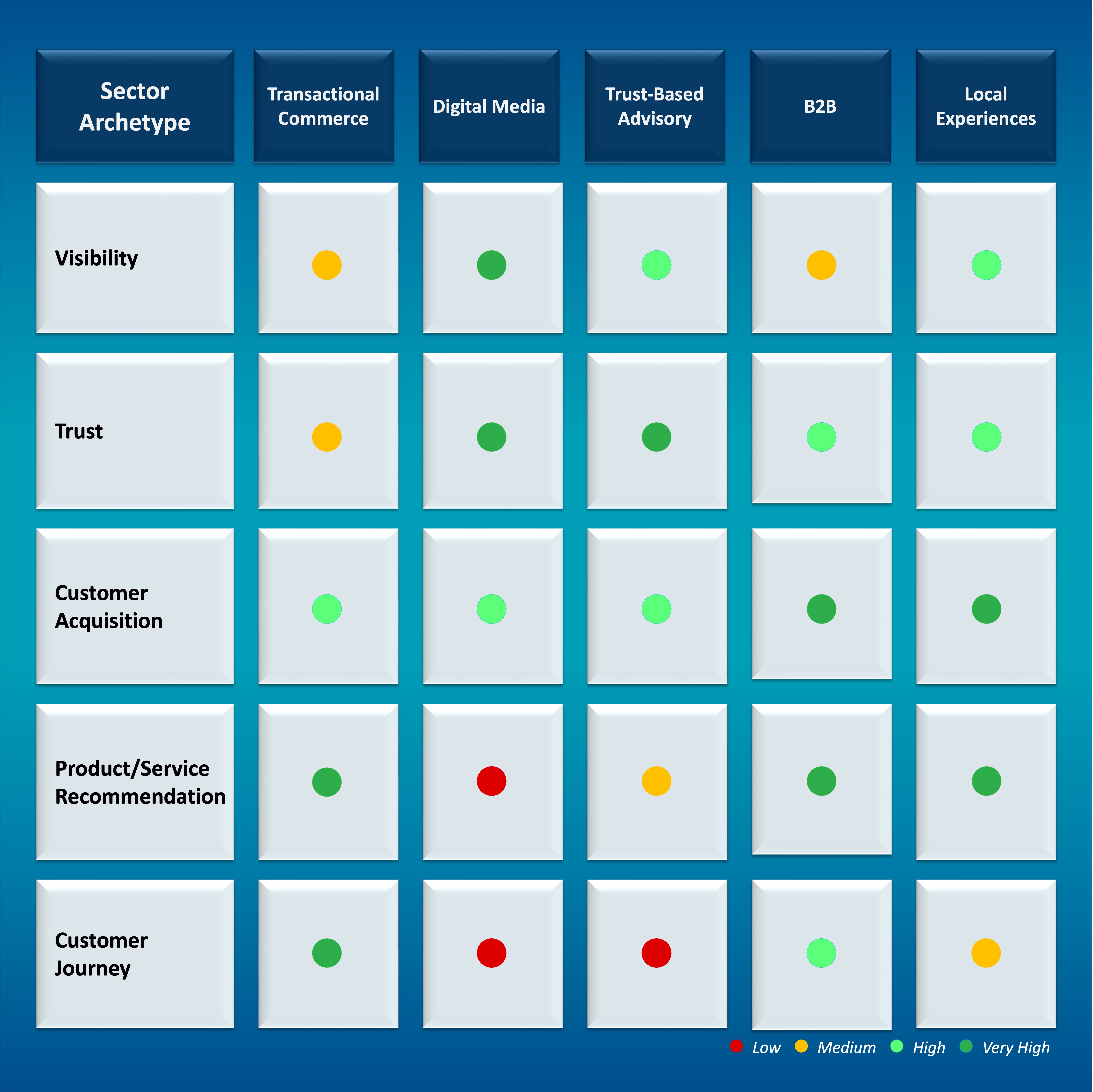
To develop an effective AI optimization strategy, companies should map their sector archetype to the key objectives of AI search optimization. The matrix below reflects observed patterns in how these objectives vary across sector archetypes, as priorities differ by organization.
Figure 3: AI Search Priority Weighting by Business Sector Archetype
Operationalizing AI Search Optimization
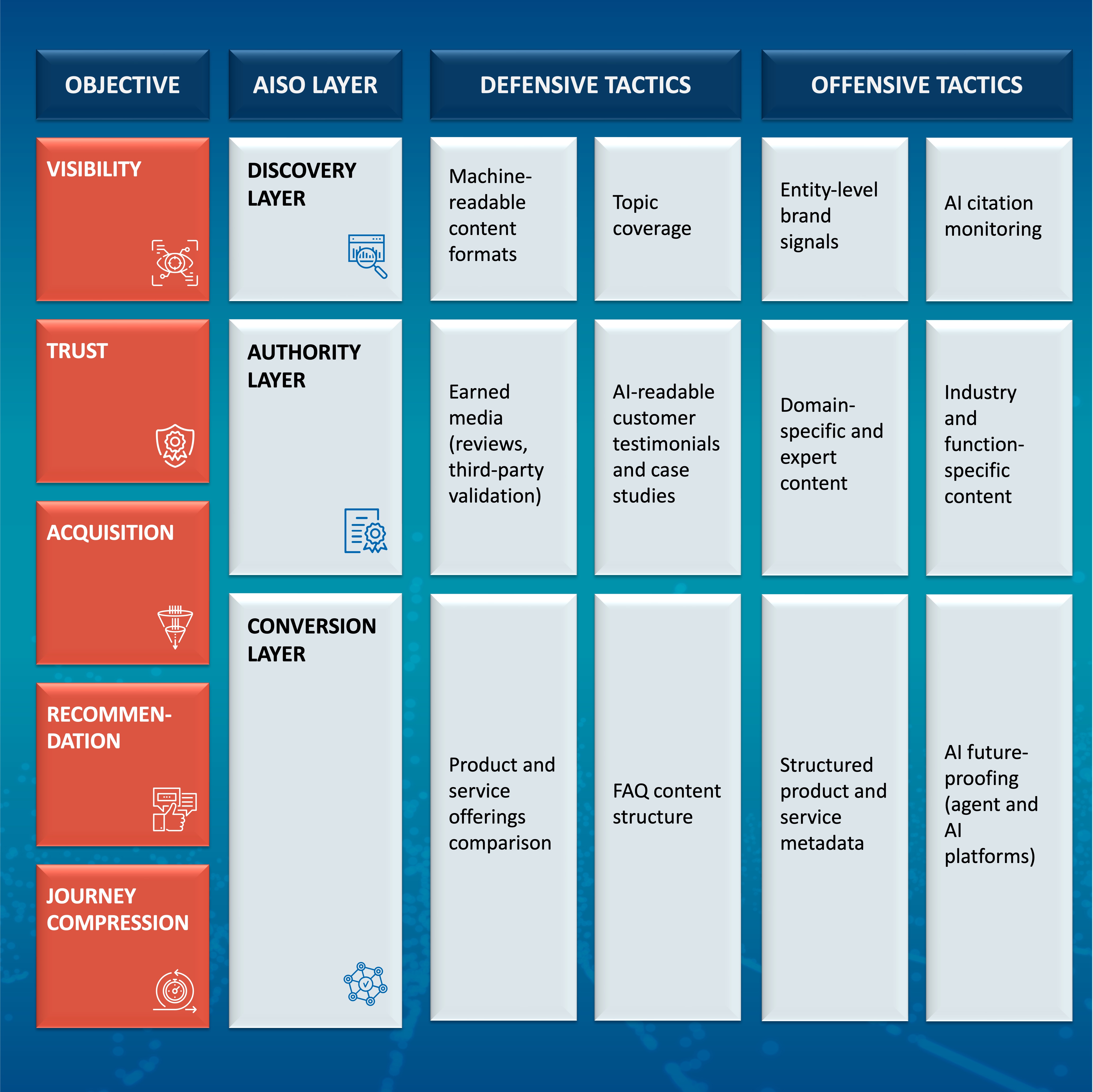
Mapping the intensity of different business objectives helps organizations determine how to navigate three distinct AISO control layers: Discovery, Authority and Conversion (see graphic below). Each layer is supported by a mix of offensive and defensive tactics, which will be explored further in part two of this series.
For example, in retail, the rise of shopper AI agents reshapes the customer purchase journey in complex ways, requiring retailers to evolve from managing a linear purchase funnel to optimizing a continuous decision loop.5 For most companies in this sector, focusing on defensive tactics that improve recommendation visibility, combined with offensive tactics that enable journey compression to conversion through agent-mediated commerce, will deliver the greatest impact.
Figure 4: Core AISO Control Layers Businesses Should Consider When Designing AI Search Strategies
The First-Mover Advantage in AI-Driven Discovery
AI platforms, features, channels and accompanying user behaviors are evolving rapidly. Rather than spending extended periods monitoring and analyzing these shifts, companies can benefit from quickly establishing a baseline AI discovery strategy and adopting a test-and-learn approach in the market.
By identifying the dominant discovery dynamics in their sector, mapping them to the most relevant business objectives and executing a focused set of tactics, organizations can quickly generate real-world feedback and refine their strategies. As the AI ecosystem continues to evolve unpredictably, companies that test, learn, and iterate early will be best positioned to adapt and capture emerging opportunities in AI-mediated discovery.
Footnotes:
1: OpenAI, “Scaling AI for Everyone” (Feb. 27, 2026)
2: Newman, Nic, “Journalism, Media, and Technology Trends and Predictions 2026,” Reuters Institute (Jan. 12, 2026)
3: McDonald, Tracy, “AIO Impact on Google CTR: September 2025 Update,” Seer Interactive (Nov. 4, 2025)
4: Guastafierro, Antonio, Francesco Di Ianni, Daniel Punt, and Jose Silva, “AI Implementation Across Search Has Entered the Mainstream and Is Redefining Information Discovery,” FTI Consulting (Feb. 23, 2026)
5: Gupta, Sumeet and Akshat Trivedi, “The Rise of AI Commerce and the Decline of Traditional Purchase Funnels,” FTI Consulting (Mar. 19, 2026)
The views expressed herein are those of the author(s) and not necessarily the views of FTI Consulting, Inc., its management, its subsidiaries, its affiliates, or its other professionals.
Related Insights
Related Information
Published
April 07, 2026
 Key Contacts
Managing Director
Senior Director
Senior Consultant