

The Rise of AI Commerce and the Decline of Traditional Purchase Funnels
Agentic AI Is Transforming the Path To Purchase and Redefining How Retailers Compete for Growth
-
March 19, 2026
-

Introduction
AI is driving long-term, structural shifts in how business is conducted.1 One example is the growing maturity and adoption of agentic AI by consumers and enterprises across internal and external customer-facing workflows. The rise of AI-mediated commerce is having a major impact on B2C and B2B purchasing behavior.
Agentic systems proactively observe, reason, plan, decide, act and adapt to changing contexts using various tools to interact with the external environment in increasingly autonomous ways.2 Now, shopping is evolving from a destination-based experience (e.g., sites, channels and stores) towards an AI-mediated experience, increasingly moving the purchase journey from search towards intent. As a result, the distance between inspiration and commercial transactions is collapsing — turning every digital moment into a seamless point of sale.
The Evolution of AI Into Agentic Systems
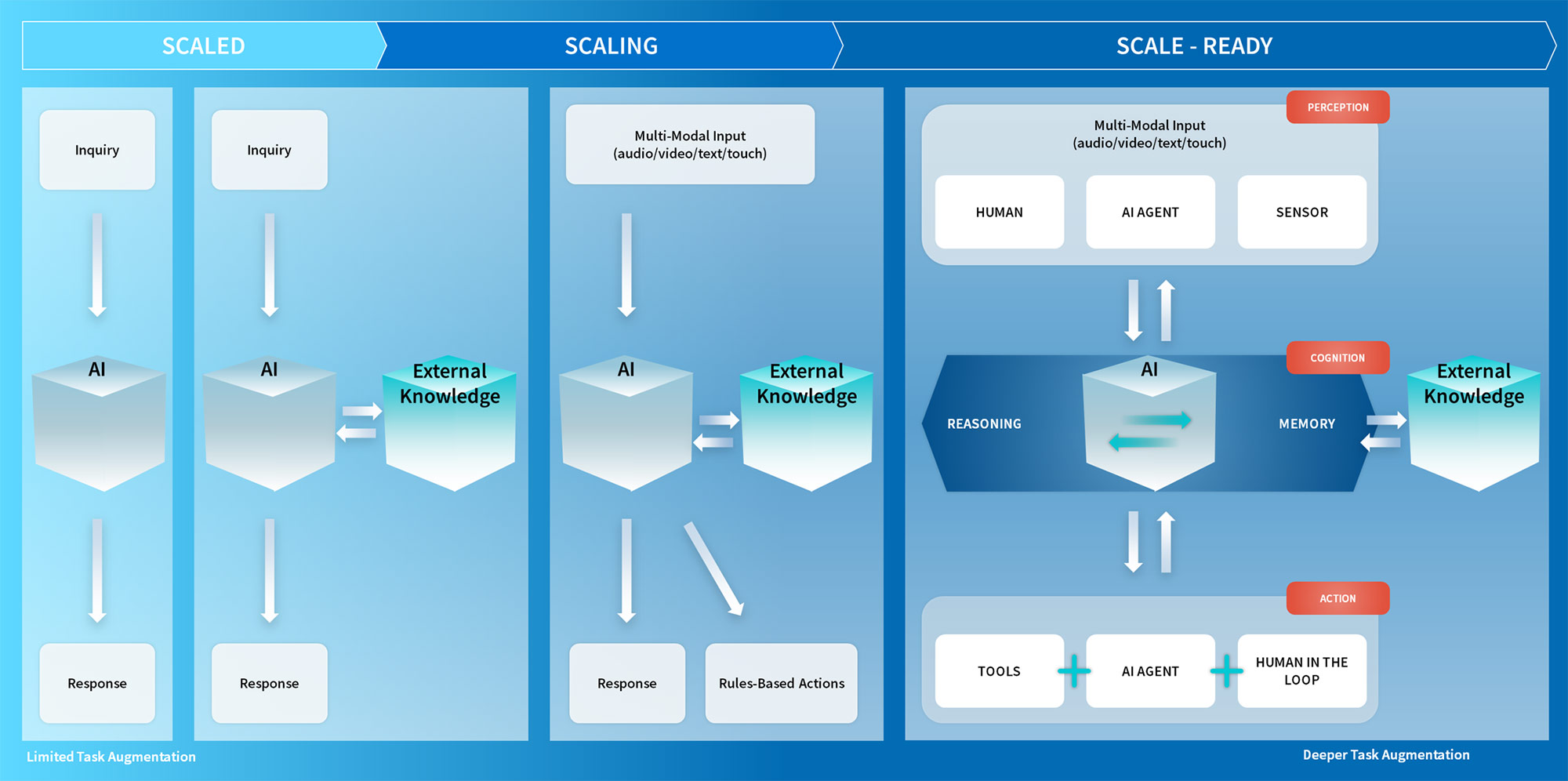
Growing use of AI in consumer-facing retail can already be seen in engagement on mainstream platforms like ChatGPT. According to the National Bureau of Economic Research, between May 2024 and June 2025, more than 2% of prompts on ChatGPT were for purchasable products; with 2.5 billion daily prompts in traffic that translates to more than 50 million daily purchase prompts on a single AI platform.3
The extent of this change becomes even more apparent when accounting for aggregate purchase intent across major AI platforms and the rapid provision of these models on consumer devices (e.g., the availability of Gemini on all Apple devices). As people move away from traditional search and increasingly use AI agents to perform tasks, consumer journeys will begin to look quite different.
An Anatomy of Agentic Shopping
For decades, retailers have optimized for customer journeys along some variation of the following model of a purchase funnel:
- Awareness
- Exploration
- Research
- Narrowing Selection
- Purchase
- Post-Purchase Engagement
- Repeat Purchase/Loyalty
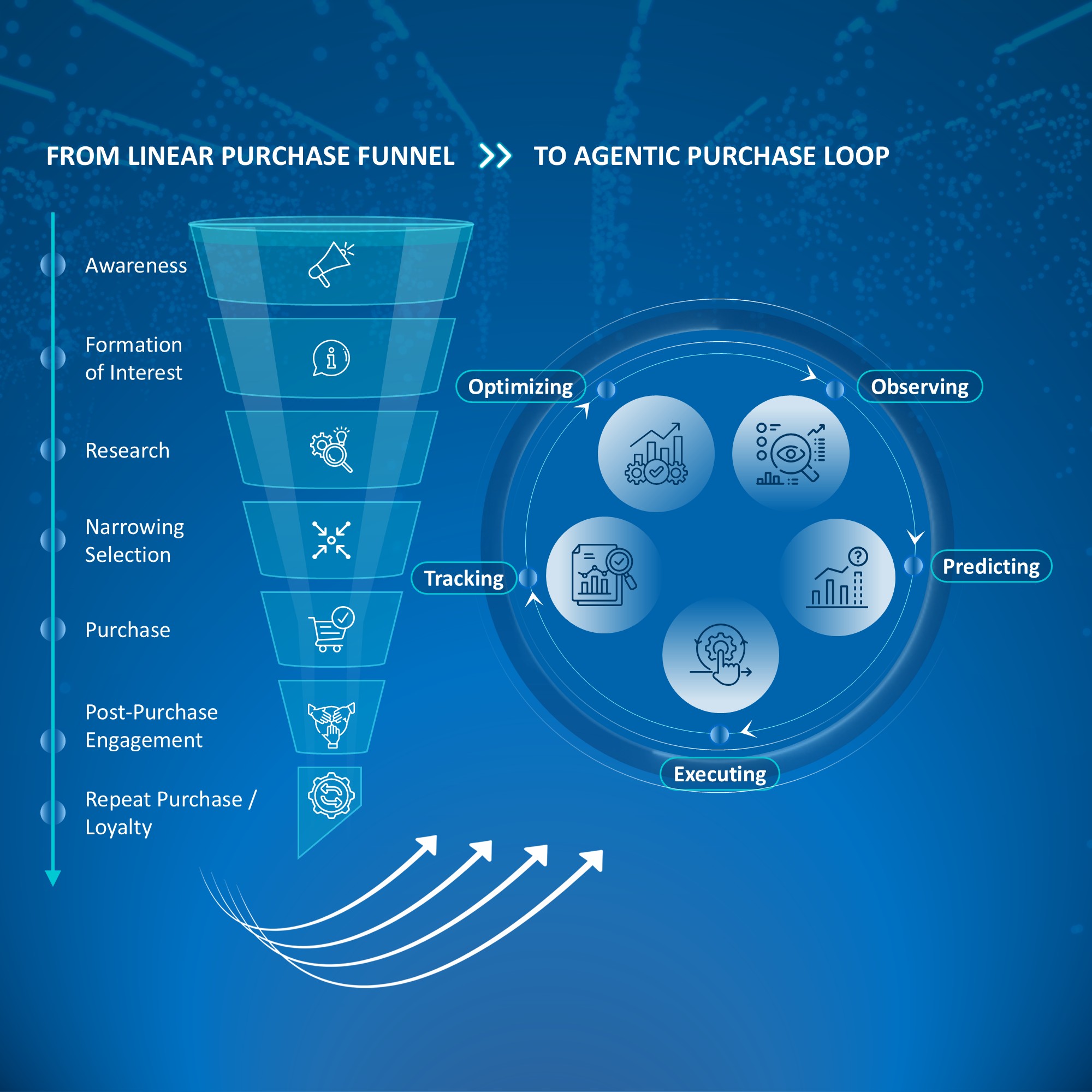
But this notion of a linear funnel is increasingly outmoded. As AI agents prioritize consumer intent and embed shopping into the moment of discovery, the gap between product exploration and purchase is disappearing. And as AI search surfaces proliferate and shoppers gradually adopt personal shopper AI agents working on their behalf, the consumer journey is beginning to resemble a loop: high velocity, compressed, personalized, non-linear and continuous.
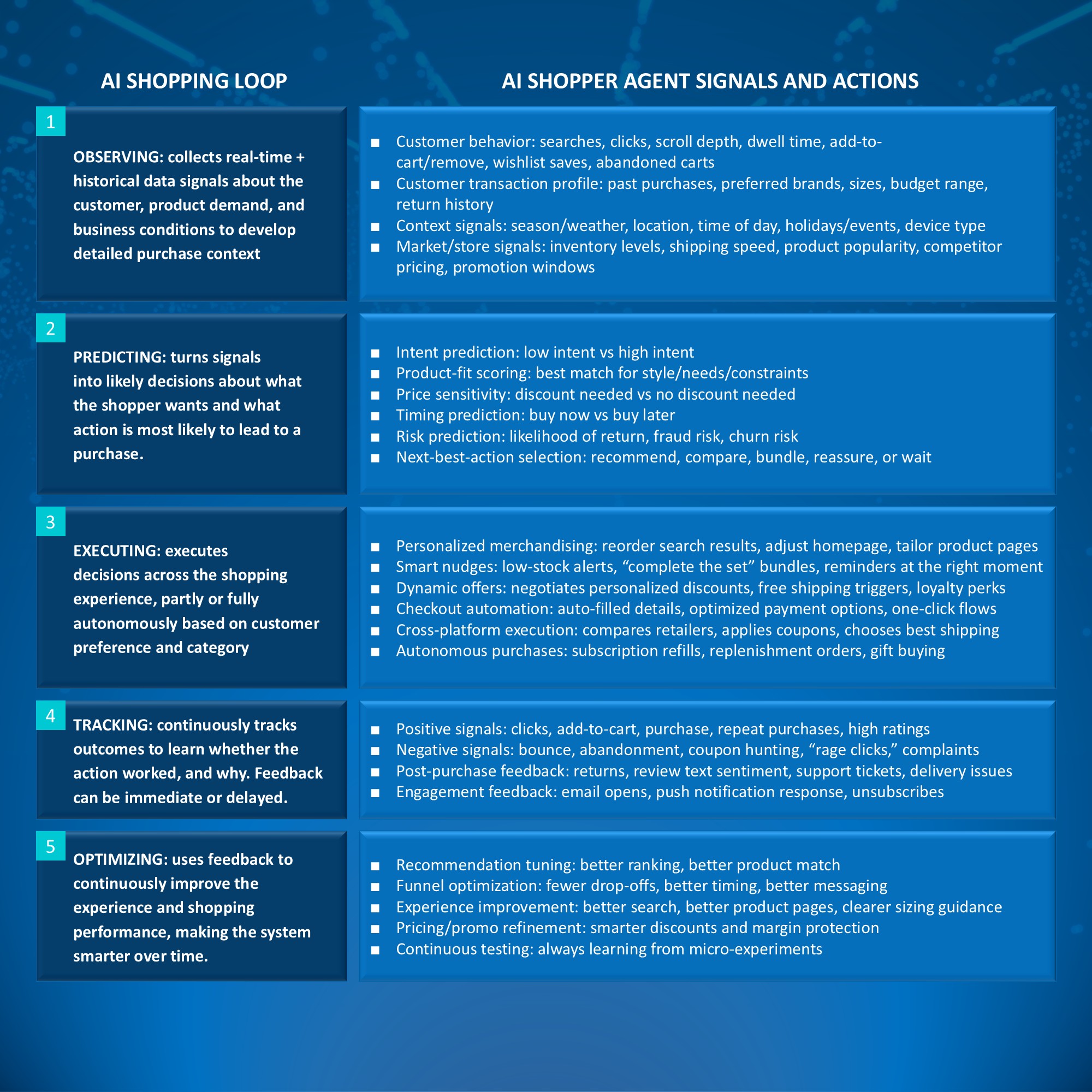
As a result, retailers will need to build their AI response across all channels so that they can collaborate with and optimize for agents and maximize their business performance. Below is a five-step model for how AI shoppers, working on behalf of consumers, will increasingly operate:
- Observing: collecting real-time and historical data signals about the customer, product demand and business conditions to develop detailed purchase context (e.g., seasons, holidays, time of day, inventory levels or shipping speed)
- Predicting: turning signals into likely decisions about what the shopper wants and what action is most likely to lead to a purchase (e.g., intent prediction based on product-fit scores, price sensitivity, timing or likelihood of return)
- Executing: executing decisions across the shopping experience, partly or fully autonomously based on customer preference and category (this could include reminders, automated purchases or dynamic offers)
- Tracking: continuously tracking outcomes to learn whether the action worked and why (feedback could be immediate or delayed, drawing on data including clicks, add-to-cart decision-making, repeat purchases or high ratings)
- Optimizing: using feedback to continuously improve the experience and shopping performance, making the system smarter over time (e.g., fine-tuning recommendations or producing better product pages)
Where To Focus Now
With an increasing consumer propensity to use AI systems during purchase, retailers must prepare to be seen and understood by both shoppers and their agents — searching, comparing, deciding and, eventually, completing transactions. For retailers across various categories, the window to build preference for an AI agent could converge quickly, and the cost of missing out on potential consumer consideration could substantially impact market position.
So, how can retailers adapt to this fast-changing retail landscape? Read the second part of this series for eight ways retailers can win business as consumer behavior shifts.
Footnotes:
1: Gupta, Sumeet and Carl Jones, “AI’s Impact on Business Transformation: Seven Structural Shifts,” FTI Consulting (Mar. 2, 2026).
2: Gupta, Sumeet, “The Shape of the Fourth AI Inflection in 2025,” FTI Consulting (Jan. 27, 2025).
3: Chatterji, Aaron, et. al., “How People Use ChatGPT,” National Bureau of Economic Research, (Sept. 2025).
The views expressed herein are those of the author(s) and not necessarily the views of FTI Consulting, Inc., its management, its subsidiaries, its affiliates, or its other professionals.
Related Insights
Related Information
Published
March 19, 2026
 Key Contacts