


Shopping in the Age of AI: Eight Strategies for Retailers To Win
How Retailers Can Effectively Prepare for the Rise of Agentic Commerce
-
March 26, 2026
-

Introduction: Key Trends
The first article in this two-part series discussed how AI-driven shopping experiences are rapidly changing the way people shop.1 As a result of growing adoption of AI agents in commerce, consumer journeys are moving away from a linear funnel structure towards a more continuous loop.
Although AI agents currently influence a small fraction of spend, the trajectory is exponential. Research indicates that by 2030, agent-influenced spend could impact around 10-20% of U.S. e-commerce as consumers transition over time from lighter AI-assisted modes, such as recommendations, to near-autonomous purchasing behaviors where the agent is orchestrating commerce workflows on the customer’s behalf.2
Figure 1 - The Trend for Adopting Agentic AI Commerce
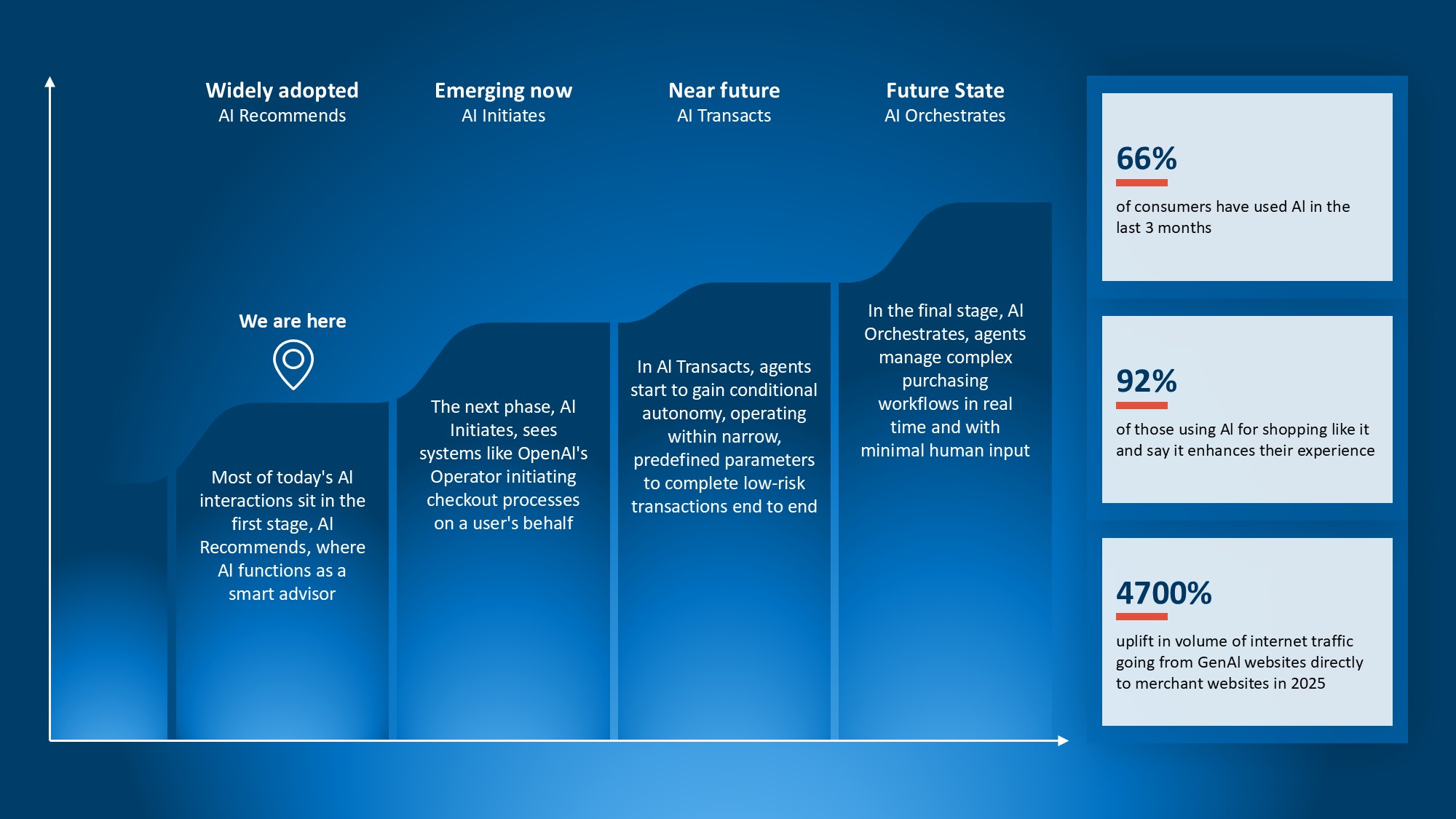
Sources: Retail Technology Review; Adobe Blog; Adobe for Business.3,4,5
Presently a majority of AI use appears to take place around supporting purchase recommendations. A recent analysis (below) of AI usage data shows that it is increasingly salient among consumers across “middle-of-funnel” shopping activities like exploring, comparing or researching products to make a decision.6
Figure 2 - AI Usage Currently Dominates the Middle of the Consumer Journey
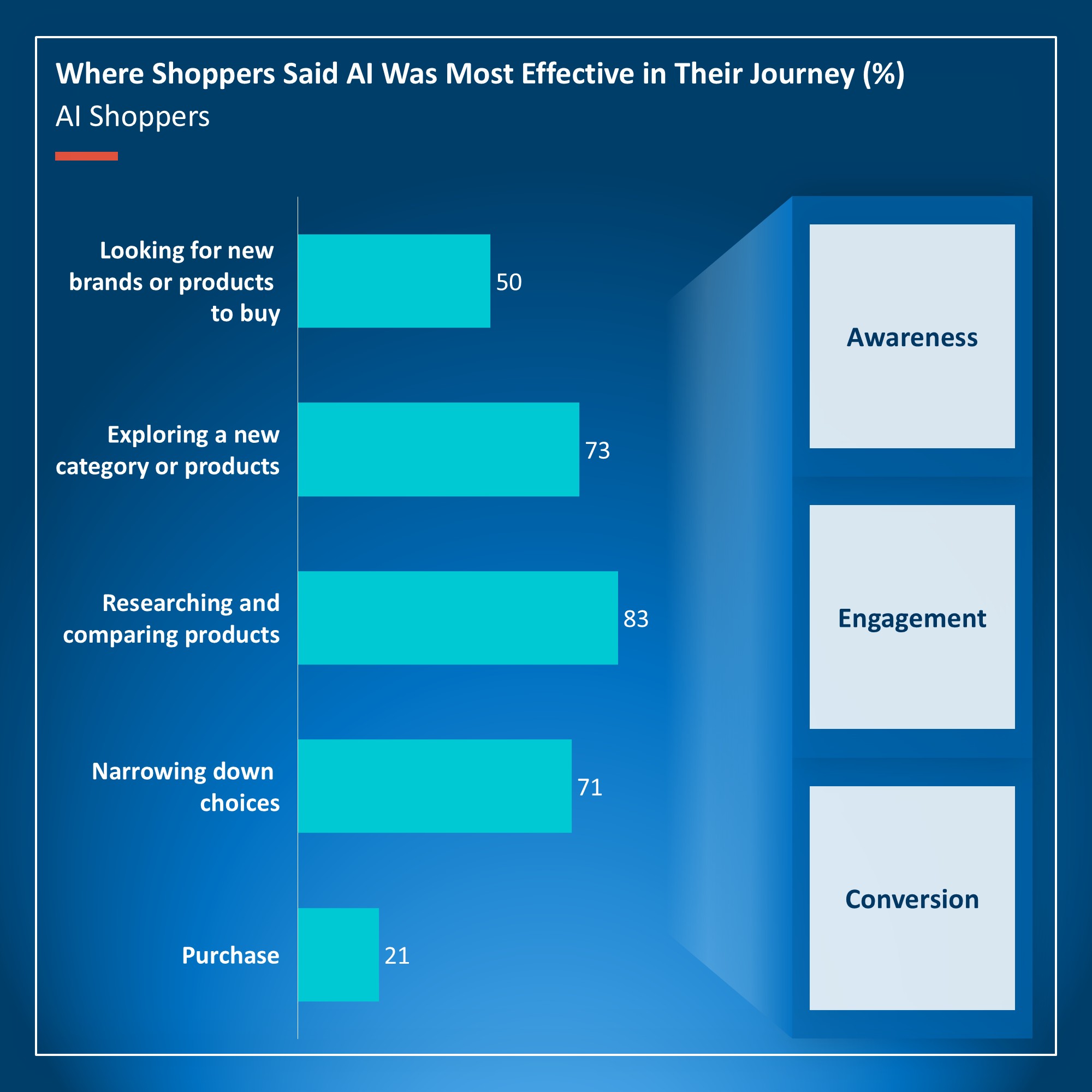
Sources: Interactive Advertising Bureau and Talk Shoppe.7
Category-specific behaviors also vary. Currently, consumer categories with higher perceived complexity dominate in AI usage (see below) as consumers leverage AI tools to reduce research loads around complex, lower-frequency purchases. However, as more shoppers begin to use AI agents, higher-frequency categories like groceries and beauty products are likely to see greater adoption.
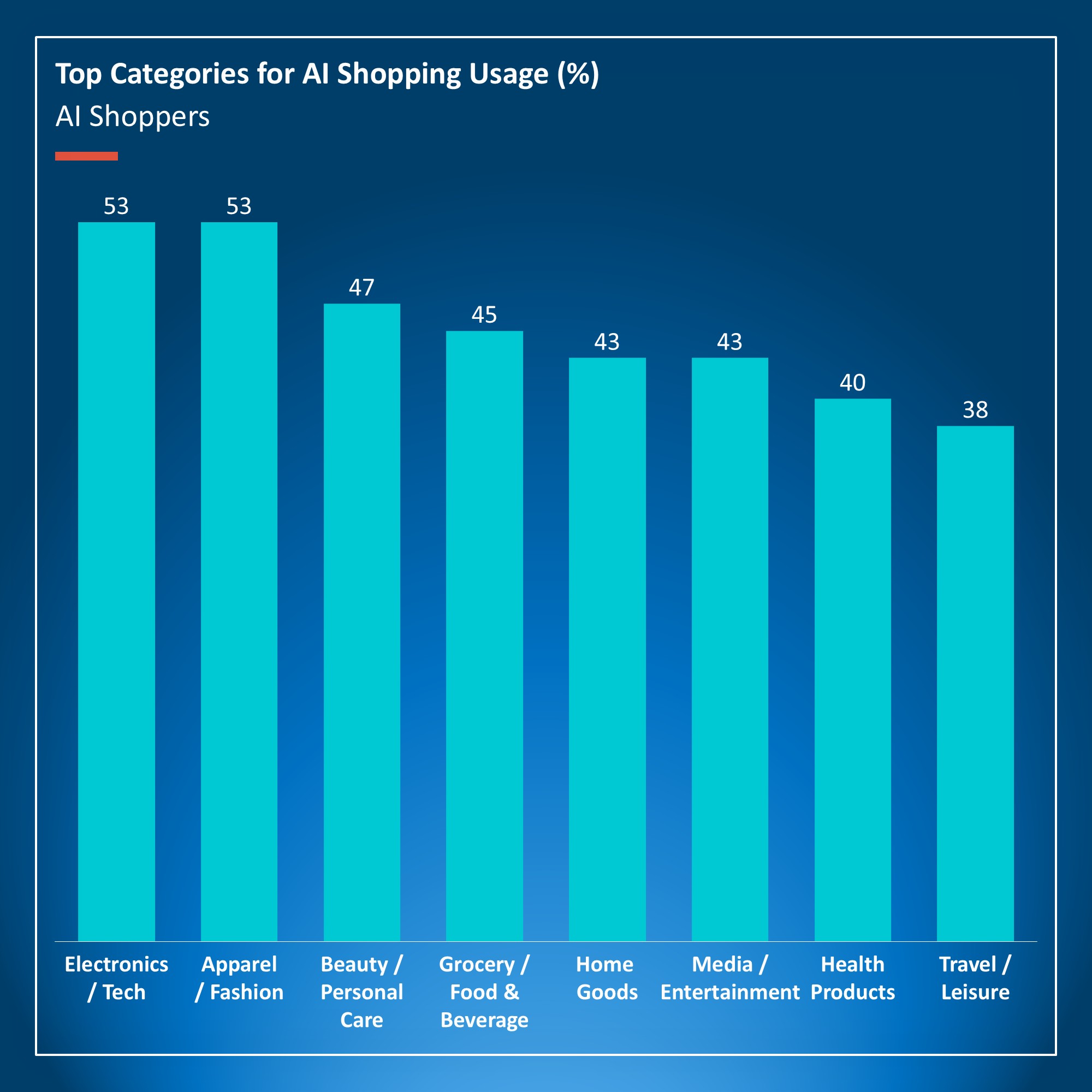
Sources: Interactive Advertising Bureau and Talk Shoppe.8
Household goods, for instance, feature products with higher purchase frequencies but lower data complexity, allowing agents to excel at replenishment and list automation. Other examples of category-specific behavior include beauty and personal care products or apparel, which are often driven by goal-based discovery (e.g., specific event styling), where AI agents have the potential to quickly move high-intent traffic to checkout. In the near-to-mid-term, high-consideration purchase categories with complex delivery specifications such as home furniture and electronics are likely to see agent assistance in research phases as opposed to a more autonomous purchase funnel.
Figure 3 - A Breakdown of Consumer Categories by Data Complexity and Purchase Frequency
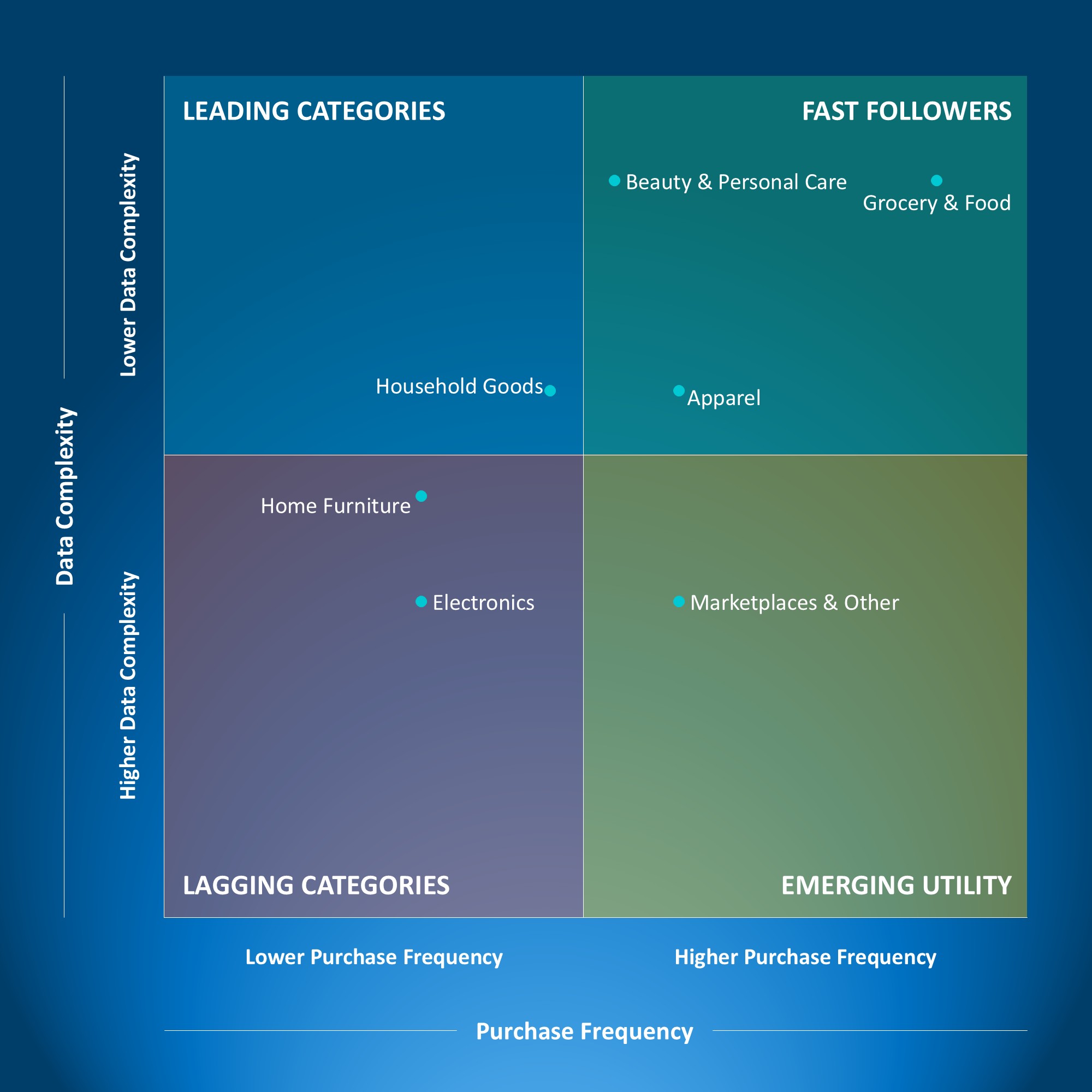
Source: Internal analysis.
How Retailers Can Win
Eight strategies are presented below for how retailers can build an effective AI response plan. Some of these strategies are not entirely new, but as AI agents amplify consumer shopping behaviors, their importance is growing:
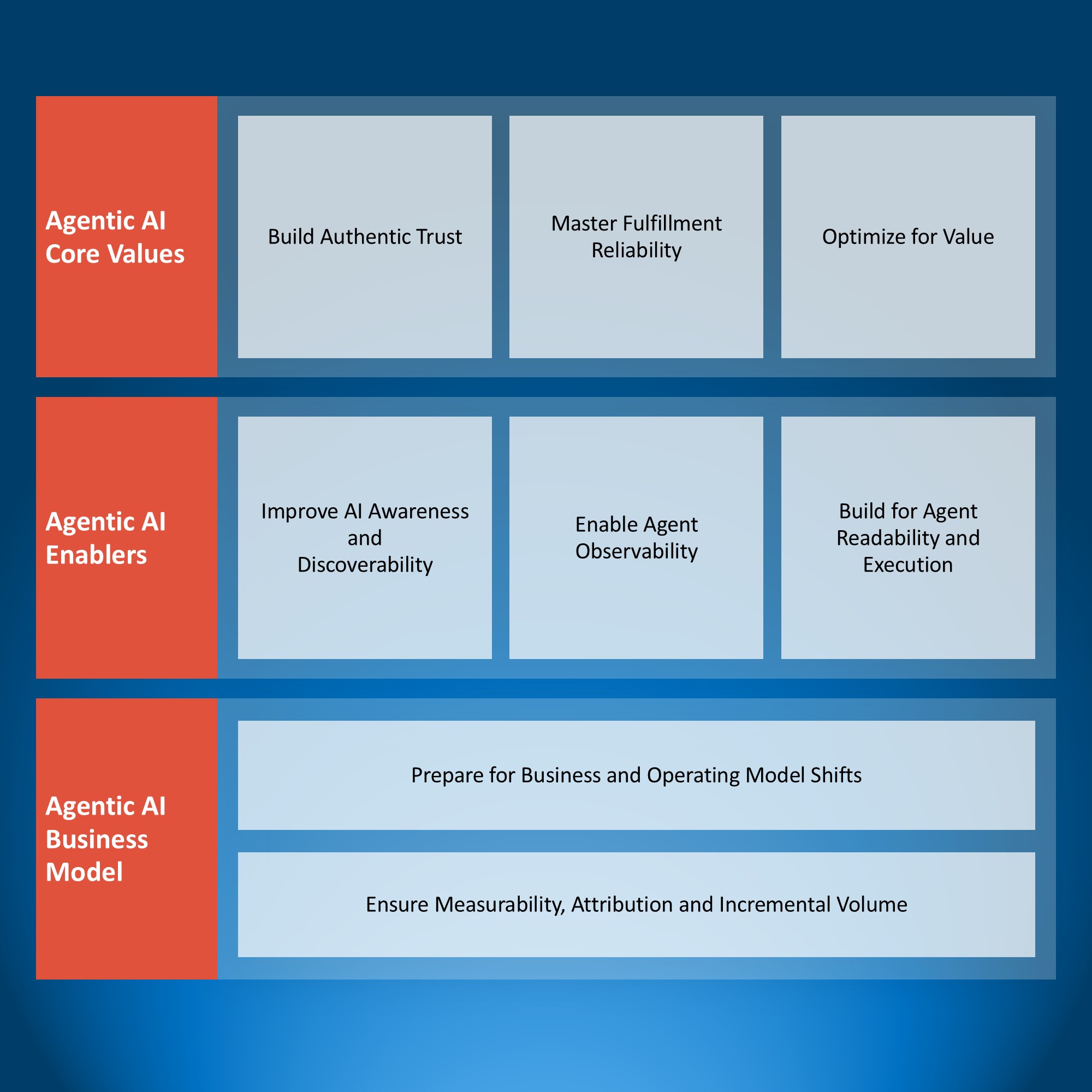
- Build Authentic Trust: Agents will favor products with the lowest chance of regret (indicated by returns, bad quality, delays) and will optimize for low-risk choices. Density and quality of verified customer reviews and review summaries will serve as the new proxy for trust. Presence in authoritative sources used for training LLMs will become important. Other trust signals such as providing clear and easy return policies, displaying shipping reliability, adding authentic product photos/videos and communicating clear guarantees (e.g., warranties, authenticity) will improve trust scores with agents.
- Master Fulfillment Reliability: Agents will avoid stores that experience delays, cancellations or backorders. As reliability becomes a ranking factor to keep up with the pace of a dynamic agentic purchase loop, retailers will need to invest in digital infrastructure to keep inventory accurate in real time, improving fulfillment speed and consistency, offering multiple delivery options (e.g., fastest/cheapest/greenest) and working to reduce out-of-stock rates.
- Optimize for Value: Agents will use multivariate data signals to compare total value of a purchase, balancing price with other attributes. This will include the fundamental quality of the product being bought, reliability and trust in retailers, total cost, bundles and add-ons, and additional perks (such as additional warranty) to arrive at value-based decisions balancing overall purchase costs and risks.
- Improve AI Awareness and Discoverability: While traditional SEO remains important, agent discoverability is shifting to AI Seach Optimization (“AISO”), also called GEO (“Generative Engine Optimization”). Ranking number one on Google searches will matter less than being a highly trusted “citation” an agent retrieves. Legacy consumer brands have historically won through physical availability and shelf dominance. In the agentic economy, AI availability can level the playing field for insurgent brands, since AI agents prioritize structured data over brand heritage and often over scale. AI challengers may seek to win on the long tail play; whereas legacy brands may win on generic queries (e.g., “laundry detergent”), insurgents can win on specific, attribute-rich queries (e.g., “non-toxic lavender detergent for sensitive skin”) by optimizing for machine readability.
- Enable Agent Observability: Increasingly, customer context will be stored in shopper agent memories. This will include everything from preferences, tone and behavior to specific transactional records, and provide context for future purchase behavior. For example, post-purchase feedback could bypass email surveys and reside in agent memory, influencing all future purchase decisions for that user. Retailers will need to develop agent observability protocols that maintain engagement with shopper agents so they can properly service and provide feedback to them as those agents serve as proxies for real customers.
- Build for Agent Readability and Execution: AI agents need clean, structured product information to compare options fast. This will require clean data structures that agents can parse instantly such as standardized product title and categories, complete attribute information (size, materials, compatibility, warranty, care instructions), accurate specs and dimensions with strong product identifiers (SKU, UPC/EAN, GTIN). If base data is messy, agents will be more likely to distrust the product. Similarly, as agents begin to execute transactions on behalf of customers, access to APIs for various functions such as checkouts, cancellations and returns is likely to become more important.
- Prepare for Business and Operating Model Shifts: In addition to the core commerce journey shifts outlined above, AI is likely to drive other retailer disruptions requiring business model evaluation and new monetization models. For example, agent discovery could cause total site traffic volume to decline, leading to display ad revenue on traditional website shelves becoming less relevant. Another key feature of AI, and agentic AI in particular, is the relentless erosion of information arbitrage, as the ability to access and interpret data in near real-time approaches universal abundance. As such, arbitrage over pricing, product information, promotions and other traditional factors erodes, forcing retailers to find new means of differentiation, including through real-world experiences, creative engagement and fast product merchandising cycles. This requires companies to leverage AI within their internal workflows to operate at a faster clock speed.
- Ensure Measurability, Attribution and Incremental Volume: Retailers and consumer product companies need to take lessons from the early days of the shift to e-commerce and the mobile internet. Ensuring that traffic attributions are accurate, incremental purchase traffic is appropriately determined and shifts across channels do not cannibalize value for volume will be critical to building sustainable operations led by the new agentic shopper.
Acting on the Next Transformation
Retail has been on a significant transformation journey in the past 20 years, as digital natives like Amazon, Netflix and Uber began to demonstrate what a new era of online-first experiences, engagement and consumption could look like. Retailers underwent major changes, and along the way, some digital-native newcomers rose to the top while major companies went bankrupt.
Now, we are at a similar moment in time. Leading retailers will need to transform once more while AI insurgents rise, capitalizing on the change that AI is bringing to the market. In an increasingly agentic marketplace, AI-driven shopping behaviors could make way for new brands to take market share from legacy retailers — and if today’s companies aren’t careful, they may find it much harder to compete.
Footnotes:
1: Gupta, Sumeet and Trivedi, Akshat, “The Rise of AI Commerce and the Decline of Traditional Purchase Funnels,” FTI Consulting (Mar. 19, 2026).
2: “Here Come the Shopping Bots,” Morgan Stanley (Dec. 8, 2025).
3: “Bazaarvoice research finds 66% of shoppers now use AI for product discovery, but 92% say reviews and real customer photos are still essential before buying,” Retail Technology Review (Jan. 28, 2026).
4: Pandya, Vivek, “Adobe Analytics: Traffic to U.S. retail websites from Generative AI sources jumps 1,200 percent,” Adobe Blog (Mar. 17, 2025).
5: Pandya, Vivek, “Adobe: Generative AI-powered shopping rises with traffic to U.S. retail sites up 4,700%,” Adobe for Business (Aug. 21, 2025).
6: Koch, Jack, et. al., “When AI Guides the Shopping Journey,” Interactive Advertising Bureau and Talk Shoppe (Oct. 28, 2025).
7: Id.
8: Id.
The views expressed herein are those of the author(s) and not necessarily the views of FTI Consulting, Inc., its management, its subsidiaries, its affiliates, or its other professionals.
Related Insights
Related Information
Published
March 26, 2026
 Key Contacts