


Little Clarity on Likely AI Job Impacts Despite Much Discussion and Debate
-
December 17, 2025
Downloads Download Article
-

Back in May, Anthropic CEO Dario Amodei, whose company created the popular AI model Claude, ignited a firestorm of debate when he opined to Axios that AI could eliminate 50% of entry-level office jobs within five years, possibly sending the unemployment rate to 10%-20% within that time frame.1 The reaction was swift, intense and divided, with some prominent politicians and business media figures viewing his prediction as a call to action to prepare workers, the business community and the government for profound workplace changes soon to come. However, several leading tech industry executives and business leaders saw his warning as either alarmist or badly errant. Some tech insiders insinuated that Amodei’s remarks were intended to slow the blitzkrieg-like rollout of Gen AI across the landscape or regulate it in some way. Amodei had previously voiced concerns over the “ready, shoot, aim” mindset behind much of the accelerating AI rollout and raised ethical considerations of an AI-driven workplace and world. The pushback against this doomsday scenario from a leading figure in the AI field (Amodei worked at Google and OpenAI prior to co-founding Anthropic in 2021) has been fierce, but Amodei continues to reiterate his dire prediction, further elaborating that jobs involving repetitive but variable tasks were especially vulnerable to replacement because AI already handles those so well.
Public anxiety over AI’s potential impact on jobs was there well before Amodei’s comments, with 48% of respondents to an August 2024 YouGov survey responding that AI would decrease job opportunities in the industry they were employed compared to 29% who responded similarly to the same question in the March 2023 survey, while only 11% expected job opportunities to increase from AI.2 Conversely, most corporate executives view AI’s potential impact on job functions and employment through a different lens than the general public does. The crux of this debate comes down to whether one believes that AI in the workplace primarily will result in job augmentation or job replacement.
As the great debate continues over AI impacts in the workplace and the broader economy, laypeople hearing experts’ opinions on the topic should ponder their possible motivations for voicing such opinions. Much of the punditry’s public conversation around likely AI workforce impacts can be disingenuous because many prominent business leaders opining on the topic have a big stake in the outcome, and their comments tend to serve that interest, such as downplaying potential AI threats to workforce dislocation and job destruction. Let’s be honest here: There aren’t many CEOs who believe in their bones that AI can eventually replace, say, 25% of the human workforce in their industry who would openly acknowledge that for fear of damaging morale in the workplace. More often, their public commentary can be deliberately vague or ambiguous. Wishy-washy comments that strive for some sort of balance, such as “AI will replace some workers but will also create many new jobs,” are likely to be distractions and are not helpful in advancing the conversation. Of course, AI will create jobs but the paramount concern here is what its impacts will be on balance, either within industries or more broadly, and it is becoming more challenging to make a persuasive argument that on balance, AI will be a net job creator for the U.S. workforce. Most Americans don’t believe it. In a recent CBS News poll, twice as many respondents said AI will reduce jobs in their field of work in the coming years rather than increase jobs (46% vs. 23%).3 This response pattern was highly consistent across all demographic breakdowns (Figure 1). It seems evident that many Americans need convincing that AI will be more friend than foe in the workplace.
Figure 1 – Over the Next Decade, Do You Think AI Will Increase, Decrease (or Have No Effect) on the Number of Jobs Available in Your Field of Work?
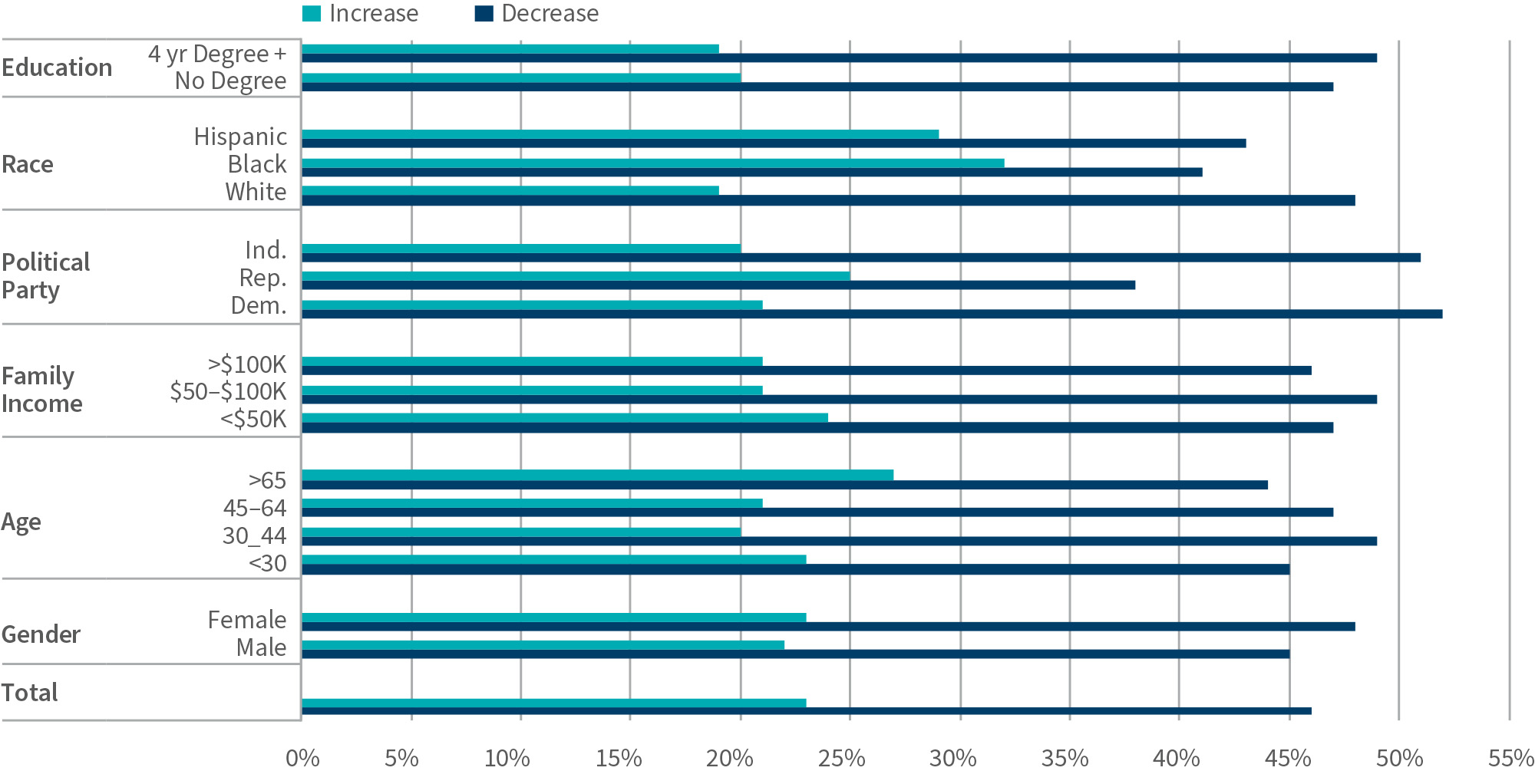
Source: CBS News, YouGov.com
Another commonly heard argument these days is that the AI revolution is akin to other profound economic resets the nation has experienced, such as the industrial revolution, the transportation revolution and the telecommunications boom, all of which caused economic dislocations but nonetheless unleashed forces of creative destruction that ultimately increased economic prosperity and advanced the well-being of the country even though there were casualties along the way. The difference here is that those “revolutions” occurred over a period of decades, giving businesses and workers ample time to redirect their ambitions. If AI-driven impacts in the workplace occur on the short timetable that many predict, the dislocations could be more severe, disruptive and perhaps more enduring than previous technological disruptions. If your primary work skills suddenly are rendered redundant or obsolete by AI, the prospect of finding similar gainful employment without substantial re-skilling is greatly diminished. Consequently, both employers and workers should have ample motivation to learn and integrate AI solutions into workflows in an expedited manner.
Another familiar talking point badly in need of refinement is that AI will free up professional workers from the routine aspects of their jobs that can be automated, thereby enabling them to do more challenging work. This is a half-truth; some workers will be liberated from mundane tasks to work on more creative projects, while others will be liberated from their jobs. It seems unlikely that everybody will be doing more interesting work.
Moreover, as we pointed out in a previous column,4 those mundane tasks for younger professional workers and recent college grads often contribute to the foundational knowledge of their business, so automating it likely entails some loss of learning that will follow them in their working careers. It is conceivable that newly minted investment bankers or lawyers today might never have to read, analyze or draft a bond indenture and prospectus by rolling up their sleeves, instead relying on AI to do the heavy lifting. Certainly, this is beneficial from a time and profitability perspective but it has a downside that is less discussed — creating a future generation of business executives who have only read the Cliff Notes in some of their “Job 101” basic training classes. College professors are contending with this issue currently. Many believe a heavily AI-dependent educational experience is depriving students of fundamental learning for the sake of expedient results, and worse yet, it is challenging to monitor or moderate in a practical or fair manner.5,6
Corporate Layoff Announcements Have Picked Up — but Why?
In the meantime, it is hard not to notice the slew of corporate layoff announcements in recent months, some of which are AI-driven. Target, Booz Allen Hamilton, PwC, Salesforce, Oracle, Microsoft and General Motors are among the many large (and profitable) companies announcing or enacting noteworthy layoffs, mostly among corporate (i.e., white collar) workers. The approach that companies take when making these layoff announcements can be quite varied, with some, such as Salesforce, openly acknowledging the impact of AI in making these job cuts while others are careful to couch the role of AI by using words like “efficiencies” and “productivity gains,” making it hard to discern the extent to which AI directly impacted these layoff decisions.7 Lastly, some public companies might exaggerate their AI-driven gains to convince shareholders they are ahead of competitors in that area. Most recently, Amazon announced the planned elimination of 14,000 corporate jobs,8 or 3.4% of its corporate workforce, while acknowledging that AI is a gamechanger for most large businesses, including its own, with rumors of more Amazon job cuts to come based on related comments from CEO Andrew Jassy. But there also are other forces at work behind recent layoffs, including many instances of corporate over-hiring in 2021, economic uncertainties and poor business visibility, so it would be misplaced to put the blame squarely on AI — though it certainly factors into the mix.
A recent Goldman Sachs survey9 tried to tease out these specific details, with 11% of its investment banker respondents saying that their clients across industries were explicitly using AI to reduce jobs, though that number jumped to 31% in the tech, media and communications sectors. Most said that clients were using AI to boost worker productivity rather than cut costs. More worrisome though, respondents said they believed that cumulative job cuts attributable to AI across its client base over the next three years could amount to 10%-14% of total headcount, depending on the industry. In other words, what has happened to date is not reflective of what those survey respondents expect to happen in the next few years.
Such a scenario writ large could amount to several million cumulative job cuts, and it doesn’t take much foresight to recognize that job displacement on this scale will become a heated economic topic and a political hot potato by 2028, should it materialize and cause unemployment to soar. A quick analysis of the U.S. workforce by occupation indicates that 49 million Americans, or nearly 32% of our 155-million-person workforce are employed in professions or positions that are highly vulnerable to AI disruption. Applying Goldman Sachs survey expectations to these figures produces a labor force reduction of at least six million workers by 2028, with the potential for considerably more as AI improves, which is nearly as many Americans who are unemployed currently.
As large companies increasingly profit from their AI investments, there has been little public discussion about who will pay for the collateral damage caused by AI — whether it’s the cost to re-skill workers, long-term unemployment assistance or the undermining social and economic effects of having a much larger percentage of the workforce permanently unemployed or underemployed. That too will be a heated debate when lawmakers and the business community finally get around to addressing it.
Gen AI and the Professional Services Industry
Gen AI’s potential to unleash knowledge and product breakthroughs in areas such as disease prevention, treatment and cures, new drug formulations and other hard sciences is revolutionary and exciting. But for many mature businesses and industries where AI will be employed, it won’t be discovering or creating nearly as much as it will be replicating, that is, performing some existing tasks, functions and workstreams more efficiently than humans — meaning faster, cheaper and/or more accurately. Its adoption and usage by large corporations essentially boils down to an ROI calculation. For companies investing heavily to bring AI technology and tools in-house, the relevant consideration is whether AI-driven worker productivity gains alone will generate sufficient IRR or if workforce reductions also must be part of that equation, and to what extent.
The professional services industry — whether it is strategic consulting, legal, finance or other business advisory work — has some unique considerations when deciding how AI will impact its traditional business models and organizational hierarchies. Certainly, there are workstreams of these businesses that fall within Amodei’s “repetitive but variable” paradigm (complex document reviews and creating PowerPoint decks immediately come to mind) where AI will be able to perform these tasks more efficiently, with fewer professionals working with AI tools to oversee processes that previously might have required dozens or hundreds of manhours to complete. Most “repetitive but variable” workstreams are carried out by junior-level professionals in their early working years, so it is likely that fewer of them will be needed strictly to accomplish these tasks. Clients may start to balk at paying large professional fees for certain projects or workflows that are done or can be done in a fraction of the time they used to be. Indeed, client pushback could be a catalyst for these changes.
These considerations must be weighed against the potentially harmful longer-term effects of reconfiguring the traditional pyramid-shaped organizational structure and leverage model of these people-driven businesses. For some firms, a large cadre of junior-level professionals comprise the foundation of the pyramid, and in time, many become the senior managers and leaders of these enterprises. Sizeable workforce reductions among this cohort over time, even by attrition, could result in a loss of institutional knowledge and disrupt the functioning continuity of the enterprise. In addition, profitability for some firms relies on a bottom-heavy leverage model – changing it could have wider implications for these firms.
Today’s professional services firms exist along a service–expertise continuum that holds important implications for the deployment of AI. At one end, repetitive tasks or templated solutions that can be addressed with greater computational power; at the other end, bespoke solutions or relationship-driven services that require higher, expert-led skills. The deployment of AI at the one end may hasten the commoditization of those solutions, and puts their bottom-heavy pyramids at greater risk. Firms at the other end, with a higher concentration of experts and less bottom-heavy pyramids may feel far fewer effects from AI disruption. Firms will have to evaluate the size and configuration of their organizational pyramids, decide how reliant they are on “repetitive but variable” client engagement workstreams, and then balance the ROI benefits that AI-driven tools can offer, versus the organizational disruption that could ensue.
Footnotes:
1: VandeHei, Jim and Mike Allen, “Behind the Curtain: A White Collar Bloodbath,” Axios (28 May 2025).
2: Ballard, Jamie, “About half of working Americans believe AI will decrease the number of available jobs in their industry,” YouGov ( 27 Aug. 2024).
3: “Opinions of Americans About the Economy and AI,” CBS News / YouGov (2 Oct. 2025).
4: Eisenband, Michael, “Will Gen AI Dumb Us Down or Smarten Us Up?,” FTI Consulting, Inc. (4 Jan. 2024).
5: “Does College Still Have a Purpose in the Age of ChatGPT?,” Bloomberg (27 May 2025).
6: Goyette, John J., “How to Stop Students From Cheating With AI,” The Wall Street Journal (20 May 2025).
7: “The list of major companies laying off staff this year includes Verizon, IBM Amazon, Starbucks, American Airlines, and more,” Business Insider (27 Nov 2025).
8: Galetti, Beth, “Staying nimble and continuing to strengthen our organizations,” Amazon (28 Oct. 2025).
9: Quiroz-Gutierrez, Marco, “Goldman Sachs survey says only 11% of companies are actively linking layoffs to AI—but the real shock is yet to come,” Fortune (30 Oct. 2025).
The views expressed herein are those of the author(s) and not necessarily the views of FTI Consulting, Inc., its management, its subsidiaries, its affiliates, or its other professionals.
Related Insights
Related Information
Published
December 17, 2025
 Key Contacts
Global Chairman of Corporate Finance