

Setting Business Transformations Up for Success by Managing Cultural Misalignment
-
December 02, 2025
-

Business transformations are driven by the promise of strengthening a company’s competitive position and creating long-term value. The rationale for a transformation may be to improve operational efficiency or organizational effectiveness, enhance product offerings or to realize cost efficiencies. However, the reality is sobering – studies show that over 60% of transformations fail to deliver the desired results, with cultural misalignment consistently cited as a leading cause.1
Cultural Misalignment in Business Transformations
Cultural misalignment arises when businesses fail to connect the strategic rationale for change with the employee experience. The consequences of cultural misalignment extend beyond a failure to deliver the desired transformation results. Cultural misalignment negatively impacts productivity, employee engagement, job satisfaction and employee retention. This human toll can have a lasting impact on operational effectiveness, slows down decision-making and introduces friction that can undermine the company’s strategic direction.
Without a deliberate effort to understand, align and manage organizational culture, most business transformations are doomed to fail, turning potential growth opportunities into a source of disruption and underperformance.
A Data-Driven Approach to Culture
So how can companies proactively manage cultural misalignment and increase their odds of delivering a successful transformation? The key to success lies in data.
While most organizations acknowledge that understanding, assessing and managing any cultural misalignment requires a data-driven approach, many struggle to go beyond basic qualitative indicators captured through annual listening surveys with comprehensive questions lists. What they need instead is a way to periodically take their organization’s pulse throughout the transformation process, and even after it is complete. This pulse check allows leadership to identify cultural hurdles to success at an early stage and steer the transformation process in the right direction.
A data-driven approach starts with data collection. Employee input is required to form an understanding of the cultural dimensions that are at play during the transformation journey and how this impacts the employee experience. If you overcomplicate the exercise, you run the risk of survey fatigue: low response rates and less reliable insights. As a rule of thumb, taking an organizational pulse should take no more than five minutes of an employee’s time.
Quadrant of Culture Drivers
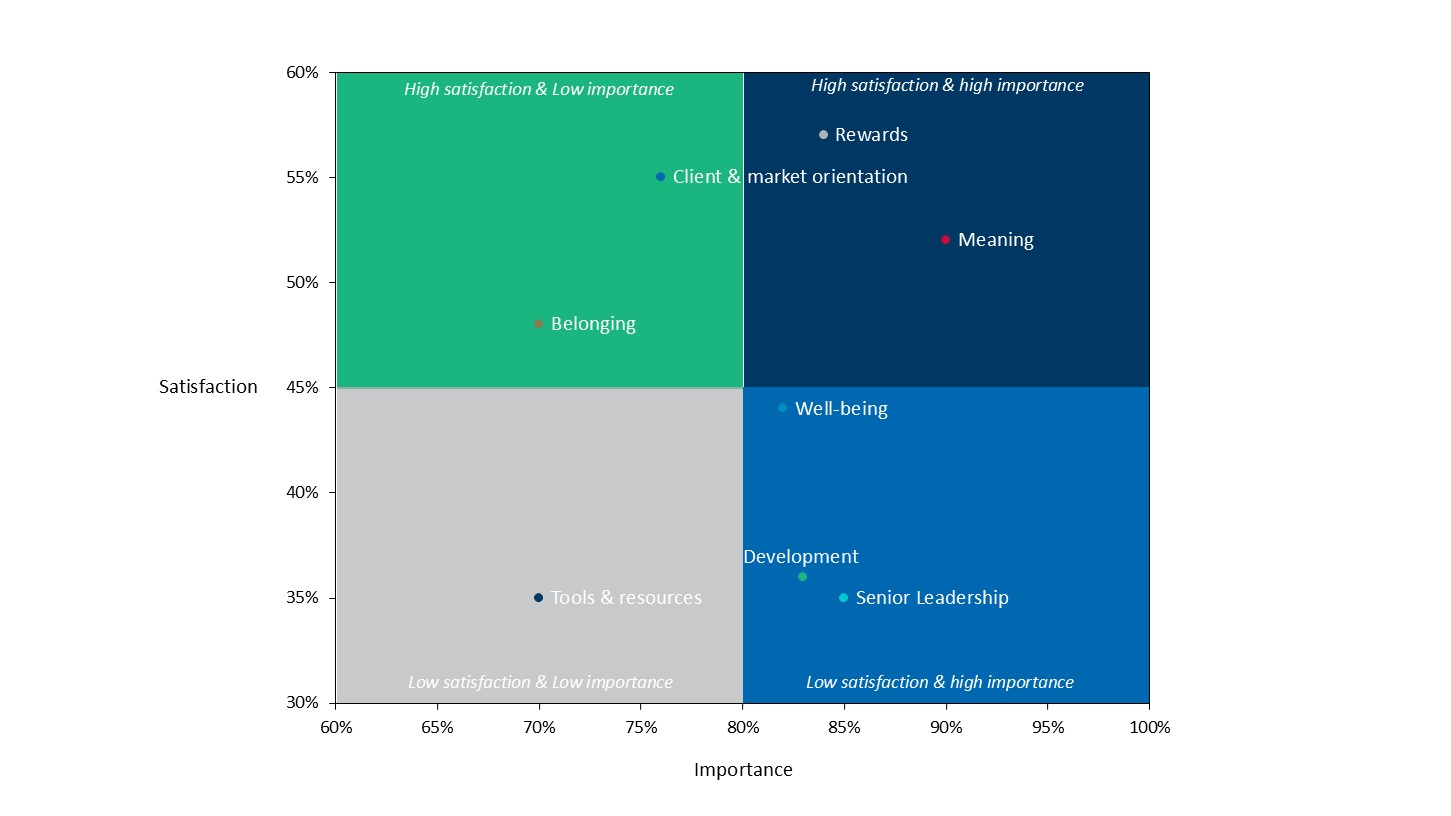
Source: FTI Consulting
Hence, a simple employee survey will suffice, but the real magic lies in its design. The questions should be aimed at gauging what aspects of the employee experience different employee groups find important and where the gaps are in relation to how satisfied they are with those aspects. The above depicts the results of an organizational pulse check in a diagram, showing where companies should double-down on their efforts (high satisfaction & high importance) and where they need to step-up (low satisfaction & high importance). Monitoring this closely will help pinpoint the dimensions of the employee experience that shape how employees work, interact, collaborate and ultimately thrive within the organization. The right insights will help leadership pinpoint where values, behaviours and expectations diverge and can equip them with actionable strategies to bridge cultural gaps.
A Practical Example
In 2022, BACU acquired HEMA’s industrial bakery operations in The Netherlands. The transaction was a key opportunity for BACU to expand its production capabilities and broaden its product portfolio. As it turns out, the transaction involved a great deal of cultural complexity.
While BACU is a family-owned business with its heritage rooted in craftmanship, close-knit relationships and a strong sense of local identity, HEMA is a large Dutch national retail chain with a well-established consumer brand and a large corporate structure driving its operations. Integrating these two businesses entailed more than ‘simply’ aligning systems, processes and reporting lines – BACU had to build a bridge between two fundamentally different organizational cultures before it could begin to capitalize on potential synergies from the merger.
Two years after closing the transaction, BACU used cultural diagnostics to assess how successful it was in navigating cultural complexities during the integration of HEMA’s industrial bakery. BACU also wanted to identify and understand any remaining cultural misalignment between the incumbent BACU population and former HEMA employees and how these could best be managed going forward without comprising its synergy case.
BACU’s CFO Erik Weerts observed that “cultural diagnostics allowed us to approach our company culture and employee experience with data-driven insights, instead of relying on our ‘gut-feel’ and intuition. The insights sparked meaningful conversations with middle management and created a shared understanding of how to manage continuous cultural integration”.
Even so, Weerts now sees they should have applied the diagnostic earlier. “Looking back at the integration journey, using a cultural diagnostic at the outset could have helped us better prepare our teams for the complexities of cultural misalignment and avoid some of the uncertainty that comes with a transformation of this scale. It would have allowed us to anticipate and proactively address cultural differences before they created friction. I am convinced that embedding those insights into the overall integration strategy from the start would have led to a smoother process”.
Takeaway for Your Business Transformations
Business transformations are journeys that management teams take their organizations on. Their success hinges on people’s willingness to embrace change. Based on our experience, companies engaging in business transformations should manage cultural complexity proactively throughout the transformation journey – not as a separate workstream but as an integral part of the overall process. By embedding cultural diagnostics into the transformation journey, leadership can move beyond intuition and assumption, toward a data-driven way of working, making cultural alignment a lever for success rather than a barrier to change.
Footnotes:
1: “Why Transformation Fail,” FTI Consulting (June 1, 2019)
The views expressed herein are those of the author(s) and not necessarily the views of FTI Consulting, Inc., its management, its subsidiaries, its affiliates, or its other professionals.
Related Insights
Published
December 02, 2025
 Key Contacts