

Structural Shift Reshaping Industrials: Geopolitical Fragmentation
Redefining the Operating Model Amidst Geoeconomic Shifts
-
August 18, 2026
-

For most of the past three decades, the industrials operating model was built on a straightforward premise: optimize globally, source from the lowest-cost location, and move product through the most efficient route available. That premise is now challenged. Where the COVID-19 pandemic exposed inherent fragility, geopolitical fragmentation has rendered this operating model obsolete.
What the Market Is Telling Us
The evidence of structural change is clear. U.S. imports from China have returned to near-2001 levels, before China’s entry into the World Trade Organization, reflecting a reallocation across more than 5,300 product categories.1 “For North American buyers, the combined share of the top three supplier countries (China, India, Vietnam) fell from 61% to 54% in a single year,” exemplifying the pace of fragmentation and realignment of supply networks.2 These are not marginal adjustments; they reflect a fundamental reconfiguration of how industrial companies source, produce and distribute.
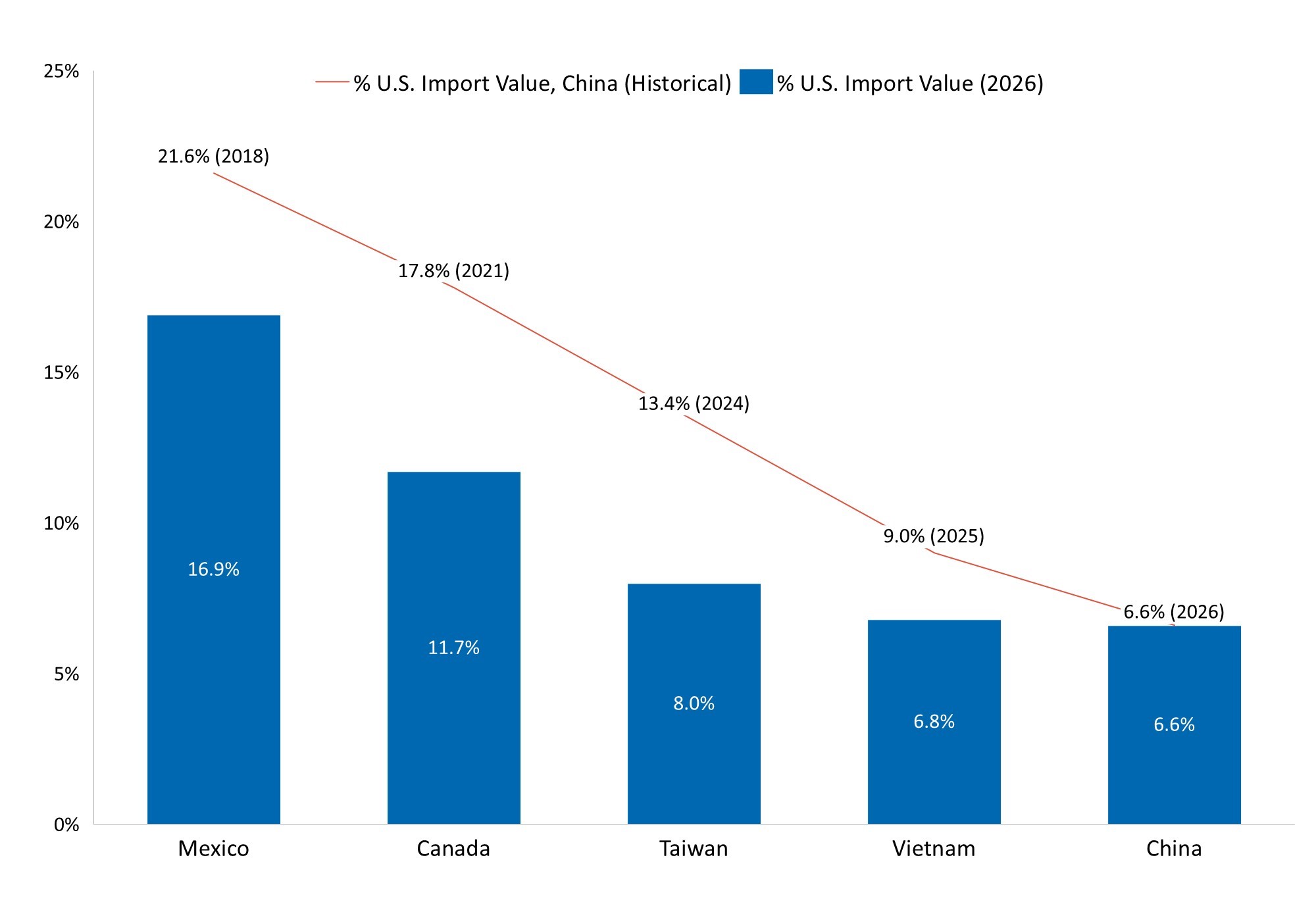
Historical Chinese Imports Percentage (%) vs. 2026 Largest Trading Partners
Source: U.S. Census Bureau
China’s own trajectory shows the scale of the shift. Its share of total U.S. imports has fallen from 21.6% in 2018 to 13.4% in 2024 to roughly 9% in 2025, and stood at just 6.6% through April 2026.3 China has dropped out of the top three U.S. suppliers entirely, now trailing Mexico (16.9%), Canada (11.7%), Taiwan (8.0%), and Vietnam (6.8%).4 The story is no longer just Mexico and Canada picking up share; Taiwan and Vietnam have moved past China as well.
Supply chain disruption ranks among the top three concerns for industrials CFOs in FTI Consulting’s 2026 Global CFO Survey, alongside inflation (47%) and capital markets uncertainty (45%), with 44% citing it as a significant risk to achieving revenue growth targets.5 Over 50% of manufacturing CFOs reported actively planning to diversify their supply chains in response to trade and tariff pressure, and more than three-quarters of manufacturers cited trade uncertainty as their top concern throughout 2025.6, 7
Geopolitics is an accelerant here—not the root cause. The underlying fragility of globally optimized, single-source supply chains was already visible (COVID-19 disruptions and subsequent recoveries laid this bare to all). But in contrast to an unpredictable pandemic, trade policy shifts have made the cost of inaction immediate and measurable: inaction leaves companies more exposed, with fewer supply options and less flexibility in fiercely competitive markets.
Re-Architecting the Operating Model
The critical distinction for industrial leaders is between optimizing an existing operating model and re-architecting it. Incremental adjustments will not be sufficient. What this moment requires is a fundamental rethink across three dimensions:
Physical infrastructure is where the reconfiguration is most visible and most capital intensive. Manufacturing footprint decisions now carry a broader set of criteria than cost alone: proximity to end markets and regional supplier bases, access to skilled labor, resources availability, policy incentives and political stability. The questions are no longer just “where” to manufacture, but “who”—internal vs. external production—and “how much,” meaning the appropriate scope and level of vertical integration for each market context. Reshoring and Foreign Direct Investment job announcements held at 244,000 in both 2024 and 2025, tied for the second-highest levels on record even as trade policy churned through the year, with government incentives, workforce availability, and supply chain risk now outranking cost reduction as the primary drivers.8 Supplier networks and logistics infrastructure are being rebuilt on the same logic, requiring meaningful capital investment to build regional capability that did not previously exist.
Information and decision flow is the dimension that receives less attention but requires complete reframing in an AI-enabled age. The old model assumes information flows sequentially through a chain, with coordination at each handoff across three levels:
- Internal flows within functions and across the company
- Intercompany flows between the business and its immediate partners
- Flows between partners upstream, downstream and across the broader network
The industrials companies building durable advantage are replacing cascading information flows across all three levels with integrated networks, where suppliers, manufacturers and downstream partners share data and make synchronized decisions in real time. The key focus here is resetting the governance for information sharing and decision rights ownership; 66% of private equity (“PE”) firms now see AI-driven results within 12 months, more than double last year’s 34%, yet acceleration without redesigned decision rights just exposes bottlenecks versus eliminating them. The takeaway: the compounding advantage of integrated decision flow is becoming increasingly difficult to access without this network mindset.9
Operating model enablement determines whether the infrastructure and information investments consistently translate into performance. This includes organizational design, core business processes, and the technology and data infrastructure that executes decisions in real time. These are strategic enablers, not simply IT projects. That 50% of PE firms cite investing and implementing technology as their top execution hurdle when working with portfolio companies reflects the organizational complexity of enabling new operating models.10
Critical Considerations for Leaders
While architecting the future model for an organization may be clear, the looming challenge is execution, with four tensions consistently surfacing in practice:
Balancing long-term investment with near-term performance. Re-architecting an operating model requires capital, time and organizational focus, all of which are in short supply when quarterly reporting and performance expectations remain. Capital access sharpens that tension: only 14% of industrials CFOs report debt financing has become significantly more available in the past year, compared to 23% of CFOs overall, even as 45% cite capital markets uncertainty as a significant risk to growth targets, well above the 40% average across all sectors.11 The companies navigating this most effectively identify near-term operational improvements that generate returns quickly enough to fund longer-term structural investments. The sequencing of that combination is itself a strategic decision.
Making long-duration decisions under uncertainty. Manufacturing footprint and supplier relationships commit capital for years. The Manufacturers Alliance found that 75% of respondents said tariff-related uncertainty limits their ability to invest and plan.12 Yet waiting for certainty carries its own cost. Building robust frameworks with hardened scenario planning opens strategic optionality with the ability to move first while the majority waits. In FTI Consulting, work with one global manufacturer, shifting to a regional or “local-for-local” operating footprint substantially reduced tariff liabilities and mitigated supply disruptions compared to industry peers.
Prioritization and sequencing. Companies that institutionalize a standardized playbook and align the organization around it are 2.3x more likely to execute effectively than those without one, per FTI Consulting’s 2026 Private Equity Value Creation Index.13 Strategic prioritization, actions sequencing, and critical pathways definition are essential to effective transformations. Decisions about what to address (e.g., manufacturing capacity and capability), sequencing actions (e.g., how to align supplier base and skilled labor to a new manufacturing footprint), and confirming critical timing “gates” inform clear organization objectives. These become the necessary inputs for rigorous financial modeling for capex, cash flow and cost projections, alongside human capital mapping and capacity planning.
Change management and stakeholder alignment. Execution relies on the performance of people. The top enablers of effective portfolio company execution are strategic alignment on value levers (36%), data quality and reporting (33%) and management incentives (33%).14 Operating model transformation in an industrials context spans multiple geographies, functions and partner relationships simultaneously. Clear communication around major moves, governance structures that connect accountability to outcomes, and incentives aligned to both near-term and long-term performance are the difference between transformation programs that deliver and those that stall.
Measuring What Matters
The full value of this transformation goes well beyond comparative cost analysis. It includes landed cost improvements, opportunity costs on cash and capital freed by better inventory positioning, the agility premium unlocked by faster decision making, and the compounding supply resilience that comes from operating a network rather than linking a chain. A focused set of outcome-oriented KPIs—tracking supply resilience (e.g., qualified alternate suppliers per part), inventory turns and decision cycle times, to name a few—reviewed at the right cadence, is more valuable than a comprehensive scorecard that diffuses attention across too many measures disconnected from core performance drivers.
Closing Thoughts
Geopolitical fragmentation is not a risk to be hedged; it is a structural condition to be designed for. The operating model built for the last era—globally optimized, sequentially coordinated and cost-centric—is giving way to one that is regionally resilient, collaboratively integrated and competitive across multiple performance metrics beyond cost.
Not every organization needs to re-architect at the same pace, but every company does need to know its own exposure well enough to make that call deliberately. Inaction is not a neutral choice (though it is an intentional one). It leaves companies more exposed to trade tensions, more dependent on fragile supply configurations, and with fewer options than peers who have progressed. The time to redesign is now, while the window to shape the outcome remains open.
This is the second in a series of six articles exploring the structural shifts reshaping industrials. Subsequent pieces will examine skilled labor scarcity, AI integration, energy dynamics and capital cost discipline.
Footnotes:
1: Alfaro, L. and Chor, D., “An Anatomy of the Great Reallocation in US Supply Chain Trade,” National Bureau of Economic Research Working Paper (November 2025).
2: QIMA, “Q1 2026 Supply Chain Barometer” (January 2026).
3: U.S. Census Bureau, “U.S. International Trade in Goods and Services” (FT-900) and Foreign Trade Highlights data (2018–2026).
4: U.S. Census Bureau, “Top Trading Partners” (April 2026).
5: Global CFO Survey (2026) — Industrials Extract [Unpublished raw data], Slide 1.
6: Federal Reserve Bank of Richmond, “Tariffs: Estimating the Economic Impact of the 2025 Measures and Proposals” (April 2025).
7: National Association of Manufacturers, 2025 Quarterly Outlook Surveys (2025).
8: Reshoring Initiative, 2024 Annual Report (2024) and 2025 Annual Report (April 2026).
9: “2025 Private Equity Value Creation Index: Recalibrating Value Creation Levers,” FTI Consulting (2025).
10: Id.
11: Global CFO Survey (2026) — Industrials Extract [Unpublished raw data], Slides 1 and 3.
12: Manufacturers Alliance, “Manufacturing Expansion Surges in 2026 Amid Cautious CEO Optimism,” CEO Outlook (February 2026).
13: “2025 Private Equity Value Creation Index: Recalibrating Value Creation Levers,” FTI Consulting (2025).
14: Id.
The views expressed herein are those of the author(s) and not necessarily the views of FTI Consulting, Inc., its management, its subsidiaries, its affiliates, or its other professionals.
Related Insights
Related Information
Published
August 18, 2026
 Key Contacts
Senior Managing Director