

What New Electricity Tariffs Could Mean for Vietnam
-
March 17, 2026
-

In October 2025, Vietnam’s Ministry of Industry and Trade approved a pilot for a significant reform of retail electricity prices.1 Whilst customers in Vietnam are currently only charged based on the amount of electricity they consume, the reforms would separate the prices into two components: a fixed capacity charge and a variable energy charge.2
For the duration of the pilot programme, this two-part tariff will only apply to large industrial customers with an average consumption of 200MWh per month (so it will not include individual households at this stage), and will be a paper-based trial, meaning that the two-part tariff will be calculated with real-world data, but with no changes to the actual prices paid by those customers during the trial.3
This pilot is intended as a prelude to the introduction of two-part tariffs for large consumers and all other customer groups in Vietnam and is part of a wider set of reforms for the Vietnamese electricity sector to facilitate the energy transition, including introducing private investment and competition into the market and promoting the development of green energy generation. The tariff also aims to incentivise more efficient electricity usage, helping to optimise the broader electricity system.4
How Two-Part Tariffs Incentivise More Efficient Electricity Usage
The proposed two-part tariff comprises a capacity charge, which is calculated based on a customer’s peak demand (in kW) in a given month — specifically, the level of demand in the 30-minute interval in the month in which the customer used the most electricity — and an energy charge, which is calculated based on a user’s total electricity usage (in kWh) throughout that month.5
Broadly speaking, the cost of providing electricity can be divided into:
- building infrastructure (such as generation plants and electricity wires), which are largely fixed costs and strongly linked to the peak level of electricity demand in the system
- generating power (such as fuel costs) and operating and maintaining infrastructure, which are largely variable costs and are more determined by the total quantity of electricity that is consumed
Typically, patterns of electricity demand are not constant throughout the course of a day.6 As such, two electricity networks that deliver the same total quantity of electricity over a period of time can have very different infrastructure requirements depending on the pattern of demand. All else being equal, the network with higher peaks in demand will tend to require more investment in infrastructure in order to prevent blackouts or equipment failures.
These network costs can typically be quite large, as electricity infrastructure is expensive. Therefore, measures that can induce customer demand to be smoothed over the course of the day and reduce the level of the highest peaks in demand could, over time, reduce the requirement for costly network infrastructure investment and thereby reduce the total cost of the electricity system to all customers.7 The proposed capacity charge aims to do just this by very clearly introducing a component to bills that is directly linked to customers’ own peak demand.8
In response to this charge, factories may extend their operating hours, operating machinery at lower intensity (or operating fewer of them) to maintain output. In such cases, it may be possible to incur a lower capacity charge whilst maintaining a similar level of overall electricity consumption. Additional automation may allow further demand smoothing by, for instance, facilitating operation through the night. Meanwhile, households may be able to time their use of appliances such as boilers and fridges or the charging of electric vehicles such that they are not using electricity at the same time. In future, this could be better facilitated through more use of ‘smart’ appliances that are able to schedule their electricity consumption without human input.
Importantly, this incentive for customers to change the pattern of their demand does not exist under the previous electricity tariff, where pricing was based purely on the volume of electricity consumed.
Figure 1-1: Illustrative Example of Different Patterns of Demand
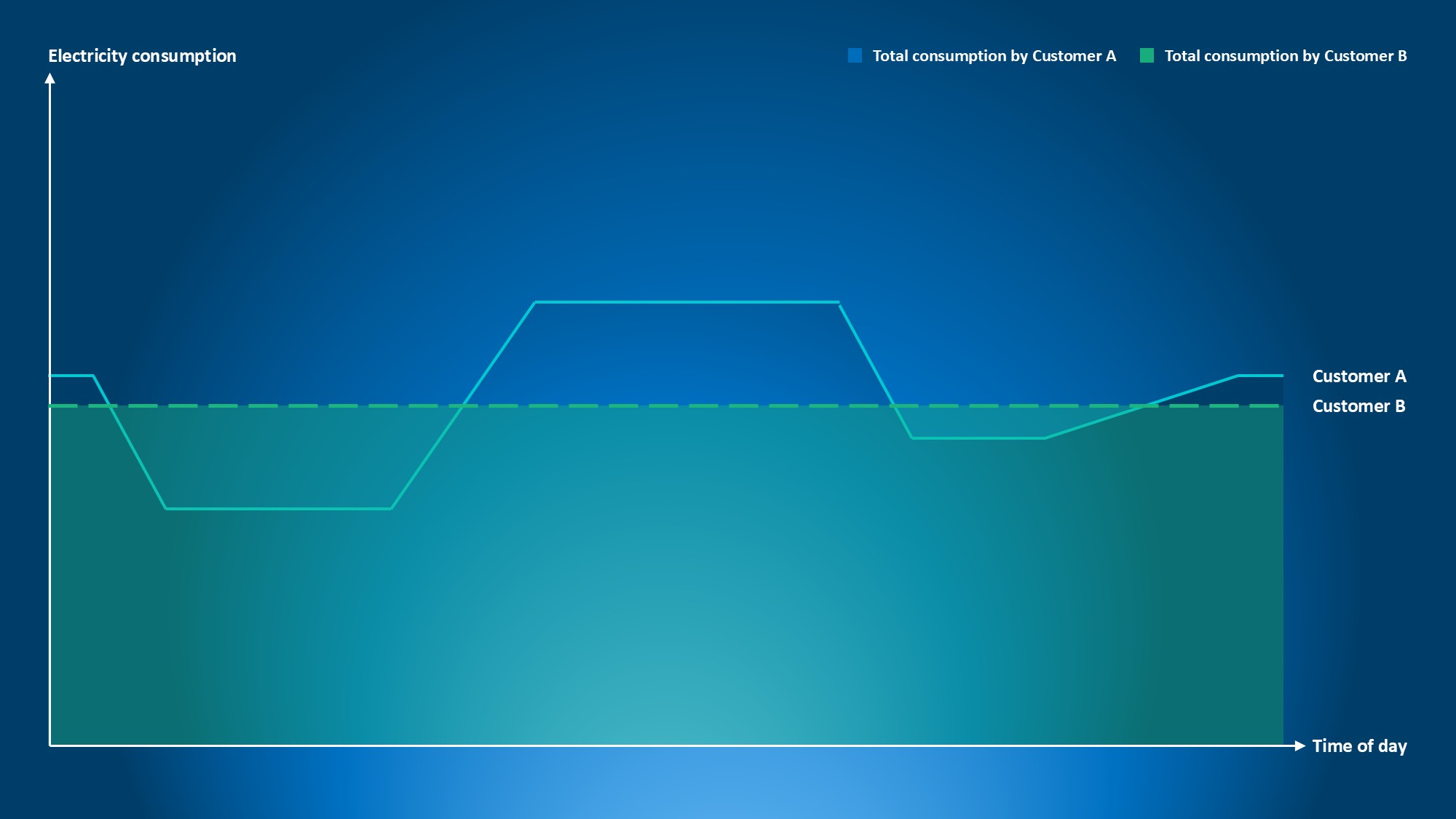
In the illustrative example above, Customer A’s peak electricity demand is higher than Customer B’s. This means that Customer A will face a higher capacity charge. If both customers consume the same total quantity of electricity in a given month, they would both face the same energy charge. Therefore, under the proposed two-part tariff, Customer A will face a higher total bill.
The two-part tariff incentivises customers to smoothen out their demand (that is, to move towards the shape of Customer B’s demand, as much as possible). This would minimise their electricity bills, and, over time, help minimise the largely fixed costs of building additional infrastructure for the electricity network.
It should also be noted that customers do not necessarily pay overall higher prices for electricity under the two-part tariff. For the newly proposed energy charge, the price per unit of electricity is likely to be lower than the unit charge under the previous single tariff, since some part of the total cost of the network will likely be recovered through the capacity charge.
Potential Limitations of Two-Part Tariffs
Only time will tell whether the two-part tariff has the desired impact on Vietnam’s electricity system. Until then, it is important to discuss the potential unintended or undesirable consequences of the mechanism.
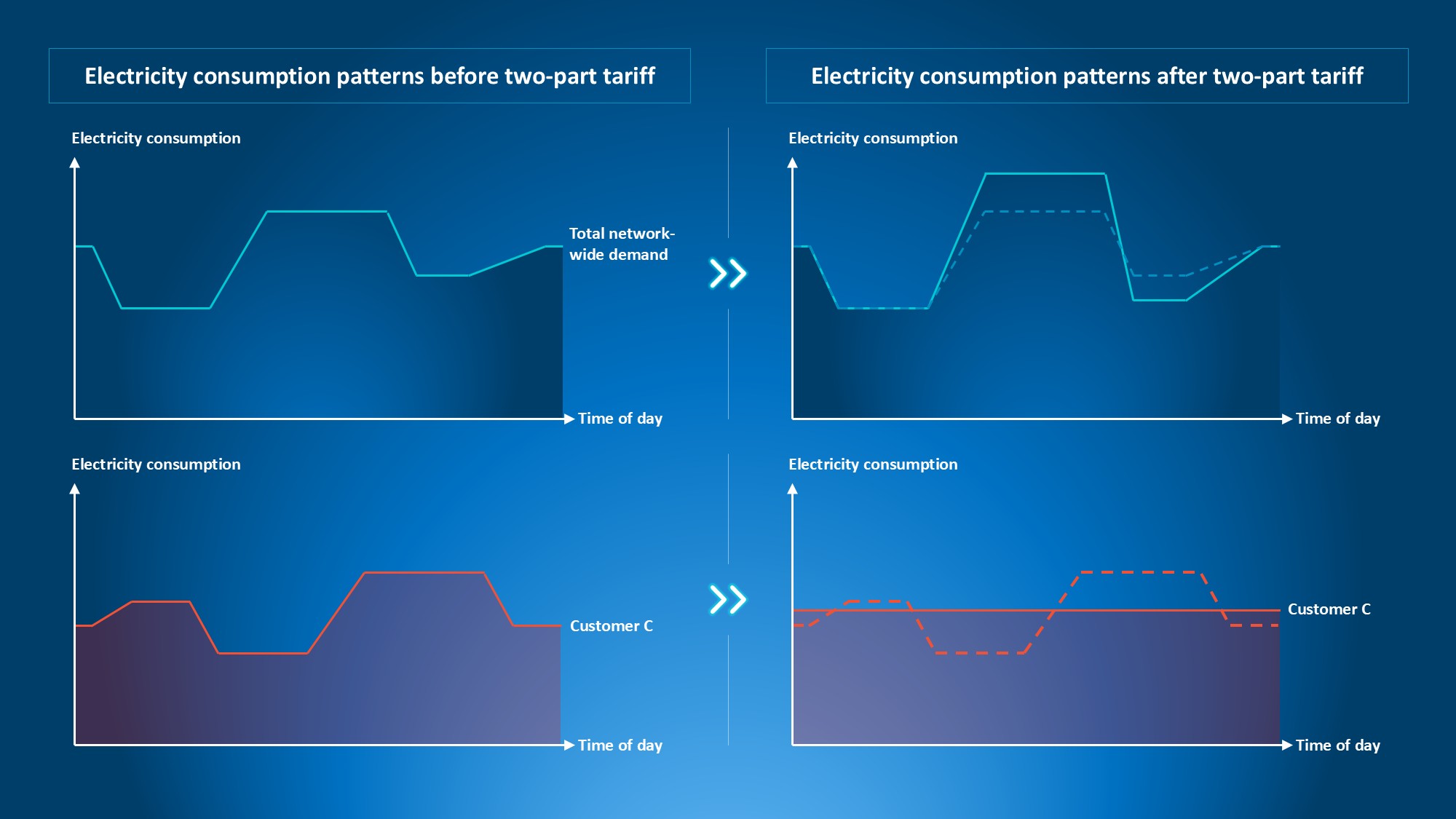
For example, there may be customers whose electricity consumption already falls significantly outside the demand peaks of the rest of the network, such as a factory that has set up its processes to perform the most power-intensive activities at night. For these customers, the capacity charge may induce them to shift some demand into the peak hours to reduce their peak consumption and hence capacity charge, running counter to the intended effect of the two-part tariff and diminishing the overall positive effect on efficiency.
This is illustrated in the figure below. If the two-part tariff encourages enough customers who have consumption patterns similar to Customer C, the impact on the system as a whole might be to increase demand in peak hours.
Figure 1-2: Illustrative Example of Possible Impact of Two-Part Tariff on Total Peak Demand
In addition, some customers may not have the necessary information or understanding of electricity usage to smoothen out their consumption, in order to optimise their capacity charge. This may be particularly true of households who may not have access to precise information on how much power is consumed by each of their appliances. Also, certain actions, such as running a washing machine late in the night, may simply be impractical for ordinary households to take.
Finally, two-part tariffs could also result in imposing higher costs on lower income households. This is because lower income households tend to use less electricity. Some of these low-usage households might therefore see an increase in their bills as they will have to pay a capacity charge even with very low levels of electricity usage otherwise. Whether or not such customers lose out will, of course, depend on the exact per unit rates applied in the capacity and usage charges, but concerns over fairness will no doubt be important when it comes to regulations concerning electricity prices.
Conclusion
Vietnam’s shift to a two-part tariff on electricity has the potential to change how (and when) customers use electricity. It is intended to improve the efficiency of the electricity network and help accelerate the energy transition. Time will tell if it has its intended effect, as Vietnam progresses through its pilot into fuller implementation.
Footnotes:
1: “Pilot implementation of two-component retail electricity tariff from October 2025,” Vietnam Electricity (10 October 2025).
2: “EVN submits two-component pricing model,” Vietnam+ (14 October 2025).
3: Ibid.
4: Ibid.
5: Ibid.
6: Phu, Le Viet, “Nonlinear temperature response of electricity loads and implications for power development policies in Vietnam,” ScienceDirect (12 August 2021).
7: “EVN submits two-component pricing model,” Vietnam+ (14 October 2025).
8: Ibid.
The views expressed herein are those of the author(s) and not necessarily the views of FTI Consulting, Inc., its management, its subsidiaries, its affiliates, or its other professionals.
Related Insights
Related Information
Published
March 17, 2026
 Key Contacts