Rethinking Sustainability Strategy
Are You Prepared for Hourly Carbon Accounting?
-
January 12, 2026
Downloads Download White Paper
-

Executive Summary
A planned update to the widely used Greenhouse Gas Protocol (“GHG Protocol”) is set to reshape corporate sustainability reporting. The proposed revisions introduce stricter requirements for using contractual energy purchases to reduce Scope 2 emissions, including Energy Attribute Certificates (“EACs”).1 A draft proposal summarizing the updates is open for public comment until January 31st, 2026, with finalized guidance planned for 2027.2
In this whitepaper, FTI Consulting’s Power Market Advisory team quantitatively analyzes the impact of the new EAC requirements for a “typical” office building. The results show that a hypothetical “net-zero” EAC portfolio allowed under current rules could only reduce about 50% of Scope 2 emissions under the proposed new rules.
Scope 2 Emissions Background
Emissions from purchased energy services, including electricity, are categorized as Scope 2 emissions. The GHG Protocol requires companies to estimate their Scope 2 emissions using two methods: the location-based method and the market-based method.3
The location-based method measures emissions based on the average carbon intensity of the electric grid where organizations operate, whereas organizations can use the market-based method to account for contractual energy purchases. The market-based method more accurately represents the actual electricity consumed by the reporting organization because companies reporting under this method can claim contractual instruments that meet specific criteria, including EACs, to reduce their Scope 2 emissions. The proposed changes to Scope 2 accounting covered in this paper primarily apply to the market-based method.
What is Changing?
Organizations planning to reduce their emissions through EACs, whether or not the EACs are bundled with claims to renewable energy consumption, will need to account for two key changes to the criteria for determining the validity of an EAC: a narrower “deliverable” boundary based on the location of the EAC source generator and a new “hourly matching” requirement based on when the underlying power associated with an EAC was generated.
Why This Matters Now
Emissions reporting is now more widespread and under greater scrutiny relative to when the GHG Protocol published its current Scope 2 guidance in 2015. Public concern that the current Scope 2 accounting rules are not sufficiently aligned with scientific knowledge motivated the GHG Protocol to revise its Scope 2 guidance, particularly on the use of EACs to reduce Scope 2 emissions, for greater accuracy, transparency, and comparability across organizations.4
The Current State of Market-Based Scope 2 Emissions Reporting
The market-based method accounts for claimed contractual energy purchases and environmental credits, such as EACs, used to reduce an organization’s emissions.5 Current guidance allows companies to reduce their reported Scope 2 emissions by retiring EACs that follow these criteria:6
- Deliverability: The certificate must come from the same market (the United States and European electricity markets are currently each defined as “one market”).
- Uniqueness: The environmental claims are unique (i.e., the credit is not owned or claimed by anyone else).
- Annual Matching: The vintage of the certificate is consistent with the period when energy was consumed (for annual matching, this means the same year).
- Retirement: The reporting company actually retired the certificate in the reporting year.
The GHG Protocol’s current proposal makes significant changes to the first and third criteria: deliverability and annual matching.
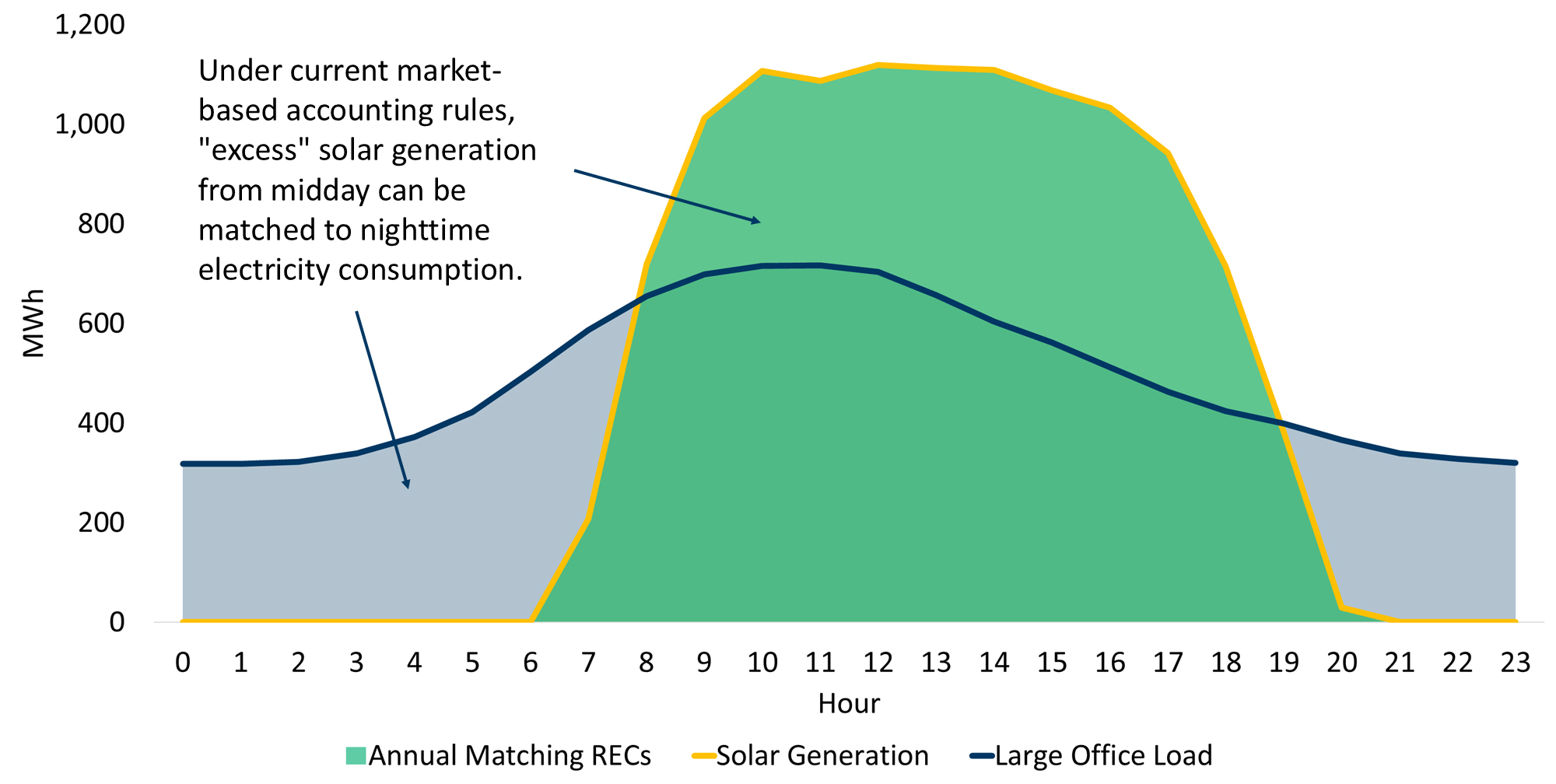
Currently, organizations can purchase and retire EACs created anywhere in the United States within the same reporting year. Figure 1 below illustrates a simplified example of annual matching for a single day. The dark blue line represents electricity demand from a large office building. To achieve “net-zero” emissions, an organization must purchase enough EACs to match its building’s electricity demand, or load. The red line represents the solar electricity generation equivalent to the EAC claims required to match the building’s daily electricity load.
Current guidance allows reporting entities to claim 100% renewable consumption and zero Scope 2 emissions from electricity as long as the amount of EACs purchased (the green area) equals the facility’s electricity consumption (the area under the blue line). However, in reality, the facility’s nighttime operations may be powered by greenhouse gas emitting generators, meaning that net emissions from the electricity consumed at the facility may not be zero. The proposed shift to hourly matching acknowledges that solar energy cannot be delivered to facilities at night without the use of energy storage and would require that renewable energy claims are backed by renewable generation that occurred in the same hour.
Figure 1: Current Market-Based Annual Matching Example
Key Changes Proposed Under the New Standard
The market-based emissions reporting proposal introduces two new requirements:7
- Narrower Deliverability: National markets may no longer be considered “deliverable” areas. Instead, EACs must be linked to generation located in the same deliverable region as a reporting organization’s facility. The proposal does not define new “deliverable” region boundaries but includes options for public feedback.8
- Hourly Matching: EACs used to reduce Scope 2 emissions must be matched to electricity consumption on an hourly basis.9
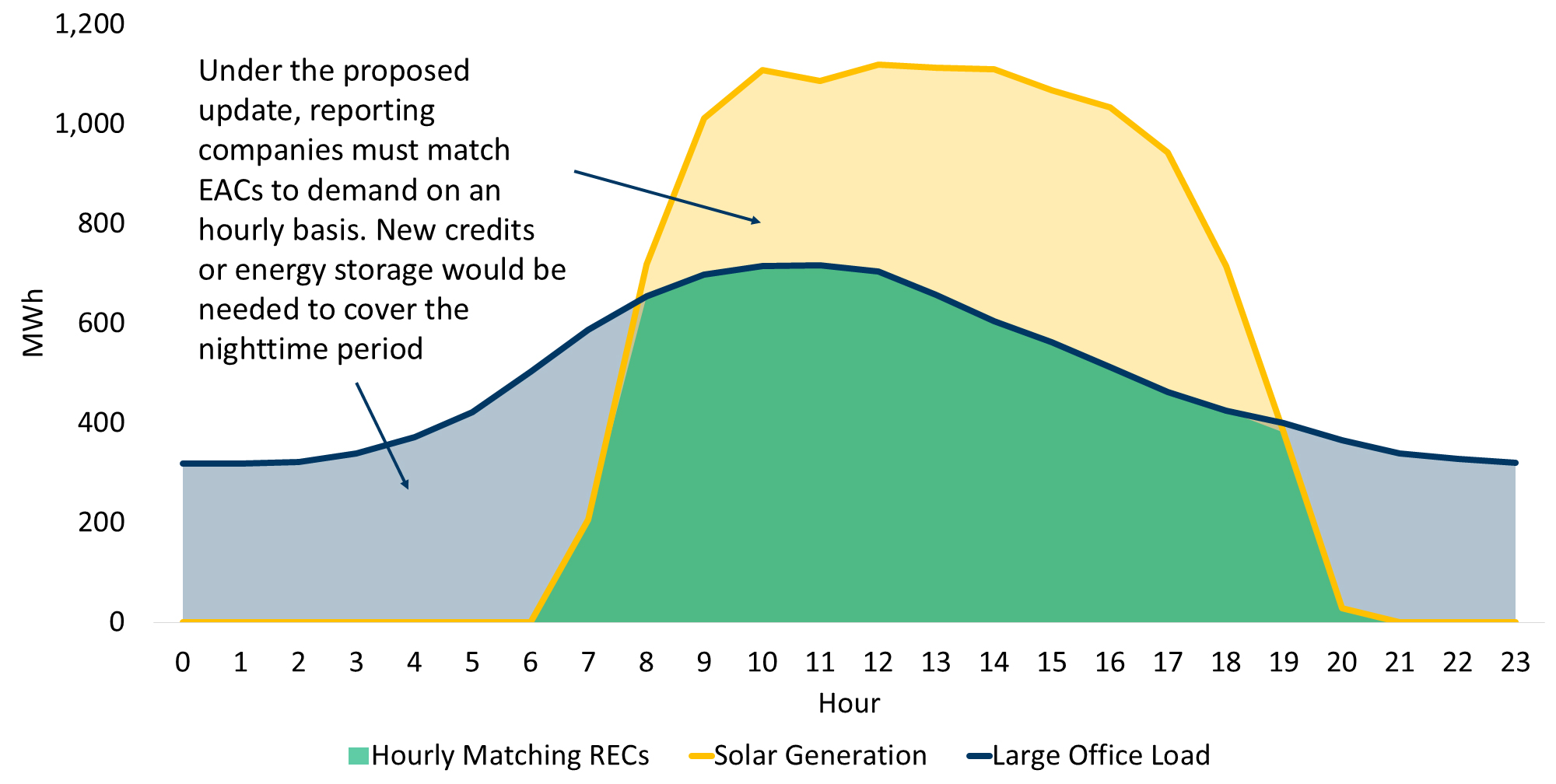
In contrast to the annual matching example illustrated in the chart above, Figure 2 outlines how hourly matching could limit the emissions reduction impact of one solar EAC procurement strategy. The green area representing valid EAC claims under hourly matching does not match the company’s total electricity consumption. Under strict hourly matching, the company cannot claim “net-zero” emissions from electricity using solar-based EACs alone.
Figure 2: Proposed Market-Based Hourly Matching Example
In addition to hourly matching, the proposal narrows the definition of deliverable region. Current guidance defines the United States as a single electricity market. A company located in Illinois can claim EACs generated by solar power plants in California—despite the fact that electricity generated in California does not power office buildings in Illinois. While the current approach to EAC accounting broadly supports renewable energy development by creating an additional revenue stream for renewable energy developers, it does not align with the physical complexity of the electric system and may lead reporting companies to overestimate the emissions reduction benefit of renewable energy credit purchases.10
From a practical perspective, hourly matching and new deliverable region boundaries will require companies to examine potential EAC purchases more thoroughly or find other ways to reduce their electricity consumption. Assuming the company has access to hourly data, identifying EACs that offer the greatest emissions reduction benefit under the new standard will require research into the EACs available in each deliverable region. That task scales in difficulty with the size and geographic footprint of the reporting organization. Multinational organizations will need to identify the approved deliverable boundaries in each country and then determine the best valid EACs for their operations in each applicable market.
To ensure a smooth transition to the new rules and to mitigate the burden placed on reporting companies, the proposal includes several feasibility measures, all of which are subject to revision:11
- Exemption Threshold: Companies that fall under a certain electricity consumption threshold and/or are classified as a small/medium business will not be subject to the hourly matching requirement. The latest guidance suggests this threshold should cover fewer than 50% of CDP-reporting companies but more than 50% of total electricity consumption.
- Load Profiles: Organizations without access to hourly electricity consumption or hourly EAC generation data can approximate hourly data from monthly or annual data using publicly available load profiles. The proposal specifies a hierarchy of load profile types for organizations to consider.
- Legacy Clause: Existing long-term renewable energy claims based on annual matching may be “grandfathered” into the new rules. The criteria for applicable claims and the duration of the legacy benefit have not been determined.
- Phased Implementation: The finalized rules are expected to be published in 2027, followed by a gradual implementation process intended to give organizations time to adjust and encourage the development of third-party resources to collect and process hourly data.
The proposal’s details, including the definition of deliverable market boundaries, will be finalized after public consultation. The public consultation materials list three potential deliverable market boundaries for the United States: the U.S. EPA’s eGRID regions, the DOE Needs Study Regions, and wholesale markets/balancing authorities.12 To analyze the potential impact of the proposed rules, we assume wholesale market/balancing authority market boundaries and limit our analysis to the PJM Regional Transmission Organization (“RTO”).
While it is impossible to track the physical flow of electricity from a specific generator to a specific consumer, most electricity remains within an RTO.13 It is reasonable to assume that electricity generated in an RTO could have been delivered to an organization’s facility located in that RTO.
Impact Analysis
FTI Consulting’s Power Market Advisory team modeled the potential impact of market-based Scope 2 emissions based on hourly matching for a hypothetical office building using PJM hourly load profiles from NREL’s ComStock Analysis Tool, a residual mix emissions factor from Green-e® for the RFCW eGRID region and hourly solar generation profiles from an internal PLEXOS dataset.14
We find that a company that purchases a sufficient number of solar energy EACs in PJM to claim “net-zero” Scope 2 emissions using the market-based approach for an office building would only be able to claim a 52% reduction in emissions under hourly matching. This result suggests that hourly matching could have a significant impact on market-based emissions reporting for companies that voluntarily purchase EACs, although the impact will vary by organization and market.
Our analysis does not incorporate long-term dynamics of renewable energy growth or decline and assumes that reporting companies will have access to hourly generation and consumption data. Our analysis also does not consider the price of EACs and other renewable energy contractual instruments, which increased dramatically following the rollback of clean energy production subsidies in the United States.15 These considerations will also affect future EAC procurement strategies.
Recommendations
Reporting organizations can take steps now to participate in the stakeholder process that determines the final version of updated rules and plan for necessary adjustments to sustainability strategies.
- Assess current emissions inventories to determine the feasibility of collecting hourly energy consumption data.
— Many companies use monthly utility bills to calculate electricity consumption. Under the proposed hourly matching rule, companies will need to use hourly data, if available, or approximate hourly data usage using load profiles. This increases the complexity of emissions data collection, particularly for shared spaces. Companies should identify whether their facilities currently provide or plan to provide hourly electricity consumption data.
- Review current clean energy procurement strategies in preparation for hourly matching.
— Companies that enter into power purchase agreements (“PPAs”) with specific renewable projects should request their hourly generation data associated with those purchases.
— Companies that rely on purchased EACs should assess the proximity of EAC generators to their facilities, the underlying energy source of the EAC and whether the EAC is tracked hourly, monthly, or annually.16
- Monitor the GHG Protocol’s public consultation process, extended through January 31st, 2026, and review the finalized Scope 2 guidance, expected in 2027.17
Footnotes:
1: Examples of EACs are renewable energy certificates (“RECs”) in the United States and guarantees of origin (“GOs”) in the EU. An EAC represents 1 MWh of renewable electricity.
2: “RELEASE: GHG Protocol Opens Public Consultations on Scope 2 and Electricity Sector Consequential Accounting,” Greenhouse Gas Protocol (October 10, 2025).
3: “GHG Protocol Scope 2 Guidance”, GHG Protocol (accessed December 22, 2025)
4: “Upcoming Scope 2 Public Consultation: Overview of Revisions,” Greenhouse Gas Protocol (September 29, 2025).
5: The market-based method also allows reporting organizations to use utility-specific emissions rates, when available, but this is not affected by the proposed updates.
6: “GHG Protocol Scope 2 Guidance”, GHG Protocol (accessed December 22, 2025).
7: “Upcoming Scope 2 Public Consultation: Overview of Revisions,” Greenhouse Gas Protocol (September 29, 2025).
8: Specific market region boundaries have not been determined. In the United States, these boundaries may be at the RTO-level or, for areas not covered by RTOs, non-RTO balancing authorities. RTOs cover most of the continental United States. Please refer to FERC for more information about RTOs.
9: “Scope 2 Technical Working Group Progress Update,” Greenhouse Gas Protocol (June 11, 2025).
10: Ibid.
11: “Upcoming Scope 2 Public Consultation: Overview of Revisions,” Greenhouse Gas Protocol (September 29, 2025).
12: “Public Consultation--Scope 2,” Greenhouse Gas Protocol (accessed December 22, 2025).
13: Power is exchanged across RTO/balancing authority boundaries. The proposed updates would allow companies to use “price-based transmission capacity analyses” to justify claims that power associated with an EAC was imported across market boundaries and should be considered deliverable.
14: ComStock Analysis Tool; 2024 Green-e® Residual Mix Emissions Rates.
15: Penrod, Emma, “Renewable power purchase agreement prices rising in wake of One Big Beautiful Bill Act,” Utility Dive (August 13, 2025).
16: Some regions have developed EAC tracking systems that plan to provide hourly tracking in the future, potentially before the new rules would come into effect. See Terada, Rachael, “Readiness for Hourly: U.S. Renewable Energy Tracking Systems,” Center for Resource Solutions (June 15th, 2023).
17: “GHG Protocol Public Consultations,” Greenhouse Gas Protocol (accessed December 22, 2025).
The views expressed herein are those of the author(s) and not necessarily the views of FTI Consulting, Inc., its management, its subsidiaries, its affiliates, or its other professionals.
Related Information
Published
January 12, 2026
 Key Contacts