


CPS 230 Beyond Implementation: What Boards and Executives Should Do Next
Five Priorities for Boards and Executives To Demonstrate CPS 230 Effectiveness in Practice
-
November 23, 2026
-

Completing CPS 230 implementation is not the same as demonstrating operational resilience. Boards and executives need evidence that critical operations can remain within tolerance, controls work in practice and accountability is embedded in day-to-day management.
For many organisations, implementing the Australian Prudential Regulation Authority’s (‘APRA’) Prudential Standard CPS 230 Operational Risk Management was a program with a deadline, budget, steering committee and delivery team. It covered the identification of critical operations, approval of tolerance levels, the material service provider register and contractual requirements.
With CPS 230 programs largely closed, the question now is whether the business has assumed the project team’s work to sustain the framework.
Five Questions Boards Should Ask
For boards, the immediate task is to challenge whether implementation has translated into operating capability. Five questions can help focus that discussion:
- Who is accountable, by name, for each critical operation, and is that consistent with our formal accountability arrangements, including the Financial Accountability Regime (‘FAR’) where applicable?
- When did we last test whether critical operations could remain within tolerance under a severe but plausible scenario, and what changed as a result?
- Which service provider failure would have the greatest impact on our critical operations, and how credible are our contingency, substitution or exit arrangements?
- Which gaps from the program are still open or risk-accepted, who owns each one, and which remediation dates have already moved?
- What independent assurance will we receive over the next 12 months, and on which parts of the framework?
Where answers reveal gaps, management should return with a named owner, a clear action and a target date.
What Boards and Executives Should Do Next
Program closure is a useful point to confirm ongoing ownership, resourcing and assurance. Five practical steps for the next 12 months:
- Run a closure review. Record what was built, what was deferred and what risks were accepted along the way.
- Agree a risk-led assurance plan. Prioritise applicable requirements and material risks across operational risk, continuity and service provider arrangements. Identify gaps in design assurance and use the findings to inform internal audit’s priorities.
- Confirm ongoing ownership and accountability. Assign owners, authority and resources; align with formal accountability arrangements, including FAR where applicable.
- Rehearse a supervisory review. Assemble the evidence pack as if APRA had already asked for it.
- Change what the board sees. Shift board reporting from delivery milestones towards test outcomes, tolerance breaches, incident trends, provider performance and remediation progress, supported by early-warning risk indicators.
These questions and actions address the central challenge after program closure: turning a documented framework into demonstrated operational resilience.
Managing the Handover to Business As Usual
The handover to business as usual (‘BAU’) can expose gaps that the CPS 230 project team had been covering.
During implementation, the project team may have carried much of the operational work: chasing service providers for evidence, maintaining the material service provider (‘MSP’) register, coordinating scenario tests and preparing board papers. In practice, the project team may have been functioning as a control. When it winds down, each of those activities needs a named, accountable BAU owner; otherwise, it risks being missed.
The more significant warning signs are gaps between what the framework assumes and what the organisation can demonstrate in practice:
- Recovery capability does not match approved tolerances. Systems or provider recovery times exceed the time available to restore a critical operation, or have not been validated through testing.
- Scenario tests do not demonstrate end-to-end recovery. Exercises test individual teams or systems without showing whether the critical operation can remain within tolerance when several dependencies fail together.
- Provider contingency arrangements are unproven. Plans assume an alternative provider, manual workaround or exit option is available without demonstrating that it can operate at the required scale and speed.
- Material weaknesses remain unresolved. Significant findings recur across incidents and tests, while remediation dates move without a clear assessment of the resulting exposure.
- Accountability has not transferred into practice. Critical recovery activities or controls still depend on former project staff, with no BAU owner able to demonstrate the authority, resources and capability to deliver them.
Each warning sign deserves attention. Whether they indicate a breach depends on the facts and the applicable requirements. They may also reveal a broader weakness: a framework that is documented but not consistently embedded in day-to-day operations.
Ownership Has To Be Named, Not Assumed
Chief risk officers should challenge whether every ongoing CPS 230 activity has a named BAU owner with the authority and resources to carry it out.
A RACI (responsible, accountable, consulted and informed) matrix can clarify these roles across tolerance reviews, scenario testing, MSP register maintenance and submissions, contract renewal checks, incident notification and board reporting.
Two tests separate a working RACI from a theoretical one:
- One accountable person, at the right level. Each critical operation needs a named business executive accountable for end-to-end performance, with defined responsibilities across contributing teams. Risk provides challenge, not operational ownership.
- Consistency with formal accountability arrangements. Where FAR applies, align the RACI with relevant accountability statements and any entity accountability map. Inconsistencies can obscure responsibility and delay incident decisions.
Executives should fund testing, MSP monitoring and assurance through BAU budgets beyond program closure. The board should challenge whether those resources are adequate.
APRA’s Supervisory Focus Extends Beyond Implementation
Implementation deadlines do not mark the end of supervisory scrutiny. APRA’s 2026–27 Corporate Plan states that it will continue to review CPS 230 implementation through prudential and thematic reviews across a range of industries.
The thematic focus this year is operational and technology risk management at general insurers and specialist payment providers. That builds on recent work with superannuation trustees and private health insurers. APRA will engage directly with entities on findings and share broader insights with industry where appropriate.
What this means in practice:
- General insurers and specialist payment providers should prepare evidence of operating effectiveness now, in light of APRA’s stated thematic focus, rather than wait for a supervisory request.
- Superannuation trustees and private health insurers should use findings from supervisory engagement to assess their arrangements and address identified weaknesses.
- Other regulated entities should assess published APRA insights against their own risks and arrangements, distinguishing supervisory observations from binding requirements.
From Design to Operating Poof
Boards should first ask management to demonstrate whether critical operations can remain within approved tolerances, where material weaknesses remain and who is accountable for addressing them. They should then consider whether the evidence is sufficient and where further testing or independent assurance is needed. The distinction is between confirming that the framework has been implemented and demonstrating that it works in practice.
| Area | Implementation | Ongoing assurance |
|---|---|---|
| Core question | Have we built what CPS 230 requires? | Does it operate reliably under normal conditions and stress? |
| Critical operations and tolerances | Identified, approved and documented | Critical operations tested for their ability to remain within tolerance under severe but plausible scenarios; tolerances reviewed as the business changes |
| Service providers | Identified, recorded and assessed against contractual requirements | Monitored for performance, concentration, upstream dependencies and exit readiness |
| Controls | Designed, documented and tested for implementation readiness | Tested for design and operating effectiveness, with weaknesses remediated |
| Evidence | Design documentation, implementation testing and readiness assessments | Test results, incident trends, provider evidence and remediation tracking |
| Management responsibility | Program director coordinates delivery; business executives retain accountability | Named business executives own ongoing operations and controls |
| Board’s role | Approve key arrangements and challenge management’s readiness assessment | Challenge management, assess assurance findings and hold executives accountable for remediation |
The business runs critical operations, owns controls and manages disruption within approved tolerances. The second line maintains the risk framework, monitors operational risk and challenges first-line controls. Internal audit provides independent assurance on the areas it reviews, including the credibility of business continuity arrangements and the effectiveness of service provider oversight.
Audit scope and timing should reflect applicable requirements and risk. Management remains responsible for addressing findings.
Assurance Is a Rolling Plan, Not a One-Off Audit
A rolling assurance plan should reflect risk, applicable requirements and framework maturity, building coverage without deferring required reviews or testing of material risks.
Testing a control’s operation has limited value if its design is flawed. Deadline-driven frameworks can be too complex to sustain or too limited to rely on. A proportionate review, independent of the framework’s designers, can identify design weaknesses and inform internal audit’s priorities. Material weaknesses should be addressed before relying on operating-effectiveness results.
A Rolling Assurance Plan Covers Foundations, Operating Effectiveness and Resilience
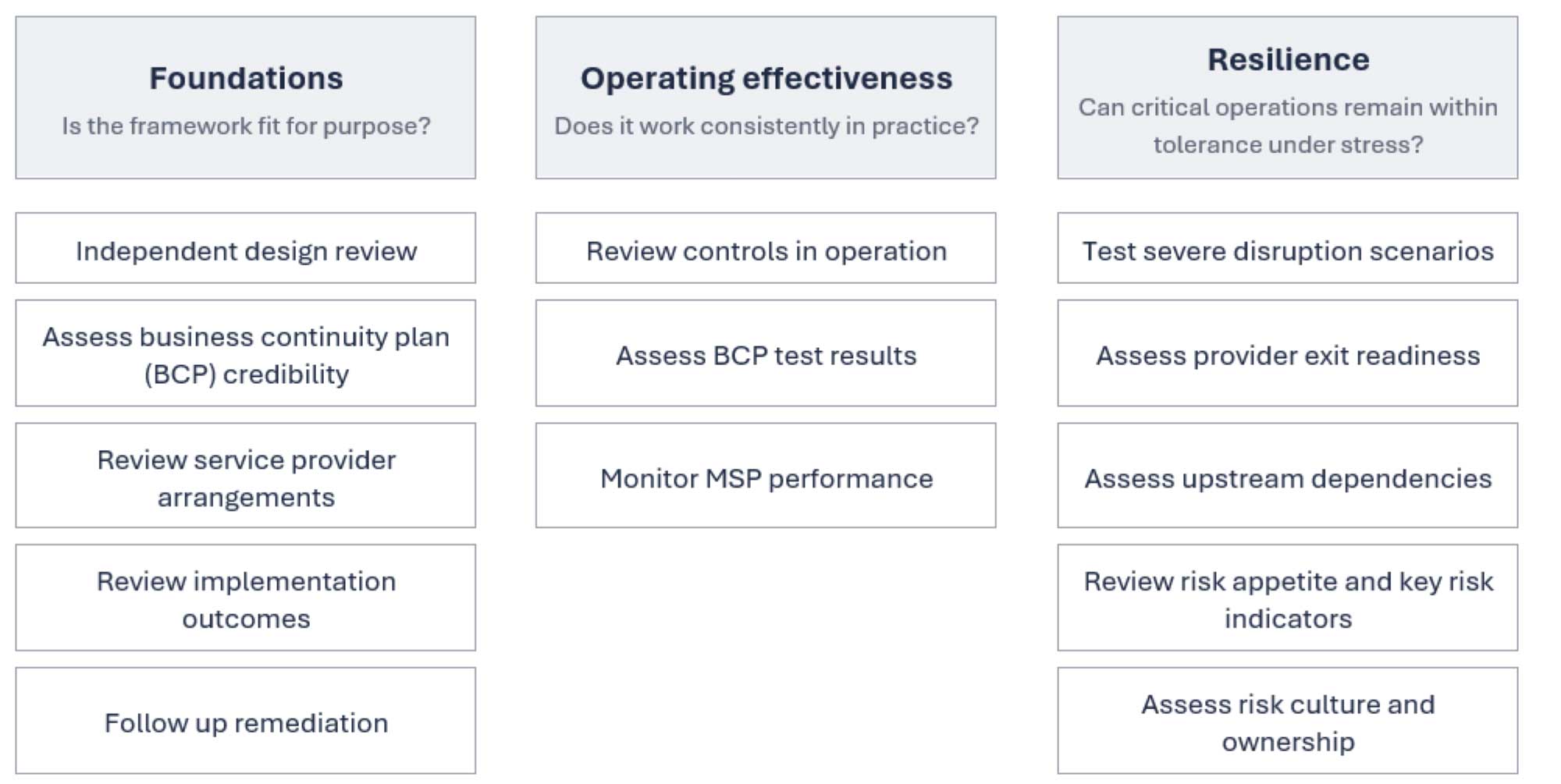
Illustrative, overlapping coverage areas, not a fixed sequence. Scope, timing and frequency should reflect applicable requirements and risk; activities may span more than one area.
Assurance findings should lead to clear treatment decisions, named owners and target dates. Boards should receive an explanation of material delays, changes in risk exposure and what further evidence is needed before weaknesses can be considered resolved.
Service Provider Oversight Needs Evidence
Contractual compliance is only part of effective service provider oversight. Material service providers can support critical operations and perform important controls, whether or not they are regulated themselves. Management should obtain evidence that the risks associated with these arrangements are understood, monitored and managed in practice, and boards should challenge whether that evidence is sufficient. Key areas include:
- Clear service dependencies. Providers should understand which critical operations their services support and identify the people, systems and subcontractors on which delivery depends.
- Continuity and incident evidence. Management should assess whether provider continuity capabilities support the organisation’s tolerance levels and account for upstream dependencies, and whether incident arrangements provide for prompt notification when agreed triggers are met.
- Relevant control assurance. Independent assurance reports can reduce duplicated reviews, but management should assess their scope, period covered, findings and relevance to its arrangements, and obtain additional evidence where gaps remain.
Strong provider performance does not remove concentration risk. Management should identify where critical operations depend on the same provider or shared subcontractor, assess the impact of disruption and report material exposures and contingency options to the board.
Completing implementation is a milestone, not the end point. The ongoing test is whether critical operations remain within tolerance, controls work under pressure and management addresses weaknesses. Boards need evidence of all three, not simply confirmation that the framework is in place.
The views expressed herein are those of the author(s) and not necessarily the views of FTI Consulting, Inc., its management, its subsidiaries, its affiliates, or its other professionals.
Related Insights
Related Information
Published
November 23, 2026
 Key Contacts
Senior Managing Director, Leader of Australia Governance, Risk and Compliance
Managing Director
Senior Director