

The Decline of Print Media
Novus/Media24 and the Limits of South African Merger Control
-
November 06, 2026
Downloads Download Article
-

In October 2024 the Competition Commission of South Africa (“Commission”) approved Novus’s acquisition of Media24’s community newspaper portfolio, the Soccer Laduma and Kick Off titles, and the On the Dot distribution business. Earlier in 2024, Media24 announced that it was moving four of its longstanding print titles, Beeld, Rapport, City Press and Daily Sun, to digital formats.
The migration decision became a central part of the merger proceedings when two competing publishers, Capital Newspapers and Caxton, appealed the Commission’s approval before the Competition Appeal Court of South Africa (“CAC”). They argued that these were not separate matters. Instead, the migration and the sale were steps in a single plan, with the migration forming part of a “composite transaction” with the notified sale, and as such the Commission should have reviewed them together. The point also mattered commercially: moving the titles online reduced the volumes distributed by On the Dot, which raised distribution costs for the rival publishers who shared that network.
The question for the CAC was therefore one of jurisdiction. Media24 sold the distribution business and also moved four titles online. Does merger control extend to the second decision, when Media24 retained ownership and control of those titles throughout? The dispute continued for more than a year and came before the CAC twice before the Constitutional Court declined to hear a further appeal.
FTI Consulting was briefed by ENS, one of Africa’s largest law firms, on behalf of the merging parties, to assess the competitive effects of the proposed transaction. Our economic analysis addressed whether the migration would have proceeded irrespective of the merger and helped to distinguish merger-specific effects from those flowing from the structural decline of print media.
This note sets out what the CAC decided, and what follows for the economic question that arises whenever a disposal forms part of a wider restructuring: which effects are attributable to the transaction, and which would have occurred anyway.
The Print Media Industry Is in Significant Decline
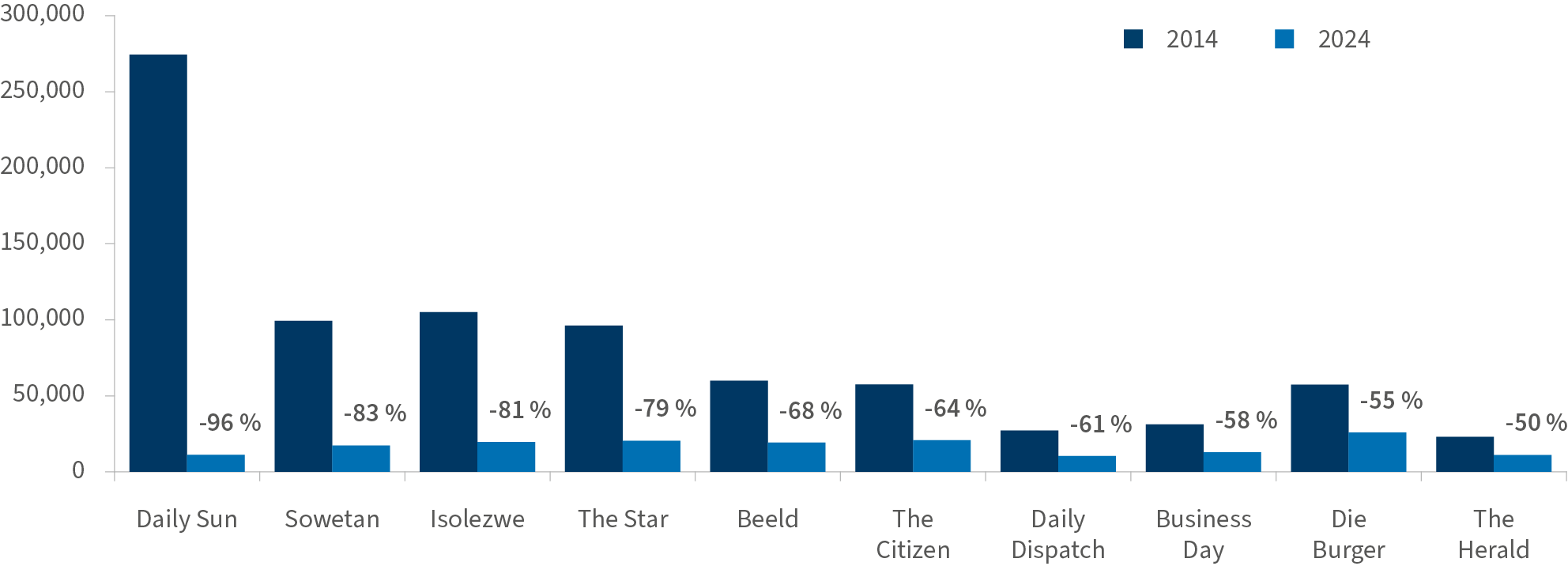
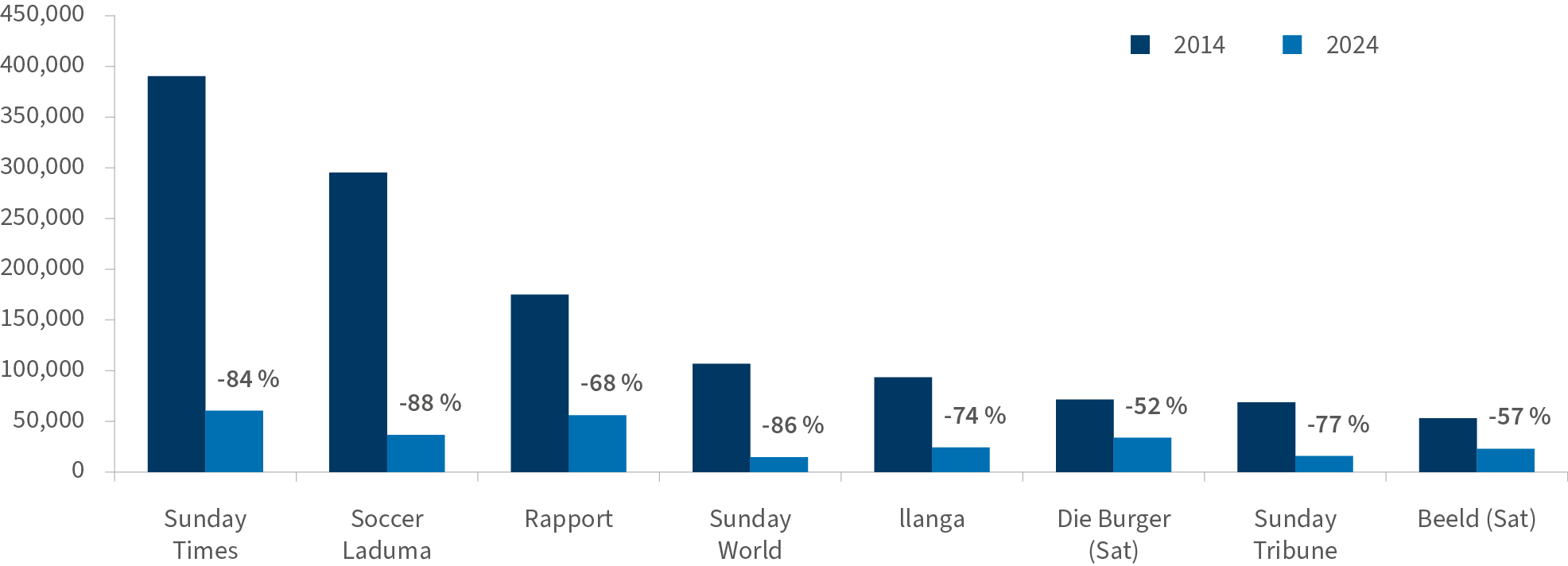
An important feature of the case’s economic context is that print newspaper circulation in South Africa has been contracting for a decade.1 Audit Bureau of Circulations (“ABC”) data, shown in Figures 1 and 2, record daily titles such as Die Burger, The Herald, Daily Sun and The Star losing between 50% and 96% of circulation between 2014 and 2024, with weekend titles including the Sunday Times, Rapport and Sunday World declining on a similar scale.
Figure 1 — Printed Daily Newspaper Circulation: 2014 Vs 2024
Source: ABC via “Newspapers and magazines are rapidly dying in South Africa”, BusinessTech, August 2024.
Figure 2 — Printed Weekly/weekend Newspaper Circulation: 2014 Vs 2024
Source: ABC via “Newspapers and magazines are rapidly dying in South Africa”, BusinessTech, August 2024.
Against this backdrop, Naspers chairman, Koos Bekker, publicly addressed Media24’s strategic decision to migrate four of its print newspaper titles to its digital platforms.2 These conditions explain why Media24 was moving its print titles to digital platforms. Nonetheless, the migration coincided with the sale of other assets, and these steps taken together gave rise to the composite transaction argument.
No Acquisition or Control, No Merger
The CAC identified the composite transaction argument as the central legal question requiring determination.3 The applicants’ criticism was that the Commission had not analysed the migration and the sale as parts of one strategic decision. On this theory, decisions taken close together in time and pointing in the same strategic direction should fall within merger review, even where no control over the affected assets changes hands.
The CAC rejected this characterisation on both legal and factual grounds. On the legal question, the CAC articulated the governing principle succinctly: “No acquisition or control, no merger.”4 The CAC emphasised that while the notified transaction involved Novus acquiring sole control over specific target businesses, the migrating newspapers remained under Media24’s total control throughout. South Africa’s Competition Act defines a merger as an action where “one or more firms directly or indirectly acquire or establish direct or indirect control over the whole or part of the business of another firm.”5 The migration decision involved no such change in control. Rather, it represented a unilateral commercial decision by Media24 regarding assets it continued to own and operate.
On the factual question, the CAC asked, “But for the merger, would the event in question still have occurred?” The evidence before the CAC was unambiguous. Media24 had maintained throughout that the migration would be implemented regardless of whether the merger took place. The CAC found that the applicants had conflated timing (i.e. that the migration steps followed merger approval) with the existence of a single plan in which the sale of On the Dot was one step.
What Are the Regulatory Implications?
The Constitutional Court refused leave to appeal in February 2026, leaving the CAC’s ruling as the authoritative statement. The line it draws is that merger review addresses changes in control, not firm conduct generally. Crucially, the CAC affirmed the Commission’s approach in isolating merger-specific effects from broader industry trends and standalone operational choices.
The first implication for parties on both sides of a merger review concerns the counterfactual against which effects are measured. The applicants’ case compared the position before the merger with the position after and attributed the difference to the transaction. Where a market is already contracting, that comparison captures the decline as well as the impact of the transaction.
The CAC asked instead whether the migration would have occurred but for the merger, and whether the merger was its dominant cause. A counterfactual of this kind cannot be observed. It has to be constructed, by measuring the underlying trend separately using evidence that predates the transaction.
The second implication concerns the economics of shared distribution networks. On the Dot’s network was built around the combined volumes of the titles it carried. When the volumes contributed by the largest titles are withdrawn, the same network cost is recovered over fewer copies, and the price per copy rises for the publications that remain.
That follows from cost allocation, not from market power. The distinction matters because a price increase imposed on a particular publisher may reflect the terms on which that publisher was previously carried rather than any change in bargaining position. A price increase after a merger therefore establishes little on its own: its meaning depends on how the network was funded before the transaction, and how it would have been priced had the transaction not occurred.
The decision does not mean that restructuring during a merger review escapes scrutiny. Rather, it places greater weight on evidence about the conditions under which the restructuring took place. The CAC preserved the position that a decision taken shortly before a merger is implemented may be sufficiently closely connected to form part of the merger decision-making process. Whether it does so is a question of economic evidence rather than of form.
For businesses contemplating a transaction alongside a wider operational restructuring, the lesson is to establish the counterfactual early and document it carefully. Contemporaneous evidence showing why operational decisions would proceed independently of the transaction can be critical to defining the proper scope of merger review and distinguishing merger-specific effects from broader market change. These are complex, fact-specific assessments that require expert economic and legal guidance from the outset to develop a robust evidentiary position and present it clearly to competition authorities and courts.
Footnotes:
1: Competition Commission of South Africa, Media and Digital Platforms Market Inquiry Final Report – Annexure 1, para 132-141, p.36-39.
2: Koos Bekker, “The evolution of news: Embracing the shift to online readership,” City Press, July 2024, Available here.
3: Competition Appeal Court. Case No: 259/CAC/Oct24. Part A Judgement, para 34, p.14-15.
4: Competition Appeal Court. Case No: 259/CAC/Oct24. Part A Judgement, para 54, p.23.
5: Competition Appeal Court. Case No: 259/CAC/Oct24. Part A Judgement, para 52, p.22.
The views expressed herein are those of the author(s) and not necessarily the views of FTI Consulting, Inc., its management, its subsidiaries, its affiliates, or its other professionals.
Related Insights
Published
November 06, 2026
 Key Contacts