


Recollections of a (Barely) Boomer: The U.S. Semiquincentennial (2026) vs. the Bicentennial (1976)
-
June 30, 2026
-

As our country prepares to celebrate the 250th year of its independence, anyone old enough to have distinct memories of our Bicentennial celebration in 1976 undoubtedly has taken some time to reflect on the national backdrops leading up to these momentous days. At the risk of sounding like a nostalgic boomer, the comparison of these two moments in our nation’s history is both encouraging and concerning.
Major technology breakthroughs this century in communications and computing have empowered businesses and individuals in ways hardly ever imagined but also have contributed to widening income and wealth disparities and a growing sense of division and alienation among many Americans. Deep political differences have infiltrated many aspects of life and made meaningful social engagement more challenging except among like-minded people. We have become more tribal and less unified. Civility in public discourse has eroded badly, and the Town Square has given way to arguing people talking over each other. Many once seemingly shared experiences, interests, sensibilities and values often have been revealed to be illusory, fragmented or contradictory. Most boomers will say it wasn’t always this way, but perhaps it was and we just didn’t know it until social media platforms came along and amplified our differences.
The 1976 Bicentennial: A Celebratory Respite Amid a Lousy Decade
Looking back, the 1976 Bicentennial was a huge national celebration and the anticipation in the weeks leading up to the event was palpable in New York City, which featured a flotilla of majestic Tall Ships and hundreds of supporting vessels throughout the city’s waterways as part of Operation Sail. Back then, fireworks celebrations didn’t just happen on designated barges but on many blocks in middle-class neighborhoods that sounded like battlefields every July 4th. Most “barely boomers” today have fond memories of Bicentennial week, which for most adults back then was a welcome distraction from the general awfulness of that time—arguably, the entire decade of the 1970s—for our nation. The summer of 1976 was also memorable for the landing of the Viking 1 spacecraft on Mars and the first photos ever sent from the Martian surface, as well as the summer Olympics from Montreal that made “perfect 10” Romanian gymnast Nadia Comaneci a household name and introduced Americans to Sugar Ray Leonard and the Spinks brothers, all of whom won gold medals and went on to championship titles once they turned professional. Yes, the Olympics were strictly for amateur athletes back then.
Our Bicentennial year also marked the first American League pennant for the New York Yankees in 12 years—then the longest drought in history for the storied club—and an appearance in the 1976 World Series, which they lost to The Big Red Machine, but which marked the start of a return to greatness for the Bronx Bombers and its diehard fanbase. For teenage fans who weren’t around during the Yankees’ glory days of the 1950’s and early 1960’s, 1976 was our first taste of playoff baseball—with plenty more to come in the ensuing years. The summer of 1976 also marked the official end of the reserve clause in Major League Baseball and the codification of free agency in its new collective bargaining agreement. The free agency era changed baseball forever and remains intact to this day, which has seen the average Major League salary soar by more than 100x in the last half century while the minimum MLB salary has increased by nearly 50x. Hard as it might be to believe, prior to free agency many professional ball players needed offseason jobs or appearance money to make ends meet.
In 1976, the New York Knicks were just three years past their second NBA championship—and nobody ever imagined we’d have to wait another 50 years for the next one. Any Knicks fan old enough to have endured that entire half-century drought is exhilarated today, but the lean years were plentiful and painful.
With the hindsight of an adult instead of the memory of a teenager, July 1976 was smack in the middle of a fraught and contentious time for our country. Our Bicentennial celebration was only a year removed from the evacuation of Saigon and the official end of the Vietnam War and almost two years removed from the resignation of Richard Nixon in the aftermath of Watergate scandal—two events that bitterly divided the nation. We also were just a couple of years past the end of the first oil crisis imposed by OPEC, following the Yom Kippur War in October 1973 that triggered a U.S. recession lasting until 1Q75. Gas prices remained nearly triple their pre-War price, a preview of what was to come with the second oil shock in 1979. The domestic economy had just gotten over its first experience with high inflation in the post-WW II period, with a worse bout still to come within a couple years. America was starting to lose its manufacturing dominance to Japan and other Asian countries. The styling and quality of U.S. made automobiles was slipping by the second half of the 1970s and was in steep decline by 1980. The famous “malaise speech” delivered by President Jimmy Carter in 1979 referenced a crisis of confidence in the country that likely had taken root a few years earlier.
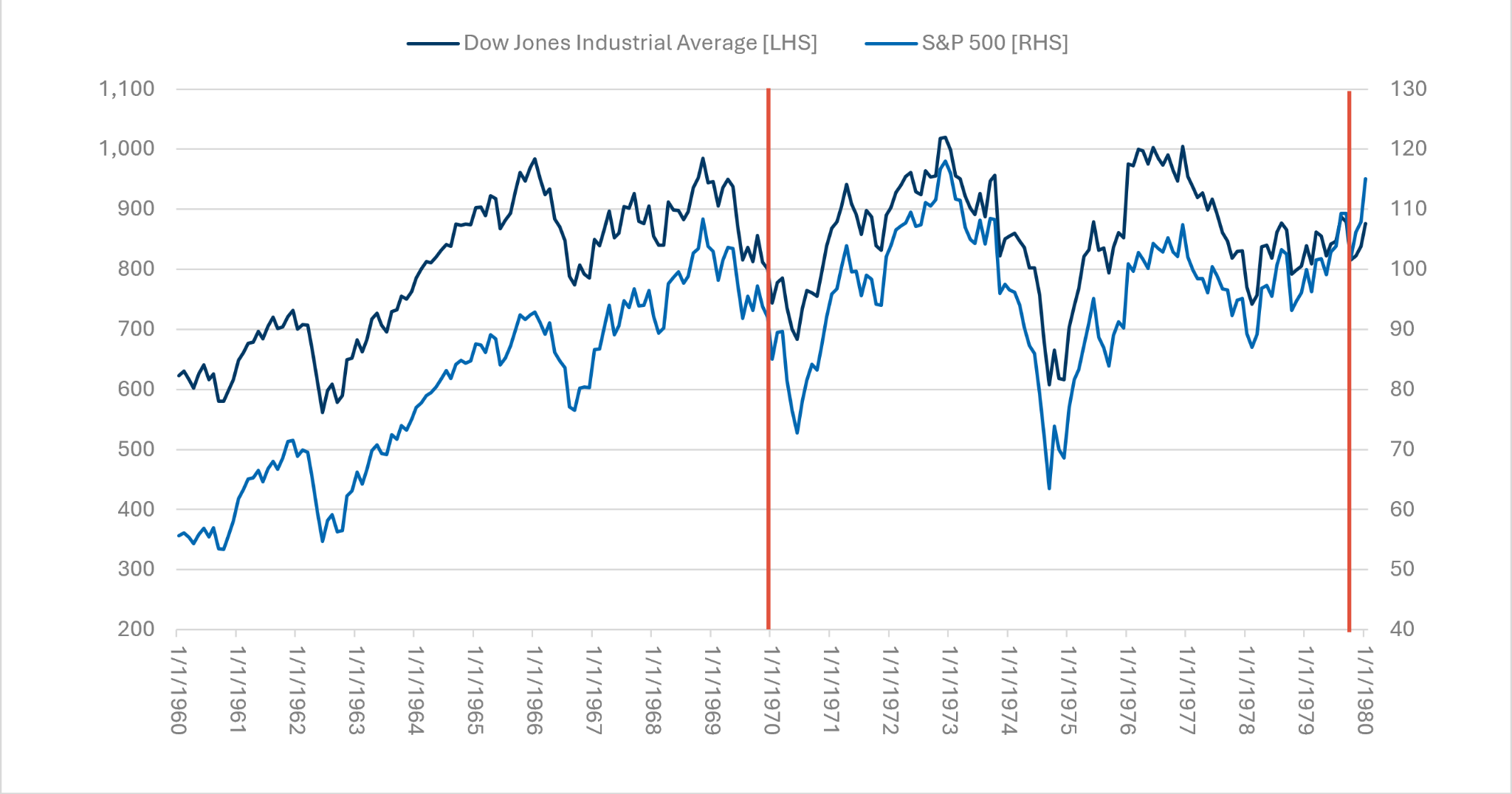
This grim reality is evidenced by the performance of financial markets during the 1970s, which sputtered for the entirety of the decade following the “Go-Go” years of the 1960s. The S&P 500 Index topped 100 for the first time in September 1968 and was barely above that level more than a decade later in December 1979 (Figure 1). The Dow Jones Industrial Average was 15% lower in December 1979 than it was in January 1966. For today’s spoiled market investors who think that 10% annual stock index returns is an American birthright, consider that the two preeminent stock market indexes provided little to no cumulative returns from the late 1960s through 1982 when a new bull market finally began nearly 15 years later.
Figure 1 - 1970s: The Lost Decade
Source: Dow Jones, S&P Global
Locally, New York City was experiencing a severe fiscal crisis that had pushed it towards bankruptcy, culminating in the infamous Daily News headline, “Ford to City: Drop Dead” at the prospect of a federal bailout in October 1975. New York City was as dirty and crime ridden as it often is portrayed in movies of the period, the definitive one being the original The Taking of Pelham One Two Three (1974) starring Walter Matthau. Son of Sam began his killing spree in July 1976 but was not yet known as the infamous serial killer he would become over the ensuing year. He was apprehended in August 1977 after several more shootings and murders. Those who think crime in New York is out of control these days would never have survived the 1970s and 1980s—but at least the city was affordable then.
Disco music was starting to boom in the summer of 1976—a year prior to the release of Saturday Night Fever— much to the dismay of all cool teenagers sporting Led Zeppelin tee shirts.
Fifty Years Later: Who is America?
America is a different place from what it was fifty years ago—after all, a half century is a long time, and only incremental change would be surprising. Demographically speaking, our country is more ethnically and racially diverse than it was in 1976. America is older, with seniors making up 18% of the population compared to 10% in 1970. Americans are more educated than 50 years ago, with a much larger percentage of us attaining a college education. We are marrying later and having families later than we once did, and marriage itself is in decline. Fewer Americans live in poverty today than in 1976, though wealth and income disparities have widened considerably in that time.1 Billionaires are being minted at a rate never seen, and the country recently crowned its first trillionaire—an amount of wealth that is beyond comprehension.
Americans used to have more in common with each other simply by virtue of limited choices. Most families watched the same television shows and nightly news programs because there were only a handful of national broadcast networks before cable television, online media and streaming platforms came along. Teens and young adults mostly listened to the same music because FM radio stations still dictated music airplay and influenced tastes. Americans overwhelmingly drove cars made by the Big Three automakers and it was unusual to see foreign made cars in most neighborhoods. Beer drinkers imbibed the same five brands. Americans in the 1970s weren’t homogenous by any stretch and were divided on many social, cultural and political issues of the day, but these differences didn’t divide us as deeply as they do today.
What changed beginning in the 1980s was an explosion of new choices for consumers in nearly all aspects of everyday life made possible by a surge of imported goods, falling prices for many consumables, new tech devices and gadgets, and new media that gave us a multitude of entertainment, lifestyle, news and recreational choices. More choice is a reflection of abundance, but over time has made Americans more individualistic and the American experience less homogeneous than it once was. In the process, Americans have become more disconnected.
Most Americans today have more material comfort and possessions than their predecessors did in 1976. We have more stuff irrespective of income group. We drive better cars, live in bigger houses, take better vacations, have more household furnishings and appliances, entertainment devices and clothing than our 1976 predecessors did. At the risk of channeling George Carlin, millions of Americans rent storage facilities just to keep all the stuff that their homes don’t have room for. Storage REITs weren’t a thing in 1976.
We may have more material abundance today, but most Americans also feel less happy, more anxious, less financially secure and more lonely or isolated than their predecessors did, as most consumers surveys consistently indicate. There aren’t many surveys that have tracked consumer sentiment for the entirety of this 50-year period, but some come close, and the results are sobering. Americans are in a lousy mood. A recent (May 2026) Gallup survey indicated that only 21% of Americans are satisfied with the way things are going in the U.S., which is in the general vicinity of the lows of the late 1970s during the second oil crisis, the recession of 1991-1992, and the aftermath of the 2008 Global Financial Crisis.2 Of the 76% who said they were dissatisfied, 50% indicated they were very dissatisfied. Similarly, the University of Michigan’s Index of Consumer Sentiment made an all-time low in May 2026, surpassing the previous low of 1979-1980 when inflation was raging and the economy was in recession even though the U.S. economy unquestionably is healthier today than it was then. How can this be?
Creature comforts have become more affordable for most Americans in recent decades but the big-ticket items of life, like the cost of housing, healthcare and higher education, increasingly have become out of reach for middle class households and that is a primary driver of financial anxiety. Many more Americans finance their material lives by taking on debt. Consumer installment debt (which excludes home mortgages) today totals $5.1 trillion, including $1.3 trillion of credit card debt, $1.6 trillion of auto loans and $1.9 trillion of student loan debt. Consumer revolving credit outstanding (mostly credit card debt) has increased at a CAGR of 7.7% over the last 50 years, easily exceeding population and income growth in that time.3
The rise of consumer finance as a dedicated industry is an underappreciated change in the landscape. In 1976 consumer finance as we know it did not exist aside from home mortgage lending and pawn shops. Nowadays, credit is readily available for Americans who can’t easily afford these creature comforts. Cars, for example, would be unaffordable for most Americans if financing wasn’t available. Auto financing and leasing allow households to have multiple vehicles or trade in a car every five years or so instead of saving over a decade for a new one, and auto financing now often extends to 7-8 years instead of the traditional five years. Less creditworthy consumers have access to credit, albeit at punitive borrowing costs and terms. If you don’t have access to credit cards, Buy Now, Pay Later programs are now a popular option. Student loan debt is causing many young adults to live at home longer and postpone major life decisions that older generations had taken on, while medical-related debt is a leading cause of personal bankruptcy. Consequently, many millions of households are financially stretched and/or living beyond their means and have the anxieties that go along with these predicaments and decisions.
The Birth of Restructuring
The restructuring industry also wasn’t a thing yet in 1976. The Bankruptcy Reform Act of 1978, the first major overhaul of bankruptcy law in 80 years, which gave us the Code chapters we work with today, was still a couple of years away. W.T. Grant (1975) and Franklin National Bank (1974) were the marquee insolvencies of the time. Large corporate conglomerates, often consisting of many unrelated businesses operating as distinct fiefdoms within a large corporate ownership structure, such as Gulf & Westen Industries and ITT Corp, exemplified a corporate strategy carried over from the 1960s. By the 1980’s, however, these behemoths were deemed unsuccessful by investors and often broken up into smaller pieces. The leverage buyout boom was still a few years away. KKR was formed in 1976 but buyout deal making on a notable scale didn’t happen until the early 1980s. It was the LBO boom of the 1980s and its subsequent bust by the end of that decade—as well as its future incarnations—that laid the foundation for the restructuring industry as we know it today.
To this boomer, it seems that the proliferation of borrowing and debt at all levels of American society—governmental, corporate and individual—is among the most profound changes in the U.S. economic landscape since 1976. Businesses and households now take on debt with little trepidation, lenders are happy to provide it, and any stigma associated with default or bankruptcy has been erased. And this has worked out surprisingly well for more than four decades, meaning that the higher leverage embedded throughout the financial system has not triggered a systemic failure event and economic collapse except for 2008. But there have been many more casualties along the way than there otherwise would have been. It’s a risk that businesses and individuals have been willing to take. We have not learned much from the 2008 crisis except to keep on borrowing. That unshakable habit will continue to keep restructuring advisors busy for years to come.
Footnotes:
1: “The United States at 250: How the Country Has Changed in the Past 50 Years,” Pew Research Center (March 25, 2026)
2: “Satisfaction with the United States,” Gallup (Accessed June 18, 2026)
3: “Consumer Credit G.19, Consumer Credit Outstanding (Levels), Revolving,” Federal Reserve Board (June 5, 2026)
The views expressed herein are those of the author(s) and not necessarily the views of FTI Consulting, Inc., its management, its subsidiaries, its affiliates, or its other professionals.
Related Insights
Related Information
Published
June 30, 2026
 Key Contacts
Global Chairman of Corporate Finance