

SEC FY 2025 Results: New Priorities, Fewer Enforcement Actions
-
May 28, 2026
-

Summary
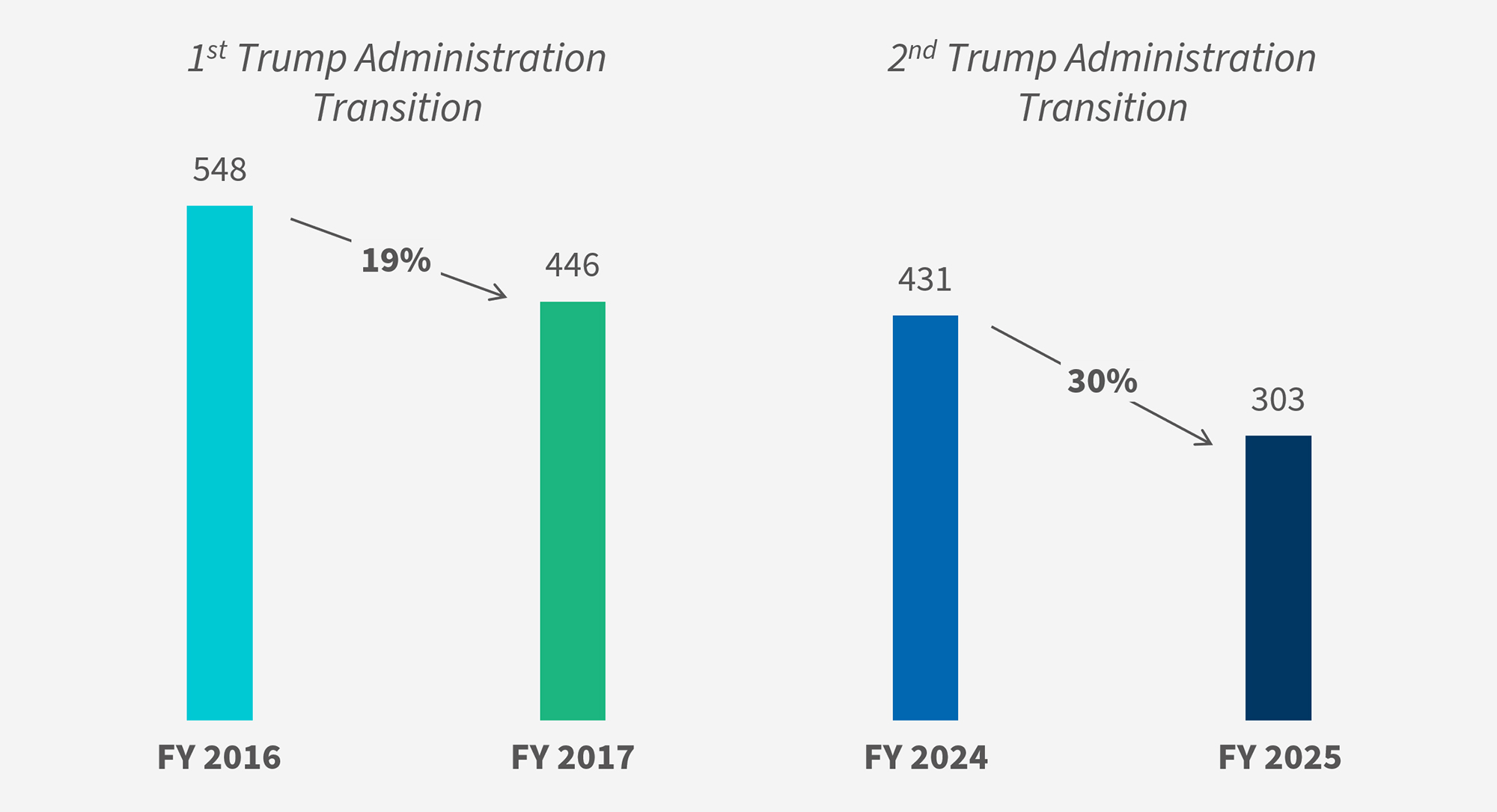
- The SEC filed 30% fewer standalone enforcement actions in FY 2025 compared to FY 2024, which was a significantly larger decrease than the 19% decline observed in FY 2017 (compared to FY 2016) after the first Trump administration transition.
- The Uyeda/Atkins SEC filed 37% fewer actions in the final eight months of FY 2025 than the Gensler SEC filed in the first four months of FY 2025; and the Uyeda/Atkins SEC filed 58% fewer enforcement actions than in the comparable eight months of FY 2017 after the transition to the first Trump administration.
- The Atkins SEC has focused on securities offerings cases (affinity and offering frauds, Ponzi-like schemes), which comprised nearly half of all its FY 2025 actions, and prioritized individual accountability with 87% of FY 2025 cases under Uyeda/Atkins including charges against individuals, compared to 48% of FY 2025 cases under Gensler.
- While fewer enforcement actions may be the new normal, an increased number of actions involving accounting misstatements and auditor violations are likely, as well as a continued emphasis on individual accountability.
Introduction
On April 7, 2026, the U.S. Securities and Exchange Commission (“SEC”) issued its summary of fiscal year (“FY”) 2025 (October 2024 to September 2025) enforcement results.1 FY 2025 was a transitional year, with the SEC led by President Biden’s appointee Gary Gensler from October 1, 2024, until January 20, 2025, when President Donald Trump was inaugurated. Thereafter, the SEC was led by Acting Chair Mark Uyeda until April 21, 2025, when President Trump’s nominee Paul Atkins was sworn in as chairman.
At his swearing in, Chairman Atkins declared “it’s time for the SEC to end its waywardness and return to its core mission….”2 To understand the practical impact of this change in focus, we compared the volume and types of standalone enforcement actions3 filed during the almost four months of FY 2025 under Chairman Gensler to those filed in the more than eight months of FY 2025 under Acting Chairman Uyeda and Chairman Atkins. We also compared the number of standalone enforcement actions filed in FY 2025 to the number filed in FY 2017 – the transitional fiscal year of the first Trump administration – to evaluate whether the return to the “core mission” suggests a return to a similar enforcement posture.
Standalone Enforcement Actions Filed in the First and Second Trump Administration Transition Years
As has been widely reported, during FY 2025, the total number of standalone enforcement actions filed by the SEC declined significantly.4 In FY 2025, the SEC filed 303 standalone enforcement actions,5 nearly 30% fewer than the 431 standalone enforcement actions filed in FY 2024.6 In contrast, during the transition to the first Trump administration in FY 2017, the total number of filed standalone enforcement actions declined by 19% with 446 standalone actions filed in FY 20177, 8, 9 compared to 548 in FY 2016,10 as shown below.
Figure 1 - Total Standalone Enforcement Actions Before and After First and Second Trump Administration Transitions11
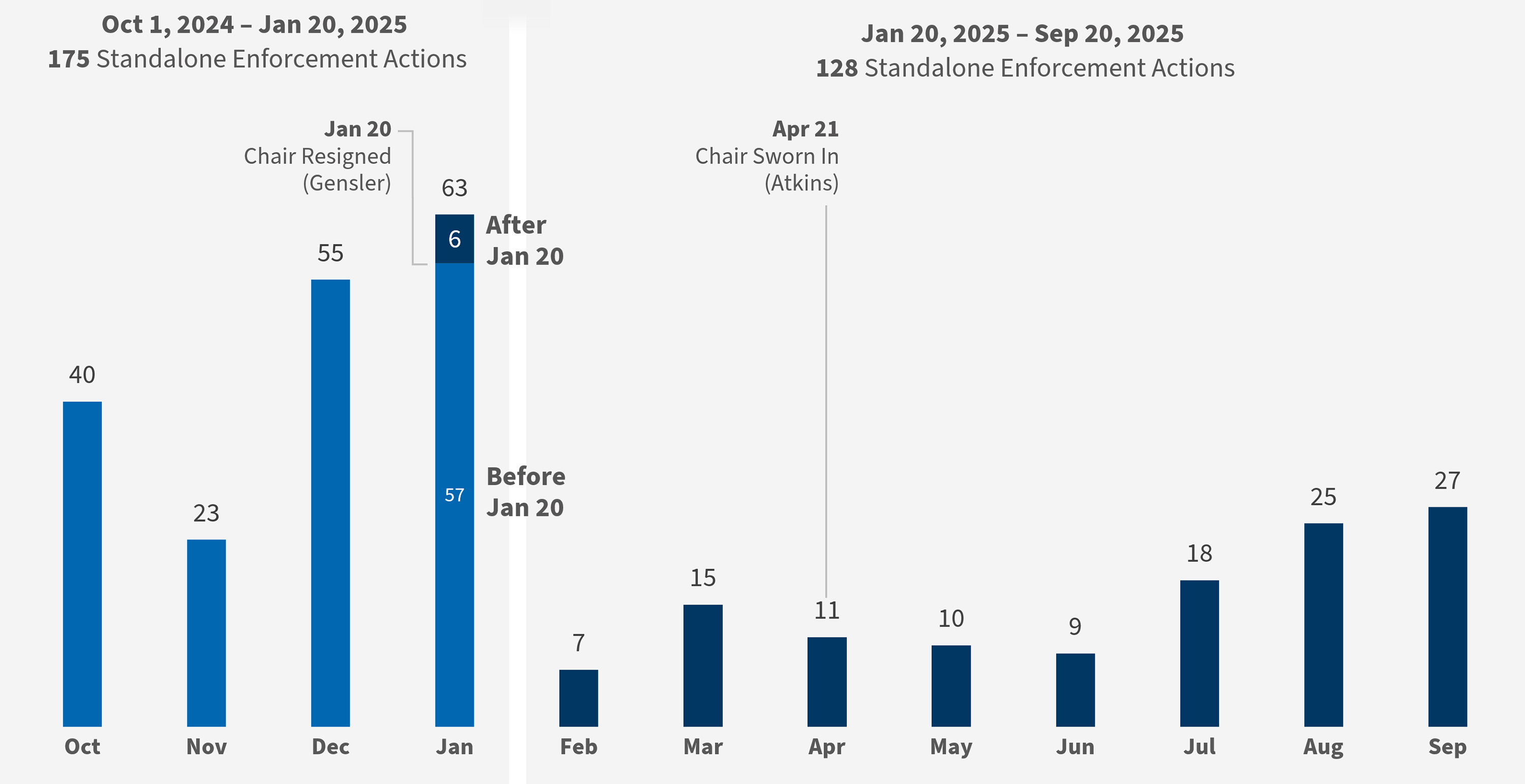
The change in the SEC’s enforcement posture under the second Trump administration is even more stark when examined on a monthly basis. The total number of standalone enforcement actions filed during the last eight months of FY 2025, after the presidential transition and under Acting Chairman Uyeda and Chairman Atkins, was 37% lower than the total number of standalone actions filed by the Gensler SEC during just the first four months of FY 2025.12 The SEC averaged only 15 filed standalone enforcement actions per month under Acting Chairman Uyeda and Chairman Atkins, significantly lower than the average of 45 monthly filed standalone actions filed between October 2024 and January 2025. Additionally, the “spike” in enforcement actions typically seen in September as the SEC seeks to close cases before the end of the fiscal year did not materialize in FY 2025.
Figure 2 - FY 2025 Standalone Enforcement Actions By Month13
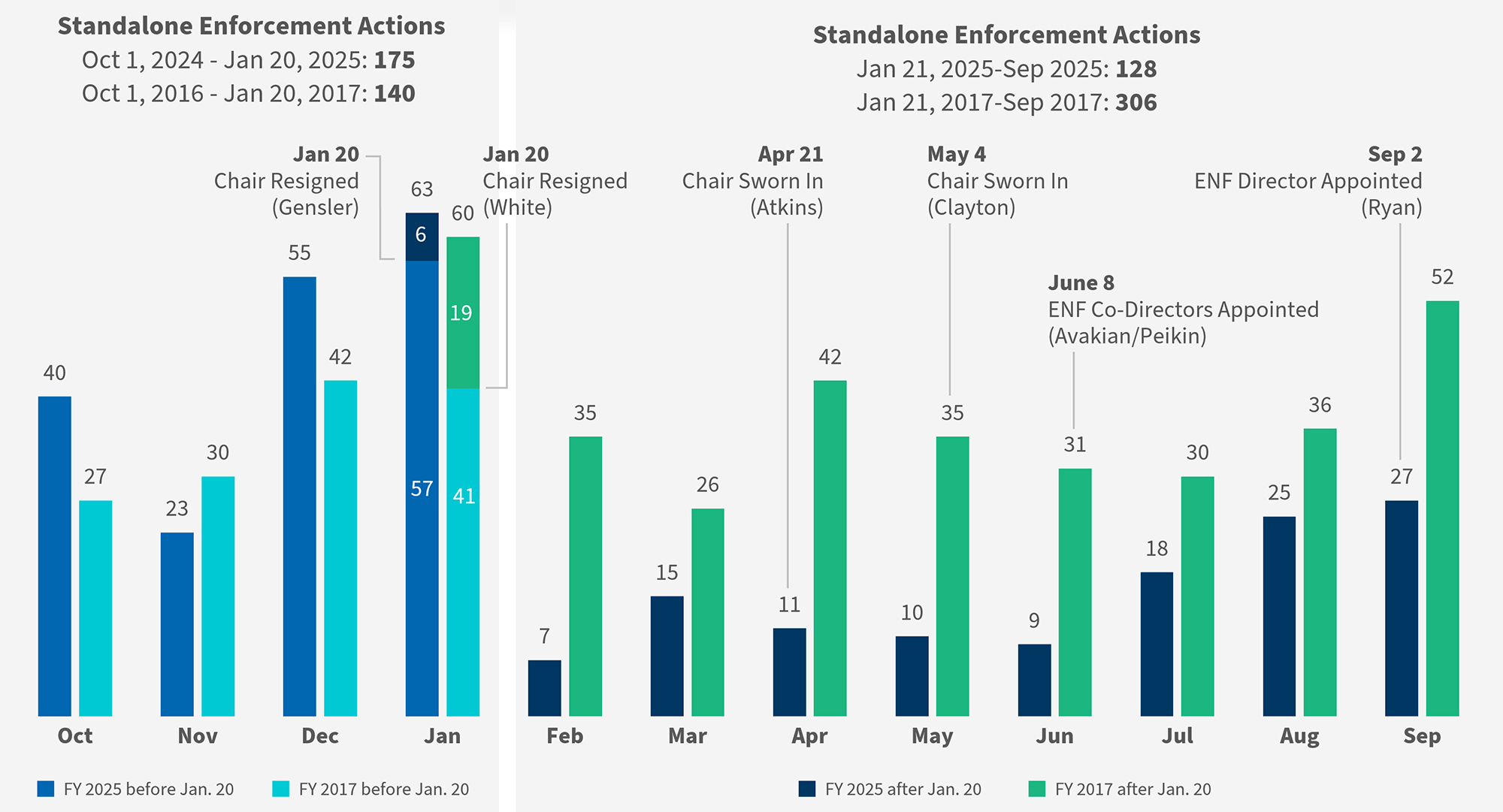
When FY 2025 is compared with FY 2017, the reduction in SEC enforcement activity after the second Trump administration transition is even more severe. The Uyeda/Atkins SEC filed 58% fewer standalone actions from January 21 to September 30, 2025, than were filed during the similar time frame in FY 2017. The reduced activity occurred despite permanent chairs being sworn in within 12 days relative to each other (Chairman Atkins on April 21, 2025, and Chairman Jay Clayton on May 4, 2017).14,15
Figure 3 - FY 2025 and FY 2017 Standalone Enforcement Actions by Month16
Four main factors likely accounted for the significant decline in enforcement activity after January 20, 2025:
- The Gensler SEC filed 25% more standalone enforcement actions from October 1, 2024, to January 20, 2025, prior to the second Trump administration, than were filed during the same period before the transition to the first Trump administration (175 in FY 2025 vs. 140 in FY 2017). This push likely cleared some of the SEC’s backlog and accelerated the number of standalone enforcement actions filed prior to the transition to the second Trump administration. Even if one were to reallocate the additional 35 “backlog clearing” standalone actions brought in the last days of the Gensler SEC over to the Uyeda/Atkins SEC, the latter still would only have filed 163 actions compared to 306 under the Clayton SEC during the similar prior period – which would still represent 47% fewer cases. Clearly, there is more to the story than the Gensler SEC accelerating as many cases as possible prior to the presidential transition.
- The reduction in standalone enforcement actions is reflective of a change in priorities by the new administration. In the SEC’s FY 2025 enforcement results press release, Chairman Atkins stated that the SEC had “redirected resources…away from approaches that prioritized volume and record-setting penalties over true investor protection” and the SEC announced that it would prioritize “bringing actions that actually prevent investor harm instead of headlines and inflated numbers.”17 The enforcement actions filed by the Atkins SEC did not include the types of “foot fault” violations related to the “off-channel communications” initiative or crypto firm registration matters that were brought under the Gensler SEC (including in the four months prior to the presidential transition).
- The Enforcement Division’s staff declined by 18% during FY 2025 due to voluntary early retirement, voluntary separation, and deferred resignation programs.18 The number of enforcement actions filed was also likely impacted by both fewer hands and a rebalancing of caseloads among the remaining Enforcement Division staff.
- The Enforcement Division was without a permanent director until Judge Margaret Ryan (ret.) was appointed, effective September 2, 2025,19 less than a month before the end of FY 2025. In comparison, during the first Trump administration, Stephanie Avakian and Steve Peikin were appointed as Enforcement Division co-directors on June 8, 2017, and Avakian had been serving as acting enforcement director from December 2016.20 The continuity of leadership in the Enforcement Division director role during FY 2017 likely influenced the higher volume of filed enforcement actions during the first Trump administration.
The Second Trump Administration’s Change in Focus During FY 2025
A summary of mix of standalone enforcement actions brought during FY 2025 prior to and after the transition to the second Trump administration is below.
Figure 4 - FY 2025 Standalone Enforcement Actions by Primary Classification21
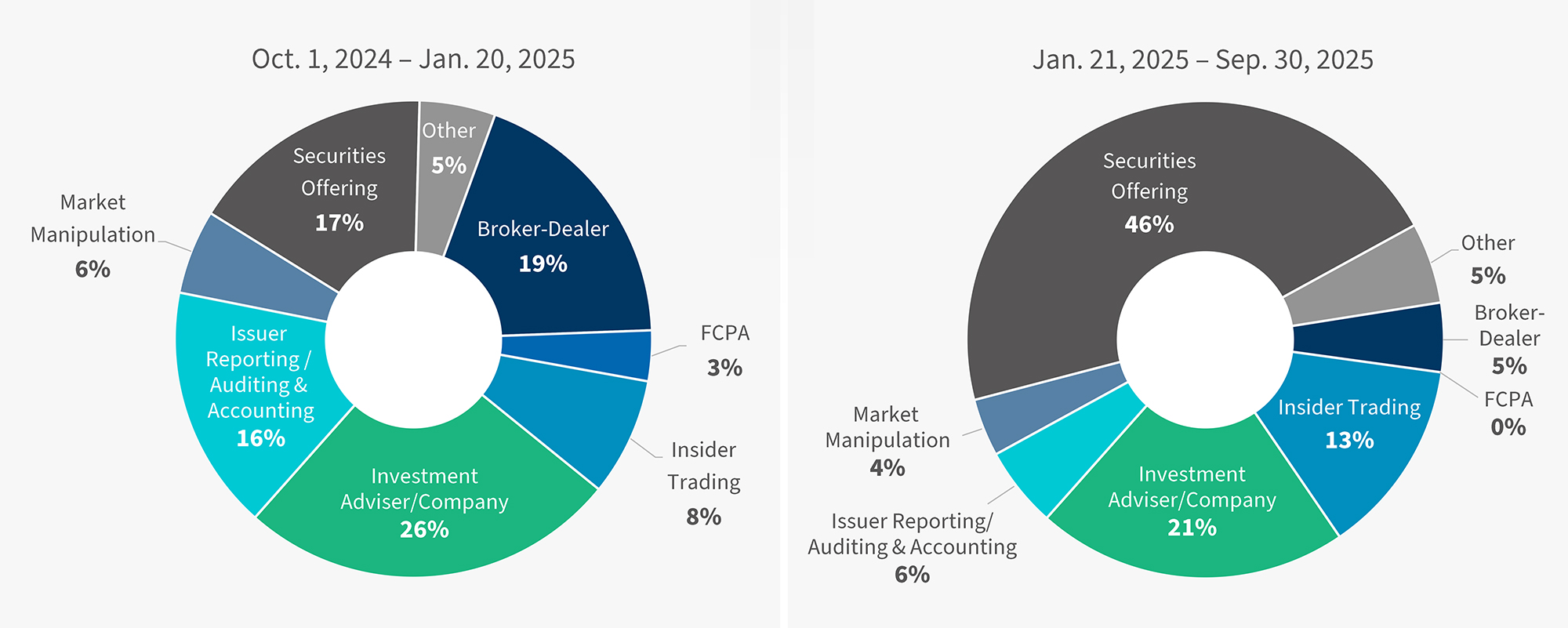
The mix of standalone enforcement actions filed during FY 2025 (as a percentage of total standalone actions) changed meaningfully after the transition to the second Trump administration. Despite the Gensler SEC’s acceleration of enforcement actions, the actions brought in FY 2025 prior to Chairman Atkins reflected a more balanced profile of cases split across categories of securities fraud. In the post-Gensler period, the focus is clear: securities offerings.
Nearly half of the enforcement actions brought under the Uyeda/Atkins SEC were related to securities offerings. The fraud represented in these types of cases generally relies on misrepresentations and false statements, such as misleading claims about the risk and potential for profit associated with an investment. These cases typically prey on retail investors, including affinity groups and investors who are less sophisticated. Often, the schemes involve Ponzi-like payments to pay unrealistic and unsustainable “returns” that are not based on actual investment returns but instead are funded with new investor money. Pursuing these cases is consistent with Chairman Atkin’s priorities of protecting retail investors and the current SEC’s focus “to hold accountable those who lie, cheat, and steal”.22
The SEC’s focus on holding individuals accountable is reflected in the significant increase in the number enforcement actions brought in whole or in part against individuals, with nearly 87% of the standalone enforcement actions brought under the Uyeda/Atkins SEC including an individual as a respondent or defendant.23 In contrast, only 48% of the actions brought by the Gensler SEC were filed in whole or in part against an individual.24
Finally, changes in the SEC’s enforcement priorities are seen with reductions in several other types of enforcement actions:
- The total number of Federal Corrupt Practices Act (“FCPA”) actions declined from six to zero, consistent with the second Trump administration’s pause and reevaluation of FCPA enforcement.
- Broker-dealer actions comprised only 5% of total actions filed (compared to 19% under Chairman Gensler) as the SEC deemphasized violations with “no direct investor harm” such as off-channel communications.25
- Fewer issuer reporting / auditing & accounting actions were filed. Initially, this was assumed to be the result of increased standalone actions brought by the Gensler SEC between October 1, 2024, and January 20, 2025. However, the reductions in enforcement staff (including accountants) may be impacting the availability to bring such actions.
Outlook for FY 2026 and Beyond
During FY 2025, the pace of filed standalone enforcement actions was significantly slower compared to the first Trump administration transition. FY 2026 started with added headwinds, including a 43-day government shutdown that impacted the SEC, and the resignation of the Enforcement Division director, Judge Ryan, on March 16, 2026, after only six months in her role.26
The reduced volume of enforcement actions, coupled with reductions in Enforcement Division headcount, suggest that reduced enforcement activity under Chairman Atkins may be the new normal. With the appointment of David Woodcock (a former regional director of the SEC’s Fort Worth regional office) as director of the Enforcement Division, effective May 4, 2026,27 time will tell as to whether enforcement activity under Chairman Atkins will return to levels seen during the first Trump administration.
While the Atkins-led SEC appears focused on individuals and protecting retail investors, in the 15 months since Chairman Gensler resigned, the SEC has filed only two significant actions involving accounting misstatements.28,29 Accounting cases can take years to investigate before an enforcement action is brought, and the SEC’s staffing reductions are unlikely to hasten any investigation. Chairman Atkins has repeatedly emphasized30 the SEC’s tripartite mission: “to protect investors; to maintain fair, orderly, and efficient markets; and to facilitate capital formation”31 and accounting misstatements undermine all three parts of that mission. We would expect to see an increase in enforcement actions related to accounting misstatements during FY 2026 and succeeding years.
The Enforcement Division has recently solicited applicants for its new “SOX Group” that would “investigate and litigate matters involving potential violations of auditing and related professional standards and provisions of the Sarbanes-Oxley Act and other relevant federal securities laws.”32 We would expect that once this group is staffed and operating, the number of accounting and auditor enforcement actions will increase, especially for matters involving internal controls over financial reporting, disclosure controls and procedures, auditor negligence or malpractice, and foreign private issuers.
We expect to see a continued emphasis on enforcement actions against individuals, given Chairman Atkins’ prior statements that “individuals commit fraud; corporations don’t.”33 With nearly 90% of the Atkins SEC’s enforcement actions naming an individual as a respondent during final eight months of FY 2025, it seems clear that enforcement actions against individuals will remain a priority.
The authors wish to thank Tyler Famiglietti for his contributions to this article.
We may use AI tools to support content creation, for example in outline organization or style guide compliance, but all substantive final content, analysis and insights originate from and are reviewed by our FTI Consulting experts.
Footnotes:
1: “SEC Announces Enforcement Results for Fiscal Year 2025,” U.S. Securities and Exchange Comm’n (April 7, 2026); “Addendum to Division of Enforcement Press Release – Fiscal Year 2025,” U.S. Securities and Exchange Comm’n (April 7, 2026).
2: Atkins, P., “Remarks at a Swearing-in Ceremony for Paul S. Atkins as Chairman of the Securities and Exchange Commission and an Exchange With Reporters,” The American Presidency Project (April 22, 2025).
3: The SEC defines “standalone enforcement actions” as the combined count of standalone administrative proceedings and civil actions filed by the SEC. Standalone enforcement actions do not include (i) follow-on administrative proceedings” or (ii) delinquent filings. “Addendum to Division of Enforcement Press Release – Fiscal Year 2025,” U.S. Securities and Exchange Comm’n (April 7, 2026).
4: Prentice, Chris, and Singh, Kanishka, “US SEC enforcement activity drops dramatically as agency ‘resets’,” Reuters (April 7, 2026).
5: Supra, note 1.
6: “SEC Announces Enforcement Results for Fiscal Year 2024,” U.S. Securities and Exchange Comm’n (Nov. 22, 2024); “Addendum to Division of Enforcement Press Release – Fiscal Year 2024,” U.S. Securities and Exchange Comm’n (Nov. 22, 2024).
7: “SEC Enforcement Division Issues Report on Priorities and FY 2017 Results,” U.S. Securities and Exchange Comm’n (Nov. 15, 2017).
8: “SEC Division of Enforcement 2017 Annual Report”, U.S. Securities and Exchange Comm’n, Div. of Enforcement, (Nov. 15, 2017).
9: “Addendum to SEC Division of Enforcement 2017 Annual Report (Select SEC and Market Data Fiscal 2017 – Enforcement Information Only),” U.S. Securities and Exchange Comm’n, Div. of Enforcement (June 2018).
10: “SEC Announces Enforcement Results for FY 2016,” U.S. Securities and Exchange Comm’n (Oct. 11, 2016).
11: “SEC Announces Enforcement Results for FY 2016,” U.S. Securities and Exchange Comm’n (Oct. 11, 2016); “SEC Enforcement Division Issues Report on Priorities and FY 2017 Results,” U.S. Securities and Exchange Comm’n (Nov. 15, 2017); “SEC Announces Enforcement Results for Fiscal Year 2025,” U.S. Securities and Exchange Comm’n (April 7, 2026), ; and “SEC Announces Enforcement Results for Fiscal Year 2024,” U.S. Securities and Exchange Comm’n (Nov. 22, 2024).
12: The date of each enforcement action was determined using the date filed as published in the Addendum to Division of Enforcement Press Release FY 2025. Supra, note 1.
13: Id.
14: “Paul S. Atkins Sworn In as SEC Chairman,” U.S. Securities and Exchange Comm’n (April 21, 2025).
15: “Jay Clayton Sworn in as Chairman of SEC,” U.S. Securities and Exchange Comm’n (May 4, 2017).
16: “Addendum to Division of Enforcement Press Release – Fiscal Year 2025,” U.S. Securities and Exchange Comm’n (April 7, 2026); “Addendum to SEC Division of Enforcement 2017 Annual Report (Select SEC and Market Data Fiscal 2017 – Enforcement Information Only),” U.S. Securities and Exchange Comm’n, Div. of Enforcement (June 2018).
17: “SEC Announces Enforcement Results for Fiscal Year 2025,” U.S. Securities and Exchange Comm’n (April 7, 2026).
18: “Securities and Exchange Commission: Recent Workforce Reductions and Other Personnel Management Changes,” U.S. Government Accountability Office 26-107813 (March 27, 2026).
19: “SEC Names Judge Margaret Ryan as Director of the Division of Enforcement,” U.S. Securities and Exchange Comm’n (Aug. 21, 2025).
20: “SEC Names Stephanie Avakian and Steven Peikin as Co-Directors of Enforcement,” U.S. Securities and Exchange Comm’n (June 8, 2017).
21: “Addendum to Division of Enforcement Press Release – Fiscal Year 2025,” U.S. Securities and Exchange Comm’n (April 7, 2026), . “Other” includes enforcement actions characterized by the SEC as “Miscellaneous,” “Public Finance Abuse,” and “Transfer Agent.”.
22: Atkins, Paul S., “Opening Remarks at the SEC Town Hall”, U.S. Securities and Exchange Comm’n (May 6, 2025).
23: We reviewed the standalone administrative proceedings and civil injunctive actions listed in the Addendum to Division of Enforcement Press Release - FY 2025 to determine whether an individual was named as a respondent/defendant either alone or jointly with a corporate entity. We found 111 of 128 standalone enforcement actions filed between January 21, 2025, and September 30, 2025, had an individual named as a respondent or defendant. “Addendum to Division of Enforcement Press Release – Fiscal Year 2025,” U.S. Securities and Exchange Comm’n (April 7, 2026).
24: Id. We found that 84 of 175 standalone enforcement actions filed between October 1, 2024, and January 20, 2025, had an individual named as a respondent or defendant.
25: For example, in January 2025, the SEC brought 12 recordkeeping enforcement actions against investment advisors and broker dealers. “Twelve Firms to Pay More Than $63 Million Combined to Settle SEC’s Charges for Recordkeeping Failures,“ U.S. Securities and Exchange Comm’n (Jan. 13, 2025).
26: “SEC Announces Enforcement Division Director Judge Margaret A. Ryan Has Resigned From Agency,“ U.S. Securities and Exchange Comm’n (March 16, 2026).
27: “SEC Appoints David Woodcock as Director of the Division of Enforcement,“ U.S. Securities and Exchange Comm’n (April 8, 2026).
28: “SEC Charges ADM and Three Former Executives with Accounting and Disclosure Fraud,“ U.S. Securities and Exchange Comm’n (Jan. 27, 2026).
29: “SEC Institutes Settled Order as to Key Tronic Corporation, Former CFO (Now CEO), and Senior Vice President for Books and Records and Internal Controls Violations,” U.S. Securities and Exchange Comm’n (April 20, 2026).
30: See e.g., Atkins, Paul S., “Opening Remarks at the SEC Town Hall,” U.S. Securities and Exchange Comm’n (May 6, 2025); Atkins, Paul S., “Keynote Remarks at The Economic Club of Washington,” U.S. Securities and Exchange Comm’n (April 21, 2026); and Atkins, Paul S., “Revitalizing America’s Markets at 250,” U.S. Securities and Exchange Comm’n (Dec. 2, 2025).
31: “About,” U.S. Securities and Exchange Comm’n.
32: Carney, John J. and Mistry, Nikita, “SEC Chief Enforcement Accountant Confirms SEC to Staff New Enforcement Group Targeting Auditors and SOX Compliance,” BakerHostetler, (April 10, 2026); “Supervisory General Attorney,” USAJOBS.
33: Atkins, Paul S., “Remarks before the Atlanta Chapter of the National Association of Corporate Directors,” U.S. Securities and Exchange Comm’n (Feb. 23, 2005).
The views expressed herein are those of the author(s) and not necessarily the views of FTI Consulting, Inc., its management, its subsidiaries, its affiliates, or its other professionals.
Related Insights
Related Information
Published
May 28, 2026
 Key Contacts
Senior Managing Director
Managing Director
Managing Director