


From Unknown to Viral: AI Narrative Seeding
Online Conversation on AI Risk and Regulation Remains Ripe for Manipulation
-
November 09, 2026
-

The events surrounding Jacob Coxon’s resignation from Anthropic and near-instant virality demonstrate how an authentic source can participate – wittingly or not – in coordinated campaigns to seed narratives on highly contentious issues. In this case, a narrative about the threats from AI was quickly co-opted by all sides of the issue. Organizations should be aware that an authentic source does not automatically establish that their reach is organic, and the two must be assessed separately. A genuine employee statement can be pre-briefed to press, seeded by funded intermediaries, validated by insiders and routed into legislation within 24 hours. The exposure for any organization in a contested policy or market environment is the same: A single, credible insider voice can quickly be converted into a durable narrative asset by parties whose interests are in opposition to the original voice.
Practical detection rests on a small number of signals: account-history versus reach mismatch, press timestamps relative to the originating post, identity and funding affiliation of first-hour amplifiers, latency of insider corroboration, automation and language-uniformity scoring and how quickly the narrative appears in policy or litigation vehicles. Monitoring these signals during or after a campaign, as well as on an ongoing basis, is critical to establishing a baseline and tracking an organization’s exposure.
FTI Consulting’s analysis of the first hours and days of the Jacob Coxon resignation thread on X identified, with medium confidence, a distribution pattern consistent with coordinated amplification by aligned advocacy efforts, rather than purely organic spread. The author and the resignation appear genuine; however, the reach did not build from his own audience. It was accelerated through pre-positioned press, a first-minute cluster of amplification from AI-safety advocates and a same-evening validation cascade from current employees of the company he criticized. Every one of those steps occurred before the platform owner engaged with the post, and while Elon Musk’s attention on a post can quickly lead to virality, in this instance his attention cannot explain the initial spike.
What Happened
On September 8, former Anthropic researcher Jacob Coxon used X to announce his resignation and criticize the pace at which major AI labs are developing increasingly capable systems, arguing that they pose a threat to humanity. He stated that he had worked in pretraining research at both Anthropic and OpenAI and argued that neither company was acting responsibly. In an interview with Fox News, Coxon denied third-party involvement in his announcement. However, he later said he “misspoke” and went on to acknowledge he worked with others to “try to make this a bit viral.”1, 2 In other interviews, he confirmed that he collaborated with friends in the AI safety space, as well as participating in the initial interview with The Wall Street Journal (“WSJ”) ahead of his public posts, to enhance the odds of visibility.3
A review of posting patterns in the first 24 hours after Coxon’s tweet revealed one company at the forefront of this coordination. Senior employees of the AI-safety advocacy group Encode interacted rapidly with Coxon’s post within the first half-hour. FTI Consulting’s analysis shows Encode’s founder retweeted Coxon two minutes and 28 seconds after his announcement. Encode’s general counsel quoted Coxon’s post six minutes and 6 seconds afterward. And Encode’s national security policy director retweeted the post eight minutes and 53 seconds after it went live.
Weeks before Coxon resigned, Encode’s founder posted publicly about the work the organization was doing to organize lab employees to speak out about safety concerns to influence lab leadership.
While the WSJ has an X account with more than 22 million followers as of September 8, it was Coxon – an unknown figure in the AI ecosystem – that went super-viral. Within an hour, his resignation post took off, and within 24 hours it had generated hundreds of thousands of interactions.
Figure 1 - Time Series of Coxon and the WSJ Posts
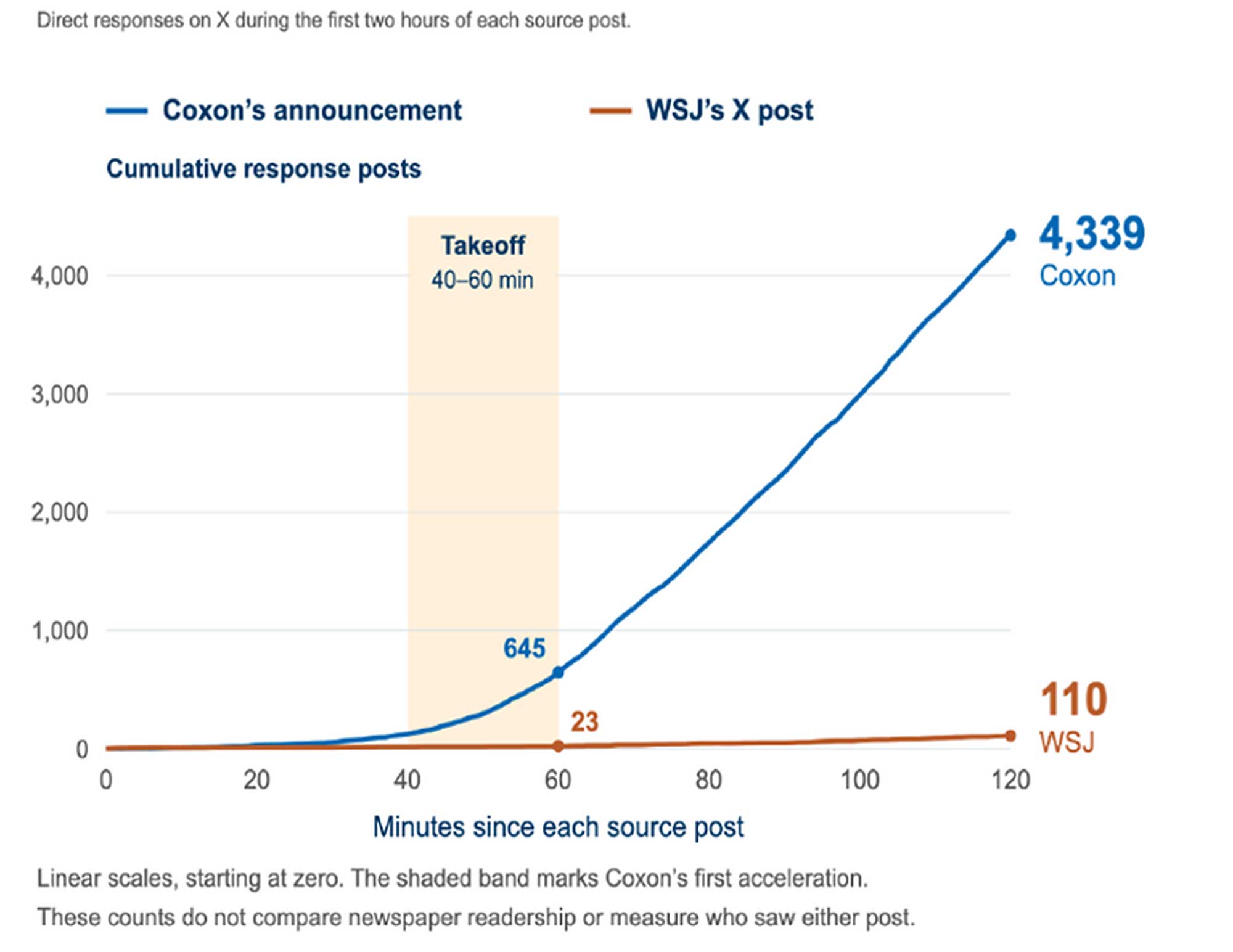
Lines Begin Upon Source Publication. Responses Include Captured Reposts, Replies and Quotes. They Do Not Include Likes, Impressions or Unique Readers.
Source: FTI Consulting analysis
The thread quickly became a major news and social media event, reaching audiences well beyond the technical AI-safety community. It was amplified by journalists, researchers, influencers, policymakers and commentators with sharply different views about the future of AI.
It did not take long for other prominent accounts to weigh in. FTI Consulting’s collection shows a Polymarket bulletin flashed 64 minutes after Coxon’s initial post. Evan Hubinger, Anthropic’s Alignment Science Lead, echoed Coxon’s concerns about AI and humanity 84 minutes after Coxon’s original post, a clear accelerant to the conversation. But by the time they engaged, Coxon’s posts were already primed for takeoff.
Weeks later, amid the heightened interest, an AI safety author said that he introduced Coxon to a public relations firm, although the author said the introduction occurred after Coxon’s post had already gone viral.4
Figure 2 - Response Rate to Coxon’s Post Within the First Two Hours

Source: FTI Consulting analysis
Why It Worked on Both Sides
FTI Consulting’s assessment found that the campaign gained traction because the same content served otherwise opposing agendas in the AI ecosystem. Different networks, despite their conflicting views, had a reason to amplify the story. The overlap was particularly potent because AI safety has recently been at the forefront of the news and while it has created misgivings among the broader public, it is also not well understood. The post also landed in a primed environment: OpenAI agents had broken out of a test environment and hacked Hugging Face in July; OpenAI’s chief scientist had publicly called for a slowdown two days earlier; and an NBC poll published the day before showed low public trust in AI from either political party.5 All of this helped tip a niche resignation story into virality.
| Group | How They Used the Post | What it Gets Them |
|---|---|---|
| AI critics and safety advocates | As insider proof that voluntary safety commitments inside the labs are falling short. | Public support for binding evaluation, reporting and oversight requirements instead of self-policing. |
| Leading AI companies | As evidence that frontier AI is powerful enough to warrant regulation, with AI companies outlining safeguards they view as acceptable. | A rulebook built around capabilities only they have. Evaluations, audits, legal teams and government-relations staff are fixed costs incumbents already carry, and smaller entrants may not be able to accommodate, potentially limiting future competition. |
| Regulation skeptics | As evidence of a “psyop” or orchestrated campaign designed to scare U.S. lawmakers into action. | A way to discredit safety advocates and criticize calls for binding regulation, including those coming from AI labs. |
The conversation surrounding Coxon’s resignation demonstrates how his announcement fueled narratives that ranged from debate about AI’s risks to humanity to questioning the credibility of Coxon and other AI researchers focused on safety.
Figure 3 - One resignation, Several Different Disputes
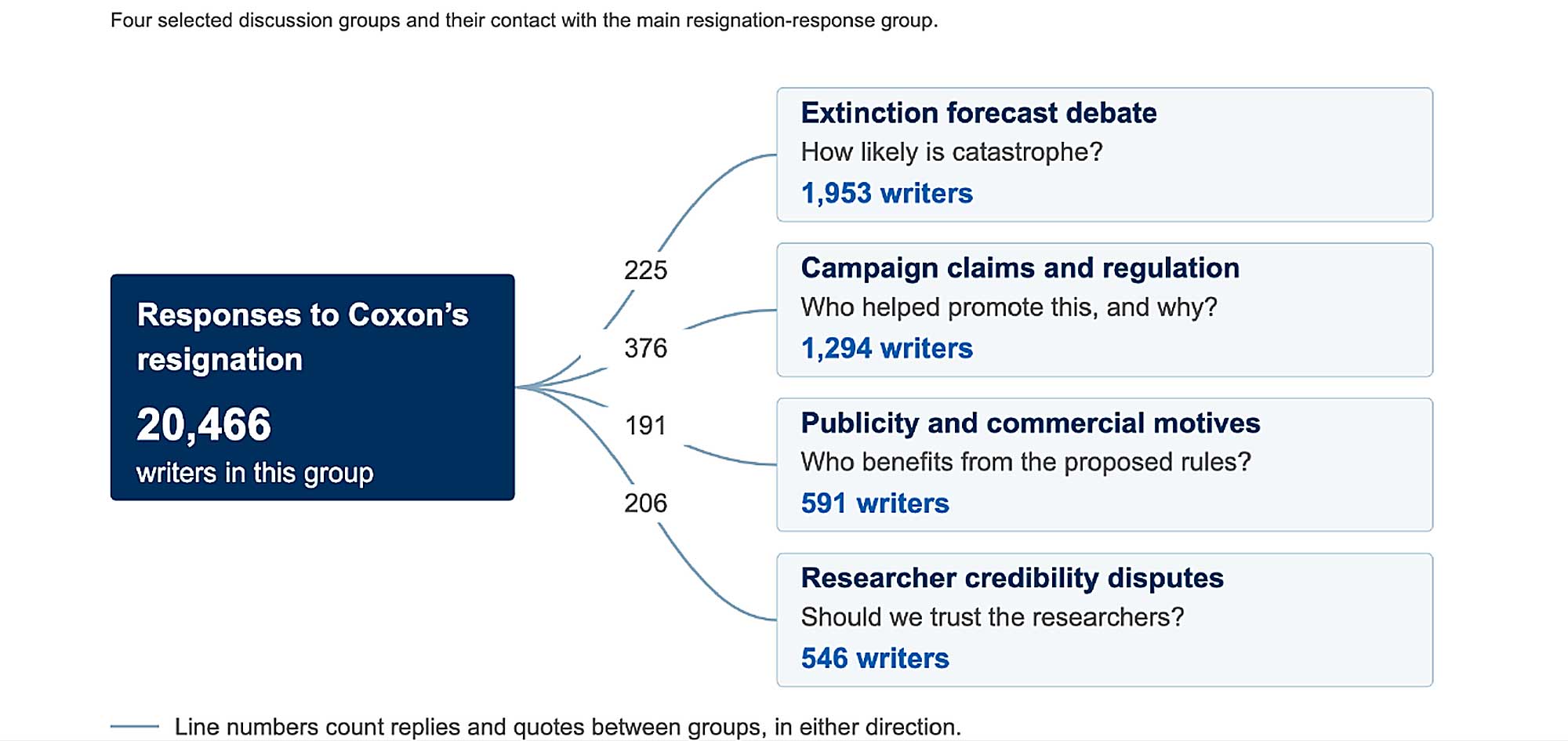
Thousands Responded to Coxon’s Resignation News, Seizing on Disparate Narratives.
Source: FTI Consulting analysis
State-Owned Media Participation
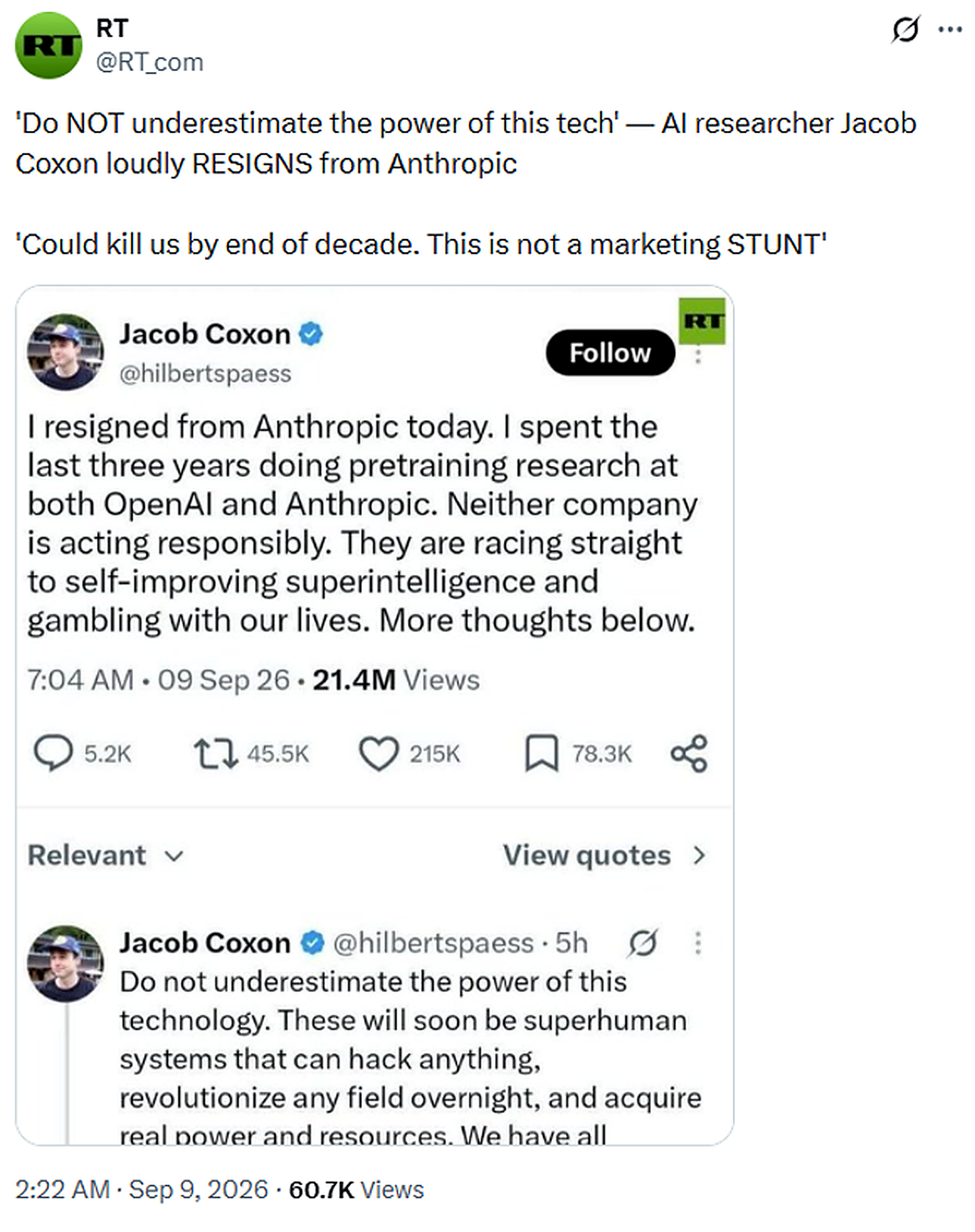
FTI Consulting’s review identified several accounts operated by, funded by or institutionally linked to foreign governments that carried the AI story as news or republished Western copy. Their involvement was a real but narrow cohort: media entities with state ties to China, Russia, Turkey, Qatar and Saudi Arabia all picked up the story. China Global Television Network’s coverage stood out. It used its coverage to argue that U.S. labs cannot be trusted to govern themselves and to cast China’s framework as the better model.6 The posts were neither primary drivers nor amplifiers in the Coxon conversation, instead serving as examples of opportunities foreign-aligned entities of varying degrees seized on to engage in a contentious U.S. political matter.
Figure 4 - Example Post of a State-Run News Outlet Using Coxon’s Post to Further Its Own Agenda
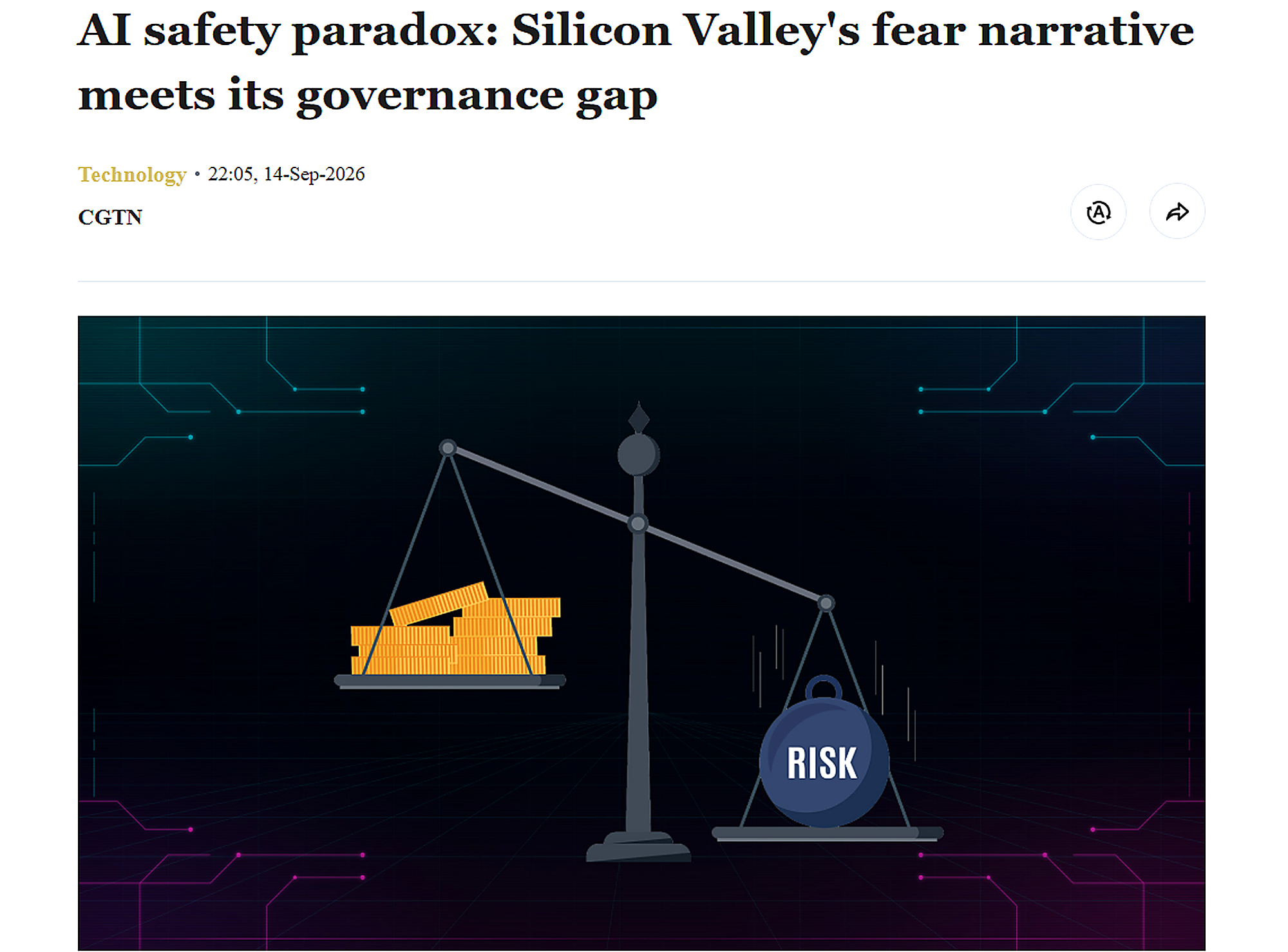
Figure 5 - Exemplar Post of a State-Run News Outlet Amplifying Coxon’s AI Warning
Why This Matters
Viral narratives rarely become consequential because of a single post. They gain traction when credible-looking voices, coordinated amplification and rapid validation create the appearance of widespread concern before an organization has time to assess what is happening.
Limiting the impact of the coordinated launch of a narrative and its potential tailwinds requires the same preparation used to address other cyber-enabled threats: intelligence collection, data availability, detection logic, defined escalation paths, evidence preservation and rehearsed containment measures. Once a coordinated distribution effort begins, the decision window may be measured in minutes rather than days.
What can organizations do?
- Develop an understanding of the advocacy groups, coalitions, communications firms, funders, influencers and policy stakeholders that could elevate a narrative involving your sector. Document known relationships and aligned interests in advance to allow early attribution and assessment to happen in minutes rather than after days of reactive research.
- Establish detection criteria for indicators that a narrative is being pushed artificially.
- Develop pre-approved holding language, factual corrections, employee guidance, stakeholder outreach plans and escalation procedures for identified inauthentic narrative spread.
- Create a process to investigate inauthentic and coordinated behavior, including assessing efforts to seed narrative campaigns, gauging narrative spread and preserving evidence of misleading or defamatory claims.
- Support mitigation strategies, including crisis communications responses and litigation support.
Strategic Outlook
The broader conversation surrounding data centers and AI advancement is likely to remain combustible and ripe for manipulation well beyond the November midterm elections in the U.S.
Americans have expressed reservations about rapid AI advancement and its implications for economic prosperity, national security, education, the environment and the fate of humanity. Politically, the issue remains a jump ball in the U.S., with recent polling showing that neither Republicans nor Democrats hold a clear advantage in public perceptions of which party is better equipped to address AI and data center issues. For instance, a September 2026 New York Times/Siena Poll showed 40% of voters believed Democrats would better handle AI issues, while 42% said Republicans would.7
Perceived risks associated with AI and ongoing efforts to shape the regulatory landscape are likely to contribute over the longer term to a narrative environment that is susceptible to domestic influence campaigns as well as nation-state attempts to exploit division.
Footnotes:
1: Coxon, Jacob (@hilbertspaess), “Misspoke with Baier, but clarified with Cooper on CNN...,” X (Sept. 8, 2026).
2: Coxon, Jacob, [Transcript] “Anderson Cooper 360,” CNN (Sept. 9, 2026).
3: Ramkumar, Amrith; Woo, Erin; Jin, Berber and Cohen, Ben, “The Anonymous Math Geek Who Quit Anthropic—and Became the Face of AI Safety,” The Wall Street Journal (Sept. 16, 2026).
4: “DEY. Comms Firm Tied to Coxon’s AI Whistleblower Story,” Everything PR News (Sept. 26, 2026).
5: Kamisar, Ben and Bowman, Bridget, “Poll: A polarized America unites behind deep concerns about AI,” NBC News (Sept. 6, 2026).
6: “AI Safety Paradox: Silicon Valley’s Fear Narrative Meets Its Governance Gap,” China Global Television Network (Sept. 14, 2026).
7: Goldmacher, Shane; Igielnik, Ruth and June, Sophia, “Democrats Gain Edge as Trump Drags Down G.O.P, New Poll Finds,” The New York Times (Sept. 15, 2026).
The views expressed herein are those of the author(s) and not necessarily the views of FTI Consulting, Inc., its management, its subsidiaries, its affiliates, or its other professionals.
Related Insights
Related Information
Published
November 09, 2026
 Key Contacts
Managing Director