Beyond Subscriptions: SaaS AI Pricing
Monetization and Pricing Models for AI Products
-
April 16, 2026
Downloads Download Whitepaper
-

Section I: How are new AI/ML technologies affecting Saas pricing?
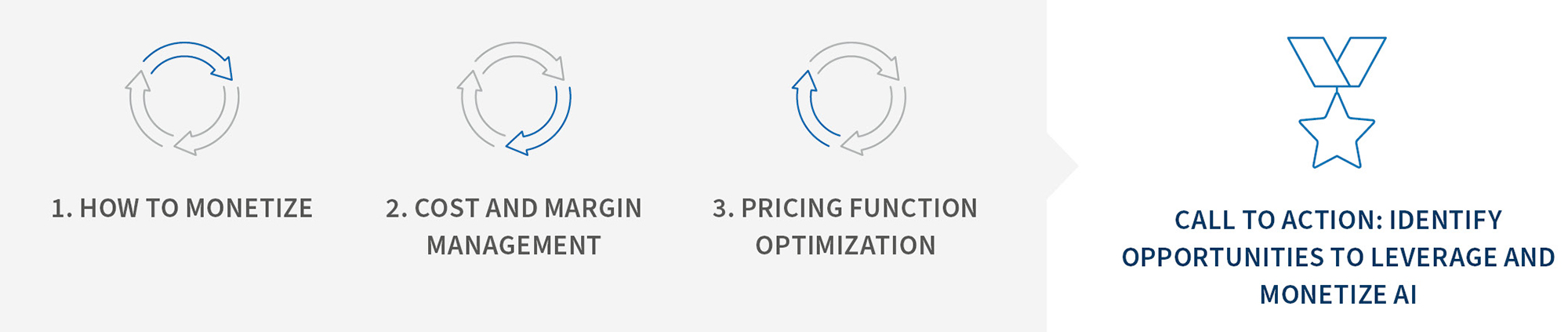
Critical Factors to Capturing AI Product Value:
Artificial Intelligence (“AI”) based products and features have grown rapidly in recent years, with almost all SaaS leaders now evaluating how to utilize AI to provide value to customers, how to monetize their AI offerings and how to utilize AI within their own organizations to drive value and efficiency. 80% of independent software vendors are expected to embed GenAI capabilities directly into their enterprise applications by 2026, up from less than 5% just a few years ago.1
AI has gained rapid popularity following the release of commercially accessible Generative AI (“GenAI”) tools (such as those developed by OpenAI, Google, Meta, DeepSeek and Anthropic, among others).
As shown in our previous article “Beyond Subscriptions: SaaS Pricing — Unlocking Growth with Innovative SaaS Pricing Models”, evaluating how to provide GenAI functionality to their customers has become top of mind for B2B SaaS providers. For those with strong GenAI use cases, monetizing these products becomes a critical step to capturing incremental revenue driven by customers’ increased willingness to pay for these enhancements.
I.A. How To Monetize: Our perspectives on the use of and aspirations for AI in B2B SaaS companies draws on our 2025 previous article, Beyond Subscriptions: SaaS Pricing — Unlocking Growth with Innovative SaaS Pricing Models. For the majority of B2B SaaS providers, AI products currently are extensions of core products — 83% currently bundle AI functions/products with their core product portfolio. Thus, pricing today must reflect a balance of maintaining alignment with core products, while at the same time capturing the incremental value driven by AI functionality.
I.B. Cost and Margin Management: Further, provision of AI-based products necessitates a higher need for margin control in pricing. AI models often drive higher variable costs to serve than traditional SaaS application software, due to incremental compute costs, data processing needs and model management/training.
I.C. Pricing Function Optimization: AI tools also represent an opportunity for B2B providers to streamline their pricing functions. Across all aspects of the pricing value chain, there are opportunities to integrate AI and broader Machine Learning (“ML”) tools to drive efficiency and pricing power.
I.D. Call to Action: Identify Opportunity to Leverage and Monetize AI
AI products (especially GenAI) offer substantial opportunities for B2B providers to meet needs of customers and capture incremental value. However, pricing models that emphasize monetization and margin management will be critical for organizations to drive real value from AI offerings.
For an overview of how software pricing has moved from models where consumers purchase licenses see Beyond Subscriptions: SaaS Pricing — Unlocking Growth with Innovative SaaS Pricing Models.
AI products and use cases have emerged rapidly, leading many SaaS providers to monetize through less complex subscription models; however, long-term pricing strategies likely will benefit from more non-subscription models.
Subscription pricing remains the dominant form of pricing for AI/ML for two key reasons: 1) organizations have moved to monetize rapidly, and subscription models are well understood internally and externally and 2) many AI products are currently sold as bundles with existing products (83% according to our research), meaning that these products naturally adopt the pricing models of the core products.
Figure 1 – % of B2B SaaS Providers Utilizing Respective Pricing Model for AI/ML Products
Subscription Pricing Is Most Utilized for AI/ML Products Due to Rapid Move to Monetize
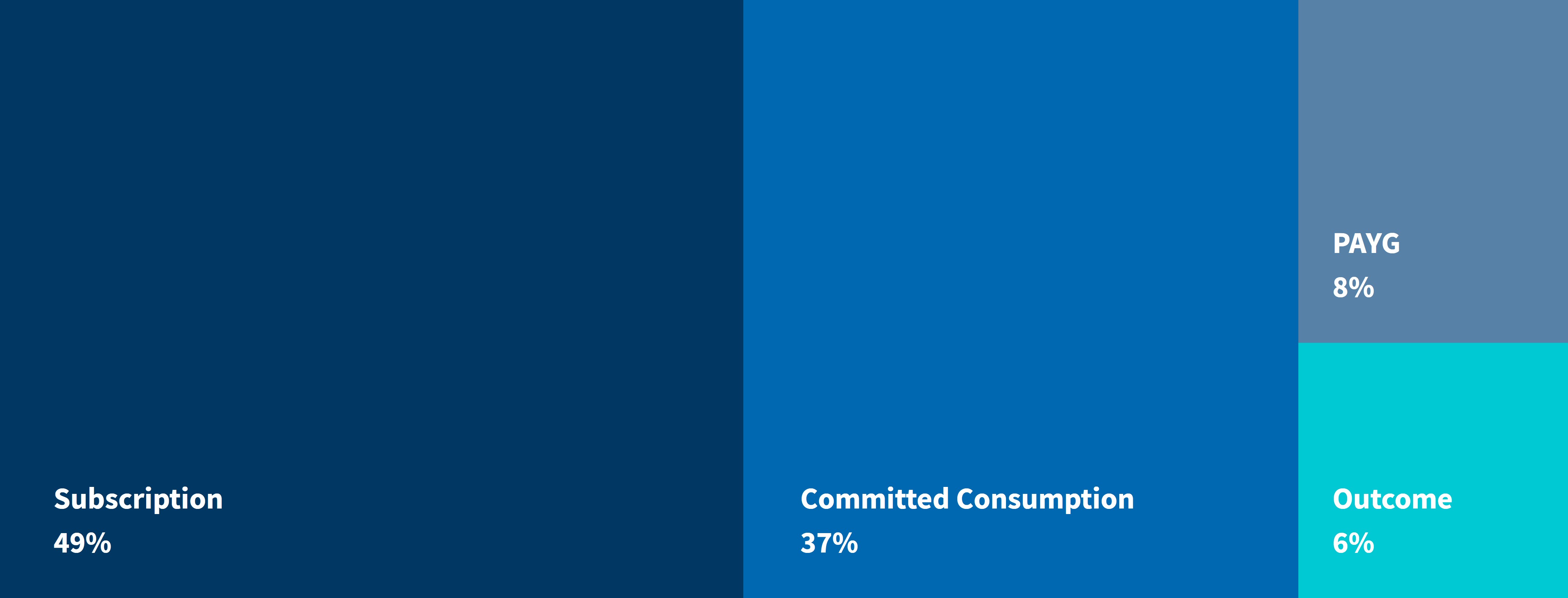
Source: FTI Consulting 2025 B2B Pricing Survey
Despite the dominance of subscription pricing models today, consumption models are highly aligned to pricing AI due to their ability to a) manage margins and b) better reflect the value provided by AI. According to our research, nearly 89% of B2B SaaS providers believe consumption models enable the best alignment of price to cost (including compute cost, data processing, model development/maintenance, etc.) for AI specific products.
Furthermore, the nature of many AI/ML products is to increase the productivity and output of the users themselves, which could lead to a reduced number of users/seats needed. In this context, subscription-based models are misaligned to the value of AI versus consumption models. As AI products and pricing models continue to mature, we believe the strong alignment of consumption models in managing margins and aligning to AI value is likely to reduce the use of subscription pricing for AI.
Outcome models have strong value propositions in theory. However, similar to the broader B2B SaaS market, it is difficult today for providers to accurately predict, track and manage outcomes of their AI products. Advancements in technology and capabilities will continue to support growing use of outcome models, but because of this reality they will be limited in practical use in the near future.
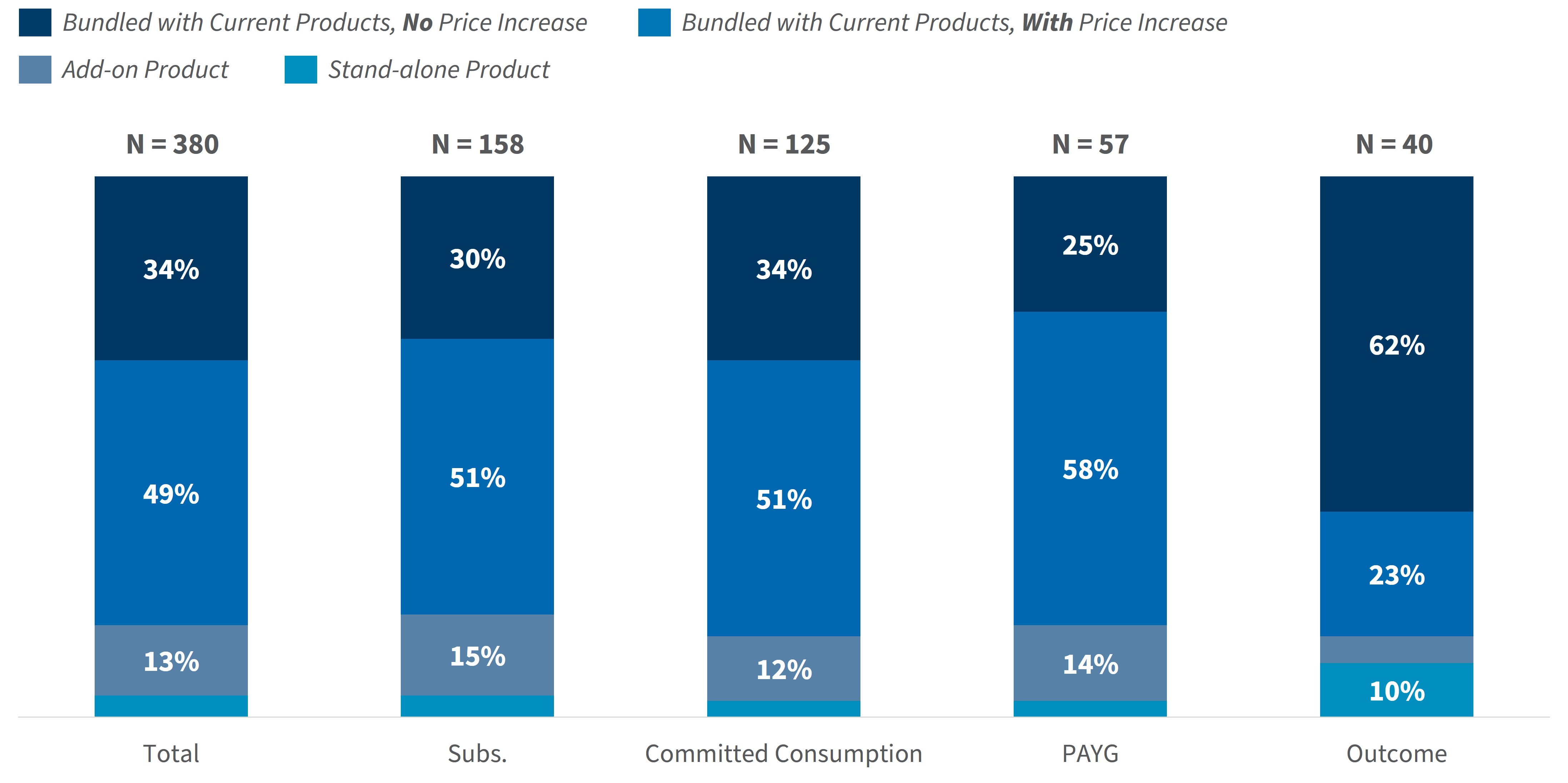
As B2B companies refine pricing strategies, customers’ greater willingness to pay (“WTP”) for AI products supports the case for monetization. AI drives incremental WTP for 66% of SaaS providers, either as standalone, add-on or bundled with a price increase.
AI functionality is mainly adopted to support and enhance core features. Our research indicates that only 17% sell their AI product as a standalone or add-on.
Bundling AI with current products at an increased price is the most common strategy used for subscription and consumption models (~51-58% report doing so) external research showing that value-aligned pricing can yield up to 23% higher ARPU without conversion impact,2 suggesting AI functionality does support increased WTP when properly positioned.
For outcome-based pricing models, 63% do not increase price for AI bundles, as AI products are designed to enhance outcomes by improving core product functionality and task execution. Since outcome models are priced on success, capture of AI value tends to already be reflected in pricing for outcomes.
Figure 2 – Subscription Pricing Is Most Utilized for AI/ML Products Due to Rapid Move to Monetize
Aside of Outcome Models, most providers are monetizing AI through their pricing models
Source: FTI Consulting 2025 B2B Pricing Survey
Best Practices for AI Pricing:
While in the long term the characteristics of AI products favor consumption and outcome models, B2B providers will still see use cases for each pricing model today, especially for organizations currently pricing through subscription models. In order to best enable pricing excellence, organizations transitioning toward or operating consumption-based models should consider the following factors that influence model selection — several of which also apply to subscription models where AI features are being introduced or expanded:
- Metric Simplicity: Pricing AI products based on consumption (especially inputs), for example, can easily become too complex for customers. Pricing leaders should ask themselves:
- Will my customer understand the metric?
- Can my customer predict how much they will use?
- Can our organization accurately & efficiently track the metric for billing?
- Usage Limits: Assess the benefits and drawbacks of adding in usage caps/thresholds (especially for subscription models). Usage thresholds can better provide predictability for the customer and provider, but may make customers feel that the product is limited/throttled or that they are not receiving full value. According to our research, providers report they often find the most success through tiered structures, which enact price differentiation and align to use/volume consumed.
- Product Value Proposition: Evaluate if each AI interaction clearly drives value for the customer and if the AI features are central to the overall product value proposition or add-on features. In contexts where there is limited incremental value from each AI interaction, charging per interaction will drive customer dissatisfaction.
- AI Output: Consider if use of the AI product/feature set can lead to the customer requiring fewer users; if the AI features are intended to make each user more productive, the unintended effect may be that the customer needs fewer users of the software, thus creating a downward pressure on subscription-driven pricing.
- Customer Mix:
- Assess the volume of AI use by your customer base to understand the balance of super-users (i.e. significant consumption of AI) vs. low-volume users.
- Contrast volume with the predictability of usage; low predictability typically requires greater contractual commitments to ensure consistent revenue streams/ customer spend.
Selecting a Pricing Unit for AI Pricing:
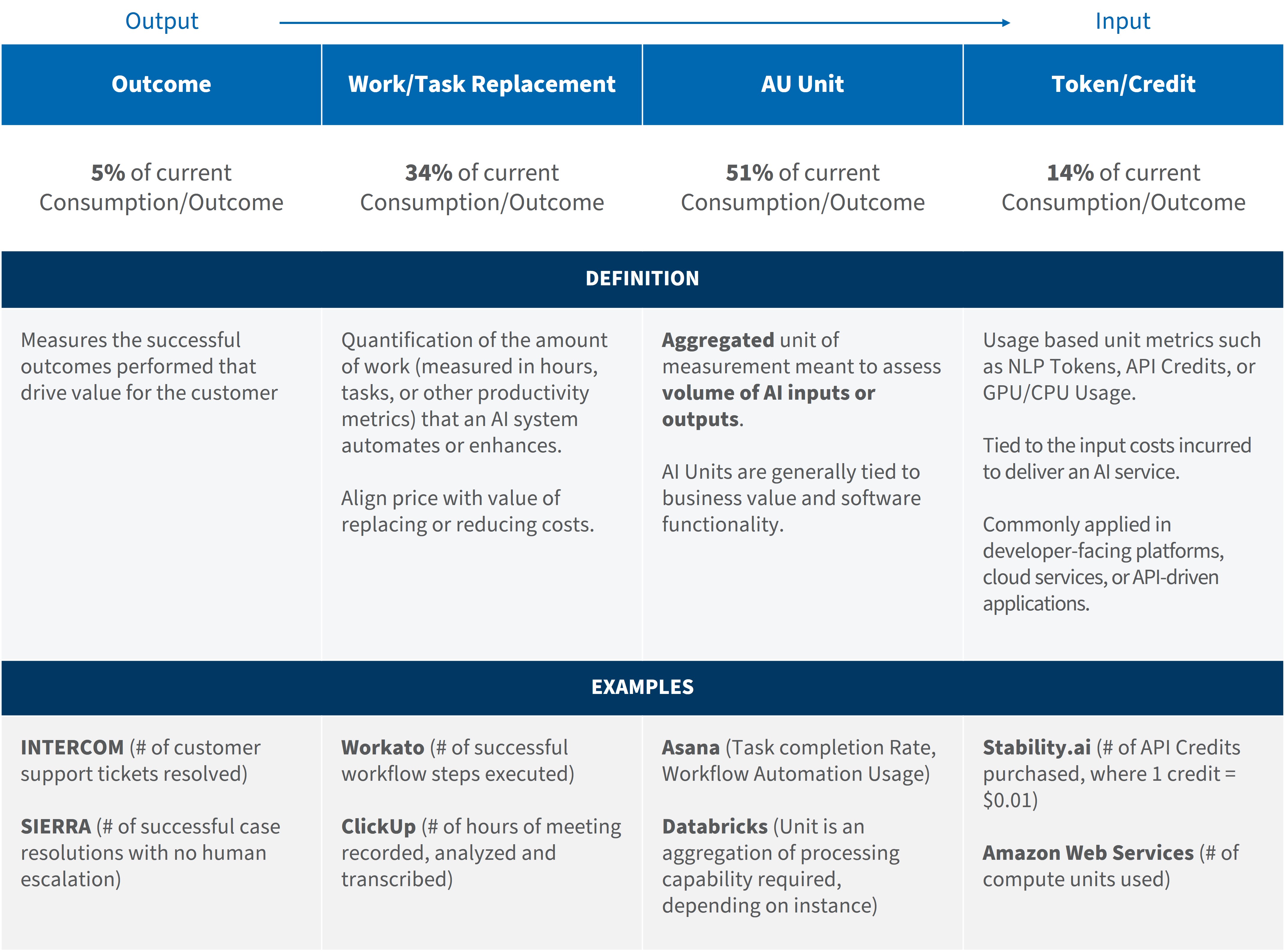
For organizations using consumption or outcome pricing models for AI, the metric used to assess volume (quantity) will be critical to successful pricing outcomes. The most common pricing metrics used for consumption/outcome pricing for AI can be split into four categories:
Figure 3 – Overview of Primary Units Used to Price AI Products with Consumption or Outcome Models
AI Pricing Units are primarily based on AI Units or Work/Task Replacement
Source: FTI Consulting 2025 B2B Pricing Survey; FTI Consulting Experience
Section III: How Can AI Be Used Within the Internal Pricing Function?
AI Units are the most common metric used in consumption pricing models, as they aggregate multiple usage metrics into a single, customer-friendly measure.
Tokens/credits, by contrast, can be overly technical and disconnected from customer value — and since AI products typically offer diverse capabilities, pricing based on a single resource metric is impractical for most solutions outside of developer/infrastructure software. Successful B2B SaaS providers are not only evaluating AI use cases in their own products, but also integrating AI/ ML tools into everyday pricing activities. The latter refers to the use of AI/ML within internal pricing operations — such as competitive price monitoring, demand forecasting and deal optimization — distinct from AI features embedded in the products sold to customers. The pricing value chain is evolving as multiple players widely adopt AI/ML to adjust pricing in real time based on competitors and optimize dynamic pricing.
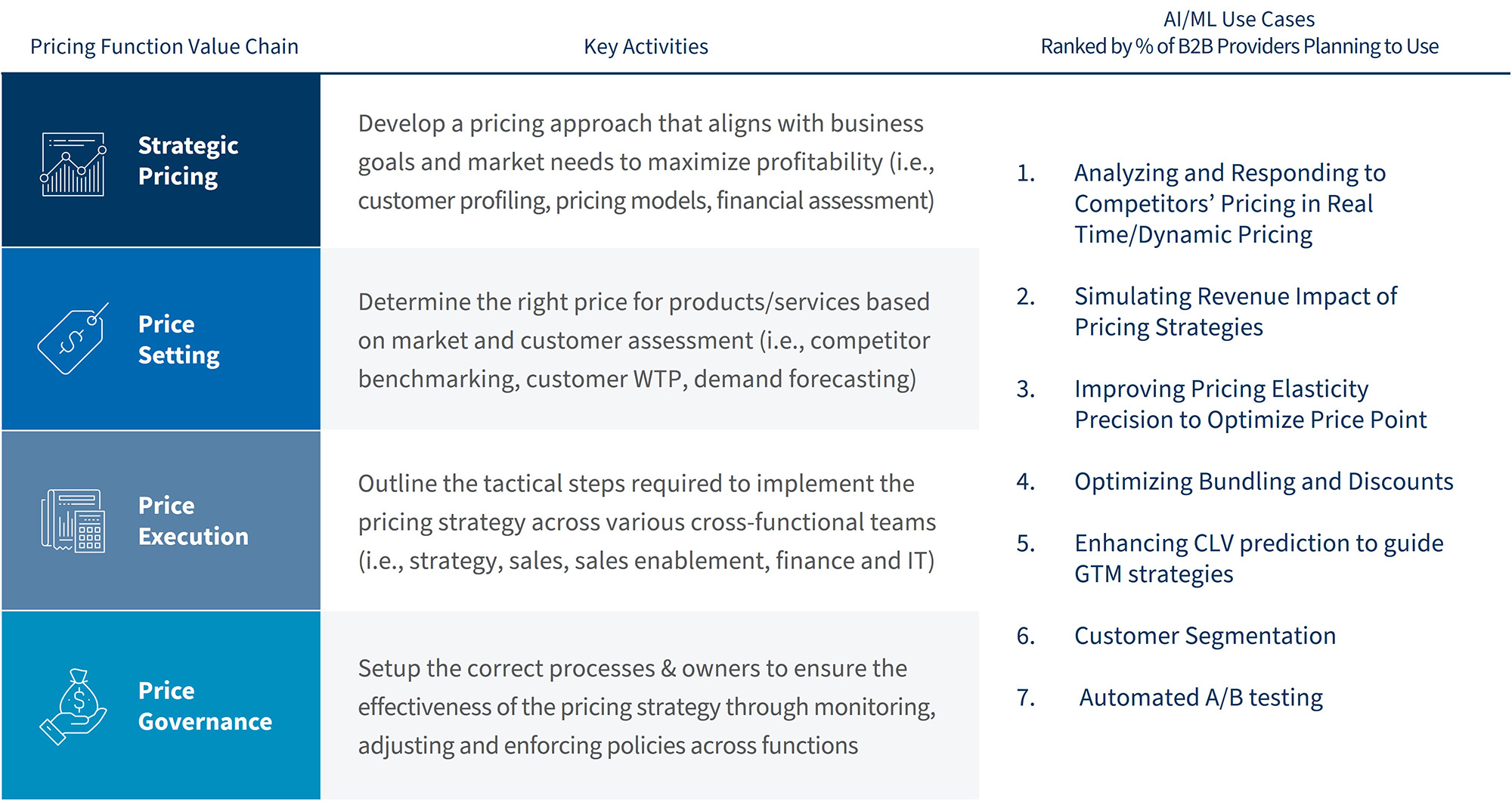
AI/ML innovation is occurring across the pricing function’s value chain, with high-growth companies leading organizations in utilizing AI/ML to optimize pricing activities.
Figure 4 – Overview of Primary Units Used to Price AI Products with Consumption or Outcome Models
Example Use Cases and Tools across the Pricing Value Chain
Source: FTI Consulting 2025 B2B Pricing Survey; FTI Consulting Experience
Positioning for AI Pricing Excellence
AI is a present-day strategic and commercial imperative. Capturing the value of AI requires deliberate action across three interconnected dimensions.
- Monetization strategy must evolve in step with AI product maturity: While subscription bundling remains the dominant approach today, the long-term trajectory favors consumption and outcome-based models that better reflect AI’s variable cost structure and value delivery. Organizations that act early to refine their pricing models will be better positioned to capture incremental WTP and sustain competitive differentiation.
- Cost and margin management cannot be an afterthought: Unlike traditional SaaS, AI products carry meaningful variable costs in compute, data processing and model management, which require pricing models to actively protect margin, not simply maximize revenue. Providers that fail to account for this distinction risk eroding profitability as AI adoption scales.
- The same AI/ML capabilities that B2B providers are embedding in their products can and should be applied internally, across competitive intelligence, demand forecasting and deal optimization, to sharpen pricing decisions and drive operational efficiency.
Taken together, the providers best positioned for long-term success will be those that treat AI pricing not as a one-time decision, but as a continuously evolving capability that aligns product value, cost structure and commercial strategy in a rapidly changing market.
Footnotes:
1: Gartner, Finance Technology Report, 2025.
2: ProfitWell / Price Intelligently, State of B2B SaaS Pricing, 2024.
The views expressed herein are those of the author(s) and not necessarily the views of FTI Consulting, Inc., its management, its subsidiaries, its affiliates, or its other professionals.
Published
April 16, 2026
 Key Contacts
Senior Managing Director
Senior Managing Director
Managing Director
Managing Director