


Early Signs Indicate DOJ’s Priorities for Fighting Fraud
-
July 24, 2026
-

The U.S. Department of Justice (“DOJ”) continues to intensify its focus on fraud enforcement – most recently with the creation of the National Fraud Enforcement Division (“NFED”). The new division was created in April of this year to focus on “fraud against taxpayer dollars and taxpayer-funded programs.”1 It was formed by taking sections within the DOJ that were focused on taxpayer fraud and had previously been housed in the Criminal Division – the Tax Section, and the Fraud Section’s Health Care Fraud Unit and Market, Government and Consumer Fraud Unit – and moving them under the leadership of a newly appointed assistant attorney general for the NFED. Acting Attorney General (“AG”) Todd Blanche also ordered that the NFED be staffed with realigned resources from other components and that an experienced Assistant United States Attorney be detailed-in-place from each of the 93 United States Attorneys’ offices (“USAO”).2 The realignment was intended to increase coordination and prosecution of crimes, including by working with counterparts at relevant investigative agencies.
This article examines what actions have been taken in NFED’s first two months, what those early actions indicate in regard to the division’s focus and why companies should take this as an opportunity to review their compliance programs and enhance their internal controls.
What Does the Organization of the NFED Tell Us?
In creating the NFED, the DOJ chose very specifically to move certain sections and not others. For example, the Health Care Fraud and the Market, Government, and Consumer Fraud Units of the Fraud Section were moved, but not the section’s Foreign Corrupt Practices Act (“FCPA”) Unit, the Health & Safety Unit, or the Corporate Enforcement and Compliance Unit. Combined with the stated decreased focus on FCPA enforcement,3 this signals a focus on domestic taxpayer fraud rather than foreign bribery. It further raises the question of whether the NFED’s focus will be on individual or corporate prosecutions.
Currently, the DOJ’s Civil Division, which is responsible for enforcement under the False Claims Act, remains separate from the NFED, with only a designated liaison between the divisions. However, Acting AG Blanche also ordered that within 120 days of the April 2026 memo creating the NFED, the Office of Legal Policy provide a recommendation on whether non-criminal elements of the DOJ should be brought within the NFED.4 This would be a historic combining of criminal and civil divisions, normally kept separate to ensure that the boundaries of parallel investigations do not get crossed or blurred.
It’s important to note that the dismantling of DOJ’s Tax Division and the creation of the NFED are two of the most significant changes in the structure of the DOJ since 1953. The willingness of the current administration to make enormous structural changes raises the question of whether future administrations will shift to more frequent changes beyond simply emphasizing priorities within the existing organization. This is made clear by a recent House bill introduced to make the NFED more permanent despite future political changes.5
What the Data Tells Us, and Doesn’t
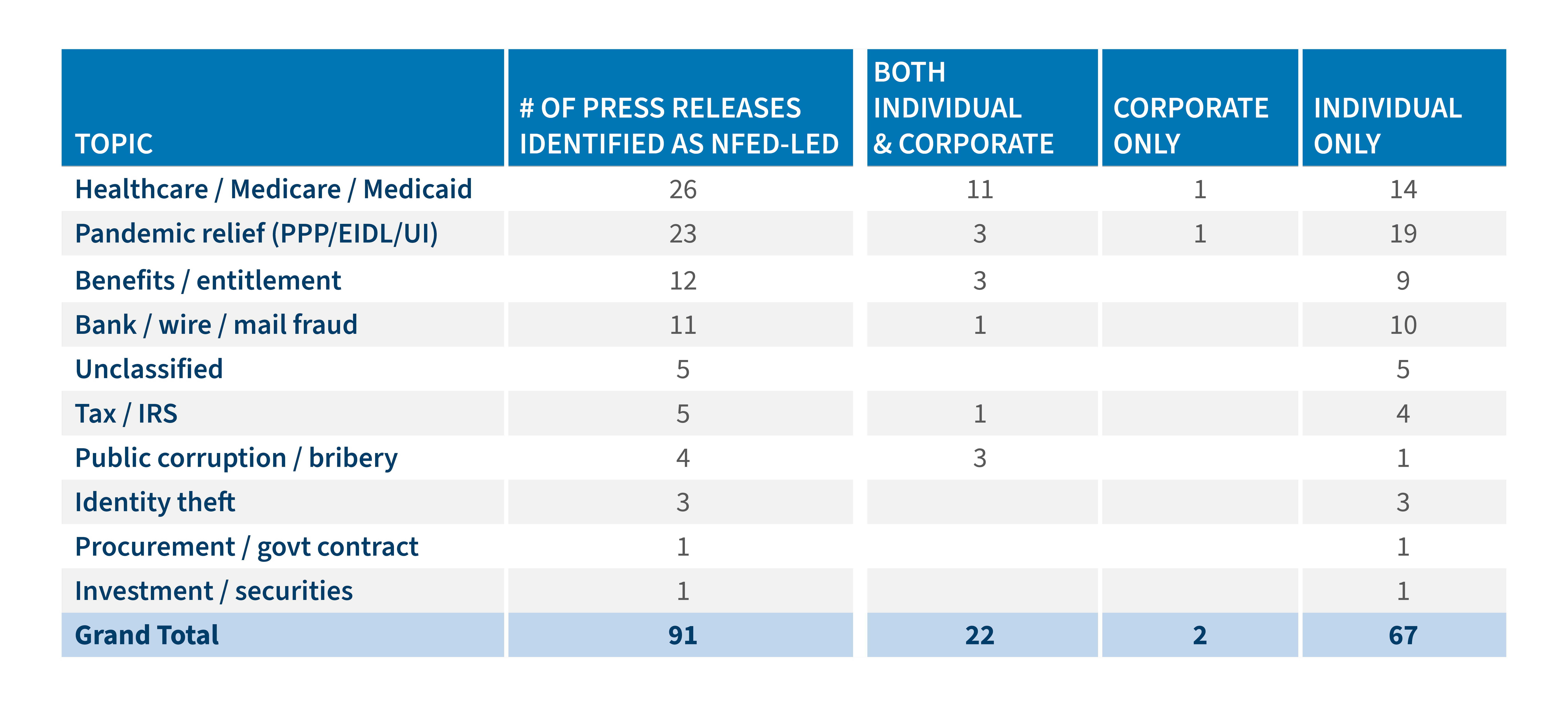
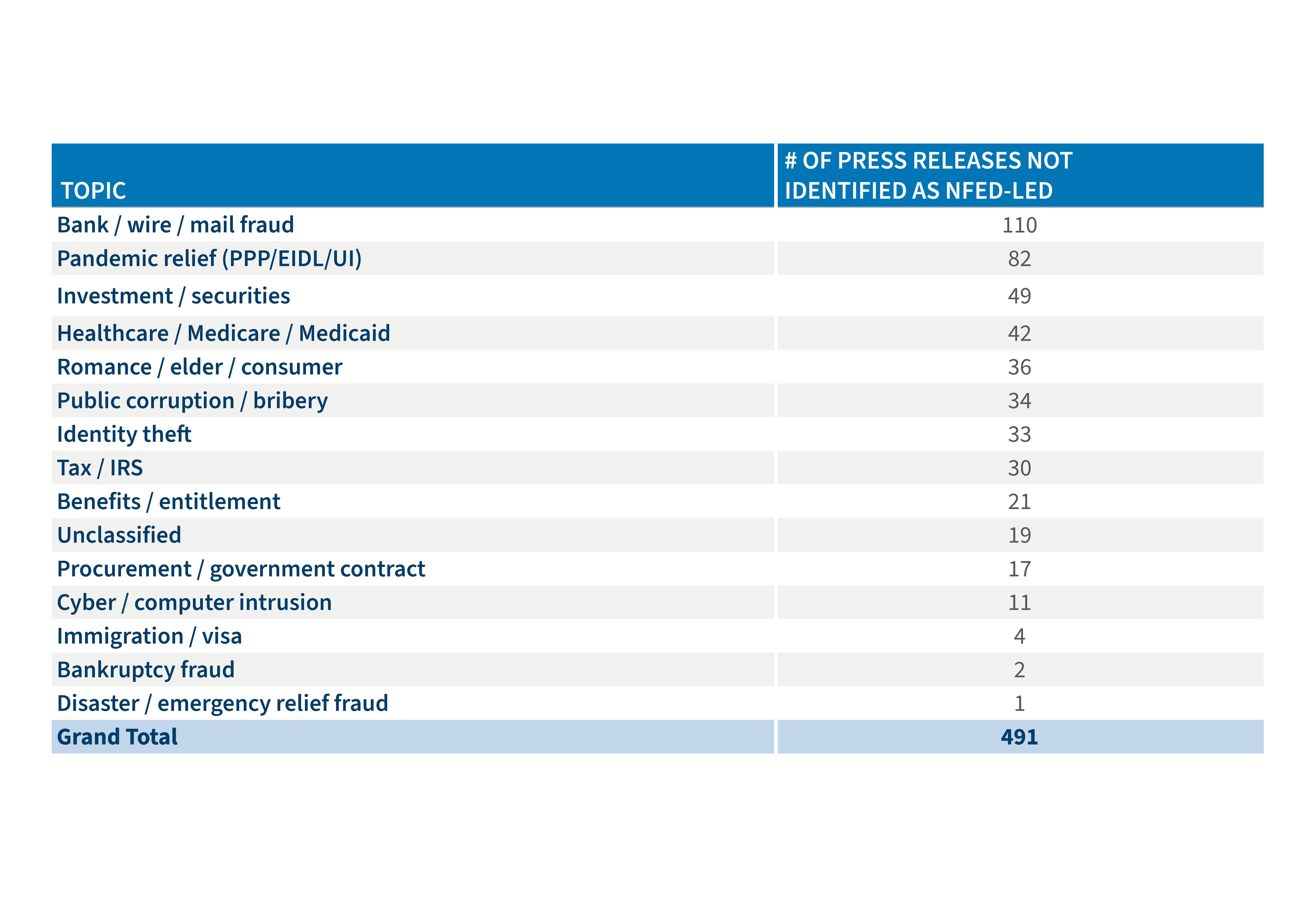
We have reviewed the nearly 600 press releases issued by the NFED or tagged to the NFED website, related to 582 distinct matters. Of those, only 91, or about 16 percent, were explicitly identified as NFED-led matters. These early indicators make it difficult to know either how the cases are identified as “NFED-related,” or whether the cases were legacy cases or new cases brought under NFED leadership. Given that much of the activity involves cases that predate NFED’s creation, the data likely overstates NFED activity while simultaneously understating its direction.
What we do see from the data is a clear focus on pandemic relief fraud and healthcare/ Medicaid fraud. As the charts indicate, these represent the vast majority of matters brought, as well as bank, wire, and mail fraud, which often subsume those same investigations. We also see that the cases illustrate a focus on individuals over corporates, in line with the administration’s stated priorities. Finally, given the larger-than-expected number of securities fraud and public corruption matters, it seems that the NFED matters are often not strictly benefits-fraud matters but combined with other crimes.
Large Dollars Make for Good Headlines
Digging into pandemic relief fraud, the largest cases involved tax preparers who appeared to be filing false returns to obtain benefits. A May 13, 2026, press release involved a tax preparer in Brooklyn, New York, who was sentenced to 36 months in prison for her role in a scheme that fraudulently claimed more than $600 million in COVID-19-related employment tax credits. From late 2021 through mid-2023, she and her co-conspirators filed more than 8,000 false tax returns for COVID-related tax credits.6
The largest healthcare-focused press release related to Purdue Pharma’s sentencing and the associated criminal penalties of over $5 billion for its role in fueling the opioid epidemic. While the $5 billion penalty is eye-popping, $3.5 billion of that amount was a criminal fine assessed in connection with Purdue’s bankruptcy proceedings. The fine is treated as a claim against the bankruptcy estate, and only a small fraction of face value is expected to be recovered. The remaining $2 billion forfeiture is subject to up to $1.775 billion in credits for value delivered to claimants through the settlement plan. This leaves a relatively small $225 million in actual incremental recovery.7
The largest financial fraud involved a dual French-Colombian citizen and resident of Miami who was sentenced to 12 years in prison for his role in a money laundering and fraud operation involving drug proceeds from the Sinaloa Cartel and other transnational criminal organizations. He purportedly operated a technology company that was a cover for a money laundering enterprise based in Florida and Colombia. In addition to the prison sentence, the court also imposed a $330 million forfeiture money judgment against the defendant.8
What Companies Must Consider
What we know from experience is that waiting for clarity is not a viable strategy. Companies should recognize that risk only increases without clear enforcement signals. In addition, the wide range of matters claimed by this new and prioritized Division indicates that anything may be fair game.
Enforcement Is Shifting, Data Gaps or Not
Structural changes, including centralized leadership, embedded prosecutors in every district, and aggressive DOJ publicity signal sustained attention to taxpayer or benefit fraud. This includes healthcare claims, workers’ compensation, or other abuse of taxpayer-funded programs.
Don’t Underestimate Government Fund Exposure
Any organization that receives federal funds or tax credits or participates in government benefit programs falls within NFED’s stated mandate. Exposure is not limited to direct recipients—subcontractors, vendors, and benefit administrators face scrutiny, too.
Reexamine Your Organization’s Fraud Detection Capabilities
Documentation is critical to demonstrating not only that controls exist, but also that they are tested and enforced. Practices should focus on whether controls both exist and are auditable. Organizations should also map exposure to understand all touchpoints with federal funds, programs or tax credits across the organization. Lastly, stress testing existing controls against current NFED-priority scheme types (pandemic relief, healthcare and others) can help ensure a foundation that continues to evolve as NFED enforcement takes shape.
Be Prepared for What Comes Next
NFED is scaling faster than the data currently shows. While organizations cannot draw firm conclusions about NFED’s direction from only two months of data, they can and should act in response to NFED’s data-driven enforcement approach and potential staying power. In this environment, the strongest organizations use ambiguity as a catalyst for action. Those who wait may find themselves exposed.
Footnotes:
1: Office of Public Affairs, Press Release, “Acting Attorney General Todd Blanche Issues Memorandum on the Creation of the National Fraud Enforcement Division,” U.S. Department of Justice (Apr. 7, 2026)
2: Ibid.
3: Department of Justice, “Guidelines for the Investigations and Enforcement of the Foreign Corrupt Practices Act (FCPA),” (June 9, 2025)
4: Office of Public Affairs, supra note 1
5: Courtney Bublé, “GOP Bill Would Cement DOJ Fraud Division In Federal Law,” Law360.com (July 6, 2026)
6: Office of Public Affairs, Press Release, “Brooklyn Woman Sentenced in $600 Million Covid Tax Credit Scheme,” U.S. Department of Justice (May 13, 2026)
7: Office of Public Affairs, Press Release, “Opioid Manufacturer Purdue Pharma Sentenced for Fraud and Kickback Conspiracies,” U.S. Department of Justice (Apr. 28, 2026)
8: U.S. Attorney’s Office, Eastern District of New York, Press Release, “Senior Executive Sentenced to 12 Years in Prison for Leading a Money Laundering Operation for Transnational Criminal Organizations,” (April 20, 2026)
The views expressed herein are those of the author(s) and not necessarily the views of FTI Consulting, Inc., its management, its subsidiaries, its affiliates, or its other professionals.
Related Insights
Related Information
Published
July 24, 2026
 Key Contacts