

Clean Currents: Electrification and the Transformation of U.S. Ports
-
February 20, 2026
Downloads Download Article
-

Electrification has moved from a climate goal to a competitive necessity for U.S. ports. Federal funding and policy alignment have opened the door, but grid capacity, equipment availability and project execution will determine which ports will benefit and lead the modernization charge and which will be left behind.
Turning the Tide: Electrification Is a Competitive Advantage
The U.S. maritime sector is undergoing a profound transformation as ports face mounting pressure from international climate commitments, federal mandates and regional air-quality regulations to reduce emissions and adopt cleaner energy sources. Historically reliant on diesel-powered equipment and systems, ports are now confronting an accelerating push toward electrification as regulatory requirements increasingly align with economic incentives.
Port electrification replaces diesel-powered systems with equipment powered by the grid or on-site energy generation from sources that range from traditional technologies to more innovative sources, such as wave, tidal or other renewable energy.
Battery energy storage systems also play a critical role in port energy resiliency to reduce disruptions to supply chain logistics. This transition delivers emissions reductions alongside tangible operational benefits such as lower operating costs, improved reliability and increased cargo throughput enabled by faster, more efficient equipment.
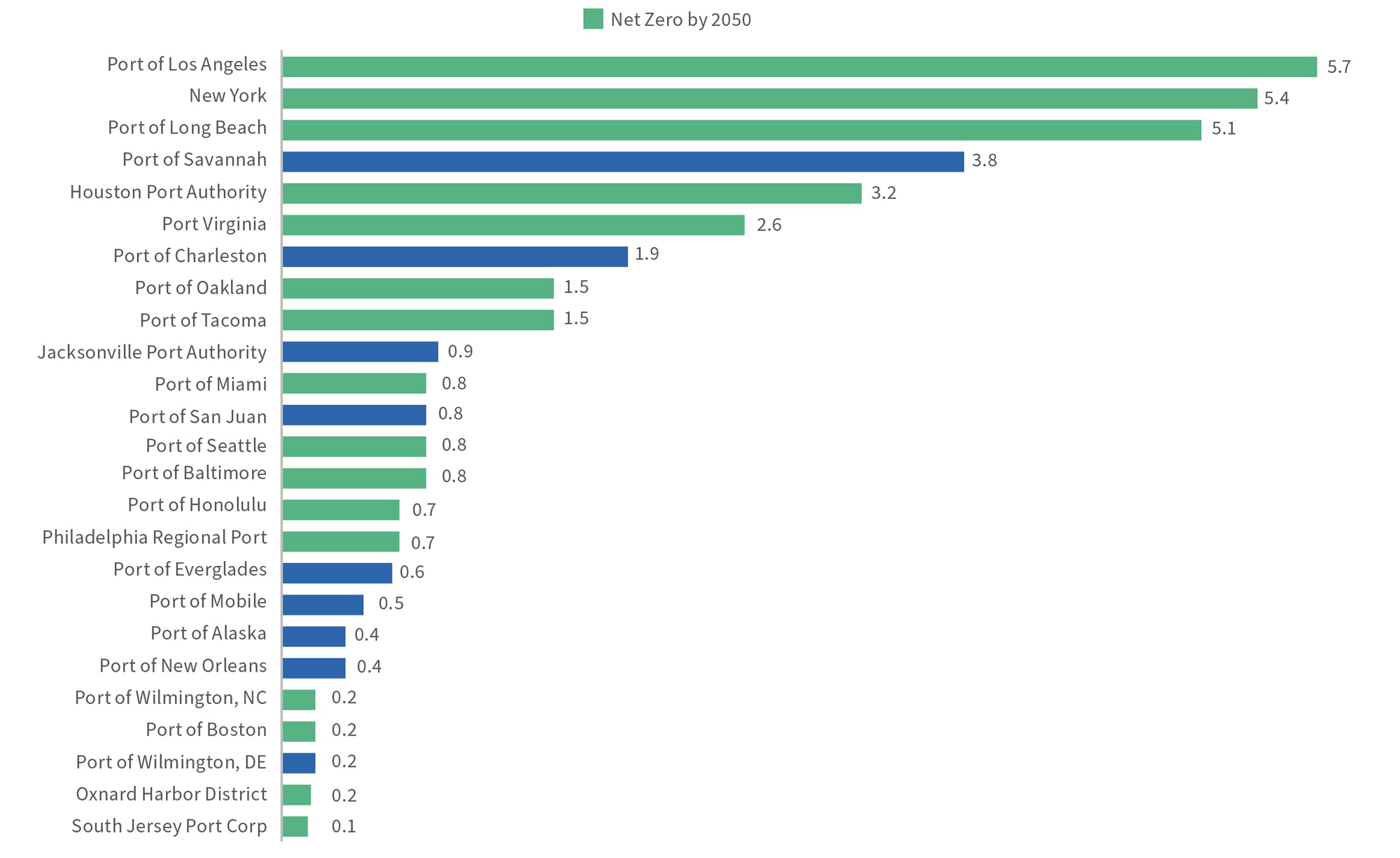
The momentum is evident: as shown in Figure 1, the top 25 U.S. container ports handled over 39 million twenty-foot equivalent units (“TEUs”) in 2023, and approximately 76 percent (76%) of that volume came from ports committed to achieving net-zero emissions by 2050. Electrification has become a defining priority for U.S. ports to remain competitive in a rapidly evolving global trade environment. Achieving these aspirations will require significant capital investment and sustained support from the federal government.
Figure 1: 2023 TEU Volume (in Millions)1
Funding Landscape: Federal Policy Is Accelerating Large Projects
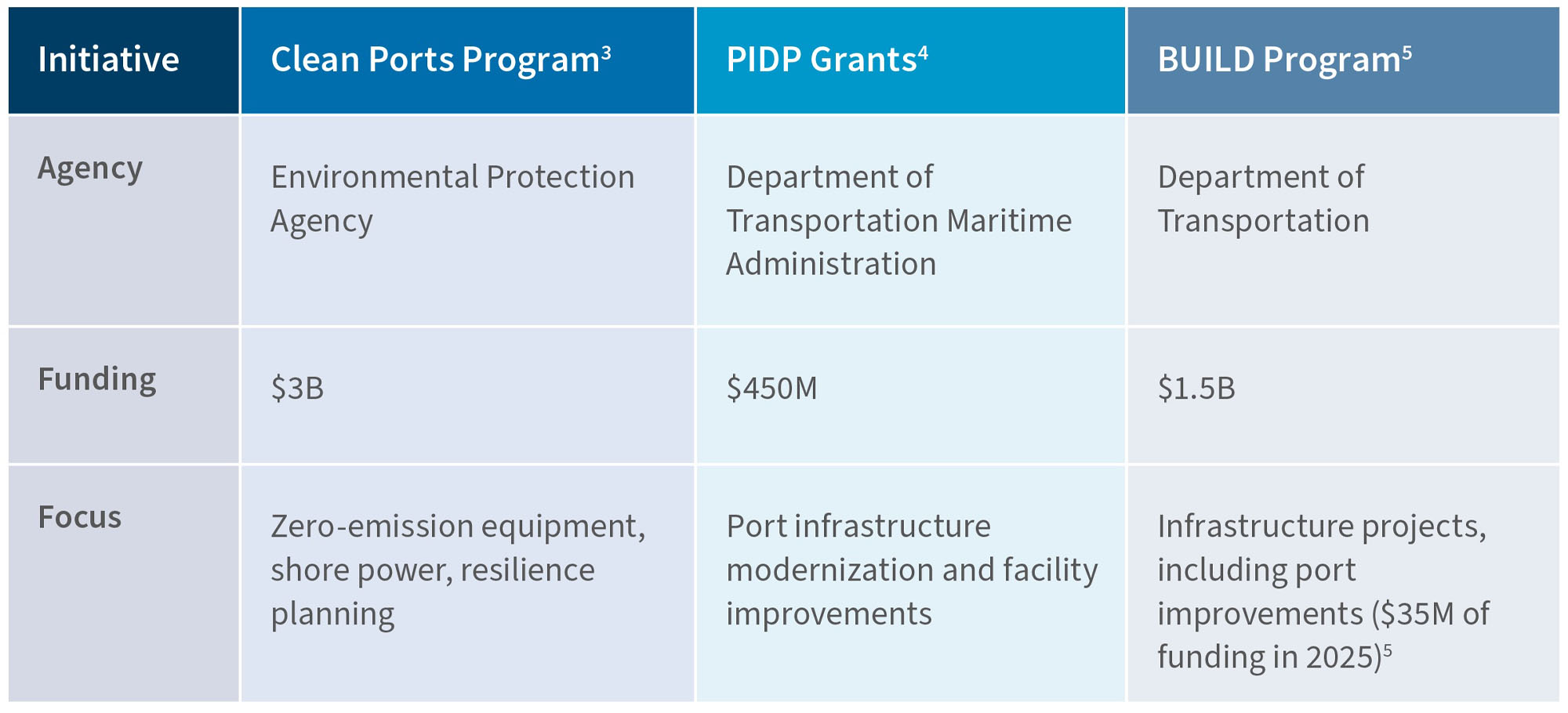
In April 2025, the Trump administration reaffirmed its commitment to port development through the “Restoring America’s Maritime Dominance” Executive Order, which directs comprehensive federal investment in the U.S. maritime industrial base, including port infrastructure.2 There are now several funding initiatives driving port infrastructure development and electrification.
Other legislation, such as the Clean Shipping Act of 2025 and the International Maritime Pollution Accountability Act of 2025, seeks to curb ship emissions and establish funding mechanisms for zero-emission technologies.6 Both bills remain at the “introduced” stage but signal continued legislative momentum for maritime decarbonization. Together, these initiatives represent a sustained, multi-billion-dollar effort to reduce emissions and modernize U.S. port infrastructure.
Figure 2: Summary of Key Port Funding Initiatives
Charting the Course: Turning Unprecedented Federal Funding Into Operational Success
The maritime and port sectors now have access to unprecedented federal funding, but capital alone will not deliver results. Ports must translate grants and other funding instruments into measurable progress while navigating significant technical and commercial challenges. As ports move from securing funds to executing projects, sustained support will be essential to convert investments into operational successes.
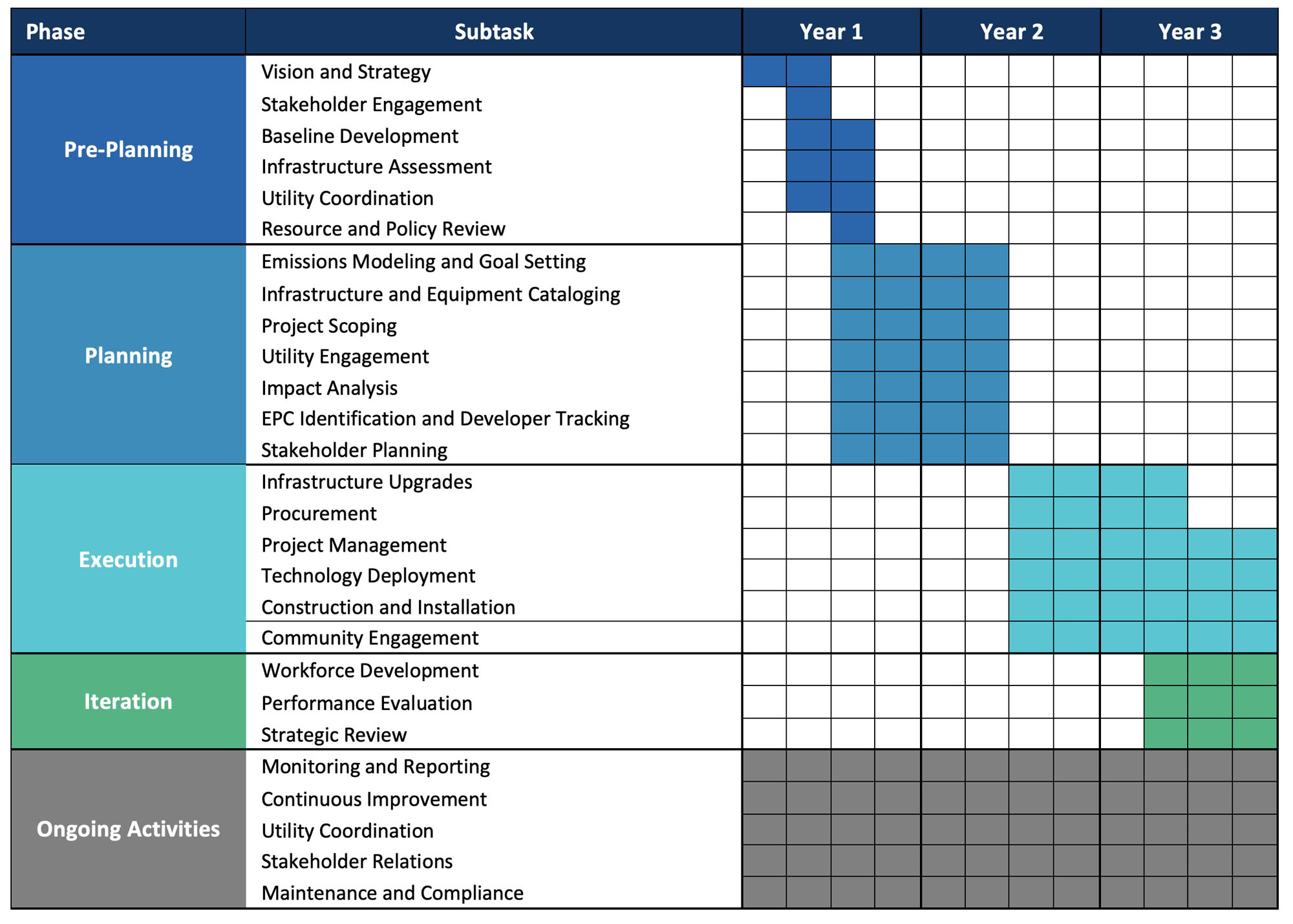
The illustrative framework below provides a pathway from federal funding allocation to operational success based on a three-year timeline.
Figure 3: Illustrative Execution Plan7
Navigating Choppy Waters: Significant Execution Hurdles in Port Electrification
While every port will present its own unique challenges, all port electrification projects typically encounter three primary obstacles: power, equipment supply and implementation.
Power Supply Challenges
Access to an adequate and reliable supply of electricity can be the most critical bottleneck. Many ports face insufficient grid capacity, long interconnection timelines and costly infrastructure upgrades that can exceed grant funding. Ports can mitigate these challenges by:
- Early engagement with utilities to ensure the port secures a timely interconnection and stays on track with electrification goals.
- Coordinating closely with utilities to conduct early grid impact assessments, pursue on-site renewable energy and battery storage systems and identify distributed energy resources to help reduce reliance on grid upgrades.
Equipment Challenges
Ports often face significant equipment challenges due to limited market availability, high costs and operational constraints. Many electric alternatives remain unavailable or do not meet regulatory standards. Ports can address this hurdle by:
- Early engagement with original equipment manufacturers and engineering, procurement and construction firms to understand availability timelines, align on compliance requirements and standardize equipment designs.
- Phased pilot projects to test new technologies in their operational environment, identify performance issues and de-risk larger investments.
Implementation Challenges
Executing electrification plans requires navigating a complex mix of stakeholders, regulatory frameworks and labor considerations. Port authorities must coordinate with terminal operators, labor unions, utilities, local governments and community groups, each with different priorities and timelines. Environmental reviews, labor negotiations and inter-agency approvals often take 12-18 months. Ports can strive to simplify stakeholder complexity by:
- Creating a unified project roadmap that aligns regulatory milestones, labor planning, procurement schedules and funding windows to maintain momentum.
- Establishing a dedicated electrification task force with representatives from key stakeholder groups to meet regularly to resolve conflicts and maintain alignment.
Beyond the Horizon: Other Key Considerations
The roadmap toward electrification and net-zero emissions should be tailored to reflect each port’s strategic goals and initiatives that extend beyond electrification. Additional considerations include the following:
PPA and Onsite Generation and Storage
To reduce or eliminate scope 2 emissions, ports must source electricity from zero emission energy generation, either onsite or via a power purchase agreement with an off-site generator. Alternatively, ports can install on-site energy generation and battery storage systems to reduce reliance on grid-supplied electricity.
Electric Vehicles and Charging Infrastructure
Driven by port-level initiatives and federal funding programs, public and private fleets are increasingly adopting electric drayage trucks. Programs such as the National Electric Vehicle Infrastructure Formula Program provide the financial backbone for infrastructure build-out and electric commercial vehicle and heavy equipment acquisition.8 Together, these efforts are key steps toward full port electrification and can help ports tailor their plans to local needs.
Staying Nimble
The funding and policy landscape shaping U.S. port modernization is evolving rapidly, creating new investment opportunities while also introducing shifting eligibility criteria, utility requirements and compliance expectations. Utilities are reassessing grid capacity, interconnection protocols and rate structures in response to the growing load demand.9 Port authorities and developers must track policy developments, align funding windows with infrastructure readiness and identify tasks that can advance in parallel, such as utility coordination, workforce training and permitting.
In summary, true electrification requires equipment, energy and execution. Ports that plan holistically will remain competitive as conditions evolve.
How We Can Help
FTI Consulting’s Power, Renewables & Energy Transition Practice offers a team of highly experienced professionals with decades of specialization supporting public sector clients in federal funding opportunities, financial and program management, compliance and stakeholder engagement, helping projects secure federal, state, and private lending, meeting compliance standards and executing sustainable infrastructure and energy projects.
FTI Consulting’s Transport and Logistics practice brings deep experience across transportation, supply chain and global freight issues, combining industry expertise with a hands-on approach focused on implementation and results. Our team has extensive experience in the ports sector, supporting clients across a wide range of areas including operations and business strategy, restructuring advisory, investigations, environmental analysis and solutions, damages assessment and expert testimony, and the implementation of advancing technologies such as wave and tidal energy.
Footnotes:
1: “Top 25 Ports by TEUs,” U.S. Dept. of Transportation Bureau of Transportation Statistics (n.d.).
2: Exec. Order No. 14269, “Restoring America’s Maritime Dominance,” Federal Register 90, 15635–41. (April 15, 2025).
3: “Clean Ports Program,” United States Environmental Protection Agency. (January 23, 2026).
4: “Port Infrastructure Development Program,” U.S. Dept. of Transportation Maritime Admin. (Dec. 23, 2025).
5: “President Trump’s Transportation Secretary Sean P. Duffy Announces Nearly $500 Million in Funding to Revitalize American Infrastructure,” U.S. Dept. of Transportation Fed’l Highway Admin. (July 15, 2025).
6: Padilla, Senator Alex, “Padilla, Whitehouse Introduce Bills to Slash Emissions From Ocean Shipping,” Press Release. (July 10, 2025).
7: FTI Consulting notes that the roadmap is based on an illustrative three-year timeline; however, project durations may vary depending on factors such as funding availability, permitting and utility coordination timelines, stakeholder engagement and the scale and complexity of individual port initiatives.
8: “National Electric Vehicle Infrastructure (NEVI) Formula Program,” U.S. Department of Energy Office of Critical Minerals and Energy Innovation (n.d.).
9: Pató, Zsuzsanna et al., “Navigating power grid scarcity in the age of renewable energy,” Regulatory Assistance Project, Energy Regulators Regional Association. (Oct. 2024).
The views expressed herein are those of the author(s) and not necessarily the views of FTI Consulting, Inc., its management, its subsidiaries, its affiliates, or its other professionals.
Related Insights
Related Information
Published
February 20, 2026
 Key Contacts
Managing Director
Managing Director
Senior Consultant
Consultant