


REIT CEO Changes and Related Compensation Trends Over the Last Decade
A Look at How REITs Are Managing CEO Compensation During Leadership Transition Periods
-
October 09, 2026
-

A major impact on any organization’s overall business strategy, decision-making and results for investors comes from changes in leadership at the top. This is no different for specialized industry companies such as REITs. Specifically, REITs have seen many CEO changes over the past decade for varied reasons, such as investor dissatisfaction, business strategy shifts and medical or retirement decisions.
The Executive Compensation and Corporate Governance Solutions group at FTI Consulting looked at the last decade of CEO changes across REITs, from 2016 to 2025, studying more than 80 total CEO changes at REITs over that time frame. We found many interesting trends focused on the recruiting and/or promotion of the CEO successor, as well as the compensation impact of the leadership shift.
A 10-Year Look-Back at Succession Choices and Compensation Decisions
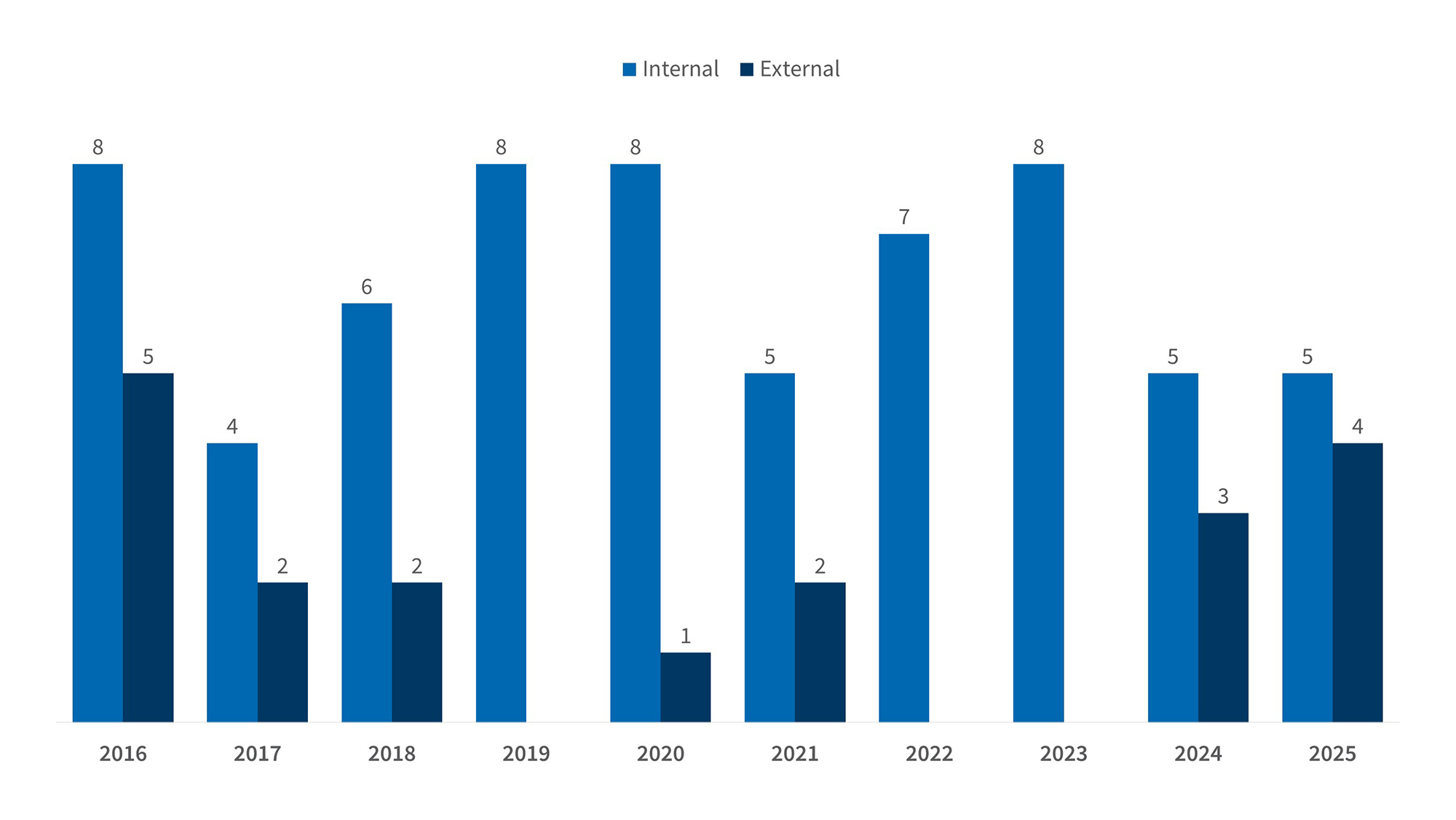
Overall, many REITs appear to have been prepared for CEO changes through clear or implied succession planning based on the predominance of internal promotions to replace outgoing CEOs.
More than 77 percent of the CEO changes we studied came from internal promotions. Interestingly, those promotions were highly concentrated, with the following two executive positions being promoted:
- 36 percent were promoted from a prior president/chief operating officer role
- 22 percent were promoted from the chief financial officer role
The balance of internal promotions were from other positions, including chief investment officer and various executive vice president roles.
Internal Promotions vs. External Hires, 2016-2025
Source: FTI Consulting analysis of publicly available sources
As these executive positions are crucial to any organization and typically participate in firm-wide decision-making, they clearly also serve as a succession vehicle for future CEO changes.
A Closer Look at CEO Compensation Between External and Internal Hires
One major component of how companies handle CEO transitions clearly revolves around compensation decisions relating to how to fill the new leadership position. We found that companies looking outside for their new CEO tend to pay more for their externally hired CEOs versus internally promoted ones, when compared to the compensation of the exiting CEO.
The overall higher compensation package to recruit an outside CEO provides a strong argument for REITs, and companies across industries, to maintain an organized succession pipeline of internal candidates to prepare for planned or unforeseen CEO changes.
Overall, in our study, externally hired REIT CEOs are being paid approximately 13 percent more on average than the prior CEO, versus a decrease in overall CEO pay for promoted CEOs of about six percent. Primarily, the increased compensation cost for externally hired CEOs arises from upfront supplemental stock award grants, with our analysis showing a median value of $4.8 million for grants made to the recruited CEO. As these grants have an average vesting period of three years, companies use these awards both as a recruiting and a retention tool.
Since internally promoted CEOs are most likely already included in their company’s annual long-term incentive programs, CEO promotions often lead to incrementally higher-value stock awards. As such, internally promoted CEOs are typically not offered a supplemental sign-on grant that would be offered to an externally hired CEO.
A prime example of an incoming CEO receiving a special stock award is Equinix (“EQIX”). In 2024, Charles Meyers transitioned from CEO to Executive Chairman, while EQIX hired Adaire Fox-Martin from outside the company as his successor. In connection with her appointment, Ms. Fox-Martin received a one-time $17 million time-based stock award, vesting over two years. The award was intended as a make-whole for equity awards Ms. Fox-Martin forfeited upon leaving her prior employer.1 This example clearly highlights an additional cost of external CEO successions that can be avoided with an internal promotion.
Executive Chairs Serve a Crucial Role in CEO Transitions
Another major trend in ensuring a smooth leadership transition is how the departing CEO is handled with the incoming CEO. In many cases, the departing CEO transitions into or remains in an executive chair or board position to provide continuity and mentorship for a new CEO.
Overall, 37 percent of departing REIT CEOs over the past ten years maintained their position on or joined the company’s board, with 19 percent occurring in connection with an external CEO hire.
Among the board positions provided to the departing CEOs:
- 77 percent remained or were newly named to the role of chairman, with 54 percent of these newly promoted to the position
- Regarding the chair positions offered to exiting CEOs, 67 percent served as executive chair
This leadership shift strategy allows for a more seamless transition of leadership by allowing the former CEOs to stay in a prominent guiding role to ease the new CEOs into their new role. This strategy demonstrates these companies’ intentions to assist the incoming CEO by keeping the former CEO in place in the chair role.
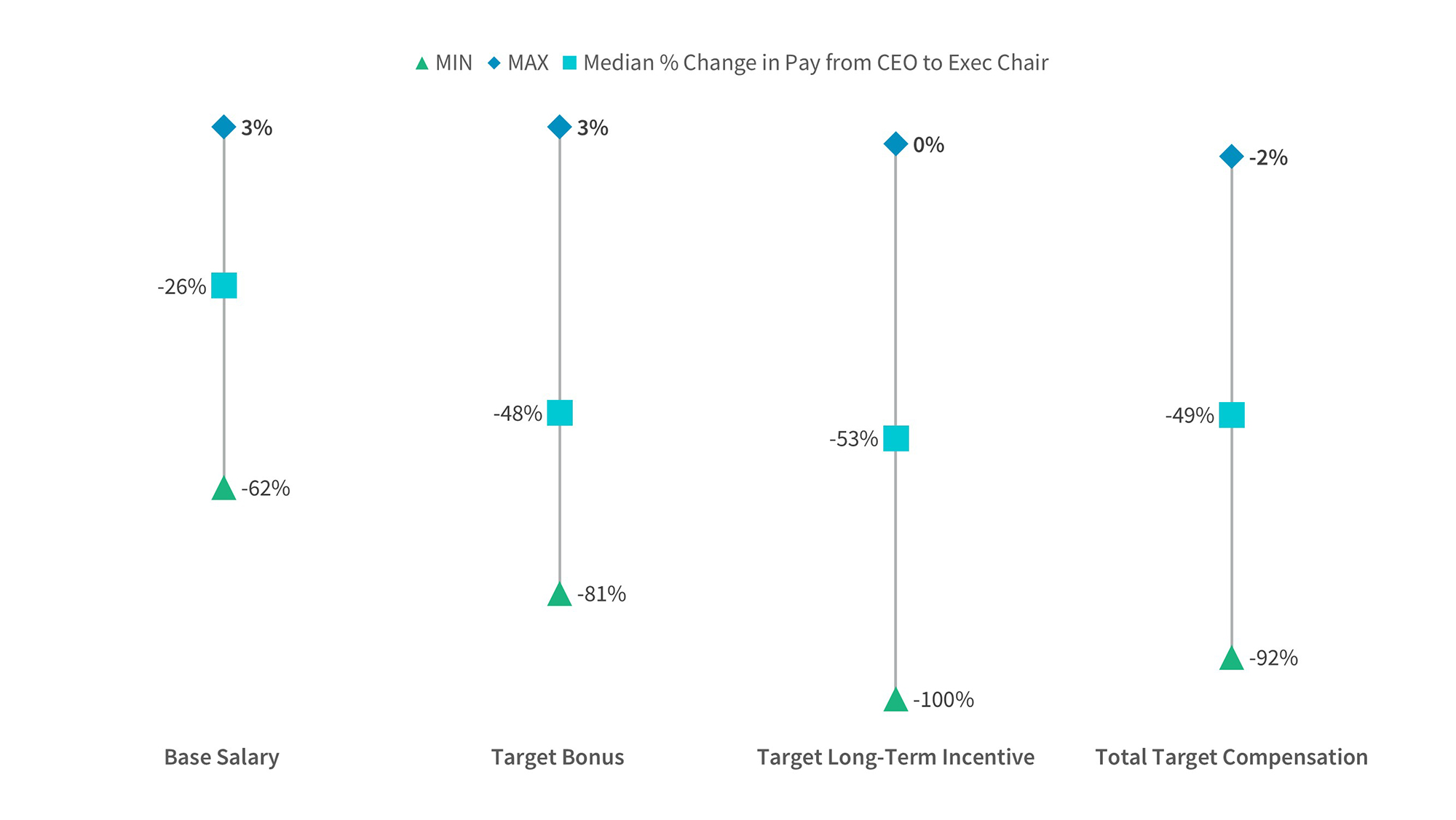
While every executive chair within the study was paid a base salary and target bonus, approximately half also received equity grants. As a result, the chair’s total compensation for those assuming the executive chair role was reduced 49 percent as compared to their compensation from their prior CEO roles. Additionally, the chair’s total target compensation at the median amounted to 47 percent of the incoming CEO’s compensation.
Below is the percent change for executive chairs versus their prior CEO compensation:
Change in Executive Chair Compensation vs. Previous CEO Compensation
Source: FTI Consulting analysis of publicly available sources
In a transformative recent case, in January 2026, Prologis (“PLD”) underwent a CEO transition with Hamid Moghadam moving from CEO and chair to executive chairman. As part of PLD’s succession plan, Dan Letter, the former president of PLD, was promoted to CEO. To ensure that Mr. Moghadam stayed in his executive chair role to support the leadership transition, he was granted a retention equity award valued at approximately $28.8 million, subject to three-year vesting. In total, Mr. Moghadam’s 2026 target compensation is approximately $23 million, after annualizing his retention award. This annual compensation as chair reflects the significant value placed on retaining his continued involvement in PLD given his role in building the company since its inception in 2011, and founding its predecessor, AMB, in 1983. Excluding the retention award, Mr. Moghadam’s target compensation as executive chair decreased by 43 percent from his prior CEO compensation package.2
In Summary
Key takeaways from this study are that: REITs have overall shown disciplined planning for succession and compensation amidst their CEO changes; internal versus external CEO hires can save organizations a significant amount of money in compensation; and many REITs are keeping former CEOs in executive chair or other board positions to manage transition risk.
Footnotes:
1: Equinix Annual Proxy Statement 2025 (Apr. 10, 2025).
2: Prologis Annual Proxy Statement 2026 (Mar. 19, 2026).
The views expressed herein are those of the author(s) and not necessarily the views of FTI Consulting, Inc., its management, its subsidiaries, its affiliates, or its other professionals.
Related Insights
Related Information
Published
October 09, 2026
 Key Contacts
Senior Managing Director
Senior Director
Director