


Three Ways AI Is Changing the Corporate Narrative
AI Is Now a Stakeholder in Its Own Right, Shaping Brand Perception Before Companies Speak
-
July 28, 2026
-

For decades, corporate communications operated within a relatively stable system. Companies could shape messaging, distribute it through established channels and largely control how stakeholders encountered the brand through media coverage, executive visibility, websites, advertising and marketing campaigns.
That model is starting to break down.
FTI Consulting’s recent article on “infinite narratives”1 explored how modern communications strategies increasingly require predictive, data-led approaches as organizations navigate fragmented stakeholder ecosystems. That challenge becomes even more urgent in the AI era, where stakeholder perceptions and opinions are being formed before organizations communicate or interact with them directly at all.
Now, AI-generated search and recommendation tools are influencing how people discover and evaluate brands, often outside traditional communications and marketing ecosystems. As a result, AI algorithms themselves have become a new stakeholder group in the communications ecosystem. Large language models synthesize and surface narratives about organizations continuously, and how a company appears in those AI-generated responses shapes brand perception just as meaningfully as any owned channels or earned media placements. As editor Adam Blair noted recently in Retail TouchPoints, “consumers are engaging with AI in ever-growing numbers.”2
Shift #1: AI Is Beginning to Shape How Brand Perception Forms
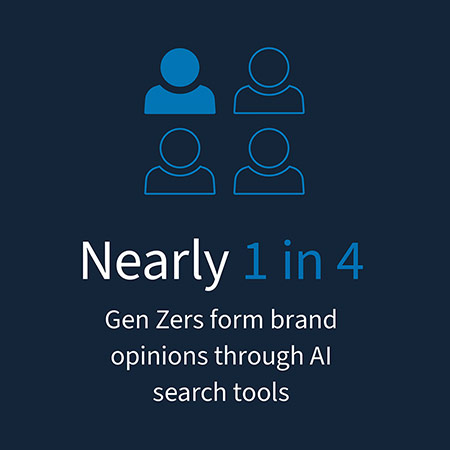
New proprietary research from FTI Consulting’s Strategic Communications segment suggests this shift is already beginning to emerge among younger consumers. In FTI Consulting’s inaugural Retail Resiliency Survey, an online survey of U.S. consumers conducted in March 2026, nearly one in four Gen Z consumers (22%) report that AI search tools already typically influence how they think about a brand.3
That finding is significant not simply because it tells us AI tools are influencing purchasing behavior, but because it means a meaningful share of the most important emerging consumer base is already starting to form opinions about brands based on what those AI tools tell them.
As Rachel Rosenblatt, Head of the Americas Retail & Consumer Products sector at FTI Consulting, recently told Business Insider, this is a fundamental shift in how organizations should think about brand visibility, control and measurement.4
“AI is already influencing purchasing decisions at a time when many organizations are still figuring out how to show up in these spaces consistently, or how to measure that influence,” Rosenblatt said.5
What This Means
Companies increasingly need to understand how their narrative is being interpreted, synthesized, and surfaced across AI-driven environments.
Shift #2: The Business Itself Is the Narrative
AI systems evaluate companies far beyond their official brand messaging. Instead, they scan the entire digital ecosystem for “truth signals,” pulling data from Glassdoor reviews, persistent Reddit threads, past crisis headlines that never quite went away, leadership commentary, public discourse and more.
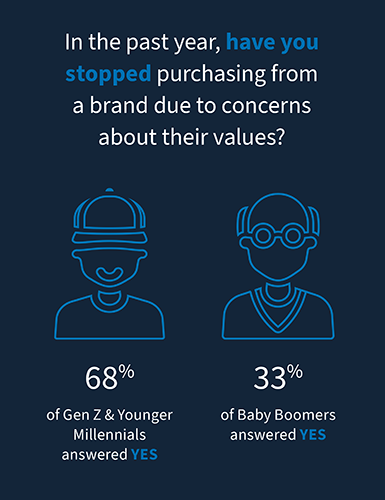
That dynamic is happening alongside a broader shift in stakeholder expectations. The Retail Resiliency Survey found that 68% of consumers ages 18-34 stopped purchasing from a brand in the past year specifically over its values. Nearly half of Gen Z consumers (45%) said how a company treats its employees directly influences whether they trust that brand. Meanwhile, 76% of consumers who walked away from a brand cited the company’s response to controversy as a driving factor in their decision.6
Collectively, the findings point to a broader reality: stakeholders increasingly evaluate companies holistically.
Narrative can no longer function as a polished layer sitting on top of the business. It matters more in AI-driven environments, where information is continuously surfaced, connected and reframed at scale. A labor issue can quickly become viral TikTok commentary, a leadership decision can become searchable context tied to a brand indefinitely and a poorly handled crisis response can remain an active part of AI summaries long after the news cycle moves on.
What This Means
The growing overlap between operations and reputation raises the stakes for narrative development. Messaging strategies that are disconnected from workforce realities, leadership behavior, governance decisions or stakeholder experience are becoming harder to sustain over time.
Shift #3: Narrative Development Requires a Different Approach
For years, narrative development was largely approached as a messaging exercise: align leadership, define positioning and distribute consistent communications across key audiences. But in today’s environment, organizations are no longer simply managing message distribution. They are managing interpretation.
“Historically, organizations had much greater ability to compartmentalize reputation,” said Rachel Rosenblatt. “What AI changes is the speed, scale, and likelihood that fragmented information sources become synthesized into a perceived, cohesive narrative about a company. That raises the bar significantly for consistency and credibility.”
This shift calls for a different approach to narrative development. Instead of beginning with the story a company wants to tell, communicators need to start by understanding the story stakeholders are already hearing.
What assumptions already exist? Which perceptions are grounded in reality? Where are the disconnects between what leadership believes and what employees, customers, investors, or AI systems are likely to conclude? These questions are becoming just as important as the messaging itself.
To answer them, organizations need a broader toolkit than communications has traditionally relied upon. Audience research can reveal how different stakeholders interpret the same message. Behavioral science helps explain why those perceptions form. Message testing can identify where intended narratives create confusion or skepticism and AI analysis can provide a window into how information is likely to be synthesized before organizations ever publish a press release, launch a campaign or respond to a crisis.
The most resilient narratives are rooted in operational reality and aligned with how stakeholders actually experience an organization, not simply how it wants to be perceived. So rather than asking only, “Is this the story we want to tell?” communicators should also ask, “Is this the story stakeholders are likely to believe?”
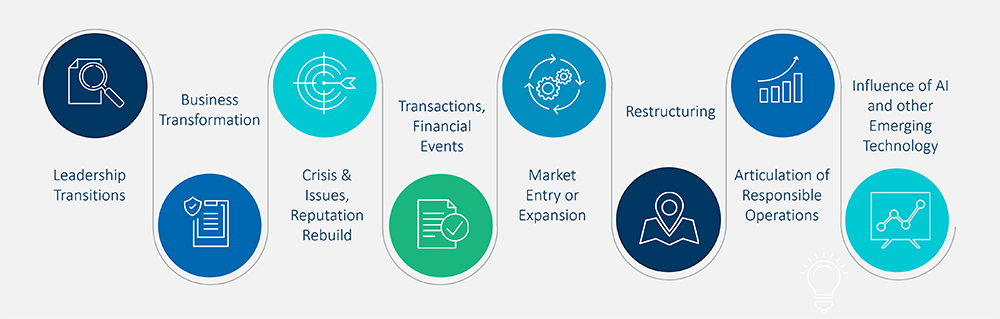
That distinction becomes especially important during periods when perception can shift quickly, including:
What This Means
The old “set the message and repeat it” playbook is becoming less effective. In AI-shaped environments, communications teams need to spend less time asking whether they delivered the message and more time understanding the story stakeholders are actually walking away with. Those aren›t always the same thing.
Narrative Resilience May Become a Competitive Advantage
Many organizations still think about AI primarily through the lens of productivity, automation or marketing efficiency. From a reputation standpoint, however, AI represents something larger: a new layer of influence shaping stakeholder judgment before companies directly engage audiences themselves.
That challenge now extends to a new kind of audience entirely. Large language models are increasingly becoming a major way that stakeholders discover, research and form first impressions of organizations. As a result, influencing how narratives are synthesized into AI-generated responses is an important part of how companies shape perception overall.
The organizations most likely to navigate this shift successfully will not necessarily be the loudest or most visible. They will be the ones with narratives strong enough to remain coherent across fragmented, fast-moving, and AI-amplified information environments. In other words, narrative resilience may become a competitive advantage in its own right.
FTI Consulting’s strategic communications experts specialize in leveraging digital insights to enhance corporate positioning. They blend audience research, message testing, AI analysis, and strategic storytelling to help organizations evaluate whether their narratives are durable, credible, and aligned with stakeholder experience before they reach the public. Contact us to learn more.
Footnotes:
1: Condon, James, Katie Bestenlehner & Mary Catherine Sullivan, “Communicating in the Age of Infinite Narratives: A Data-Led Approach to Event-Driven Communications,” FTI Consulting (May 29, 2026).
2: Blair, Adam, “Growing Adoption of AI Makes It the Next ‘Trust Battleground,’” Retail Touchpoint (Apr. 27, 2026).
3: FTI Consulting, Retail Resiliency Survey 2026 (Apr. 27, 2026).
4: “Now That’s What I Call an Insight,” Bus. Insider (Apr. 15, 2026).
5: Id.
6: FTI Consulting, supra note iii.
The views expressed herein are those of the author(s) and not necessarily the views of FTI Consulting, Inc., its management, its subsidiaries, its affiliates, or its other professionals.
Related Insights
Published
July 28, 2026
 Key Contacts