


AI Use in Prior Authorization Requires Operational Proof
Why Policies, Model Validation, and Human Review Are Not Sufficient
-
November 25, 2026
-

The use of artificial intelligence (“AI”) is changing prior authorization (“PA”) in ways that conventional utilization management (“UM”) controls were not designed to address. AI introduces risks along with the benefit of increased processing volume. AI can influence what information a reviewer sees, how clinical criteria are applied, which cases are escalated and how quickly a decision is made. Weak assumptions, incomplete data fields or poorly configured workflows can therefore affect an entire population before a traditional audit detects the pattern.
Health plans need a higher standard of proof to address these risks. The mere presence of an AI policy, a model inventory, technical validation and a clinician somewhere in the workflow does not ensure that an AI-enabled PA process is operating appropriately. Plans need evidence showing what the technology influenced, what information supported each material decision, whether required clinical judgment occurred and whether patterns across cases reveal emerging problems, such as inappropriate denials, delays in care or inconsistent decision-making for patients with similar clinical needs.
That is the central compliance challenge: AI governance must extend beyond the model and into the operating system in which clinical decisions occur.
How AI Affects Prior Authorization
Many PA risks predate AI. Inappropriate denials, inconsistent criteria application, inadequate clinical review, poor documentation and weak delegated oversight are not new challenges in PA. But AI changes the scale, speed and visibility of those risks.
A manual error might affect one case. A flawed algorithm, workflow rule or data transformation can reproduce the same error across thousands of requests. Clinicians may also give machine-generated recommendations more weight than they realize, particularly when the output appears objective, arrives early in the review or is embedded in the normal workflow. A vendor can change a model or configuration without changing the health plan’s written policy. These risks may not be visible in a conventional case file unless the organization preserves the AI recommendation, model and criteria versions, reviewer action and final determination.
There is a silver lining to these risks. AI also creates new data-driven evidence that plans can use. Recommendation logs, confidence scores, exceptions, clinician overrides, model versions, workflow changes and links to appeals can reveal how the decision system behaves. The compliance question is no longer limited to whether a sampled determination followed policy. It also includes whether the system is producing unusual patterns across services, reviewers, providers, populations and delegated entities.
Figure 1 - How AI Changes the Control Problem
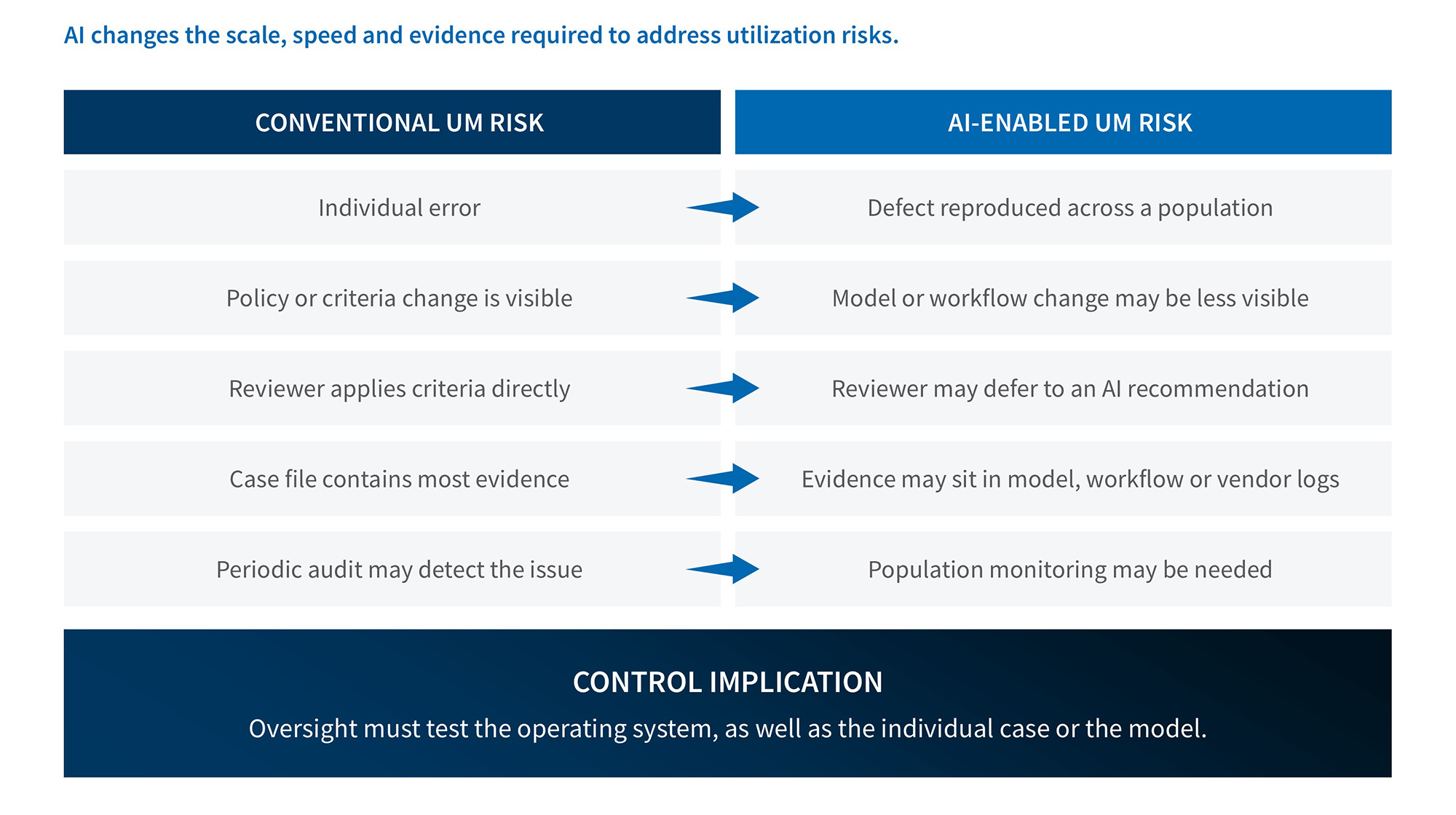
AI changes how quickly control failures can spread, how visible they are and what evidence effective oversight requires.
Prior Authorization Is Becoming a Regulated Data Product
Federal and state requirements are making PA more structured and observable. Under CMS-0057-F, impacted payers began publicly reporting specified PA metrics in 2026.1 Application program interface requirements taking effect primarily in 2027 will support electronic requests and responses, communicate whether a request is approved, denied or requires more information and provide a specific reason for denial.2
These requirements turn requests, criteria, documentation, decisions, reasons, timing and appeals into data that can be exchanged and analyzed. PA is therefore becoming more than an internal operational process. It is becoming a regulated data product: The information must be complete, traceable, timely and capable of supporting external scrutiny.
State requirements reflect the same direction. California’s Senate Bill 1120, which went into effect on January 1, 2025, applies to health plans and disability insurers using AI, algorithms or other software in utilization review, including through contracted entities. It requires patient-specific clinical information rather than group data alone, bars the tool from denying, delaying or modifying care on medical-necessity grounds, reserves that determination to a competent licensed professional and requires periodic review of the tool’s performance, use and outcomes.3 Oregon’s House Bill 3134, which went into effect January 1, 2026, expands PA reporting and requires public availability of specified data.4 These requirements differ, but both call for reliable evidence about decisions and process performance.
Human Review Is a Control Only When It Is Independent
A clinician’s presence in a workflow does not prove that the clinician exercised independent judgment. Meaningful review requires access to the relevant member-specific information, authority to disagree with the technology, sufficient time to evaluate the case and documentation that explains the basis for the decision.
This distinction matters because automation bias can exist even when every adverse decision receives a human signature. A reviewer may accept a recommendation because the system appears reliable, because performance expectations discourage additional review or because disagreement requires extra work. Oversight should therefore examine more than whether a clinician touched the case. It should test what the clinician saw, what the AI recommended, whether the reviewer could override it, what happened when reviewers disagreed and whether later appeals expose weaknesses in the original review.
The proposed Doctors Not AI Act of 2026 follows this logic. If enacted, it would require adverse benefit determinations involving clinical judgment to be made by an appropriately qualified licensed professional who independently evaluates the enrollee’s circumstances and does not treat AI output as presumptively valid. It would also require disclosure and preservation of AI-related documentation. The bill remains pending and is not current law, but it illustrates the direction of legislative scrutiny.5
Responsible Use Must Be Demonstrated Through Evidence
Health plans should be able to reconstruct an AI-influenced PA decision from beginning to end. At a minimum, the record should identify:
- The member-specific clinical information available at the time of review
- The applicable coverage criteria and version
- The AI or software tool used, its approved purpose and the relevant version
- The recommendation, score, summary or other output presented to the reviewer
- The reviewer’s action, qualifications and documented reasoning
- The final determination and notice
- Any appeal, overturn, complaint, delay or access consequence
- Any model, criteria, vendor or workflow change that may have affected the process
This evidence serves two different purposes. Decision traceability allows the organization to explain what occurred in a specific case. Population monitoring allows it to identify patterns that individual case review may miss. Neither replaces clinical judgment. Together, they allow compliance and clinical leaders to test whether the operating system is functioning as intended.
Figure 2 - Decision Evidence Chain
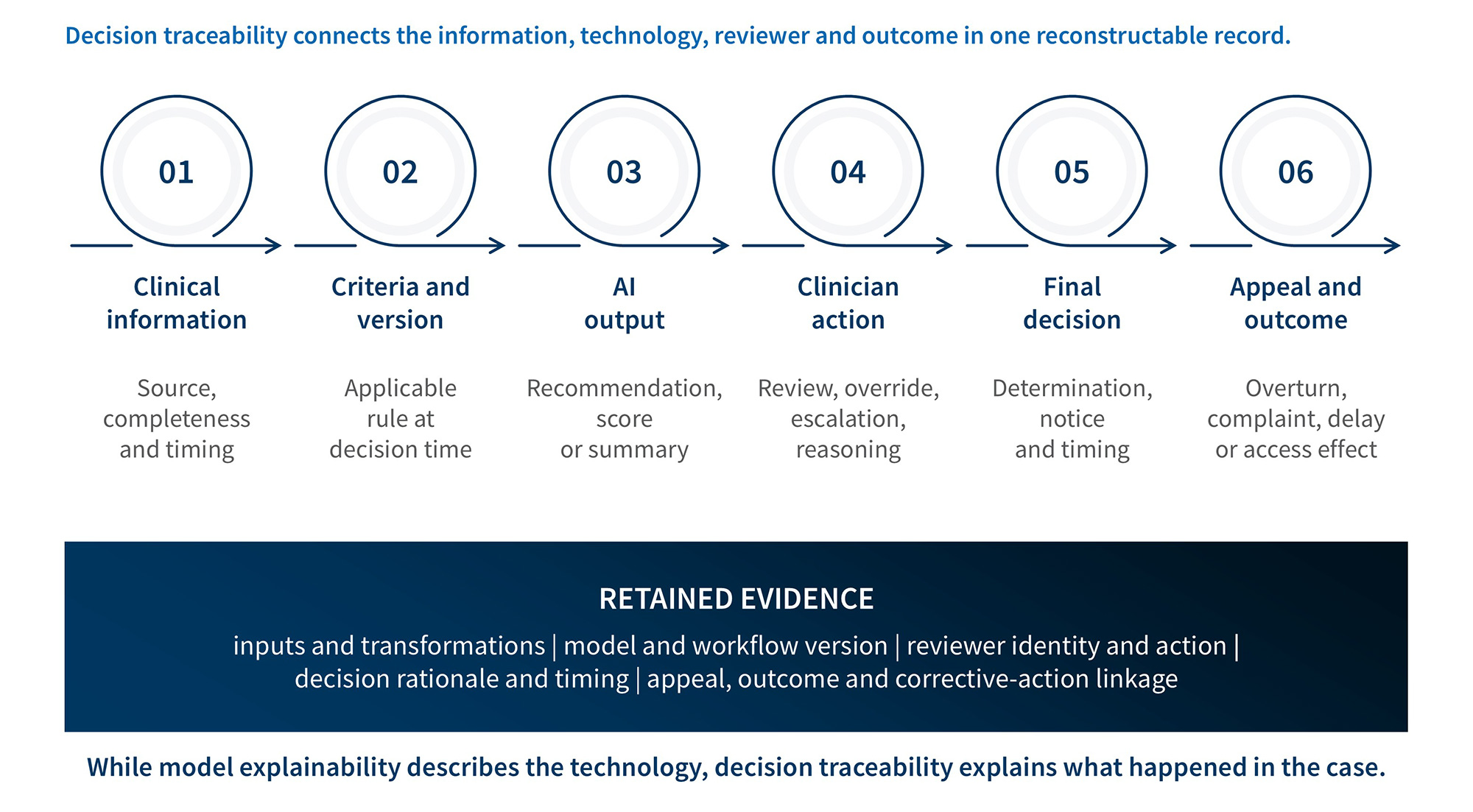
A reconstructable decision record connects member-specific information, technology, clinical review, and outcomes.
Delegation Does Not Transfer Accountability
The oversight problem becomes harder when a health plan delegates PA or supporting functions to a utilization management vendor, specialty benefit manager or risk-bearing provider organization. The plan may not own the model, control its updates, understand the training data or receive transaction-level information showing how the AI tool influenced decisions.
Contract language and vendor attestations are not sufficient. A plan needs the right and practical ability to identify material AI uses, review implementation and change controls, obtain transaction-level performance data, test clinical-review requirements, investigate outliers and evaluate incentives that may affect vendor or reviewer behavior. If a plan cannot independently monitor an AI-enabled delegated function, it cannot credibly claim effective oversight of that function. California’s explicit inclusion of contracted entities makes this a direct compliance issue for covered California businesses.6
What Executives and Boards Should Require
Executives and boards need clear evidence about exposure, control effectiveness, outcomes and unresolved risk. Management reporting should answer four questions:
- Where does AI influence PA, and which uses can affect member access or adverse determinations?
- Can the organization reconstruct a material decision and show that required clinical judgment occurred?
- Are denial, timing, appeal, overturn, override, complaint and access patterns within defined tolerances?
- Do internal and delegated processes produce issues that are investigated, corrected and monitored for recurrence?
The underlying data must be complete and captured accurately, the measures must be calibrated to the service and population and threshold breaches must lead to investigation. Management should also disclose where data is missing or where a vendor limits visibility. The appearance of precision is more dangerous than an acknowledged control gap.
Figure 3 - From Governance Claims to Operational Proof
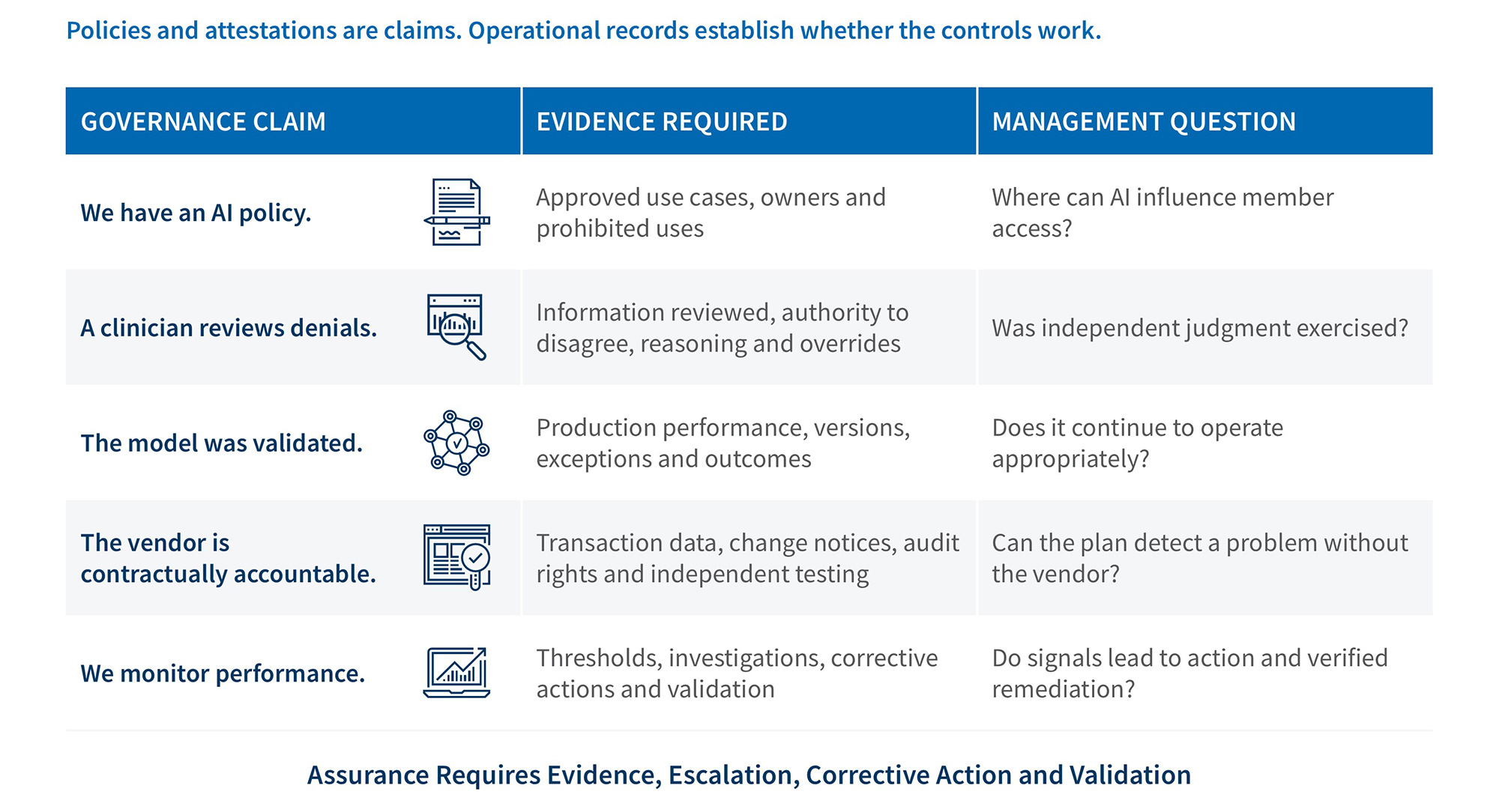
Governance statements become credible only when the organization can produce evidence and answer the corresponding management question.
The Standard Is Operational Proof
Responsible AI in PA will be judged through operational evidence: whether the organization can reconstruct decisions, demonstrate independent clinical judgment, detect population-level risk, oversee delegated functions and show that identified problems lead to corrective action.
The immediate priority is to define what evidence each AI-enabled workflow must generate, who reviews that evidence, what results require escalation and how the organization verifies that remediation worked. Health plans that cannot answer those questions remain exposed even if their models perform well in technical testing.
Footnotes:
1: CMS Interoperability and Prior Authorization Final Rule, 89 Fed. Reg. 8758 (Feb. 8, 2024) (to be codified at 42 C.F.R. pts. 422, 431, 435, 438, 440, 457 & 45 C.F.R. pt. 156).
2: Centers for Medicare & Medicaid Services, Fact Sheet, “CMS Interoperability and Prior Authorization Final Rule CMS-0057-F” (Jan. 17, 2024).
3: Cal. Health & Safety Code § 1367.01(k)(1)(A) (eff. Jan. 1, 2025); Cal. Insur. Code § 10123.135(j)(4) (eff. Jan. 1, 2025); see California Department of Insurance, “Guidance SB 1120:1, Use of Artificial Intelligence, Algorithms and Other Software Tools in Utilization Management” (May 5, 2025).
4: Oregon State Legislature, 2025 Regular Session, ch. 388 (House Bill 3134).
5: U.S. Congress, H.R. 10210, Doctors Not AI Act of 2026, introduced Sept. 1, 2026 (pending legislation).
6: Cal. Health & Safety Code § 1367.01(k)(1)(A) (eff. Jan. 1, 2025); Cal. Insur. Code § 10123.135(j)(4) (eff. Jan. 1, 2025).
The views expressed herein are those of the author(s) and not necessarily the views of FTI Consulting, Inc., its management, its subsidiaries, its affiliates, or its other professionals.
Related Insights
Related Information
Published
November 25, 2026
 Key Contacts
Senior Managing Director
Senior Managing Director
Managing Director
Managing Director
Senior Director