


From Storefronts to Algorithms: 10 Strategic AI Decisions Retail Leaders Must Make
The AI Playbook for Modern Retail Leaders
-
June 04, 2026
-

The platform era fundamentally reshaped retail economics, driving price transparency, compressing fulfillment expectations, shifting demand to digital marketplaces and forcing enterprise-wide digitization. Retailers who embedded digital into their operating models converted infrastructure into structural advantage, while those who treated it as a channel extension fell behind.
AI represents the next structural reset. It does not simply digitize transactions; it reshapes how decisions are made, demand is captured and value is created. New AI model classes like foundation models and agentic systems are moving from recommending products to executing and orchestrating purchases. As AI increasingly intermediates product discovery and transactions, weaknesses in pricing, product data, inventory accuracy and fulfillment reliability will translate into lost demand and margin pressure.
Now, retail is entering a phase where competitive advantage will be defined not by digital presence, but by decision intelligence and real-time execution. The question for leadership teams is no longer whether AI will matter, but where it will structurally alter competitive economics — and how quickly they must act. The following ten strategic decisions define where retail leaders must focus to protect margin, capture demand and build advantage in an AI-driven market.
Ten Strategic Decisions
The following are not simply priorities or use cases — they represent strategic decisions retailers must make on where to invest, scale and redesign operating models as AI reshapes retail economics.
Competitive advantage in retail will concentrate across three economic levers: demand generation, margin control and cost-to-serve. Underpinning these levers is an enterprise foundation layer consisting of data and decision infrastructure that enables AI-driven execution at scale.
The ten decisions below reflect where AI is materially altering competitive economics over the next three-to-five years. Their relative importance will vary depending on a retailer’s category positioning, degree of product differentiation and role in the value chain.
Not all of the decisions demand new inventions, however; some point to execution gaps in mature capabilities, while others require improved economics driven by advances in AI, and an even smaller set require structural redesign enabled by agentic systems.
How AI Is Reshaping Retail Economics Across the Value Chain
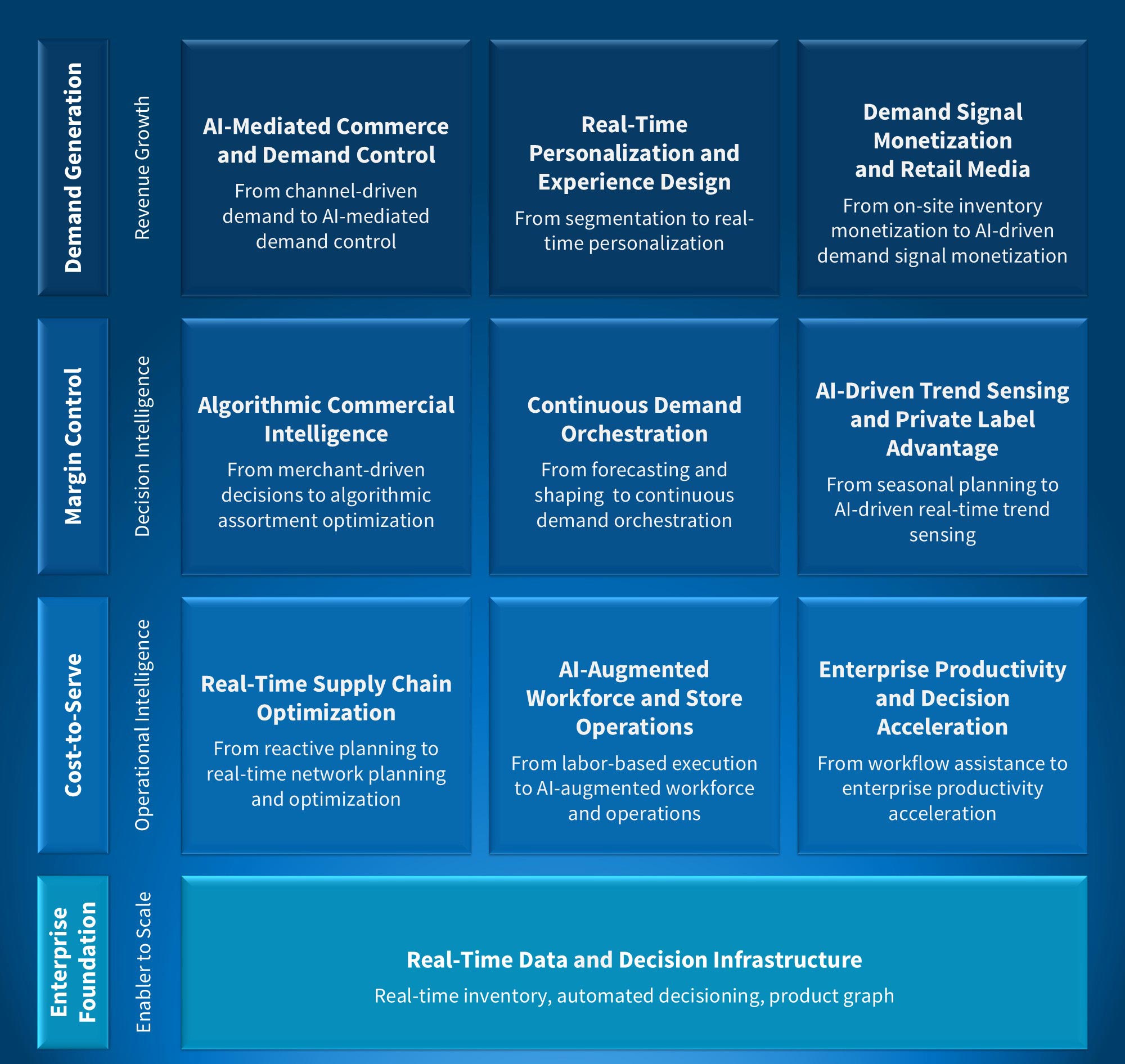
Source: FTI Consulting analysis.
Above: Ongoing shifts are redefining how value is created and translate directly into a set of strategic decision domains for retail leaders.
Each decision domain reflects a distinct source of value, ranging from demand capture and margin optimization to operational efficiency and the foundational capabilities required to enable AI at scale.
Demand Generation: Who Controls and Captures Customer Demand?
AI is shifting control of product discovery and demand capture from channels to algorithms. As AI intermediates discovery — and increasingly, transactions — visibility is determined by machine-readable data, pricing signals and fulfillment performance rather than digital shelf placement. Retail leaders must determine how to remain visible, competitive and influential in AI-mediated demand environments.
Strategic Decisions:
- AI-Mediated Commerce and Demand Control: AI agents are influencing (and in some cases executing) purchase decisions, shifting demand control from channel positioning to algorithmic ranking. Retailers must decide how to make products discoverable and competitive in AI-mediated channels where machine-readable data, pricing signals and fulfillment reliability determine visibility and conversion.1
- Real-Time Personalization and Experience Design: Personalization is evolving from segmentation and recommendations to dynamically constructed, real-time shopping experiences. Operationalizing real-time, individualized content, pricing and offers becomes central to driving conversion and basket expansion.
- Demand Signal Monetization and Retail Media: As AI intermediates discovery, demand capture extends beyond owned channels. Leveraging first-party data and retail media capabilities becomes critical to influencing visibility across these environments
Margin Control: How Is Economic Value Set, Optimized and Protected?
AI is redefining how commercial decisions are made — shifting from periodic optimization to continuous, signal-driven control of pricing, promotion and assortment. Margin performance will increasingly depend on the speed, integration and quality of these decisions. The imperative is to move from fragmented decision-making to integrated, real-time control of margin drivers.
Strategic Decisions:
- Algorithmic Commercial Intelligence: Historically siloed decisions are converging into a unified AI-driven commercial engine. Integrating these capabilities enables continuous, AI-driven margin optimization.
- Continuous Demand Orchestration: Forecasting is making way to active demand shaping. Moving beyond prediction to real-time influence — through pricing, promotions and inventory signals — becomes a key lever for margin control.
- AI-Driven Trend Sensing and Private Label Advantage: Generative models unlock earlier detection of emerging trends and accelerate product development cycles. Compressing time-to-market and expanding private label advantage becomes increasingly important in margin-critical categories.
Cost-To-Serve: Who Controls Operational Execution — and How Is Efficiency Achieved at Scale?
AI is shifting operations from static planning to real-time orchestration across supply chain, labor and fulfillment. Competitive advantage will depend on the ability to dynamically allocate resources and execute decisions at scale. The focus is on moving from reactive execution to AI-driven operational control.
Strategic Decisions:
- Real-Time Supply Chain Optimization: Inventory allocation, replenishment and network decisions are becoming continuous and data-driven. Embedding real-time decision-making into supply chain operations reduces working capital intensity while improving service levels.
- AI-Augmented Workforce and Store Operations: AI is enhancing store execution through labor optimization, computer vision and intelligent task management. Improving productivity and consistency, while enhancing customer experience without proportional labor growth, is central to scalable operations.
- Enterprise Productivity and Decision Acceleration: AI embedded across merchandising, planning, finance and marketing is compressing decision cycles and increasing organizational throughput. Scaling these capabilities drives faster, more coordinated execution across the enterprise.
Enterprise Foundation: What Enables AI To Scale Across the Enterprise?
AI-mediated demand, decision-making and operations require a fundamentally different enterprise backbone. Without real-time, integrated and machine-readable data, AI cannot operate consistently or at scale. The priority is establishing the enterprise infrastructure required to enable continuous, real-time execution at scale.
Strategic Decision:
- AI-Native Data and Decision Infrastructure: AI systems depend on real-time product data, inventory visibility, pricing discipline and integrated governance. Building a unified data and decision infrastructure enables consistent, scalable performance across all value layers.
A Value Creation Framework: How Retail Leaders Should Act
AI is reshaping where value is created and how leaders must act to capture it. The critical leadership challenge is not to just identify opportunities, but to determine how to act on them with clarity and discipline.
The below value creation framework is built on two factors:
- Value Layer (rows): Where value is created across the retail enterprise (e.g., demand generation, margin control, cost-to-serve and the enterprise foundation required to enable scale)
- Leadership Action Required (columns): The nature of the response required (e.g., whether to close execution gaps, reprioritize and scale investment, or redesign the operating model)
AI Value Creation in Retail: A Strategic Decision Framework
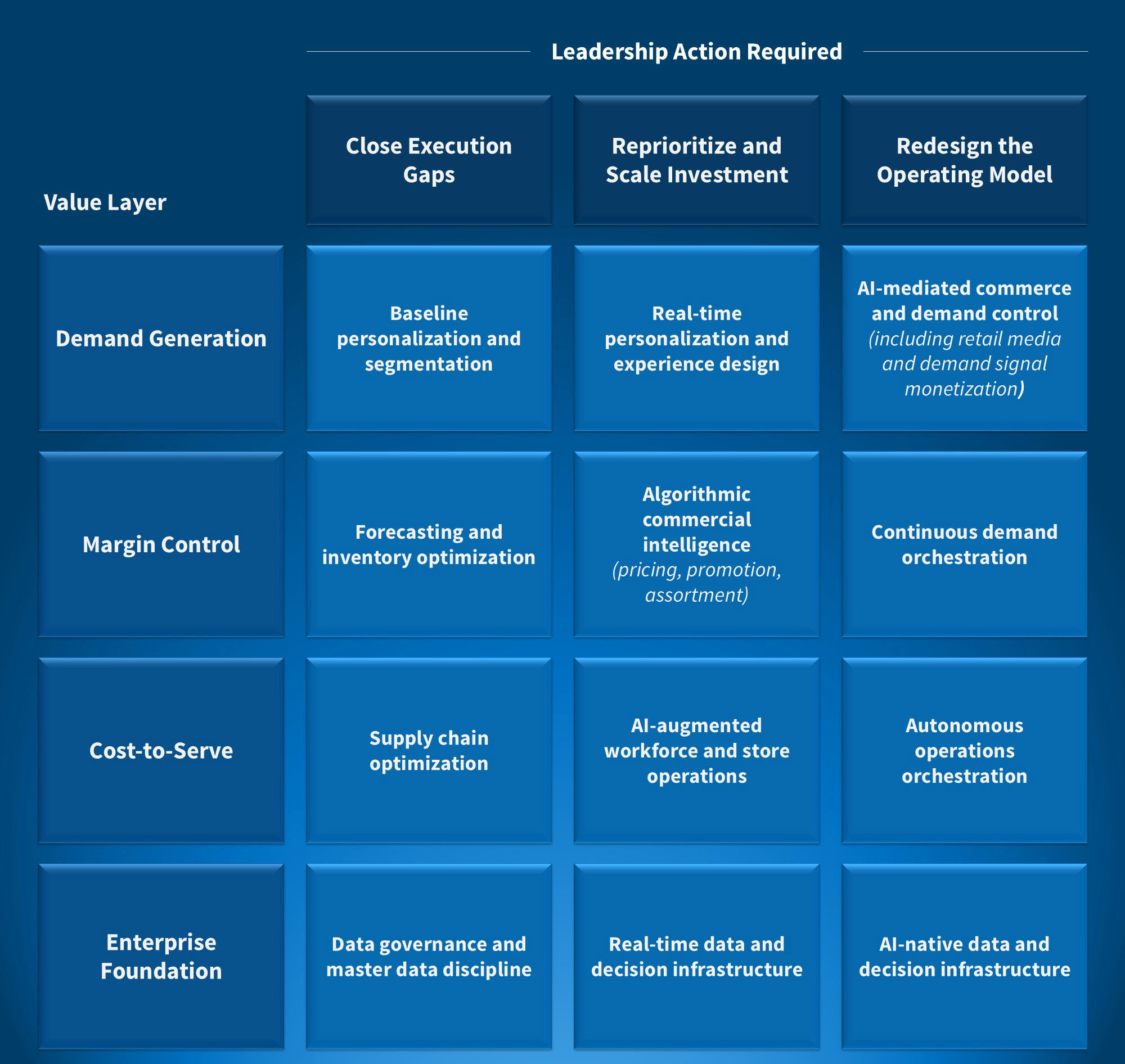
Source: FTI Consulting analysis.
Above: Where to close execution gaps, reprioritize investment and redesign operating models.
This framework distinguishes among three types of leadership action:
- Close Execution Gaps: Proven capabilities with clear ROI that remain under-deployed. Failure to execute creates direct margin leakage and operational inefficiency. These require operational rigor and accountability, not further experimentation.
- Reprioritize and Scale Investment: Established capabilities whose value has materially increased due to advances in AI. These represent near-term opportunities for growth and margin expansion. Capital allocation should reflect this shift.
- Redesign the Operating Model: Structurally new capabilities that shift demand control and decision rights. These require deliberate changes to operating models, data architecture and governance. Delay risks structural disadvantage.
What This Means for Retail Leaders
AI is no longer an innovation agenda item — it’s a core driver of retail economics. Retail leaders who succeed will not be those who experiment most broadly, but those who act with discipline.
Retailers will need to close execution gaps, scale where value has increased and redesign operating models where AI is reshaping how demand is captured and decisions are executed. Those who move decisively will be able to move from AI experimentation towards a sustained competitive advantage.
Footnotes:
1: Carl Jones, and Akshat Trivedi, “Shopping in the Age of AI: Eight Strategies for Retailers To Win,” FTI Consulting (Mar. 26, 2026),
The views expressed herein are those of the author(s) and not necessarily the views of FTI Consulting, Inc., its management, its subsidiaries, its affiliates, or its other professionals.
Related Insights
Related Information
Published
June 04, 2026
 Key Contacts