

Today’s Housing Market Freeze Has Ominous Business Implications for 2027
-
November 13, 2026
-

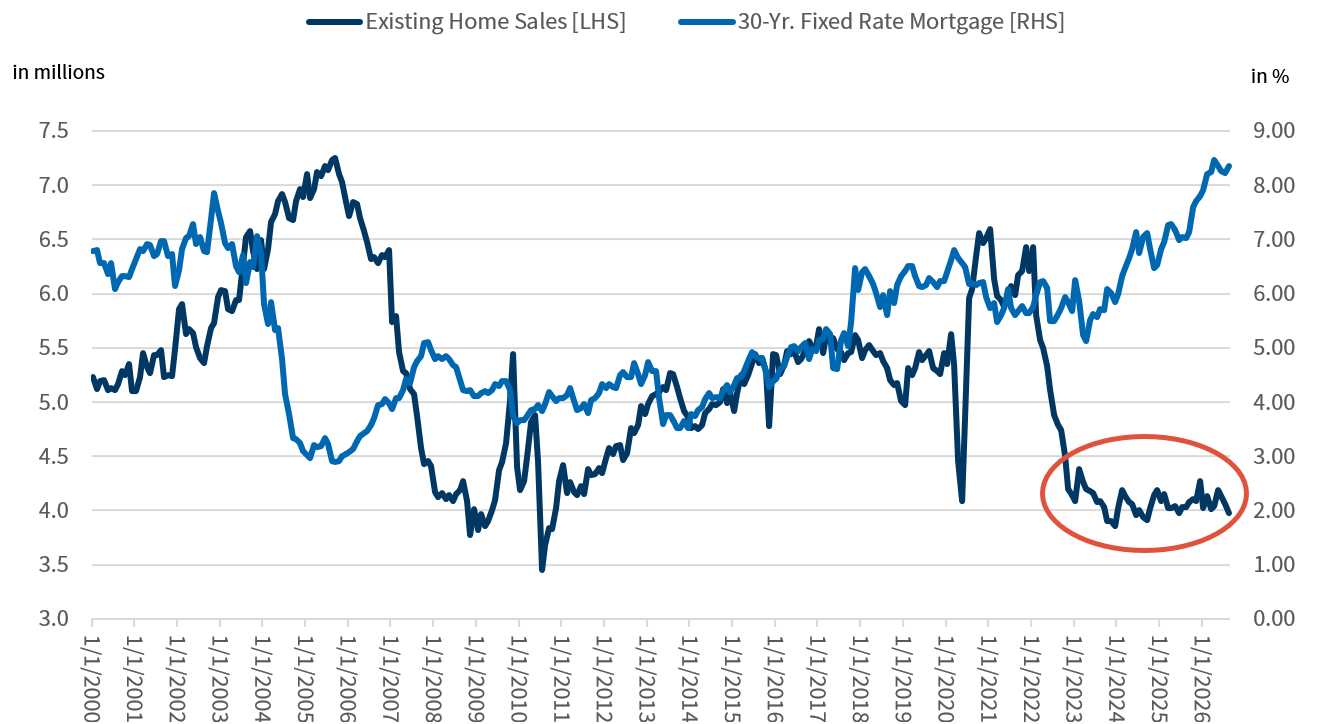
“Wait till next year” has long been the refrain of disappointed baseball fans of perennial losing teams counting on an upcoming turnaround season, often naively. It has also become a prevailing hope for the beleaguered U.S. housing market, which has plodded along near century lows in home sales for four consecutive years. Annual existing-home sales have averaged 4.1 million units since 2023 (Figure 1), about 21% below the long-term average and slightly worse than the prolonged downturn that followed the end of the housing bubble and subsequent global financial crisis from 2008-2011. Yet this current impasse looks very different from a recession-driven housing slump. For housing-dependent businesses that have been preserving liquidity while waiting for a rebound, the more consequential question is whether their balance sheets can withstand another year of depressed transaction activity.
The hoped-for recovery has failed to materialize in each of the last two years, and the conditions required for a meaningful rebound remain elusive. The housing market’s central problem is no longer simply a shortage of homes; it is a shortage of willing sellers, reinforced by mortgage-rate lock-in and an affordability gap that is unlikely to close in 2027.
None of this surprises us. We’ve written previously that the U.S. housing market is stuck in a quagmire dating back to the Fed’s zero interest rate monetary policy (“ZIRP”) during the COVID-19 pandemic. An intervention that was meant to keep the economy from collapsing during the pandemic has resulted in a huge unintended consequence that has bogged down the housing market for several years. Americans’ residential mobility is at a record low, with Point2Homes reporting that just 11% of households changed residences (owners or renters) in 2024 compared with 14.3% a decade ago, based on U.S. Census Bureau data, with homeowner mobility falling to 5.1%.1 We are stuck in place like never before.
At first glance, there are reasons why it may sound strange to describe the housing market in such dire terms. Median home prices nationally remain at or near record highs, while houses in more affluent zip codes often sell within weeks of listing, and nearly 30% of purchases are completed in cash.2 These indicators, however, mask deeply unhealthy market dynamics.
That lock-in effect is the main constraint on transaction activity. Many homeowners still hold mortgages near 3.0% and would rather remain in place than cut their asking price and finance a new purchase at a rate that has roughly doubled since 2021. The result is a hard ceiling on existing home sales and an affordability barrier for prospective buyers who want to transact but cannot make the economics work.
With mortgage rates again topping 7.0% and the likelihood of a higher-rate environment ahead, current fundamentals point to more of the same — or worse — in 2027.3 A material decline in home prices appears unlikely, but it may be the catalyst required to bring supply and demand closer to equilibrium.
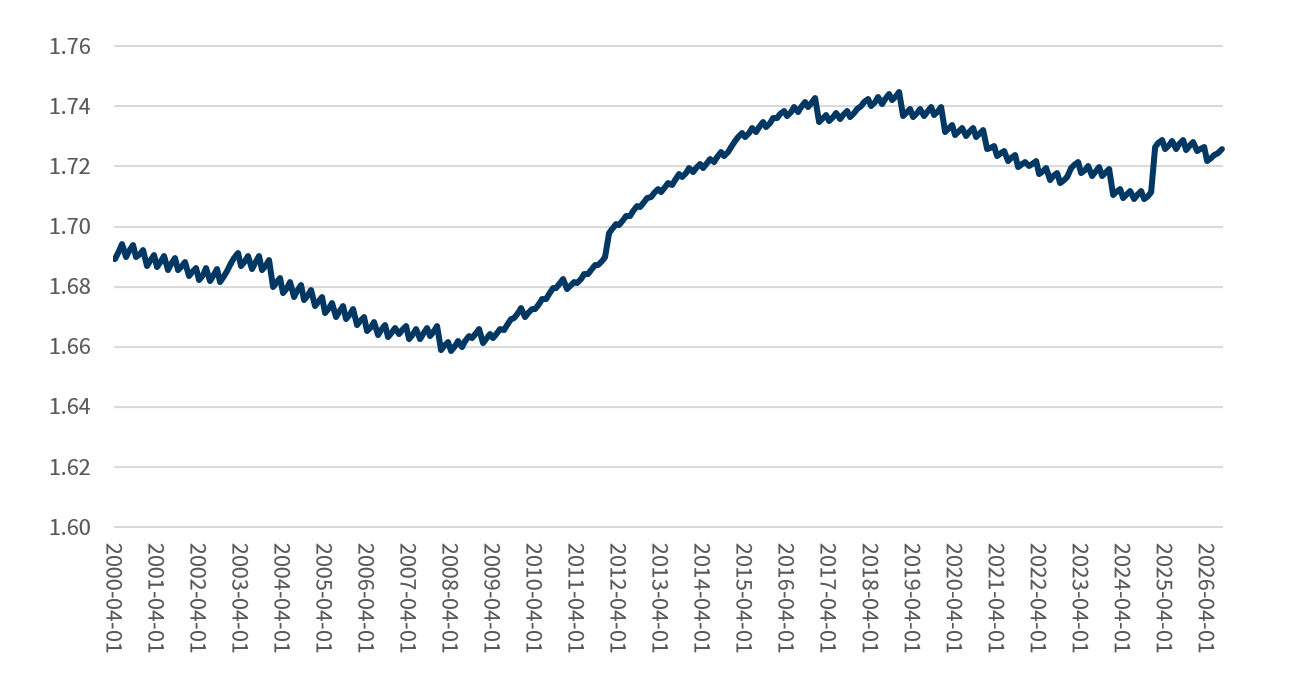
The long-term shortage of housing stock remains an impediment to more home buying, particularly in affordable markets, but it does not fully explain today’s exceptionally low transaction volumes. New homebuilding has picked up since 2020, and the relative housing shortage has eased somewhat since 2019 (Figure 2). The more immediate constraint is a shortage of existing homeowners willing to sell and surrender low-cost mortgages just five years removed from the ZIRP housing boom.
Federal Housing Finance Agency data indicate that 50% of homeowners with mortgages have locked in rates of 4.0% or less.4 They have little incentive to sell without a top-dollar offer. Over time, life events will compel more owners to upsize or downsize and bring additional supply to market, but only five years removed from the ZIRP housing boom, that adjustment has not yet occurred.
A meaningful recovery would therefore require lower home prices, lower mortgage rates or both. With long-term Treasury yields — the main determinant of mortgage rates — firmly above 5.0% and bond investors signaling a new rate environment for sovereign debt, another difficult year lies ahead. Economists surveyed by Bloomberg forecast existing-home sales of 4.2 million units in 2027, with downside risk if mortgage rates remain above 7.0% throughout the year.5
It’s Not Just the Housing Sector
The implications extend well beyond housing itself. Lower home sales reduce demand for the products and services associated with moving, including building products, remodeling and renovation, furniture, large appliances, home repair, housing-product distribution and residential real estate services. Weak volumes amplify operating leverage, compress margins and consume working capital. Companies acquired during the low-rate housing boom may also carry debt sized for stronger demand, leaving less flexibility as liquidity reserves decline. For sponsor-backed and other leveraged businesses in these sectors, the central risk is that liquidity and covenant headroom may be depleted or exhausted before transaction volumes recover, while elevated base rates and credit spreads make refinancing more difficult. Names such as Interior Logic Group, American Bath Group, Cornerstone Building Brands and AHF Products come to mind as especially vulnerable to another year of depressed housing activity.
There’s a New Sheriff in Town
Treasury Secretary Bessent declared “I am the house now”6 in early September after Treasury intervened in currency markets to prop up the yen, but his remarks were more widely taken by some as a dare to trading desks not to be at cross-purposes with Treasury’s market interventions. Bessent also tried to tamp down interest rates on the long-end of the Treasury yield curve via bond market buybacks, but that tactic quickly proved ineffective, as Treasury bond yields have steadily increased since that move.7
Increasingly, it is clear that neither the Treasury nor the Fed controls the long-term interest-rate narrative. The bond market ultimately determines the price required to finance heavily indebted sovereign borrowers. Treasury yields for 10- to 30-year maturities recently reached their highest levels in 24 years, while borrowing costs for several major sovereigns have risen by 50-75 basis points in recent months.8 If bond investors remain less tolerant of large, persistent structural deficits that go unaddressed by political leaders, higher national risk-free rates will continue to flow through to private-sector borrowing costs. Housing feels the effect first because mortgage rates adjust quickly to Treasury markets, but other interest-rate-sensitive sectors, such as automobiles, will follow.
For housing-dependent businesses, the risk is therefore not simply another year of disappointing demand. It is that liquidity, covenant flexibility and refinancing capacity will deteriorate further before transaction volumes recover. Boards, lenders and sponsors should plan for a prolonged housing freeze rather than assume that 2027 will provide relief. In this market, “wait till next year” is not a strategy.
Figure 1 — Existing Home Sales vs. Mortgage Rates
Source: Bloomberg
Figure 2 — U.S. Adult Population to Number of Housing Units
Source: FRED, the Federal Reserve Bank of St. Louis
Footnotes:
1: Andrea Hopulele, “Mobility Rates Reach Record Low: In 2024, Americans Moved Less Than Ever,” Point2Homes (October 20, 2025).
2: “NAR Existing-Home Sales Report – August 2026,” National Association of Realtors (September 10, 2026).
3: Falen Pitts, “MBA Forecast: Mortgage Originations to Decrease 5 percent in 2027 as Mortgage Rates Remain Above 7 Percent,” Mortgage Bankers Association (October 11, 2026).
4: Ma Zhihan, “Home Improvement Retail: No Recovery in Sight,” Bernstein/Societe Generale Group (September 9, 2026).
5: Prashant Gopal and Paulina Cachero, “Mortgage Rates at 7% Are Forcing Home Sellers to Slash Prices,” Bloomberg (September 24, 2026).
6: Caitlin McCabe, “Bessent Dares the Market to Cross Him: ‘I Am the House Now,’” The Wall Street Journal (September 9, 2026).
7: Ibid.
8: “ICAEW – Chart of the Week: Long-Term Interest Rates,” Institute of Chartered Accountants in England and Wales (ICAEW) (September 3, 2026).
The views expressed herein are those of the author(s) and not necessarily the views of FTI Consulting, Inc., its management, its subsidiaries, its affiliates, or its other professionals.
Related Insights
Published
November 13, 2026
 Key Contacts
Global Chairman of Corporate Finance