


Beyond Workflow Automation
A Framework for Assessing Agentic Readiness and Value Creation
-
October 19, 2026
-

Workflow software is shifting from predefined task routing toward platforms that coordinate outcomes across agents, software, automation and people. This agentic software can interpret objectives, determine actions, gather context, use tools and adapt execution as conditions change.
This shift changes both the role and economics of enterprise software. Gartner estimates that up to $234 billion, approximately 20% of enterprise application software as a service (“SaaS”) spending could be exposed to “agentic arbitrage” by 2030 as agents reduce users’ direct interaction with applications.1 An illustrative underwriting scenario, not a market forecast, shows the potential impact: if seat revenue on agent-addressable accounts falls 20%–40% over a renewal cycle, outcome-based pricing replaces only half of the lost revenue, and inference costs move into cost of goods sold (“COGS”), software gross margins could decline more than 70% to below 60%. The actual impact will depend on workflow exposure, pricing power, adoption and delivery economics, but the direction is clear: value is shifting from application access toward work performed and outcomes delivered.
For investors and management teams, the central question is whether a workflow software provider can reposition itself as a trusted execution platform — and capture enough value to offset seat compression, product cannibalization and required investment in AI.
From Deterministic Automation to Workflow Execution
Traditional automation follows a predefined path; agentic workflows can determine and adapt the path dynamically within defined constraints. Consider an illustrative enterprise using the same workflow platform across three processes.
The assumptions below demonstrate the potential operating and software economics; they are not forecasts.
Invoice exceptions: Assume the company processes 100,000 invoices annually, with a 12% exception rate and 15 minutes of manual work per exception. Today, rules identify mismatches and route 12,000 exceptions to finance. If an agent gathers the relevant records, diagnoses the cause and resolves 80% within defined authority, approximately 9,600 exceptions and 2,400 hours of manual work could be eliminated.
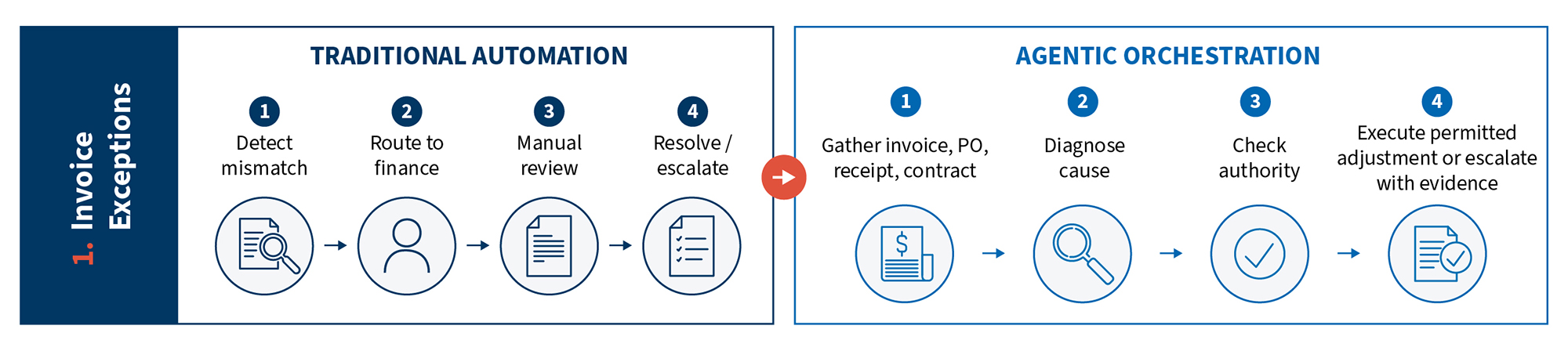
Customer service: Today, routing rules categorize a billing complaint and assign it to an agent. An agentic workflow could reconstruct the customer and transaction history, identify the cause, issue an authorized credit or correction and escalate only cases exceeding its risk or confidence threshold. This potentially reduces case volume and application use by support personnel.
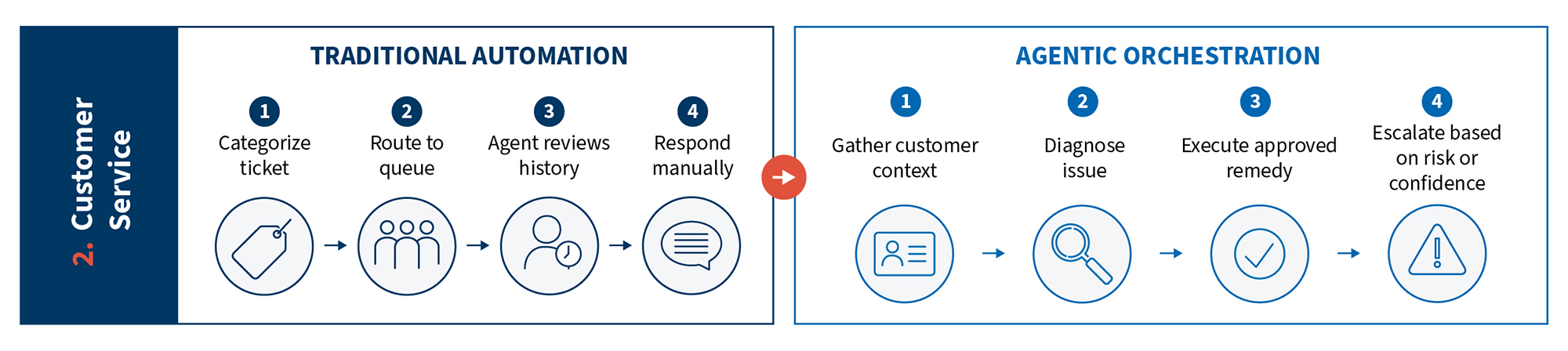
Employee onboarding: Today, a new hire triggers a standard sequence of forms, approvals and account-creation tasks. An agentic workflow could adapt the process to the employee’s role, location, start date, equipment needs and missing information, reducing administrative handoffs and involving people only when approval or judgment is required.
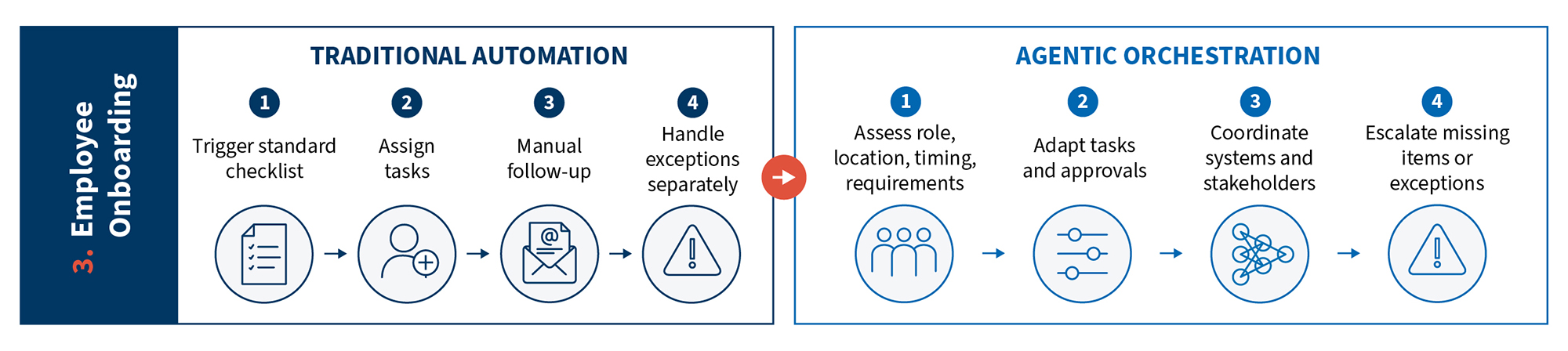
Across these workflows, customers may reduce labor, cycle times and software seats, while vendors incur new inference and orchestration costs. Capturing value therefore depends on shifting monetization toward transactions, resolutions or outcomes.
Workflows will remain hybrid: automation for stable work, agents for variable work and people for decisions requiring higher-order judgment, particularly when they are material, regulated or ambiguous. The goal is the economically appropriate allocation of work based on complexity, risk, confidence and cost, not maximum autonomy.
Two real-world examples illustrate this kind of deployment. UiPath Maestro offers coordination of agents, robots, systems and people across governed workflows.2 ServiceNow reports AI and automation supporting 89% of self-service requests and 37% of customer-support case workflow, though activity remains concentrated in routing, categorization and summarization.3
Six Signs That a Company Is Falling Behind
Workflow software providers risk losing ground to competitors and adjacent platforms when they cannot translate AI capabilities into repeatable workflow execution and economic value. FTI Consulting’s assessment of 57 providers identified six warning signs:
- Workflow context is fragmented. The platform lacks process state, business semantics, decision history, exception data or outcome measures. The result is lower accuracy and higher cost: Gartner predicts that organizations prioritizing semantics in AI-ready data could improve agent accuracy by up to 80% and reduce costs by up to 60% by 2027.4 The differentiated asset is enterprise judgment, exception history and outcomes, not data access alone.
- AI augments tasks but cannot complete workflows. Copilots search, summarize or recommend but cannot plan, act, adjust execution or resolve exceptions. The result is pilots that fail to deliver measurable value: Gartner forecasts that more than 40% of agentic AI projects will be canceled by 2027 because of cost, unclear value or inadequate controls.5
- Integration stops at connectivity. The product exchanges data but cannot reliably transact across applications, application programming interfaces (“APIs”), documents, legacy interfaces, automation and people. Anthropic reported more than 10,000 active public Model Context Protocol servers by December 2025.6 As connectivity becomes table stakes, insufficient permissions, execution reliability and recovery become the visible constraint.
- Enterprise controls are insufficient. Identity, permissions, evaluation, observability, auditability, escalation, suspension and recovery are not embedded. The result is production fragility: Gartner predicts that 40% of enterprises will demote or decommission autonomous agents by 2027 because of governance gaps identified after deployment.7
- Economics remain anchored to human seats. Management cannot demonstrate that agentic revenue will exceed seat compression, cannibalization, inference expense and delivery costs. The result is revenue and margin pressure even when the product delivers greater customer productivity.
- Deployments remain bespoke and pilot-led. Implementation is services-intensive, while testing, monitoring, customer success and value measurement remain unstandardized. The result is a delivery model that can constrain repeatability and software-like operating leverage.
Assessing Agentic Readiness
The framework evaluates providers across two axes, each aggregating three of the six underlying dimensions:
- Workflow Execution Readiness: The ability to understand objectives, determine and execute the required steps, handle exceptions and deliver workflows reliably and repeatedly. It aggregates agentic orchestration, execution reach and operating readiness.
- Enterprise Reach: The extent to which a provider has the context, system access, permissions, integrations and controls required to execute across the organization rather than within isolated tasks. It aggregates enterprise context, governance and controls, and value-capture readiness.
Agentic Workflow Readiness
FTI Consulting assessed 57 providers across these six dimensions and aggregated the results along two axes: Workflow Execution Readiness and Enterprise Reach. The resulting 2×2 matrix identifies four strategic positions: agentic leaders, AI-capable but exposed, broad reach with an execution gap and structurally exposed.
Exhibit 1 – Agentic Workflow Readiness: Workflow Execution Readiness vs. Enterprise Reach Across 57 Workflow Software Providers
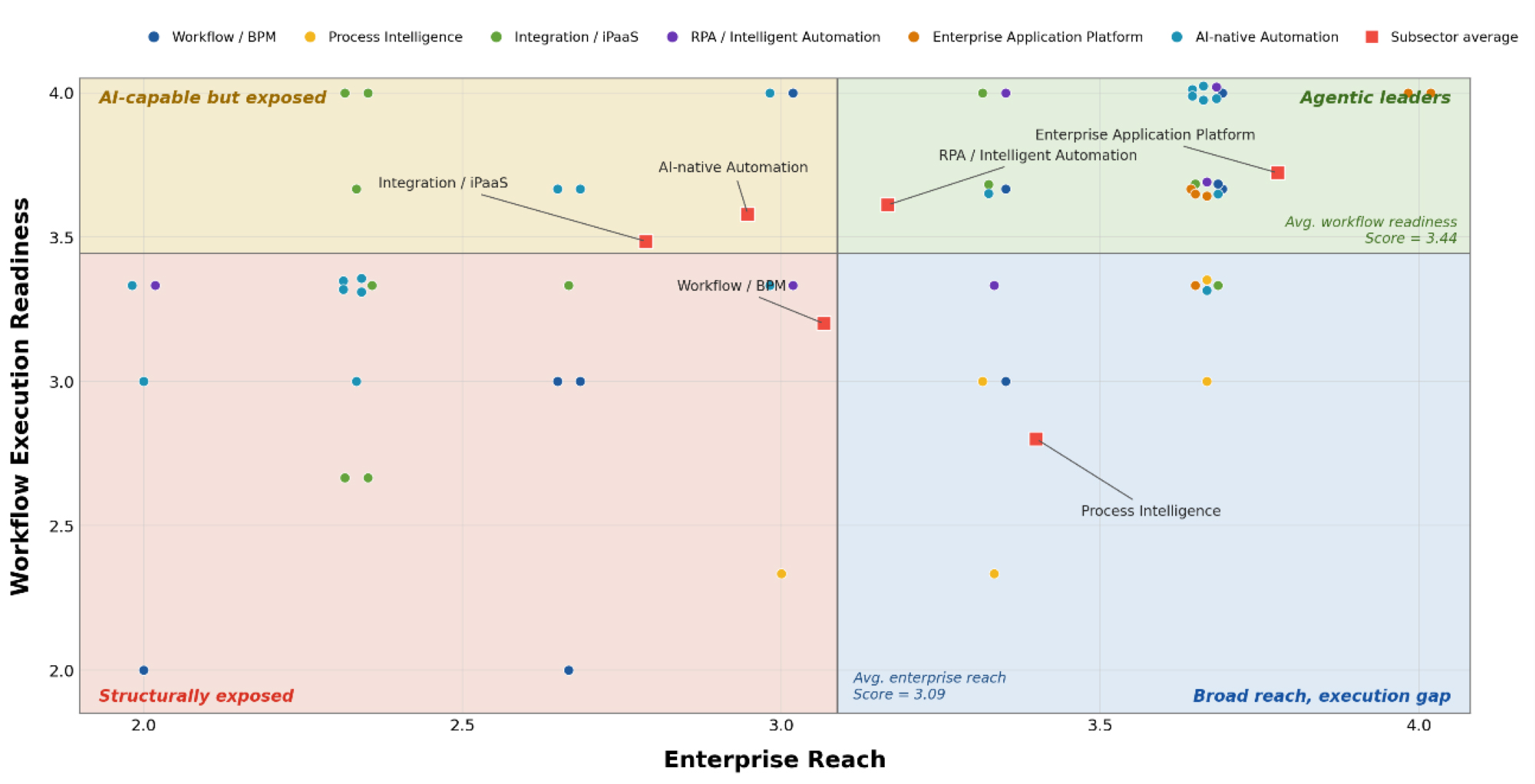
Dots represent companies; larger markers show subsector averages. Positions reflect relative readiness based on public information, not company performance or investment attractiveness.
Note: All 57 companies are plotted. Companies with identical scores are slightly offset for visibility; red squares show exact subsector averages.
Subsector averages reflect different starting advantages rather than definitive winners and losers. Enterprise application platforms generally benefit from broader access to business data, workflows and users, while robotic process automation (“RPA”) and intelligent-automation providers bring stronger execution across systems.
In our analysis, integration platforms and AI-native providers generally demonstrate stronger Workflow Execution Readiness but more limited Enterprise Reach, often reflecting narrower workflow ownership or organizational access. Process-intelligence providers possess valuable workflow context but typically require greater execution capability. Traditional workflow and business process management (“BPM”) providers appear more exposed when differentiation rests on visualization, basic connectors, routing logic, limited proprietary context or seat-based pricing.
Company-level results vary significantly within each subsector, demonstrating that category alone does not determine readiness. Acquisitions, partnerships and internal investment may help providers combine execution capability with enterprise reach, but their effectiveness ultimately depends on integration, production adoption and measurable outcomes. Exhibit 1 is intended to diagnose capability gaps, not identify investment winners or losers.
Six Priorities for the Ownership Agenda
For investors and management teams, the objective is to strengthen their organizations’ Workflow Execution Readiness and Enterprise Reach through six ownership priorities:
- Map the current state: Assess the company against the six warning signs and six readiness dimensions, then benchmark its position against competitors and adjacent platforms.
- Quantify economic exposure: Model seat compression, cannibalization, agentic revenue, delivery costs, required investment and margin impact.
- Pressure-test the roadmap: Determine whether management is building toward workflow outcomes and has the talent, technology, implementation capability and customer evidence to deliver.
- Prioritize defensible workflows: Focus on workflows where differentiated context, access, expertise or distribution can improve retention, margins or revenue.
- Close capability gaps: Use internal investment, partnerships, alliances or mergers and acquisitions (“M&A”) to address gaps in execution, context, governance or distribution.
- Track execution: Monitor deployment rates, implementation time, workflow reuse, intervention rates, cost per outcome, agentic revenue, contribution margin and customer return on investment.
Implications Across the Investment and Ownership Cycle
Across the investment and ownership lifecycle, investors can evaluate Workflow Execution Readiness and Enterprise Reach through four lenses:
- Diligence: Position the company on both axes and assess revenue exposure, workflow differentiation, production capability, enterprise access and competitive risk.
- Underwriting: Model agentic upside against seat compression, cannibalization, delivery costs and required investment.
- Value creation: Identify workflows where stronger execution and enterprise reach could improve customer value, retention, margins, or revenue, supported by measurable milestones and key performance indicators.
- M&A and capability gaps: Determine whether build, buy, partner or consolidation strategies could close gaps in execution, context, governance or distribution.
For management teams, the strongest opportunities are workflows where execution capability can be combined with broad enterprise reach. Product, implementation, customer success and pricing can then be aligned around measurable outcomes.
For investors, this framework provides a way to assess whether a portfolio or public company can close its capability gaps before agents change how its software is used, valued and bought. For both investors and management teams, the key risk is not a lack of AI features, but insufficient execution readiness or enterprise reach to defend and capture workflow value.
Footnotes:
1: Gartner, Press Release, “Gartner Says $234 Billion in Enterprise Application Software Spend Is at Risk from Agentic AI,” (July 1, 2026).
2: UiPath, “Business Orchestration Software for Enterprise Processes” (n.d.).
3: ServiceNow, Press Release, “Reimagining Support with the ServiceNow AI Platform” (n.d.).
4: Gartner, Press Release, “Gartner Says Lack of Semantics Causes Inaccurate AI Agents and Wasted Spending,” (May 11, 2026).
5: Gartner, Press Release, “Gartner Predicts Over 40% of Agentic AI Projects Will Be Canceled by End of 2027,” (June 25, 2025).
6: Anthropic, Press Release, “Donating the Model Context Protocol and Establishing the Agentic AI Foundation,” (December 9, 2025).
7: Gartner, Press Release, “Gartner Says Applying Uniform Governance Across AI Agents Will Lead to Enterprise AI Agent Failure” (May 26, 2026).
The views expressed herein are those of the author(s) and not necessarily the views of FTI Consulting, Inc., its management, its subsidiaries, its affiliates, or its other professionals.
Related Insights
Published
October 19, 2026
 Key Contacts
Senior Managing Director
Senior Managing Director
Managing Director
Managing Director