

The Decision Deficit: Rethinking Business Reviews
-
October 26, 2026
-

Every executive team knows the pattern. A 90-minute business review begins with dozens of slides, familiar metrics and limited time for the questions that matter most. By the end, the meeting may produce broad alignment but few clear decisions, owners or next steps.
This is a common challenge with monthly business reviews (“MBRs”) and quarterly business reviews (“QBRs”). When these forums become reporting exercises, they consume valuable leadership time without consistently driving action.
A well-designed business review, however, can serve as a powerful management and growth mechanism. For CEOs, CROs, CFOs and their leadership teams, structuring the cadence around decisions, tradeoffs and follow-through can improve both executive effectiveness and business performance.
The Business Case for Rebuilding the Cadence
A decision-focused business review is a core commercial operating discipline that directs executive attention to the decisions that most influence revenue, margin and growth. But as complexity increases, ineffective reviews can lead to slower decisions, fragmented accountability and reactive course correction. Already, executives face major challenges in their work:
- Executive time is already focused on decisions but often used inefficiently: A study of 500 managers and executives by decision-intelligence firm Cloverpop found that 98% fail to apply best practices when making decisions.1 Business reviews must be designed so that they value leaders’ time, instead of adding just another meeting to their calendars.
- Reporting-heavy meetings carry a real, compounding cost at the executive level: Executives spend nearly 23 hours per week in meetings, while separate research estimates meetings cost organizations more than $29,000 per employee annually.2, 3 Inefficient executive reviews also create downstream follow-ups, check-ins and additional reporting requirements.
A well-structured, well-timed review, however, can help leaders resolve tradeoffs, assign ownership and stay aligned on the business’s highest-priority decisions. Here’s why:
- Decision effectiveness is closely linked to strong outcomes: A 2024 Decision IQ Benchmark Survey found that effective decision-making styles can have up to an 80% correlation with strong decision outcomes and are six times more common than ineffective styles in successful companies.4 MBRs and QBRs provide a critical forum for leaders to apply these disciplines consistently.
- Formal, decision-oriented operating rhythms correlate with materially faster growth: Companies with formal revenue operations (“RevOps”) functions report 36% higher revenue growth, while organizations with mature RevOps functions have seen 19% faster revenue growth and 15% higher win rates.5, 6 MBRs and QBRs can be used to drive, assign and track decisions rather than simply review performance.
- AI is opening up more time for executive decision-making: A 2025 survey of more than 1,000 go-to-market professionals found that 55% of RevOps and sales operations professionals use AI at least weekly, while nearly 70% of RevOps AI users report being satisfied with AI’s ability to support more accurate sales forecasting.7 As AI reduces the time required to reconcile and interpret data, leadership teams can spend more time debating implications and making decisions.
What Belongs in an MBR or QBR?
A decision-focused business review should answer three interconnected questions:
- What decisions does the business need to make during this cycle? Identify the specific choices requiring leadership attention, such as reallocating headcount, adjusting targets or refining the ideal customer profile (“ICP”). The agenda should center on decisions to be made rather than topics to be reviewed.
- What has changed enough to warrant discussion? Focus materials on meaningful variances, emerging risks and exceptions that require leadership attention. Metrics that meet targets and remain on plan can be reviewed outside the meeting, preserving time for issues that require debate or action.
- Who has the authority and accountability to decide? Assign clear ownership to each decision in advance and distinguish between issues that require broader executive alignment and those that should be resolved by a single, accountable leader.
Clear boundaries are essential. Status updates, routine metric reviews and detailed deck walkthroughs should sit outside the executive forum. RevOps and other supporting functions should provide the data and analysis, while leadership remains accountable for the decisions and actions that follow.
Putting This Into Practice
A decision-focused business review requires a clear operating rhythm that moves the executive team from preparation to decision-making and follow-through. The strongest processes focus the agenda on material decisions, prepare leaders in advance with the right information and maintain accountability after the meeting.
The MBR/QBR Planning-to-Execution Cycle
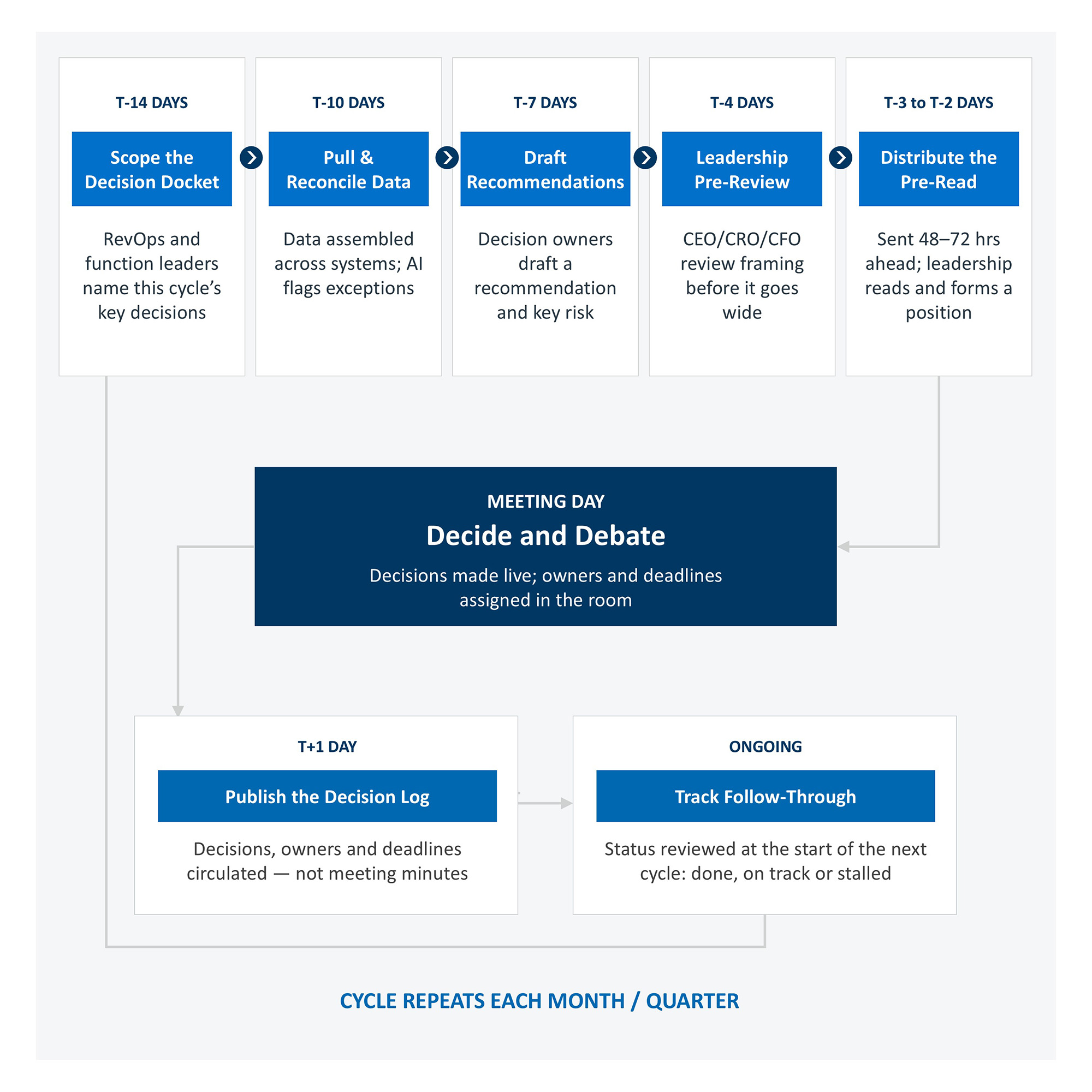
Effective business reviews are won before the meeting begins. The planning cycle should ensure that leaders enter the room with the right context, clear recommendations, and a defined set of decisions to make.
Source: FTI Consulting
The meeting itself should be the shortest step in the cycle. Most of the work happens before and after, through disciplined preparation, clear decision ownership and consistent follow-through.
What Belongs in the Pre-Read
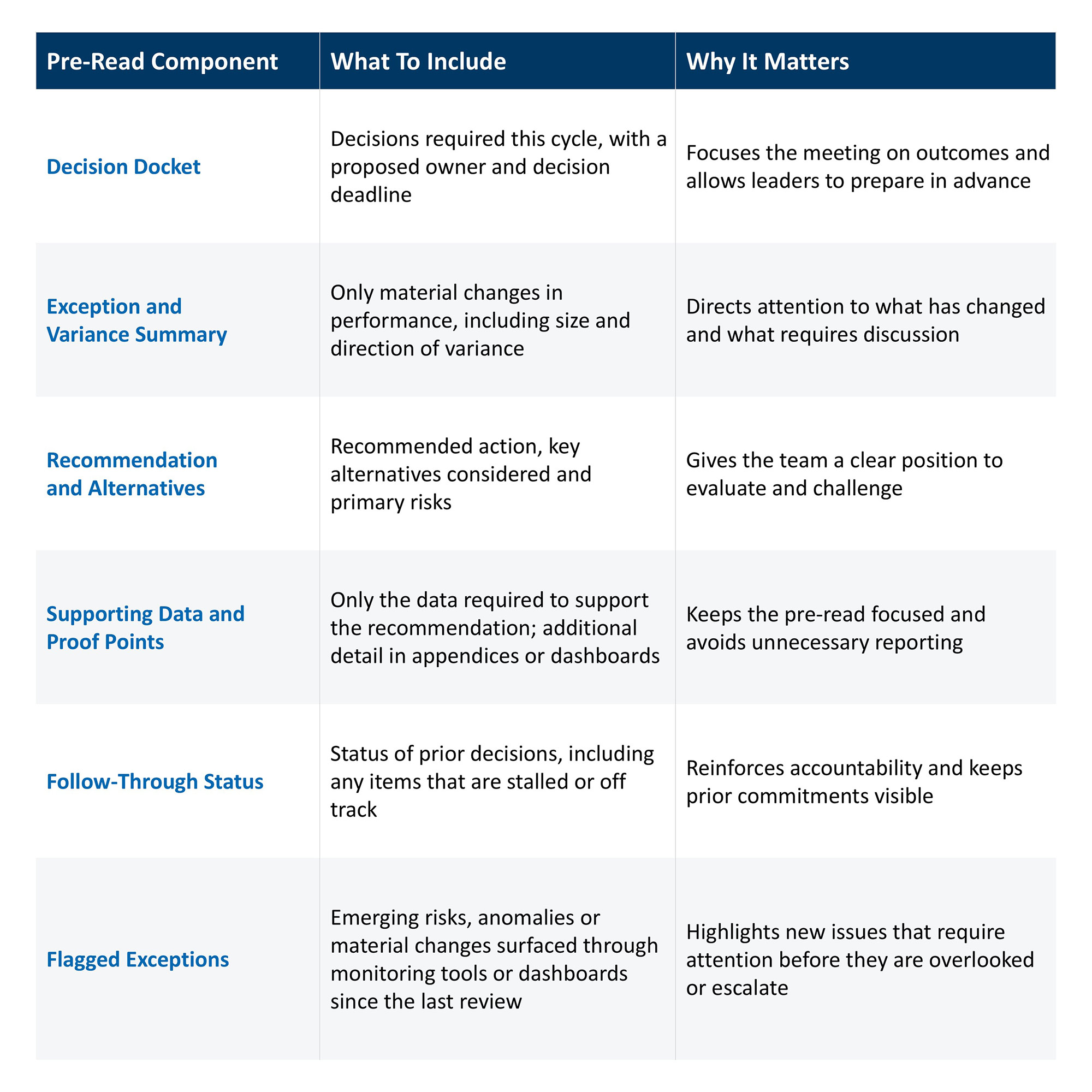
The pre-read should equip leaders to arrive informed and ready to decide. Rather than recreate a status deck, it should focus attention on the decisions required, the material changes since the last cycle, and the information needed to evaluate the recommended path forward.
The Bottom Line
The direction is clear. Executive teams create more value from business reviews when they use them to make decisions, resolve tradeoffs and reinforce accountability rather than simply report performance.
The question is not whether a company should hold business reviews. It is whether those reviews consistently produce clear decisions, defined ownership and disciplined follow-through. When they do, the business review becomes a meaningful operating mechanism rather than a recurring reporting exercise.
Footnotes:
1: Erik Larson, “Don’t Fail At Decision Making Like 98% Of Managers Do,” Forbes (May 18, 2017).
2: Leslie A. Perlow, Constance Noonan Hadley and Eunice Eun, “Stop the Meeting Madness,” Harvard Business Review (July–August 2017).
3: David Smith, “State of Meetings Report 2025,” Flowtrace (January 21, 2025).
4: Erik Larson, “New Study: 49% Of Companies Have Stagnant Decision Styles — Can Technology Help?,” Forbes (August 20, 2024).
5: Becca Eddleman, “RevOps Trends 2026: Top 4 Shifts in People, Process, and Tech,” Skaled (December 10, 2025).
6: Kushal Magar, “2026 RevOps Report: Key Trends Reshaping Revenue Operations,” SyncGTM (March 11, 2026).
7: Brandon Tucker, “AI in RevOps Survey: Here’s How AI Power Users Get Real Results,” ZoomInfo (updated July 2, 2026).
The views expressed herein are those of the author(s) and not necessarily the views of FTI Consulting, Inc., its management, its subsidiaries, its affiliates, or its other professionals.
Related Insights
Published
October 26, 2026
 Key Contacts
Senior Managing Director
Managing Director
Senior Director
Consultant